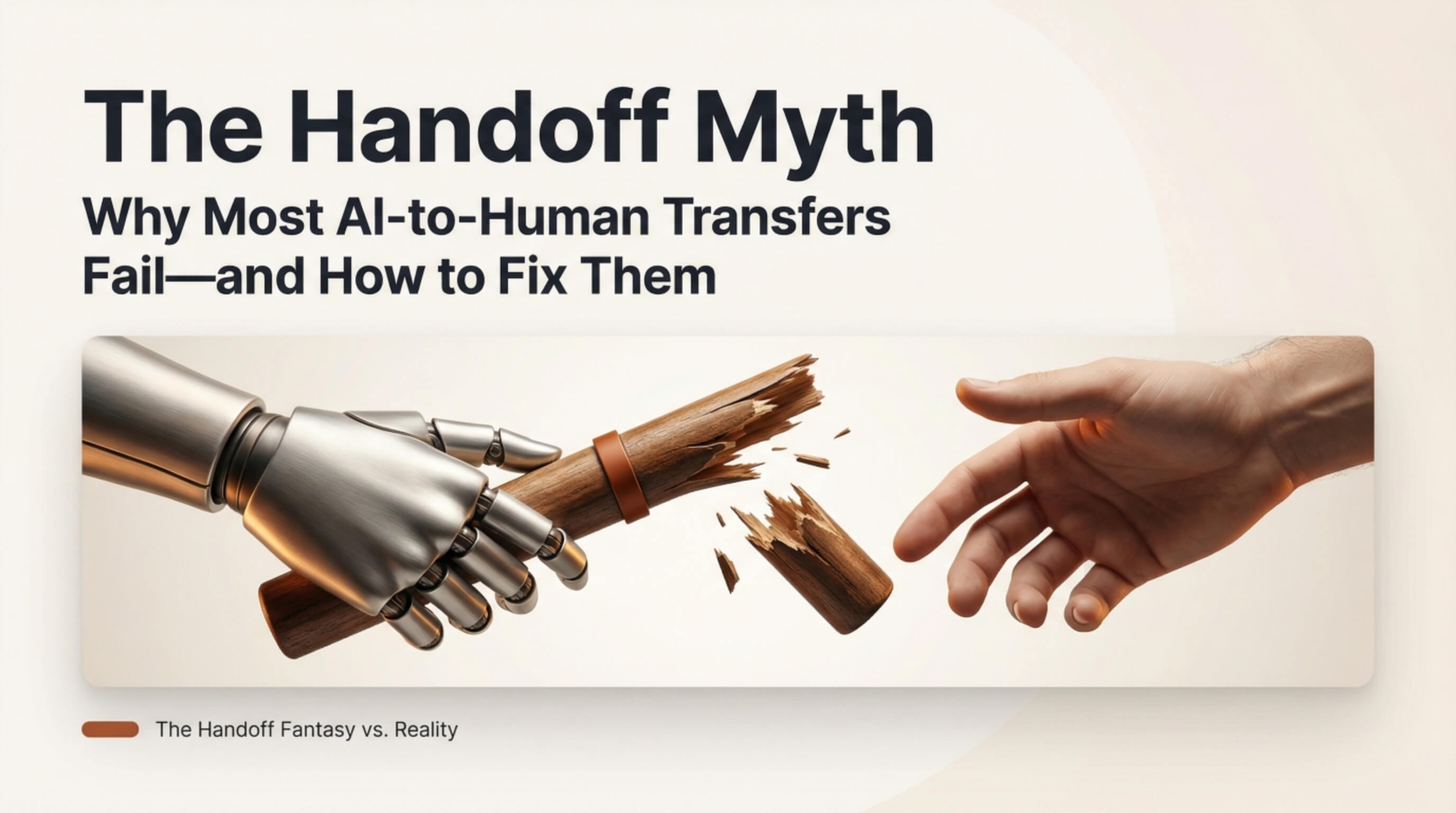
The Human-in-the-Loop Myth: Why Most AI Implementations Fail at Handoffs
Every AI vendor sells you the same dream: "Our bot handles 80% of queries, and for the rest, seamless human handoff!"
Sounds perfect. Except it rarely works that way in practice.
After deploying hundreds of AI automation systems across retail, healthcare, legal, and B2B services, we have learned an uncomfortable truth: most "human-in-the-loop" implementations create more problems than they solve.
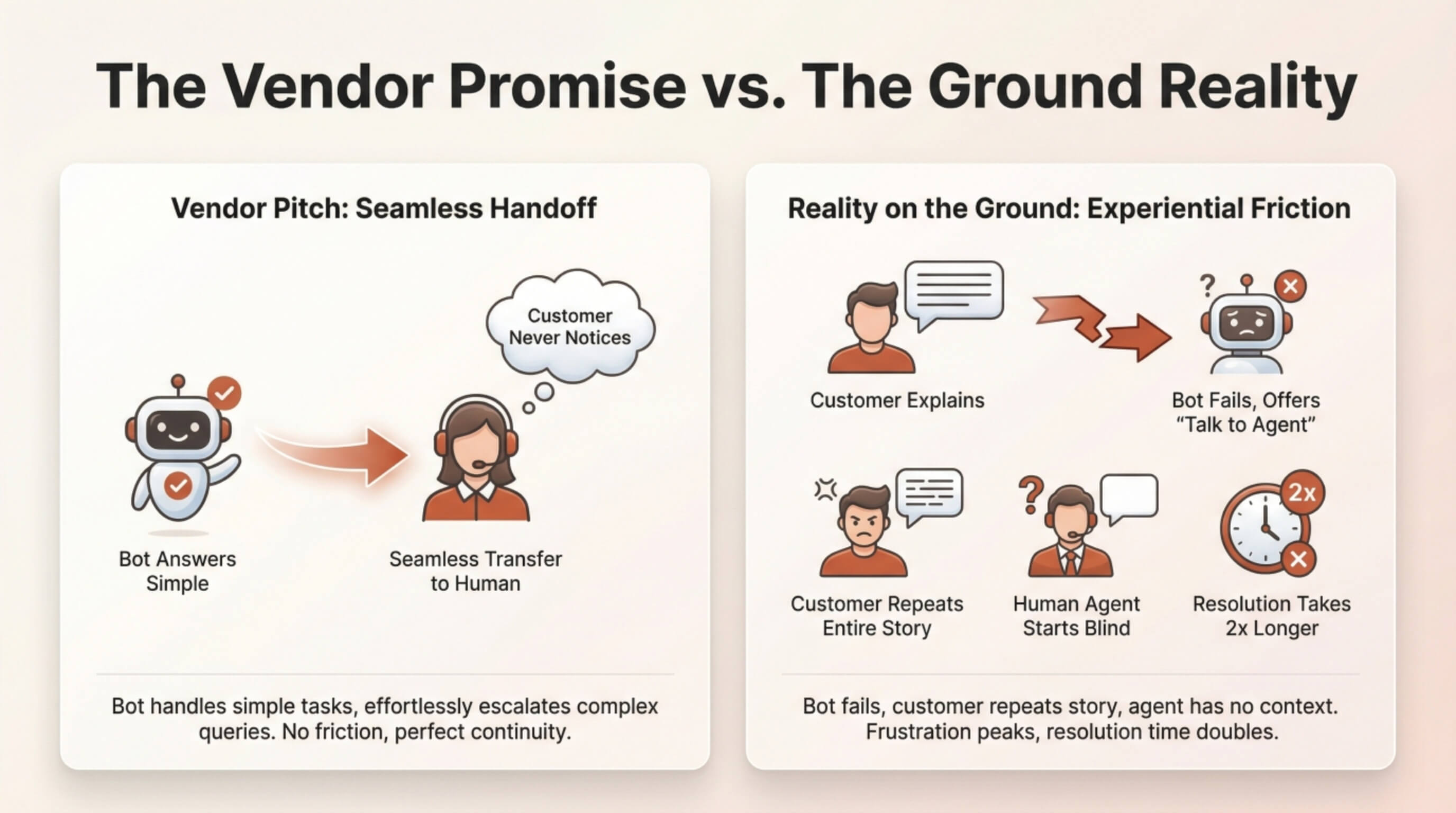
The Handoff Fantasy vs. Reality
Vendor pitch: Bot answers simple questions, seamlessly transfers complex ones to humans, customer never notices.
Reality on the ground:
- Customer explains problem to bot
- Bot does not understand, offers "talk to agent"
- Customer repeats entire story to human
- Human asks questions bot already asked
- Customer frustration peaks
- Resolution takes 2x longer than if human handled it from start
The friction is not technical. It is experiential.
Why Seamless Handoffs Are Harder Than Vendors Claim
1. Context Loss is Real
When a bot escalates, what actually transfers?
Usually: a transcript. Sometimes: basic customer info.
What is lost: tone, urgency, emotional state, implied meaning, conversation history the bot "sort of" understood but did not document.
The human agent starts blind. The customer starts annoyed.
2. The 3-Second Rule
Our data from thousands of customer interactions: if a human does not pick up within 3 seconds of handoff request, 40% of customers abandon.
Most businesses staff for average load, not peak. During busy periods, "seamless handoff" becomes "please hold for 5 minutes."
The bot bought you efficiency. The handoff killed your CSAT.
3. The Training Gap
Your bot trained on thousands of conversations. Your human agent?
They got a playbook. Maybe a morning briefing.
When edge cases hit—and they always do—the agent improvises while the customer watches. The bot was actually more consistent.
When NOT to Hand Off (And When You Absolutely Must)
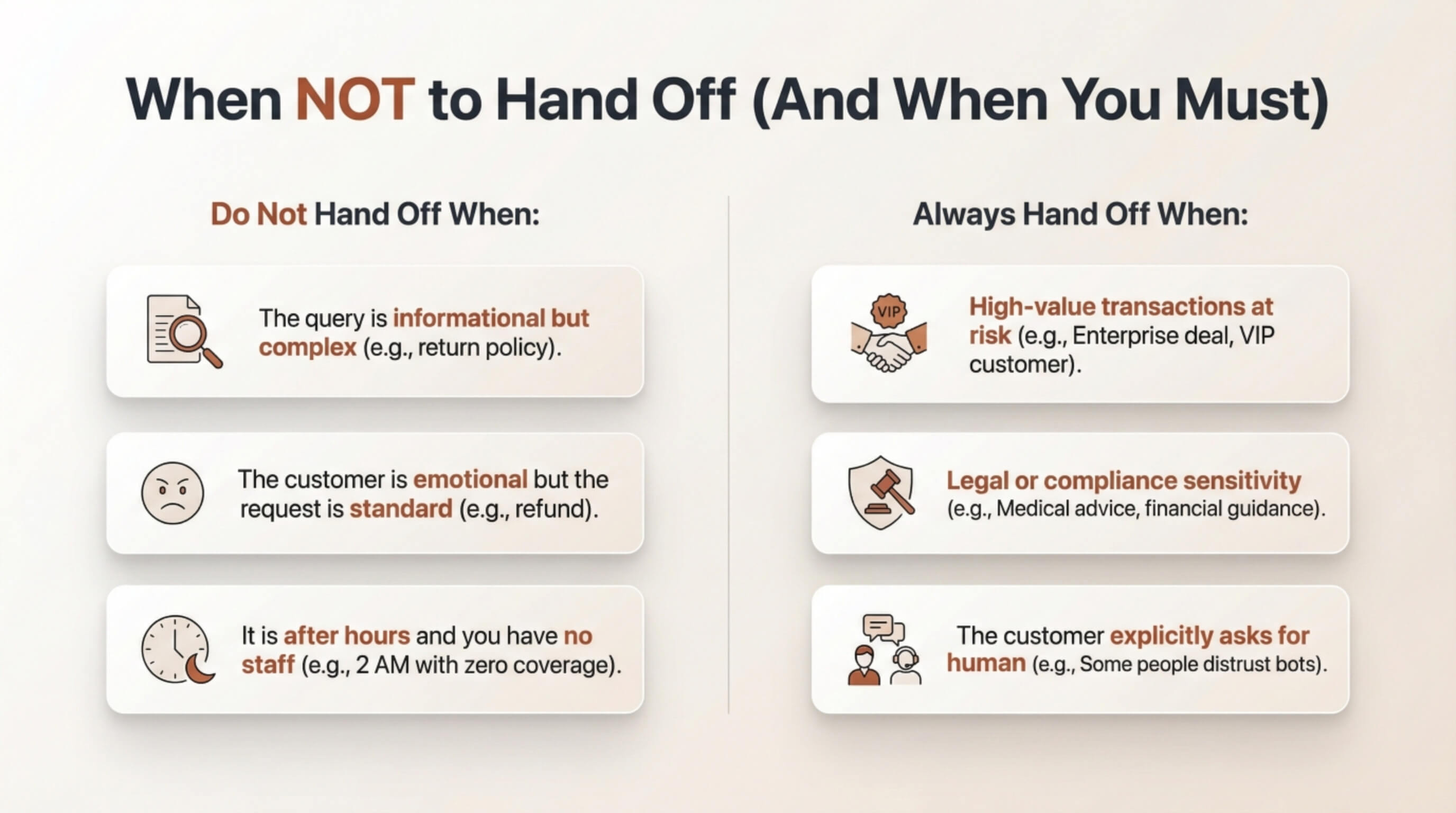
Do not hand off when:
- The query is informational but complex — "What is your return policy for international orders?" The bot can find this. Do not waste human time.
- The customer is emotional but the request is standard — Angry customer wants refund. Bot can process. Human empathy helps, but if your process is solid, automation resolves faster.
- It is after hours and you have no staff — Obvious, but businesses still offer "talk to agent" at 2 AM with zero coverage. Better: "We will callback at 9 AM" with scheduled follow-up.
Always hand off when:
- High-value transactions at risk — Enterprise deal, VIP customer, potential churn. The cost of automation failure exceeds cost of human time.
- Legal or compliance sensitivity — Medical advice, financial guidance, anything regulated. Bot provides info. Human provides judgment.
- The customer explicitly asks for human — Some people distrust bots. Forcing automation damages relationship. Honor the request immediately.
The Versalence Approach: Context-Aware Escalation
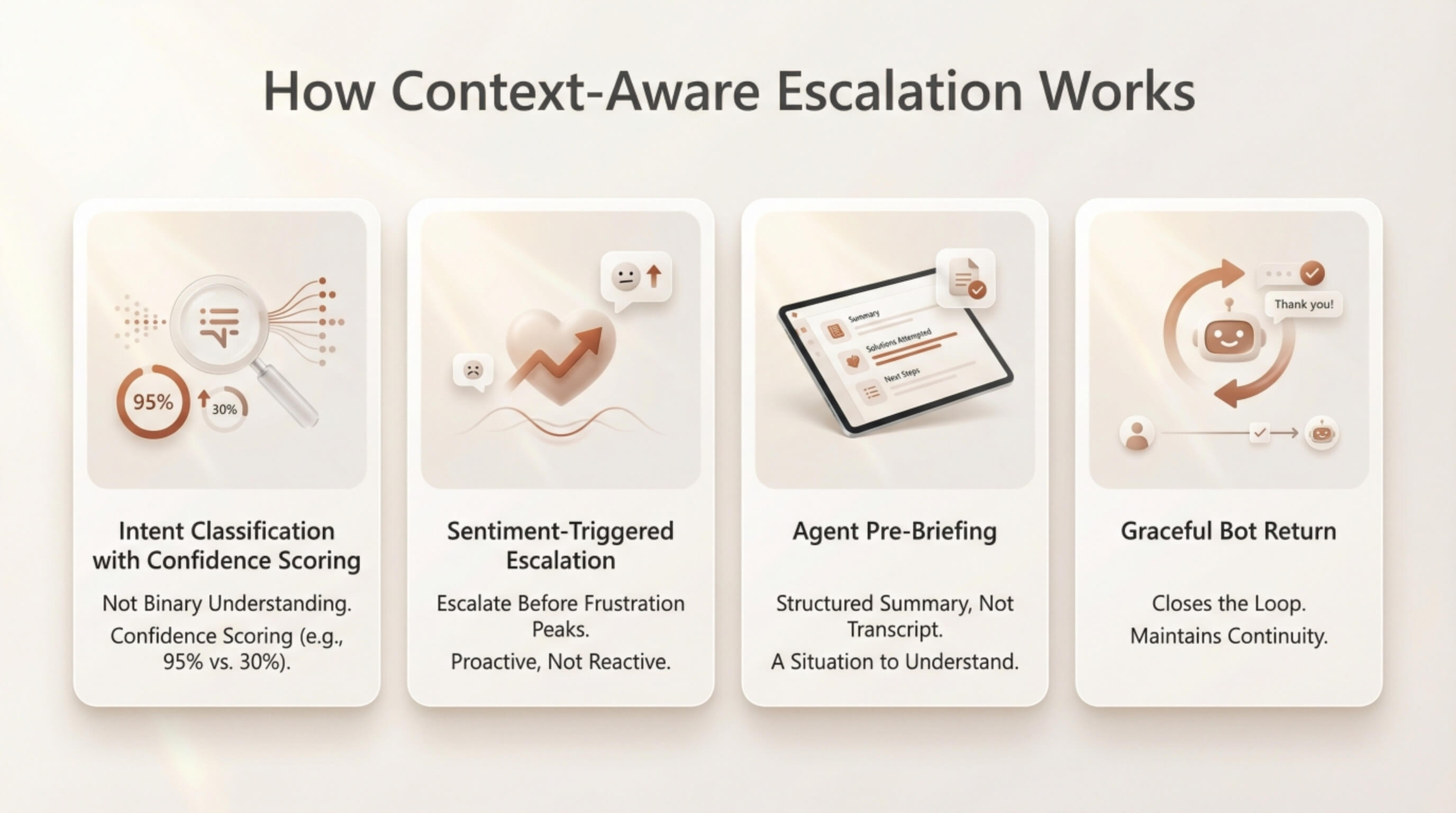
We stopped building "human-in-the-loop" systems. We build context-aware escalation instead.
Here is the difference:
Human-in-the-Loop:
- Bot fails → offer human
- Same handoff for everyone
- Transcript dump
- Agent starts cold
- Customer repeats
Context-Aware Escalation:
- Bot assesses → routes intelligently
- Different paths for different contexts
- Structured context + sentiment + predicted intent
- Agent starts informed
- Customer continues
How it works:
1. Intent Classification with Confidence Scoring
Not "bot understands" vs "bot does not understand."
Instead: Bot 95% confident → handle automatically. Bot 60% confident → confirm with customer before acting. Bot 30% confident + high value context → immediate human with full briefing.
2. Sentiment-Triggered Escalation
Customer showing frustration signals? Escalate before they ask. Proactive beats reactive.
3. Agent Pre-Briefing
When escalation happens, agent sees:
- Summary of what customer wants
- Bot attempted solutions
- Customer sentiment trend
- Suggested next steps based on similar resolved cases
Not a transcript to read. A situation to understand.
4. Graceful Bot Return
After human resolves, bot re-engages for follow-up: "Was your issue resolved? Anything else I can help with?"
Closes the loop. Maintains continuity.
Real Results: What Context-Aware Escalation Delivers
Healthcare client (patient scheduling):
- Before: 23% abandonment after handoff offer
- After: 7% abandonment with context-aware routing
- Agent handle time: -40% (better briefing)
B2B SaaS client (enterprise sales):
- Before: Bot qualified leads, humans re-qualified (duplicate work)
- After: High-confidence auto-qualification, medium-confidence human review, low-confidence immediate human with full context
- Sales cycle: -15 days
E-commerce client (order support):
- Before: 24/7 bot, business-hours human handoff
- After: Tiered response—bot handles 70%, smart routing handles 20%, humans handle 10% that actually need them
- Support cost: -35%, CSAT: +12 points
The Bottom Line
"Human-in-the-loop" is not a feature. It is a design philosophy. And most vendors get the philosophy wrong.
The goal is not to add humans as a fallback. It is to deploy humans precisely where they create value—and keep automation everywhere else.
This requires:
- Better intent classification (not just NLP, but confidence scoring)
- Smarter routing (not binary bot/human, but nuanced pathways)
- Richer context transfer (not transcripts, but structured intelligence)
- Continuous optimization (learn from every handoff, improve routing)
At Versalence, we build these systems. Not because handoffs are easy, but because when done right, they transform customer experience.
The myth is not that humans should be involved. The myth is that involvement should be a safety net. It is not. It should be a precision tool.
Want to see how context-aware escalation works in your specific use case? Schedule a demo or read about our vCX platform.
About the Author: The Versalence AI team has deployed conversational AI systems for businesses across healthcare, legal, retail, and B2B services, handling millions of customer interactions annually.