Reduce Your Drag: The Hidden Cost of Business Friction
Reduce Your Drag: The Hidden Cost of Business Friction
Every business has drag. Not the aerodynamic kind, but the operational kind — the friction that slows decisions, delays customer responses, and turns your team into firefighters instead of strategists. You don't notice it accumulating. It creeps in through spreadsheets, manual handoffs, and tools that don't talk to each other. Until one day, you realize your business is moving at half the speed it could be.
This is the story of how modern companies are diagnosing and removing their drag — and why the ones that do it fastest will own the next decade.
What Is Business Drag?
Drag is any force that opposes your business's forward motion. In physics, drag increases with speed. In business, it increases with scale. The more you grow, the more processes, systems, and handoffs you add. Each one seems small. A five-minute data pull. A ten-minute approval wait. A customer email that sits unread for an hour. But compounded across a team of twenty, fifty, or two hundred, these micro-frictions become macro-problems.
The drag audit — a diagnostic we run with every client — typically reveals the same pattern. Forty to sixty percent of a team's productive time is spent on work that could be automated, consolidated, or eliminated entirely. Not because people are inefficient. Because the systems were never built for the speed the business now requires.
The worst part? Most companies don't know they have drag. They normalize it. "That's just how we do things here." Until a competitor who removed their drag starts delivering in hours what takes them days.
The Six Sources of Drag
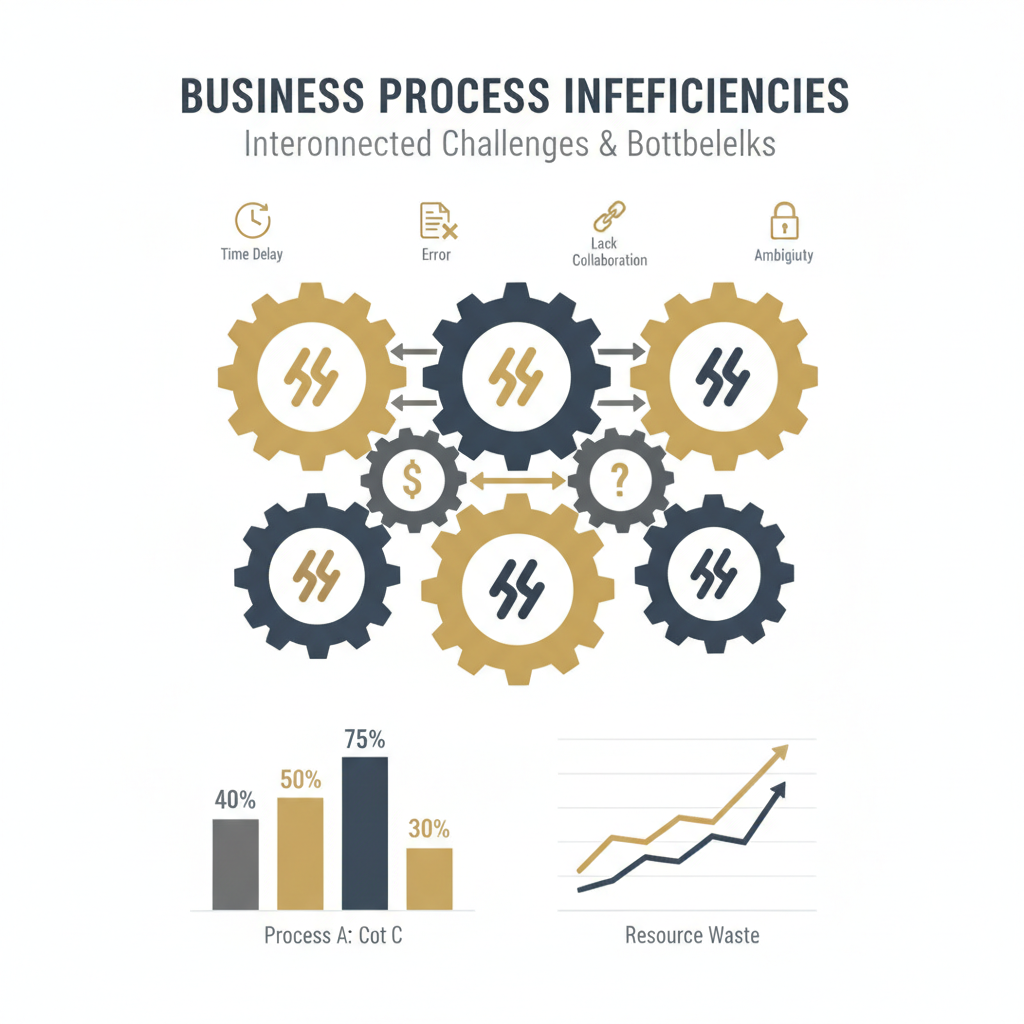
After analyzing hundreds of operations across industries, we've identified six consistent sources of business drag. Every company has at least three. The most struggling have all six.
1. Manual Reporting
Your team compiles reports by hand. Someone pulls data from three systems, copies it into a spreadsheet, formats it, checks it, and emails it to stakeholders. Weekly. Sometimes daily. The time cost is obvious — hours of skilled labor on information assembly. The hidden cost is worse: by the time the report reaches decision-makers, the data is already stale. You're making decisions about yesterday's reality while competitors are operating in real-time.
2. Customer Wait Times
A customer sends an inquiry. It sits in an inbox. Someone sees it, routes it, maybe forgets it. The customer follows up. The team apologizes. This dance costs you more than the immediate sale. It costs you trust, reputation, and lifetime value. In an age where consumers expect instant responses, every minute of delay is a competitive disadvantage.
3. Data in Silos
Your CRM doesn't talk to your accounting system. Your support platform doesn't share context with sales. Your marketing team guesses at lead quality because they can't see what happened after handoff. Every disconnected system is a decision-making blind spot. Your business has the data it needs to make smart choices. It just can't access it without a human bridge.
4. Reactive Operations
You find out about problems after they cost you money. A client churns before you notice the warning signs. A project goes over budget before you see the trend. An inventory gap causes a stockout before you get the alert. Reactive operations mean you're always playing defense. And in business, defense doesn't win games.
5. Teams Drowning in Manual Work
Your best people — the ones you hired to think, strategize, and build — are stuck doing work that a machine could handle. Data entry. Status updates. Formatting documents. Scheduling meetings. Not only is this expensive, it's demoralizing. Talent leaves companies where they feel like cogs in a machine. They stay where they feel like operators of one.
6. Vendor Lock-In
You built your business on someone else's platform. It worked fine at first. Then they raised prices. Then they removed features. Then they changed their API and broke your integrations. You have no leverage because migrating feels impossible. You're not a customer anymore. You're a captive.
Why Now? Why AI?
Removing drag used to mean expensive consultants, multi-year IT projects, and custom software builds that cost six figures. That model worked for enterprises with deep pockets. It didn't work for mid-market companies that needed speed and agility.
AI has changed the economics. What required a team of engineers six months ago can now be built in weeks. Not because AI replaces human judgment — because AI handles the repetitive, rule-based work that was consuming your team's capacity. The diagnosis, the pattern recognition, the data movement, the response generation. AI does the heavy lifting. Humans do the high-leverage thinking.
The companies removing drag fastest aren't the ones with the biggest budgets. They're the ones that understood this shift first and moved decisively.

The Drag Removal Framework
We use a four-phase framework with every client. It works because it's diagnostic first, prescriptive second. You can't fix what you haven't measured.
Phase 1: Diagnose (48 hours)
Map every workflow. Identify every handoff. Time every manual process. Count every system that doesn't connect. The output is a drag scorecard — a ranked list of friction points by time cost and business impact. This isn't guesswork. It's measurement.
Phase 2: Architect (2 weeks)
Design the integrated system. Which workflows get automated? Which data gets unified? Which alerts get built? This phase defines the future state — the version of your business that operates without the drag you've normalized.
Phase 3: Forge (30-120 days)
Build the systems. Custom automation, unified dashboards, AI-powered responses, predictive alerts. This is where the work happens. Not in theory, but in working code that your team uses daily.
Phase 4: Operate (Ongoing)
Systems degrade without care. New drag accumulates. We monitor, optimize, and expand the automation as your business evolves. This isn't a one-time fix. It's a permanent capability.
What Removing Drag Looks Like
A real estate agency was manually processing leads from four ad platforms. Each lead took six hours to reach a human response. After automation: ninety seconds. Lead-to-response time dropped 99%. Conversion rate tripled. One person handled what used to take four.
A manufacturing company was compiling production reports every Friday. Three hours of manager time. After automation: real-time dashboard, zero human input. Managers started using that time for supplier negotiations and process improvement.
A professional services firm was losing clients to slow proposal turnaround. Average response time: four days. After AI-assisted drafting and workflow automation: four hours. Win rate increased 40%. They weren't selling harder. They were responding faster.
None of these companies are technology companies. They're real businesses with real operations that simply decided drag was unacceptable.
The Competitive Advantage of Speed
Business strategy books talk about moats — network effects, brand loyalty, proprietary technology. But in the 2020s, the most underrated moat is operational speed. The ability to respond to customers faster, to see market shifts sooner, to iterate on your product quicker than competitors who are still compiling their weekly reports.
Speed compounds. A team that saves ten hours a week reinvests that time into better service, sharper strategy, or faster growth. A company that responds to leads in minutes instead of hours converts more of them. An organization that sees problems before they become crises prevents the crises entirely.
This is what removing drag buys you. Not just efficiency. Momentum.
Where to Start
You don't need a full transformation to begin. Start with one high-friction workflow. Pick the one that consumes the most time, causes the most errors, or creates the most customer complaints. Map it. Measure it. Then remove it.
The first win creates organizational appetite. Teams that experience a ten-hour process reduced to ten minutes start asking: what else can we fix? This is how drag removal becomes a company capability rather than a one-time project.
Three questions to ask your team this week:
- What do you spend time on that feels mechanical and repetitive?
- Where do customers wait the longest for a response or resolution?
- What data do you need to make better decisions that you can't currently access?
The answers are your drag. The solutions are available. The only question is whether you'll move before your competitors do.
Conclusion
Drag is the silent killer of business momentum. It doesn't announce itself. It accumulates. It normalizes. And it leaves you wondering why growth feels harder than it should.
The companies winning right now aren't working harder. They're working cleaner. They've removed the friction, automated the repetitive, and freed their people to focus on what humans do best: judgment, creativity, and relationship.
Your business is already moving. The question is whether your systems are helping or holding you back.
Ready to remove your drag? Let's diagnose your operations and build the systems that let you move at the speed your business deserves.
📧 Email: sales@versalence.ai
🌐 Website: versalence.ai
📞 Book a diagnostic call: Schedule here