AI in Manufacturing: How to Turn Predictive Alerts into Autonomous Workflows by 2026
The Silent Killer on the Factory Floor
In the world of manufacturing, silence is rarely golden. The abrupt silence of a production line signifies an unplanned stop, a broken component, a costly delay. According to a Deloitte report, the average factory loses between 5% and 20% of its productive capacity to downtime. For industrial manufacturers, this translates to a staggering $50 billion in annual losses. It’s the silent killer of profitability, efficiency, and competitiveness.
For years, the promise of Artificial Intelligence—specifically predictive maintenance (PdM) and automated quality control (AQC)—has been heralded as the solution. The vision is compelling: AI models that analyze real-time sensor data to predict equipment failure before it happens, and computer vision systems that spot microscopic defects with superhuman accuracy.
Yet, for many organizations, this vision remains trapped in "pilot purgatory." They’ve invested in the models and the sensors. The alerts are firing. But a critical gap remains between the digital insight and the physical action. An alert pops up on a dashboard or lands in a flooded email inbox, but what happens next? A supervisor has to manually verify the issue, a technician has to look up the part number, a planner has to reschedule production—a slow, error-prone, and disconnected human process.
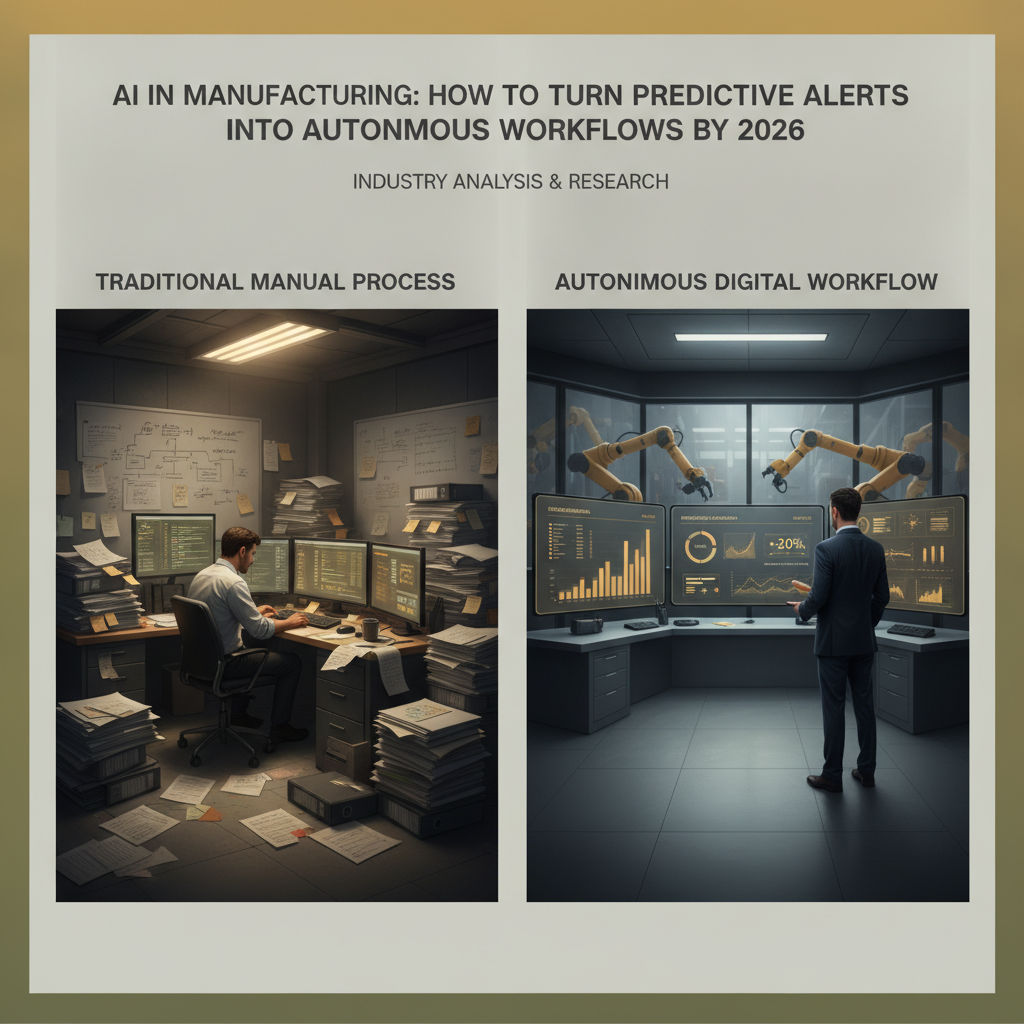
The problem isn’t the AI model; it’s the lack of an intelligent, automated workflow to act on its insights. By 2026, the manufacturers who lead the pack won't just be the ones who can predict problems; they will be the ones who have automated the response.
The Compounding Costs of Operational Disconnect
The gap between AI-driven alerts and operational action isn't just an inconvenience; it's a significant financial drain and a strategic liability. Understanding these costs is the first step toward building a truly intelligent factory.
1. The True Cost of Downtime: Unplanned downtime is more than just lost production. It's a cascade of compounding costs. When a critical machine fails, you pay for idle labor, potential overtime for catch-up work, and the logistical nightmare of rescheduling shipments. Missed deadlines can lead to contractual penalties and, more damagingly, a loss of customer trust that is hard to win back. A predictive alert that isn't acted upon immediately is a missed opportunity to turn a small, planned repair into a major, catastrophic failure.
2. The High Price of Imperfection: Similarly, quality control alerts that rely on manual intervention are slow and inefficient. By the time an operator notices a quality trend on a dashboard, hundreds or even thousands of faulty units may have already been produced. This leads directly to increased scrap and rework costs, which the American Society for Quality estimates can consume 15-20% of sales revenue. Furthermore, if a defect slips through, you face warranty claims, recalls, and irreversible brand damage.
3. The Widening Skills Gap: The manufacturing workforce is undergoing a seismic shift. Experienced technicians are retiring, and new operators face a steep learning curve with increasingly complex machinery. An AI alert that simply says "Vibration Anomaly on Axis-B" is meaningless without the tribal knowledge to interpret it. This skills gap makes it difficult to diagnose and resolve issues quickly, extending downtime and increasing the risk of incorrect repairs.
4. Drowning in Data, Starving for Action: Modern factories are data-rich environments, generating terabytes of information from SCADA systems, Manufacturing Execution Systems (MES), and thousands of IoT sensors. The challenge has shifted from data collection to data operationalization. Without a system to automatically connect an AI insight (from sensor data) to an operational system (like a Computerized Maintenance Management System, or CMMS), this data remains trapped in silos, creating noise instead of value.
Versalence: Bridging the Gap with Intelligent Automation
At Versalence AI, we recognize that the ultimate value of AI isn't found in the algorithm alone, but in the seamless integration of that algorithm into the fabric of your daily operations. Our solution isn't about replacing your existing AI models; it's about unlocking their true potential with AI-powered automation and intelligent, conversational workflows.
We build the crucial connective tissue between your systems, your data, and your people, transforming passive alerts into decisive, automated actions. We achieve this by designing and deploying sophisticated workflow engines using extensible, powerful platforms. Our expertise is in creating the conversational layers and deep integrations that make automation feel intuitive and powerful. This focus is reflected in our work and contributions to open-source repositories like versalenceai/botpress, where we build the tools to connect next-generation conversational AI with the complex software ecosystem of the modern enterprise.
Here’s how our approach transforms two of the most critical areas in manufacturing:
Use Case 1: Predictive Maintenance 2.0 – From Alert to Resolution in Minutes
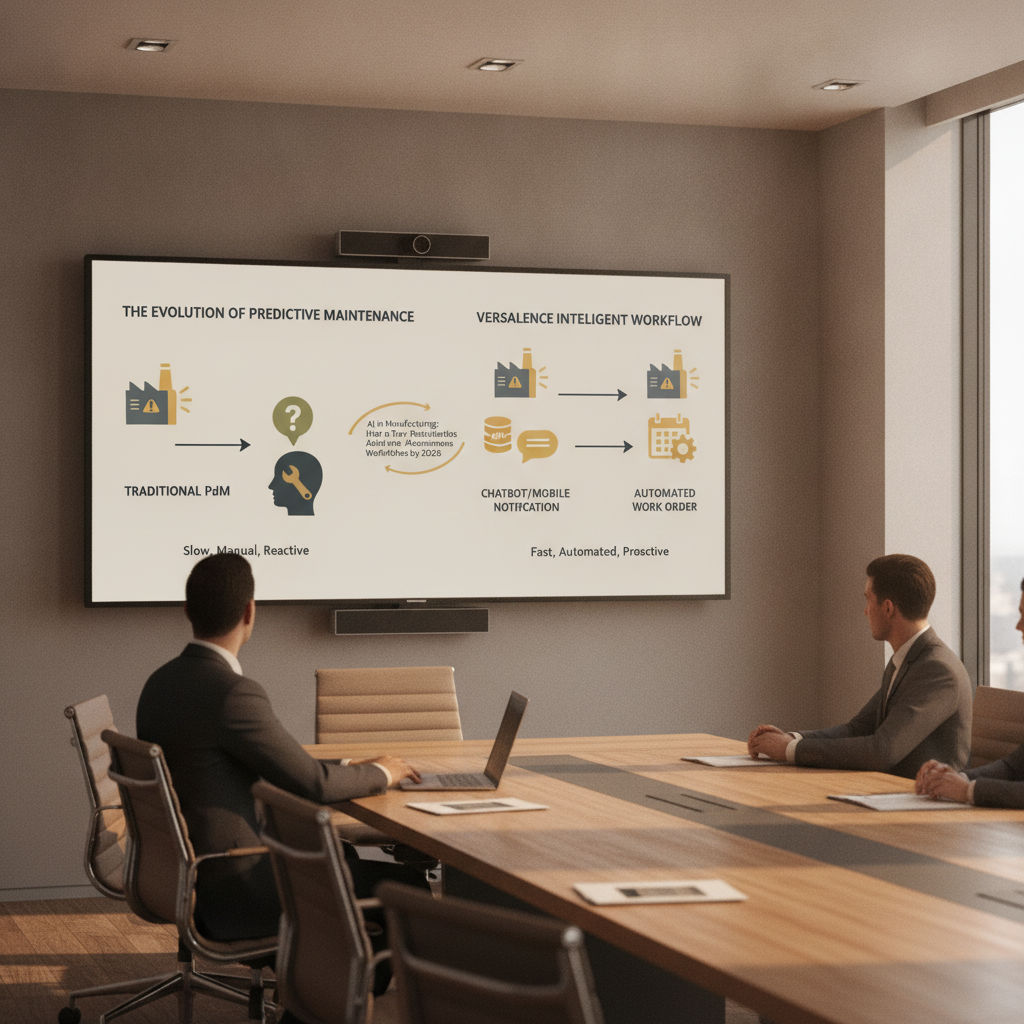
The Old Way (Standard PdM): An AI model analyzes vibration data from a CNC machine and flags a high probability of a bearing failure. It generates an email to a general maintenance inbox and a red flag on a dashboard. The shift supervisor sees it hours later, assigns a technician to investigate, who then spends time diagnosing the already-diagnosed problem, finding the right part in the ERP, and manually creating a work order. The entire process takes hours or even days, while the machine inches closer to failure.
The Versalence Intelligent Workflow:
-
Automated Ingestion & Enrichment: The moment the AI model generates the alert via an API call, our workflow engine ingests it. It doesn't just pass it along; it enriches it. The engine automatically queries your MES to check the current production schedule, your ERP for part availability and location, and your CMMS for the machine’s maintenance history.
-
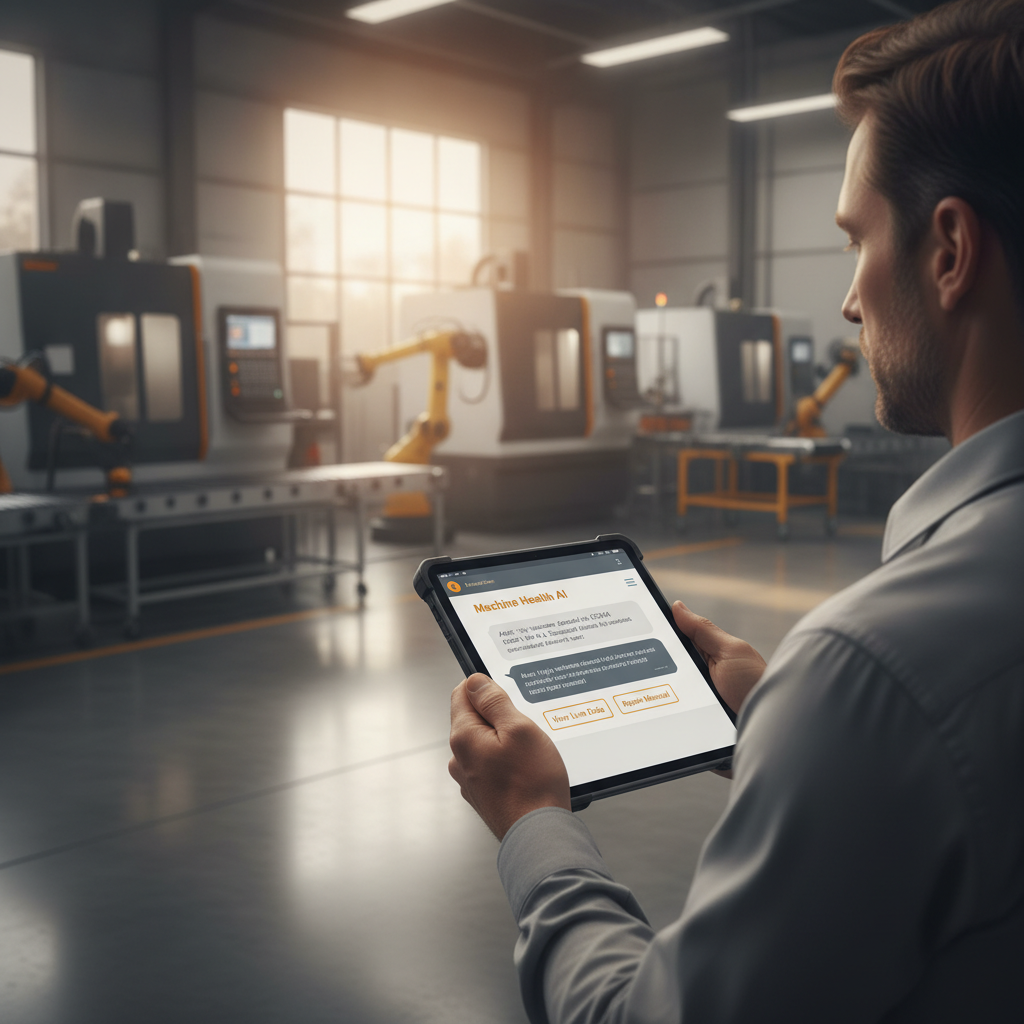
Conversational Dispatch: The workflow doesn't send a cryptic email. It dispatches a clear, actionable message to the on-duty technician via a mobile app like Microsoft Teams or a dedicated web interface. The AI-powered chatbot says:
"Heads up, Mark. CNC Mill #4 shows a 92% probability of a spindle bearing failure in the next 48 hours. The required part (Part #BR-549) is in stock in Bin 7A. The current production run on Mill #4 is scheduled to finish in 3 hours. Do you want me to create a priority work order and schedule a 1-hour maintenance window?"

-
Human-in-the-Loop Action: The technician simply replies "Yes" or taps a button. The workflow engine takes over, executing a series of automated tasks:
- It creates a detailed work order in the CMMS.
- It reserves the part in the ERP/inventory system.
- It blocks out the maintenance window on the MES production schedule, notifying the planning department.
-
Guided Execution: When the technician arrives at the machine, they can use the same conversational interface to pull up digital work instructions, schematics, or even video tutorials for the repair. If they get stuck, they can ask the AI assistant to connect them with a remote senior expert. This turns every technician into your best technician.

Use Case 2: Autonomous Quality Control – Closing the Loop in Real-Time
The Old Way (Standard AQC): A computer vision system on an assembly line detects a surface scratch on a product. A red light flashes, and an operator manually diverts the product for inspection. They log the defect in a spreadsheet at the end of their shift. The quality team analyzes these spreadsheets weekly to spot trends, long after thousands more faulty products may have been produced from the same root cause.
The Versalence Intelligent Workflow:
-
Instantaneous Triage: The vision system's API call triggers our quality control workflow. The system immediately logs the defect with a timestamp and a high-resolution image.
-
Automated Root Cause Analysis: The workflow engine acts as a digital detective. It instantly queries upstream systems for correlated events. Did the temperature in the molding machine fluctuate 90 seconds before the defect occurred? Was a new batch of raw material introduced? Did a robotic arm's pressure sensor register an anomaly?
-
Intelligent Notification & Escalation: It alerts the line supervisor with context-rich information via their preferred device:
"Quality Alert on Line 2. A micro-fracture defect has been detected on Unit #A-4821. Our analysis shows a 75% correlation with a 5-degree temperature drop in Oven #3 that occurred at 10:32 AM. The 10 preceding units and 3 subsequent units from that batch are being automatically diverted for inspection. Do you want to pause the line or notify the process engineer?"
-
Closed-Loop Learning: The supervisor’s decision and the engineer’s final root cause analysis are captured within the workflow. This data—the defect, the correlated factors, and the resolution—is fed back into a central database. This not only provides a perfect digital thread for compliance and auditing but also serves as new training data to make the core AI models more accurate over time. It transforms your quality control from a reactive, lagging indicator into a proactive, self-improving system.
The Same Powerful Engine, Applied Across Your Operations
The power of this intelligent workflow approach extends far beyond the factory floor. The same core principles of connecting systems, automating processes, and leveraging conversational AI can revolutionize other parts of your business:
- Supply Chain & Logistics: Imagine a logistics manager simply asking, "What's the ETA for the steel shipment from ACME Corp?" and getting an instant, consolidated answer from the supplier's system, the freight carrier's API, and real-time traffic data, instead of making three phone calls.
- Safety & Compliance: A sensor detecting a chemical leak could trigger a workflow that automatically initiates shutdown procedures, alerts specific first responders with a map to the location, and sends out mass notifications, all within seconds.
- Employee Onboarding & Training: A new machine operator can be guided through their first setup by an AI assistant on a tablet, providing step-by-step instructions and answering questions in natural language, dramatically reducing training time and errors.
The Tangible ROI of Intelligent Automation
Moving from passive AI alerts to autonomous workflows delivers concrete, measurable returns that go straight to your bottom line. While results are unique to each facility, our clients and industry benchmarks point to significant gains:
- Reduction in Unplanned Downtime: By converting predictive alerts into scheduled maintenance, manufacturers can reduce unplanned downtime by 20-30%.
- Improved Mean Time to Repair (MTTR): Arming technicians with all the information they need before they even start a job can lower MTTR by 15-25%.
- Decreased Scrap & Rework: Real-time, closed-loop quality control identifies and addresses root causes faster, cutting scrap rates by 10-20%.
- Increased Labor Productivity: Automating routine data lookups, reporting, and work order creation can boost the productivity of your skilled engineers and managers by 5-10%, freeing them to focus on strategic improvements.
Your Factory's Future Starts with a Smarter Workflow
The future of manufacturing in 2026 and beyond will be defined by speed, agility, and intelligence. Having AI models is no longer a competitive advantage; the real advantage lies in your ability to act on their insights at machine speed.
If your organization is ready to move beyond AI pilots and build a truly autonomous, self-improving operation, the journey starts with bridging the gap between insight and action.
Contact the experts at Versalence AI to schedule a consultation. Let's design the intelligent workflows that will power your factory of the future.
Email us at sales@versalence.ai or visit versalence.ai to begin the conversation.
Work With Versalence
Ready to remove the drag from your business operations? Our AI automation and system integration team delivers measurable results in 30-120 days.
📧 Contact us
✉️ sales@versalence.ai