
Microservices vs Monolith: The Decision Framework for Scaling AI Systems
Every software engineering team, CTO, and digital transformation leader eventually faces the same crossroads when planning a new application build: Should we start with a monolithic architecture, or should we embrace microservices from day one?
For years, the technology industry has swung back and forth like a pendulum between these two paradigms. A decade ago, the monolith was viewed as a relic of the past, while microservices were hailed as the ultimate solution for scale, agility, and modern development. Today, after watching countless organizations collapse under the weight of distributed system complexity—often referred to as "microservices envy"—the pendulum is swinging back toward pragmatic, modular monoliths.
But as AI-powered automation and intelligent workflows become central to modern business operations, this age-old debate has gained a new layer of complexity. Modern applications aren't just processing user CRUD (Create, Read, Update, Delete) operations; they are running resource-intensive Large Language Models (LLMs), executing asynchronous AI agent workflows, and connecting to dynamic, cloud-based intelligence platforms like Botpress.
At Versalence AI, we specialize in Custom Software Development, integrating advanced AI capabilities into core business systems. Because we operate at the intersection of enterprise software architecture and artificial intelligence, we cannot afford to rely on guesswork or passing fads. We need a systematic, repeatable way to architect applications that scale efficiently without drowning our clients in technical debt.
This blog post outlines the exact decision framework we use for every new build, how the integration of AI changes the traditional rules of software architecture, and how Versalence AI leverages intelligent automation to deliver scalable, future-proof applications.
The Business Impact of Architectural Missteps
The architecture you choose on day one dictates the speed at which you can innovate in year three. When businesses struggle with the challenges of choosing between microservices and monoliths, the symptoms usually manifest in the bottom line, not just in the codebase.
The Cost of Premature Microservices
Many organizations fall into the trap of over-engineering. Driven by the success stories of tech giants like Netflix, Uber, or Amazon, startups and mid-market enterprises often attempt to build complex distributed systems before they have product-market fit or the necessary domain knowledge.
When a company adopts microservices too early, the business impact is severe:
- Skyrocketing Infrastructure Costs: Instead of hosting a single application, the organization is suddenly managing dozens of databases, containers, load balancers, and network gateways.
- Deployment Paralysis: What used to be a simple code deployment becomes a complex orchestration of inter-dependent service updates, requiring massive DevOps overhead.
- Debugging Nightmares: Tracing a single user request across fifteen different microservices requires advanced observability tools that most teams don't have the bandwidth to manage.
- Wasted Developer Cycles: Engineers spend 40% of their time writing boilerplate code for service-to-service communication, API gateways, and serialization, rather than building actual business value.
The Cost of the "Monolith Trap"
Conversely, holding onto a monolithic architecture for too long—especially an unstructured "big ball of mud" monolith—creates a different set of business bottlenecks.
- The Single Point of Failure: A memory leak in a new AI feature can crash the entire application, taking down user portals, payment gateways, and backend reporting all at once.
- Scaling Inefficiencies: If an application features a lightweight user dashboard and a highly compute-intensive AI document parsing engine, scaling the monolith means scaling everything. You pay for massive servers just to support the AI engine, wasting money on the dashboard component.
- Developer Bottlenecks: As the engineering team grows, developers begin stepping on each other's toes. Merge conflicts become daily occurrences, and deployment cycles slow to a crawl because the entire system must be regression-tested for every minor change.
The goal is to find the "Goldilocks Zone"—the architectural paradigm that allows for rapid initial development while leaving the door open for future scalability.
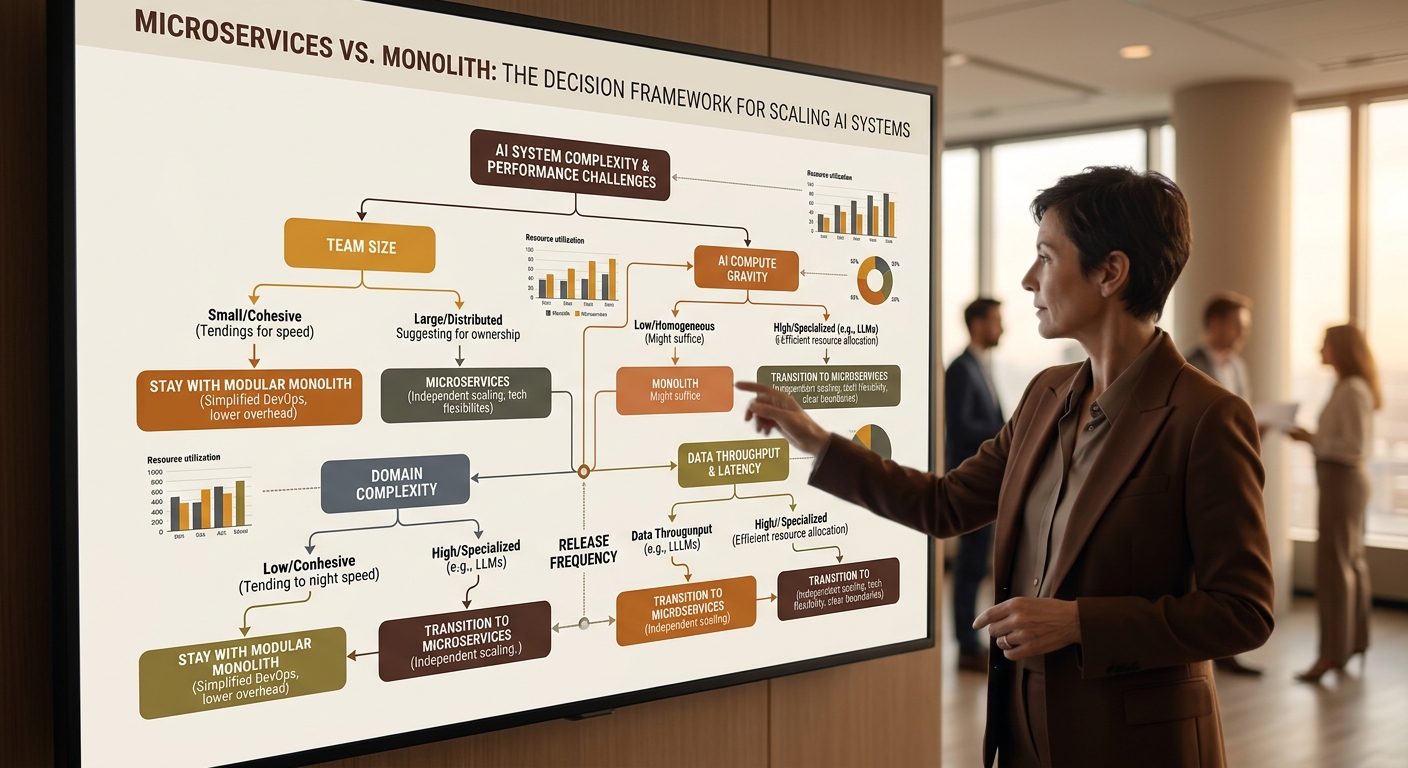
The Decision Framework: How We Evaluate New Builds
At Versalence AI, our architectural decision framework removes emotion and hype from the equation. We evaluate every new project against five core pillars before writing a single line of code.
1. Domain Complexity and Bounded Contexts
Before deciding on an architecture, we analyze the business domain using principles from Domain-Driven Design (DDD). We look for "Bounded Contexts"—natural dividing lines in the business logic.
If a new application is relatively simple (e.g., a customer portal with a predictable set of workflows), a monolithic architecture is almost always the right choice. However, if the application encompasses wildly different domains—such as an e-commerce platform that includes a real-time AI recommendation engine, a massive logistics routing system, and a core user identity service—we begin to look at separating these into microservices.
The Rule: If we cannot clearly define the boundaries of a service, it belongs in a monolith. Prematurely splitting poorly understood domains leads to distributed monoliths, which carry the downsides of both architectures and the benefits of neither.
2. The AI and Compute Gravity
This is where Versalence AI's framework diverges from traditional software engineering models. The introduction of AI drastically alters how we think about compute resources.
Traditional web operations (loading a user profile, saving a form) take milliseconds and require minimal CPU. AI operations (generating a conversational response via an LLM, vectorizing a large document, or executing an agentic web search) can take seconds and require massive computational power.
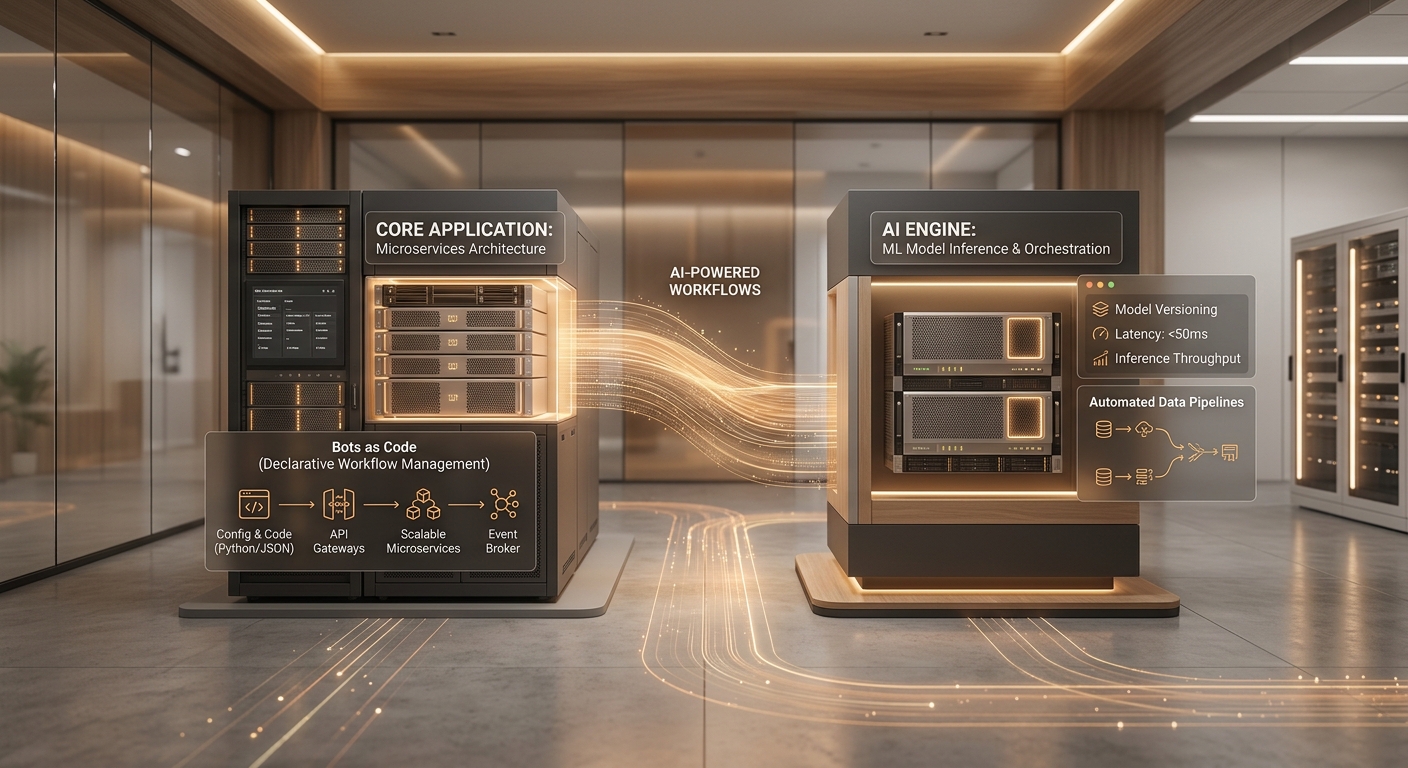
The Rule: We isolate heavy, asynchronous, and unpredictable compute workloads. Even if the core of the application is a monolith, the AI inference engine and intelligent workflow processes are built as decoupled, headless microservices. This allows us to scale the AI components independently on high-performance GPUs or specialized cloud instances without inflating the cost of hosting the core application.
3. Organizational Structure and Cognitive Load (Conway's Law)
Conway's Law states that organizations design systems that mirror their own communication structures. If we are building a product for a startup with a tight-knit team of four developers, forcing them into a microservices architecture will overwhelm their cognitive load. They will spend all their time managing infrastructure.
If we are building a system that will be maintained by five distinct engineering departments at a large enterprise, a monolith will result in endless communication bottlenecks. Microservices allow independent teams to work, deploy, and scale autonomously.
The Rule: The architecture must match the team. We use modular monoliths for small-to-medium teams, ensuring that the code is structured cleanly into distinct modules. This keeps cognitive load low while allowing for an easy transition to microservices later when the team size justifies it.
4. Infrastructure and DevOps Maturity
Microservices require a highly mature DevOps culture. You need automated CI/CD pipelines, container orchestration (like Kubernetes), infrastructure as code (Terraform), centralized logging, and distributed tracing.
The Rule: If a client lacks an internal DevOps team or the budget for advanced infrastructure tooling, we default to a well-architected monolithic approach. At Versalence AI, we use AI-powered automation to handle much of the DevOps lifecycle, but we never push a client into an architectural paradigm their team cannot maintain.

5. Data Architecture and Consistency Requirements
The hardest part of microservices isn't the code; it's the data. In a true microservices architecture, every service must have its own independent database. If you have ten microservices reading from the same shared PostgreSQL database, you don't have microservices—you have a distributed monolith with network latency.
The Rule: We evaluate the need for transactional consistency. If the application requires strict ACID (Atomicity, Consistency, Isolation, Durability) guarantees across multiple business domains (e.g., financial transactions), we keep those domains unified. We only extract services when eventual consistency is acceptable.
How Versalence AI Delivers This Solution: Intelligent Architecture in Practice
Understanding the framework is only half the battle; executing it with precision is where Versalence AI truly excels. We leverage AI-powered automation, intelligent workflows, and modern cloud-native tooling to build systems that adapt to our clients' evolving needs.
When we approach Custom Software Development, we utilize an architectural pattern we call the "AI-Enhanced Modular Monolith." This approach gives our clients the rapid deployment and simplicity of a monolith, with the scalable, asynchronous power of microservices reserved specifically for AI and automation components.
Integrating Botpress for Conversational Microservices
A perfect example of how we handle this architectural division can be seen in our approach to conversational AI and intelligent assistants. Many businesses try to bake complex chatbot logic, state management, and LLM integrations directly into their core application backend. This rapidly bloats the monolith, creating tightly coupled, fragile code.
Instead, we leverage specialized, modern tools. For example, our work and contributions in the open-source space, such as the versalenceai/botpress repository (a fork/deployment of Botpress Cloud), highlight our approach. Botpress is the ultimate platform for building next-generation chatbots and assistants powered by OpenAI.
Rather than building conversational AI directly into the client's core web application (the monolith), we treat the Botpress environment as an independent, intelligent microservice.
- Bots as Code: Using the
@botpress/sdkand@botpress/cli, we define the AI assistant's logic, prompts, and workflows entirely as code. - Seamless CI/CD Integration: Because we use the CLI and SDK, the bot is version-controlled alongside the main application. We build automated CI/CD pipelines that deploy changes to the Botpress Cloud environment independently of the core monolith.
- Decoupled Architecture: The client's core monolith simply interacts with the Botpress AI via lightweight API calls or webhooks. All the heavy lifting—LLM token management, conversation state tracking, and fallback logic—is handled by the Botpress environment.
This is the decision framework in action: we isolate the complex, high-compute, distinct domain (conversational AI) into its own scalable service, while keeping the client's core business logic (user management, billing, standard data entry) in a highly maintainable, unified application.
AI-Powered Automation and Workflow Orchestration
Building software is inherently complex, regardless of the architecture chosen. Versalence AI mitigates this complexity by embedding AI-powered automation directly into the development and deployment lifecycles.
When building a modular monolith that is designed for future extraction into microservices, discipline is key. Developers must not allow modules to become tightly coupled. We deploy AI-driven static analysis tools and automated PR (Pull Request) reviewers that actively monitor the codebase. If a developer attempts to bypass an internal API boundary and create a hard dependency between two distinct modules, our intelligent automation flags the code before it is merged.
Furthermore, we use AI to automate the generation of boilerplate infrastructure code. Whether we are provisioning a single robust instance for a monolith or spinning up serverless functions for decoupled AI tasks, our intelligent workflows generate the Terraform scripts, Dockerfiles, and deployment manifests. This drastically reduces human error and accelerates time-to-market.
Related Solutions We've Built
At Versalence AI, this decision framework has been battle-tested across numerous industries and custom software deployments.
Intelligent Customer Support Ecosystems We've utilized the "AI-Enhanced Modular Monolith" to build highly scalable customer support platforms. The core ticketing system, user authentication, and data analytics run in a fast, efficient modular monolith. Meanwhile, the automated triaging and conversational AI agents—built using tools like the Botpress SDK—operate as decoupled, headless services. This ensures that massive spikes in customer support inquiries (which trigger heavy LLM usage) never slow down the dashboard performance for human support agents.
Data Parsing and Document Automation Platforms For clients in legal and financial sectors, we've built systems that ingest thousands of PDFs daily. Applying our framework, the user-facing upload portals and basic metadata management remain unified. However, the Optical Character Recognition (OCR) and LLM-driven entity extraction run entirely as independent, queue-driven microservices. We utilize intelligent workflow orchestration to pass data seamlessly back to the core monolith once processing is complete, preventing the main application from timing out during heavy document processing.
Automated CI/CD and Code Review Workflows We've developed internal tooling that bridges the gap between monoliths and microservices. By deploying custom AI agents that hook directly into GitHub repositories, we automate code reviews, security vulnerability scanning, and module dependency tracking. This ensures that as an architecture evolves, technical debt is caught and eliminated autonomously.
Results & ROI: The Value of Pragmatic Architecture
When businesses partner with Versalence AI and adopt our architectural decision framework, the results are immediate and measurable. By avoiding the "Microservices Envy" trap and leveraging intelligent automation, our clients achieve remarkable Returns on Investment:
- 30-40% Faster Time-to-Market: By starting with a cleanly designed modular monolith, we bypass the immense setup time required for complex distributed systems. Startups and enterprises can launch features faster and test market viability without delay.
- Up to 50% Reduction in Cloud Infrastructure Costs: By selectively decoupling only the most compute-intensive components (like AI inference and automated workflows), our clients avoid paying for redundant databases and idle container orchestration clusters.
- Zero-Downtime AI Scaling: Because tools like Botpress and LLM integrations are architected as decoupled nodes, clients can scale their AI operations from 100 queries a day to 10,000 queries an hour without any performance degradation to their core platforms.
- Reduced Developer Onboarding Time: A well-structured modular monolith is significantly easier for new engineers to comprehend. With clear bounded contexts and AI-automated code documentation, new hires become productive in days, not weeks.
Building modern, AI-integrated software doesn't mean you have to succumb to architectural chaos. It requires a pragmatic, deeply analytical approach that values business outcomes over industry buzzwords.
Call to Action
The architectural foundation of your software will dictate its future success. If your business is struggling with technical debt, sluggish deployment cycles, or the complexities of integrating modern AI capabilities into legacy systems, it is time to rethink your approach.
At Versalence AI, we design, build, and deploy intelligent custom software that is built to scale without the headache of premature over-engineering. We bring clarity to the Microservices vs Monolith debate, ensuring your technology serves your business goals, not the other way around.
Stop wrestling with architecture and start scaling your capabilities. Contact Versalence AI today to discuss how our custom software development and intelligent automation solutions can future-proof your next big build.
Email us at: sales@versalence.ai or visit our website at versalence.ai to schedule a technical consultation.
Work With Versalence
Ready to remove the drag from your business operations? Our AI automation and system integration team delivers measurable results in 30-120 days.
📧 Contact us
✉️ sales@versalence.ai