
Stop AI Scope Creep: Shipping Enterprise AI Workflows in 30-120 Days
The enterprise AI landscape is currently experiencing a massive disconnect between expectation and reality. While executive boards mandate rapid AI integration to maintain competitive advantages, engineering and product teams are finding themselves trapped in what the industry has aptly named "Proof of Concept (PoC) Purgatory." According to recent industry analyses, up to 80% of enterprise AI projects never make it to production. They start with grand ambitions, immense budgets, and limitless scope, only to languish in endless research and development cycles.
At Versalence AI, we recognized early on that treating artificial intelligence like a traditional, multi-year software transformation project is a fundamental mistake. The technology moves too fast. By the time an 18-month AI roadmap is completed, the underlying foundation models, SDKs, and best practices have completely shifted.
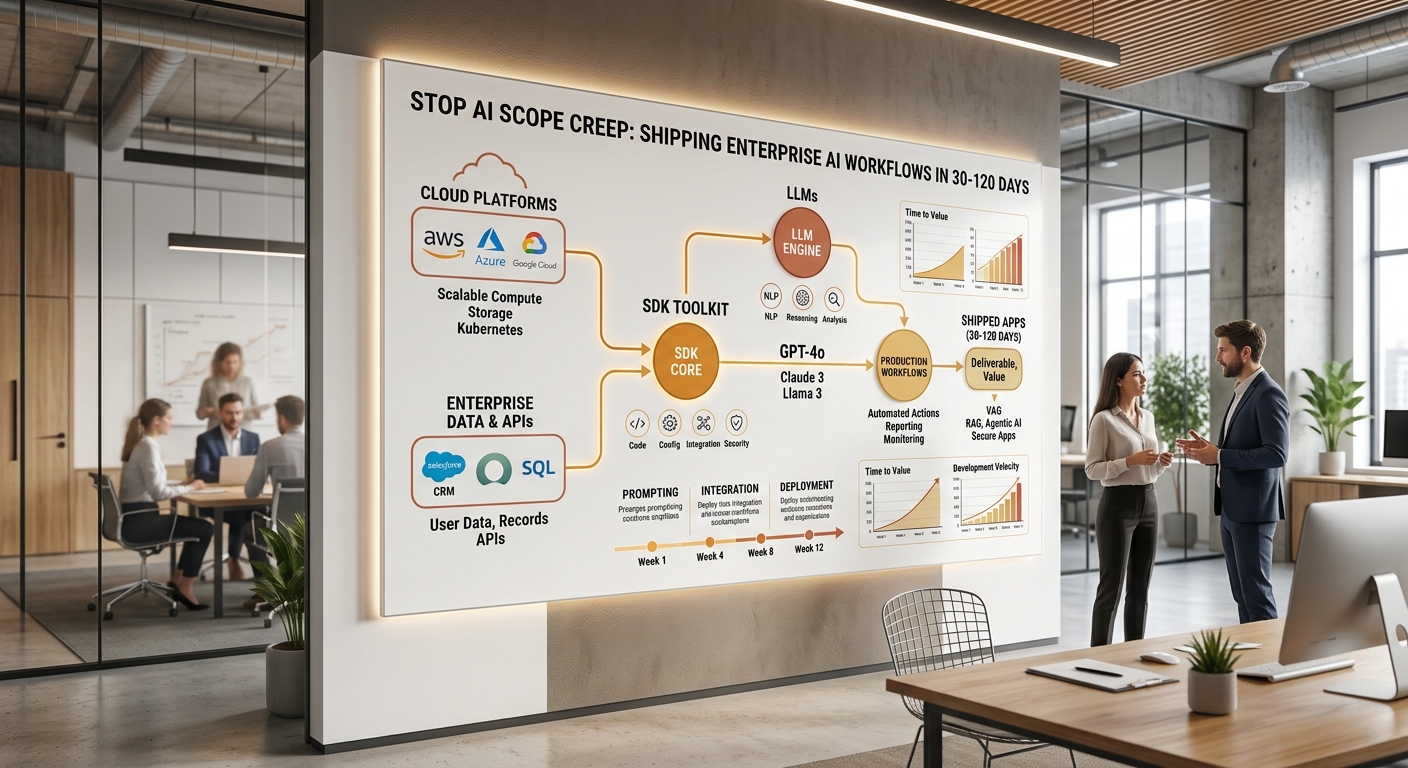
This is exactly why we established The 30-120 Day Delivery Promise. We believe that if an AI project cannot demonstrate tangible ROI and reach a production environment within a four-month window, the scope is fundamentally flawed. In this comprehensive guide, we are going to unpack exactly how Versalence scopes, architects, and ships AI-powered automation and intelligent workflows that actually reach the hands of users—without sacrificing security, scalability, or performance.
The Business Impact: The Hidden Cost of Endless AI Development
Before diving into the methodology, we must address why scoping AI correctly is a critical business imperative. When businesses struggle with AI implementation, the symptoms are almost always the same:

- The "Boil the Ocean" Syndrome: Companies attempt to build an omniscient AI that can solve every departmental issue at once, from HR onboarding to complex customer support and financial forecasting.
- The Infrastructure Trap: Teams spend six months building foundational LLM (Large Language Model) orchestration, vector databases, and state-management frameworks from scratch, ignoring existing enterprise-grade tools.
- Stakeholder Fatigue: When business sponsors fund a project but see no functional prototype or operational impact for three quarters, funding dries up, and the project is abandoned.
The financial cost of these delays is staggering. Beyond the direct engineering costs, there is a massive opportunity cost. While a company spends a year building an in-house chatbot architecture from scratch, their competitors are already using off-the-shelf, integrated platforms to reduce support ticket resolution times by 40%.
To combat this, enterprise AI must be approached through the lens of rapid, iterative product engineering rather than academic research. The goal is not to build a perfect, all-knowing system. The goal is to build a highly constrained, highly effective intelligent workflow that solves a specific, painful bottleneck.
The 30-120 Day Delivery Framework: How We Scope for Success
Shipping enterprise AI in 120 days or less is not about cutting corners or ignoring security. It is about brutal prioritization, intelligent tooling, and leveraging powerful pre-built architectures. Here is how Versalence structures our project scoping to guarantee delivery.
1. Discovery and Strict Constraint Mapping (Days 1-14)
The foundation of a successful AI project is established before a single line of code is written. During the first two weeks, we work closely with stakeholders to identify the "highest-impact, lowest-friction" use cases.
We apply a strict scoping filter to proposed AI features:
- Is the data accessible? If an AI feature requires data that is siloed in legacy, on-premise servers with no API access, it is immediately removed from the 120-day scope. We only target workflows where data is structured, accessible, and clean.
- Is the task deterministic or probabilistic? We isolate workflows where AI excels—summarization, data extraction, natural language routing, and semantic search. We avoid tasks where a 1% hallucination rate would cause catastrophic regulatory failure, unless human-in-the-loop guardrails are explicitly designed into the UX.
- What is the measurable KPI? If we cannot define exactly how the AI will save time, reduce costs, or generate revenue (e.g., "reduce Level 1 support escalation by 30%"), the project is not scoped.
By the end of Day 14, we deliver a highly constrained statement of work that outlines exactly what the AI will do, what it will not do, and the exact metrics it will improve.
2. Architectural Selection & Platform Leverage (Days 15-30)
The biggest mistake engineering teams make is trying to build foundational AI infrastructure from scratch. They build custom orchestrators, session management handlers, and channel integrations. At Versalence, our secret to rapid delivery is leveraging and extending powerful, enterprise-grade platforms.
A prime example of this is our deep integration with and utilization of Botpress. As seen in our active repositories (such as the versalenceai/botpress infrastructure), we don't waste time rebuilding the wheel. Botpress is the ultimate platform for building next-generation chatbots and assistants powered by OpenAI.
By leveraging the Botpress Cloud infrastructure, SDKs, and CLIs, we instantly bypass months of foundational development. Instead of building channel integrations for Discord, WhatsApp, or web portals, we use robust, pre-existing hooks. Instead of writing custom Node.js scripts to manage conversational state and memory, we rely on a platform designed specifically for stateful AI interactions.
During this phase, we map out the architecture:
- The Orchestration Layer: Utilizing platforms like Botpress to manage the flow, state, and routing of conversations.
- The Intelligence Layer: Connecting custom OpenAI endpoints, Anthropic models, or locally hosted open-source LLMs depending on data privacy constraints.
- The Integration Layer: Mapping out the API calls to the client’s internal systems (CRMs like Salesforce, ERPs, or internal databases).
3. AI-Powered Automation & Intelligent Workflows (Days 31-90)
With the foundation secured, the core engineering phase begins. This is where Versalence engineers build out the intelligent workflows. Because we aren't bogged down building infrastructure, we spend this crucial 60-day window focusing purely on business logic, AI reasoning, and data retrieval (RAG).
Building Context with Retrieval-Augmented Generation (RAG): Generic LLMs are essentially useless for enterprise problems without specific context. We build intelligent RAG pipelines that ingest the client's proprietary knowledge bases. We configure vector databases that allow the AI to semantic search internal documentation in milliseconds.
Developing Custom Plugins and DevTools:
Leveraging tools like the @botpress/sdk and @botpress/cli, our team develops highly customized plugins tailored to the client's specific ecosystem. If a client needs their AI assistant to autonomously query a legacy logistics API, parse the XML response, convert it to natural language, and update a Zendesk ticket, we build a dedicated plugin for that exact workflow.
We treat bots "as code." By maintaining our AI infrastructures in version control (using platforms like GitHub and CI/CD pipelines), we ensure that the AI behaviors are reproducible, testable, and scalable. This infrastructure-as-code approach is exactly how we prevent the fragile, "black box" deployments that plague many internal AI projects.

4. Guardrails, Testing, and Deployment (Days 91-120)
An AI workflow is only as good as its safety mechanisms. In the final month, we transition from building to hardening.
- Prompt Injection Defense: We implement architectural barriers to prevent bad actors from manipulating the AI into exposing internal system prompts or confidential data.
- Hallucination Mitigation: We adjust model temperatures, implement strict grounding techniques, and mandate citation of internal sources. If the AI cannot find the answer in the provided vector database, it is hard-coded to gracefully escalate to a human agent rather than guessing.
- Human-in-the-Loop (HITL) Fallbacks: For high-stakes workflows, the AI is designed as a "co-pilot" rather than an autopilot. The AI does the heavy lifting—gathering data, summarizing user intent, drafting a response—but a human operator clicks "approve" before the final action is taken.
By Day 120, the client has a fully functioning, highly integrated AI workflow deployed in a production environment, actively solving the problem we identified in Week 1.
Technical Spotlight: How We Utilize the Botpress Ecosystem
To understand how we achieve this speed, it’s worth looking at the tools we utilize. The versalenceai/botpress repository highlights our commitment to robust, scalable platforms.
When scoping a conversational AI or intelligent agent project, building from scratch often means worrying about:
- How do we handle message queueing?
- How do we deal with users typing multiple messages before the LLM responds?
- How do we format UI elements (buttons, cards, carousels) across different chat platforms?
By utilizing the Botpress ecosystem, we utilize their Integrations (public integrations on the Botpress Hub), Devtools (CLI, SDK, API Client), and Plugins.
For example, when a client requires an internal HR assistant, we use the Botpress SDK to write deterministic rules for sensitive actions (like requesting paid time off) while using the OpenAI-powered generative nodes to handle free-form employee questions (like "What is our policy on remote work?"). This hybrid approach—combining strict deterministic logic with generative AI—is the key to shipping enterprise applications that are both magical and deeply reliable.
Furthermore, because Botpress supports robust API capabilities, we can embed these assistants directly into the client's custom software via React or Angular web components, ensuring the AI feels like a native part of their product rather than a bolted-on widget.
Related Solutions We've Built
Our 30-120 day scoping methodology isn't just theory; it is the framework we use to deploy transformative solutions across multiple industries. By leveraging robust architectures and intelligent workflows, we have successfully deployed solutions such as:
1. Autonomous Customer Success Routing (Shipped in 45 Days) Many support teams drown in Tier-1 queries. By deploying an intelligent assistant that intercepts incoming tickets, analyzes user intent using natural language processing, and queries the company’s internal Confluence pages via RAG, we built a system that autonomously resolves 35% of all incoming queries. Complex queries are automatically routed to the correct human department, pre-populated with a summary of the user's issue and suggested solutions.
2. Conversational BI & Data Querying (Shipped in 90 Days) For a mid-sized logistics company, executives were frustrated by the bottleneck of waiting for data analysts to build SQL dashboards for simple questions. We scoped and delivered a secure, internal AI assistant that translates natural language questions ("How many shipments were delayed in the Midwest last week?") into SQL queries, executes them against a read-only database replica, and returns the data as formatted text and charts.
3. Multi-Channel E-commerce Concierge (Shipped in 110 Days) Leveraging the omnichannel capabilities of Botpress, we delivered an AI assistant deployed simultaneously on WhatsApp, Discord, and Web. The AI connects directly to Shopify APIs, allowing users to track packages, initiate returns, and receive personalized product recommendations based on their purchase history, all through natural conversational flows.
Results & ROI: Why Speed to Market Matters
When AI projects drag on for a year, the ROI calculations become incredibly strained. By compressing the delivery timeline to 30-120 days, the business metrics shift dramatically in favor of the enterprise.
- Immediate Cost Reduction: A customer support bot deployed in 60 days begins saving human-hours immediately. These immediate cost savings often fund the next phase of AI development, turning the AI initiative into a self-funding project.
- Rapid User Feedback: The faster an AI tool is in the hands of real users, the faster you capture edge cases and feedback. An AI tuned by 30 days of real-world use is infinitely more valuable than an AI tuned by 12 months of theoretical lab testing.
- Adaptability: By keeping scopes tight and deployments rapid, businesses remain agile. If a new, dramatically cheaper or more capable LLM is released halfway through the year, a modular, rapidly deployed architecture can easily swap out the underlying model without derailing a massive, monolithic development cycle.
The reality is that AI-powered automation is no longer a futuristic luxury; it is a baseline expectation for modern enterprise efficiency. However, the path to AI maturity is not paved with endless R&D and bloated software cycles. It is paved with strict scoping, intelligent leverage of existing platforms, and a relentless focus on shipping usable workflows.
Stop Waiting on AI. Start Shipping.
If your organization has been stuck in AI planning meetings for months, or if you have an AI proof-of-concept that refuses to scale into a production-ready tool, it is time to change your methodology.
At Versalence AI, we specialize in taking complex AI ambitions, breaking them down into manageable, high-impact scopes, and delivering robust, secure, and scalable solutions in 120 days or less. By combining deep engineering expertise with powerful frameworks like Botpress, we ensure your AI initiatives actually see the light of day.
Ready to define your 120-day AI roadmap? Stop spinning your wheels on infrastructure and start delivering automated value to your business and your customers.
Contact Versalence AI today. Visit us at versalence.ai or email our engineering strategy team directly at sales@versalence.ai to schedule your initial discovery and scoping session.
Work With Versalence
Ready to remove the drag from your business operations? Our AI automation and system integration team delivers measurable results in 30-120 days.
📧 Contact us
✉️ sales@versalence.ai