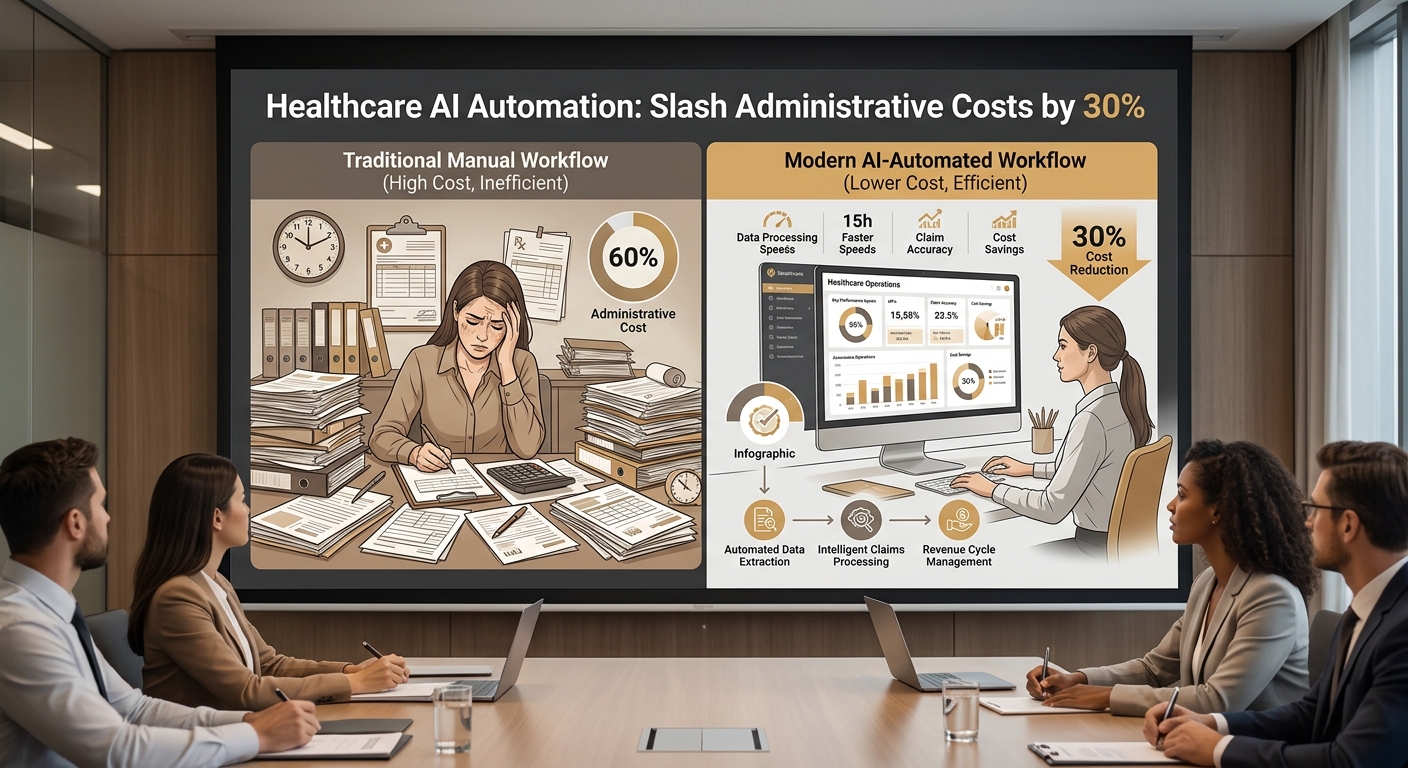
Healthcare AI Automation: Slash Administrative Costs by 30%
The healthcare industry is currently facing an unsustainable paradox: while medical science and clinical technologies have advanced at breakneck speeds, the administrative machinery that runs healthcare organizations remains stuck in the past. Today, for every hour a physician spends directly caring for patients, they spend nearly two hours on administrative tasks. Nurses, front-desk staff, and billing departments are similarly overwhelmed, drowning in a sea of prior authorizations, patient scheduling conflicts, insurance verifications, and redundant data entry.
When the conversation turns to Artificial Intelligence in healthcare, the media and tech enthusiasts immediately jump to clinical applications: robot surgeons, AI models that detect tumors earlier than human radiologists, and predictive algorithms forecasting patient deterioration. While these clinical advancements are monumental and absolutely vital for the future of medicine, they are not where the immediate, scalable ROI lies for health systems today.
Looking ahead to 2026, the real revolution in healthcare AI isn't starting in the operating room—it is starting at the front desk. Administrative automation is the "gateway drug" to widespread AI adoption in healthcare. By solving the most painful, expensive, and lowest-risk operational bottlenecks first, healthcare organizations can build the internal trust, technical infrastructure, and financial ROI necessary to support clinical AI in the future.
At Versalence AI, we recognize that businesses struggle to implement these solutions. Between strict compliance requirements, siloed Electronic Health Record (EHR) systems, and a fear of "AI hallucinations" damaging the patient experience, many health systems remain paralyzed. In this comprehensive breakdown, we will explore why administrative automation is the critical first step for healthcare in 2026, the specific operational bottlenecks it solves, and how Versalence AI leverages powerful conversational AI engines—specifically leveraging platforms like Botpress—to deploy intelligent workflows that cut administrative costs by up to 30%.
The Business Impact: Why Administrative AI is the Gateway
To understand why administrative AI is the critical entry point for health systems, we must look at the current macroeconomic state of healthcare. Hospitals and clinic networks are operating on razor-thin margins, often hovering between 1% and 3%. Concurrently, the industry is experiencing a massive labor shortage. Healthcare workers are leaving the field at unprecedented rates, citing burnout driven largely by administrative burden.
When a healthcare organization attempts to deploy a clinical AI tool—such as an algorithmic diagnostic assistant—it faces a steep uphill battle. The tool must clear rigorous FDA approvals, integrate seamlessly into a physician’s already-cluttered workflow, and overcome immense skepticism from clinicians whose licenses (and patients' lives) are on the line. The cost of failure is catastrophic.
Conversely, administrative AI carries low clinical risk but offers incredibly high operational reward.
Consider the average patient journey before they even see a doctor:
- Discovery & Scheduling: The patient calls to find an appointment, often waiting on hold for 15-20 minutes, leading to high abandonment rates.
- Intake & Registration: The patient fills out paper forms or clunky digital portals, providing information that the clinic already has on file, which a staff member must manually re-type into the EHR.
- Triage & FAQs: The patient calls back with routine questions: "Do I need to fast before my blood test?" or "Where do I park?"
- Billing & Insurance: Staff members spend hours on the phone with insurance companies for prior authorizations, while patients struggle to understand their explanation of benefits.
By automating these specific workflows, health systems achieve three critical objectives: First, they immediately reduce the operational strain on their workforce, allowing staff to focus on high-value human interactions. Second, they drastically improve the patient experience, providing instant, 24/7 access to information. Third, and perhaps most importantly for the long-term AI strategy, they prove to their internal stakeholders—from the board of directors to the medical staff—that AI is a safe, reliable, and helpful tool.
Once doctors trust the AI that manages their schedule and handles their patient intake, they will be much more open to trusting the AI that helps them read an MRI in 2026.
How Versalence AI Delivers This Solution
Building healthcare AI is fundamentally different from building e-commerce or customer service AI. It requires a rigorous approach to security, compliance (HIPAA), data privacy, and interoperability. A generic out-of-the-box chatbot is not sufficient; healthcare requires intelligent, context-aware agents that can navigate complex medical ontologies and integrate securely with legacy EHR systems like Epic, Cerner, or Athenahealth.
At Versalence AI, we solve this by architecting AI-powered automation and intelligent workflows using top-tier enterprise orchestration platforms. A core piece of our conversational AI architecture leverages Botpress, the ultimate platform for building next-generation chatbots and assistants powered by advanced Large Language Models (LLMs) like OpenAI.
Here is a deep dive into how Versalence AI engineers and deploys these solutions for healthcare organizations:
1. Advanced Conversational Interfaces via Botpress Cloud
The era of frustrating, decision-tree chatbots that force patients into endless loops of "Press 1 for hours, Press 2 for scheduling" is over. We utilize Botpress Cloud to build highly intelligent, natural-language patient assistants. Because Botpress is powered by advanced LLMs, patients can interact with the system just as they would with a human receptionist.
A patient can type or say: "I have an appointment next Tuesday with Dr. Smith, but my daughter is sick and I need to push it to Thursday afternoon. Also, will my Aetna PPO cover this visit?"
Using the robust NLP capabilities orchestrated through Botpress, the AI parses multiple intents from this single message:
- Identify the patient and current appointment (Entity extraction).
- Process the cancellation/reschedule request (Intent: Reschedule).
- Query the doctor's availability for Thursday afternoon (API call to EHR).
- Process the insurance verification question (Intent: Insurance Check).

Versalence AI utilizes the Botpress SDK and CLI to treat "bots as code." This means our deployments are highly structured, version-controlled, and seamlessly integrated into a health system’s existing CI/CD pipelines. This developer-first approach ensures that as a hospital scales its AI operations, the underlying architecture remains stable, secure, and easily auditable.
2. Secure EHR Integration and Intelligent Workflows
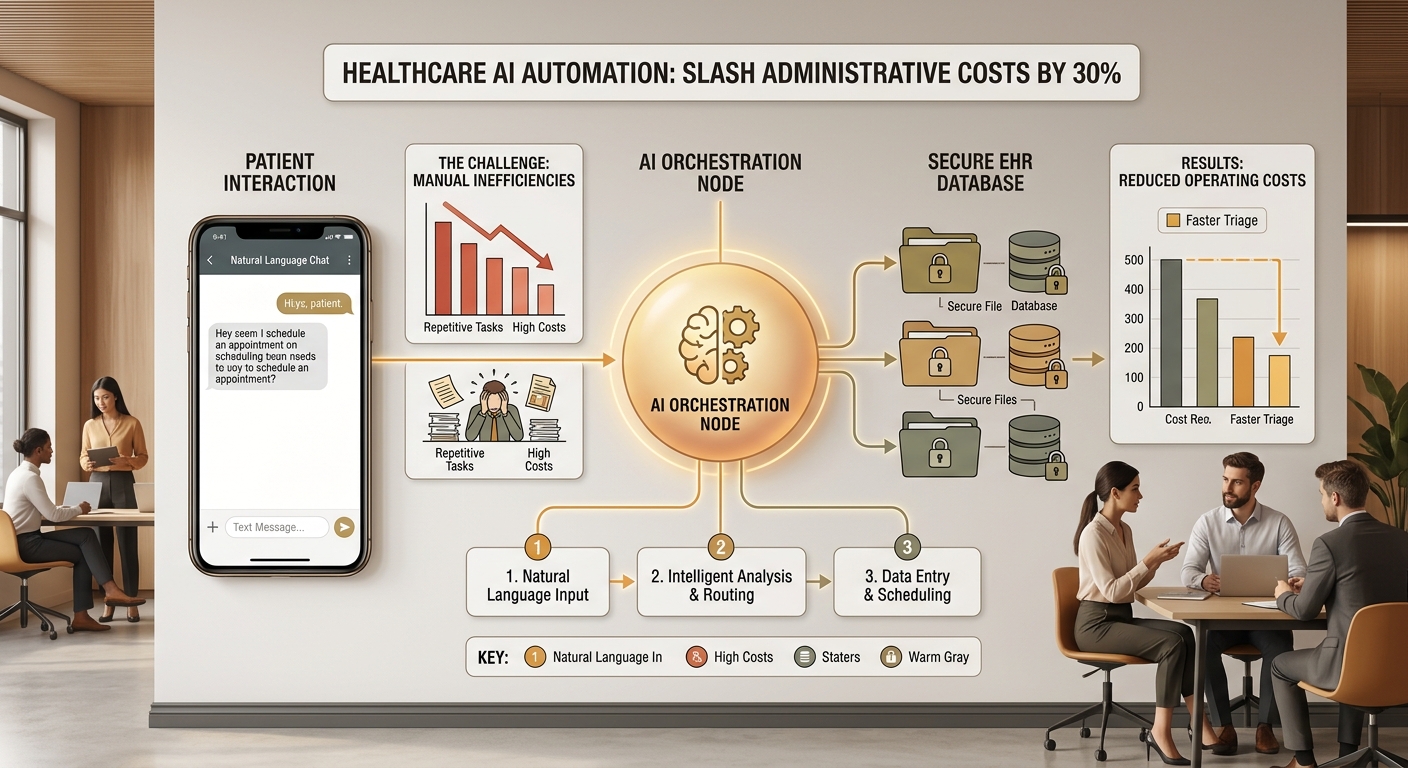
An AI assistant is only as smart as the data it can access. A standalone chatbot is practically useless in healthcare if it cannot read or write to the system of record. Versalence AI bridges this gap by building secure middleware that connects the Botpress conversational layer to the hospital's EHR and Revenue Cycle Management (RCM) software.
We utilize secure, HIPAA-compliant REST APIs and HL7/FHIR (Fast Healthcare Interoperability Resources) standards to enable real-time data exchange. When a patient requests to schedule an appointment, our intelligent workflow:
- Authenticates the patient securely.
- Pings the EHR for available time slots based on the specific provider and appointment type.
- Presents options to the patient in a natural conversational flow.
- Writes the confirmed appointment back to the EHR instantly, complete with an AI-generated summary of the patient's chief complaint for the physician to review.
3. Eradicating Hallucinations with Constrained RAG Architecture
The biggest fear healthcare executives have regarding LLMs is "hallucination"—the AI confidently providing incorrect medical advice or administrative information. To combat this, Versalence AI implements a strict Retrieval-Augmented Generation (RAG) architecture.
We decouple the language capabilities of the LLM from its inherent knowledge base. When a patient asks a question via our Botpress-powered assistant, the AI is explicitly instructed not to use the open internet or its pre-trained data to answer. Instead, the workflow triggers a semantic search against a closed, securely managed database of the hospital’s specific verified documents (e.g., specific clinical guidelines, insurance policy PDFs, doctor bios, and pre-op instructions).
The LLM then synthesizes an answer strictly based on the retrieved documents. If the answer is not in the hospital's verified database, the AI is programmed to gracefully fail and route the patient to a human agent, providing the staff member with a full transcript of the conversation to ensure a seamless handoff.
4. Multi-Channel Deployment Strategy
Patients interact with healthcare across multiple touchpoints. Versalence AI ensures that the administrative automation meets the patient where they are. Using Botpress’s extensive integration capabilities (available via the Botpress Hub), we deploy these intelligent workflows across:
- Web Portals: Embedded directly into the hospital's homepage or patient portal.
- WhatsApp & SMS: Proactive messaging for appointment reminders, secure link delivery for intake forms, and post-discharge follow-ups.
- Voice/Telephony: Integrating the conversational AI into the hospital’s IVR (Interactive Voice Response) system, allowing patients calling the main phone line to speak naturally to the AI to route calls or manage scheduling.
Related Solutions We Build
Administrative automation is a broad category, and the "gateway" extends beyond just patient scheduling. Utilizing the same core architecture of intelligent workflows and AI orchestration, Versalence AI builds a suite of interconnected solutions for healthcare:
- Intelligent Document Processing (IDP) for Referrals: Fax machines still inexplicably dominate healthcare. We build workflows that use Computer Vision and OCR to ingest inbound faxes (like primary care referrals), extract the relevant patient data and diagnostic codes using LLMs, and automatically populate the EHR, turning an unstructured analog process into a structured digital one.
- Internal Staff Helpdesk Assistants: Physicians and nurses waste countless hours trying to navigate internal IT systems, HR portals, and complex clinical protocols. We deploy internal-facing Botpress assistants that act as a concierge for the staff. A nurse can ask the AI on their mobile device, "What is the updated protocol for pediatric asthma admissions?" and receive an instant, cited answer from the hospital's internal knowledge base.
- Automated Post-Discharge Follow-up: 30-day readmission rates are a major financial penalty for hospitals. We build automated SMS/WhatsApp workflows that check in with patients daily after discharge. The AI asks simple questions about pain levels, medication adherence, and symptoms. If the NLP detects a concerning response (e.g., "my incision is red and warm"), the intelligent workflow immediately escalates the case to a triage nurse, potentially preventing a costly ER readmission.
Results & ROI: The Transformative Power of Admin AI
The goal of AI in Healthcare by 2026 is not replacing human clinicians; it is augmenting the human workforce by entirely removing the robotic, repetitive tasks from their plates. When health systems partner with Versalence AI to implement administrative automation, the return on investment is rapid, measurable, and highly impactful across multiple departments.
While results vary based on the scale of the deployment and the specific workflows automated, health systems utilizing our AI architectures typically see outcomes such as:
- 30% to 40% Reduction in Call Center Volume: By empowering patients to self-serve scheduling, insurance queries, and routine FAQs through an intelligent conversational interface, call center queue times plummet. The cost per patient interaction drops from an average of $10-$15 for a human-handled call to mere cents for an AI-handled interaction.
- 50% Faster Patient Intake: By sending automated, conversational intake workflows via SMS prior to the appointment, patients arrive with their data already securely written into the EHR. This eliminates waiting room bottlenecks, reduces manual data entry errors by staff, and ensures the physician has the patient's information formatted and summarized before stepping into the room.
- Maximized Provider Utilization: AI scheduling assistants are relentless optimizers. When a patient cancels an appointment at the last minute, the intelligent workflow immediately queries a waitlist and sends automated SMS offers to fill the slot. This drastically reduces no-show rates and ensures that highly compensated physicians are operating at maximum utilization, directly driving top-line revenue.
- Drastic Reductions in Staff Burnout: The most profound ROI is often qualitative. When medical assistants, receptionists, and billing coordinators no longer spend 70% of their day on hold with insurance companies or transcribing paper forms, job satisfaction skyrockets. Retention rates improve, saving organizations hundreds of thousands of dollars in recruitment and training costs.
As we move toward 2026, the dividing line between successful, thriving health networks and struggling, resource-drained clinics will be their adoption of administrative AI. Those who implement intelligent workflows today will build the data infrastructure, staff familiarity, and financial surplus necessary to comfortably integrate the more complex clinical AI tools of tomorrow.
Administrative automation is the gateway drug to the future of healthcare. It is low-risk, high-reward, and immediately accessible.
Let Versalence AI Transform Your Operations
Navigating the complexities of healthcare IT, HIPAA compliance, and AI integration requires a specialized partner. You do not have to settle for off-the-shelf chatbots that frustrate patients, nor do you have to wait a decade for AI to become practical.
At Versalence AI, we design, build, and deploy enterprise-grade AI automation tailored specifically to the operational bottlenecks of your healthcare organization. From advanced Botpress-powered patient assistants to seamless EHR integrations, we turn your administrative burdens into streamlined, intelligent workflows.
Ready to cut costs, empower your staff, and drastically improve your patient experience? Contact us today at sales@versalence.ai or visit versalence.ai to schedule a technical consultation. Let us build the gateway to your AI-powered future.
Work With Versalence
Ready to remove the drag from your business operations? Our AI automation and system integration team delivers measurable results in 30-120 days.
📧 Contact us
✉️ sales@versalence.ai