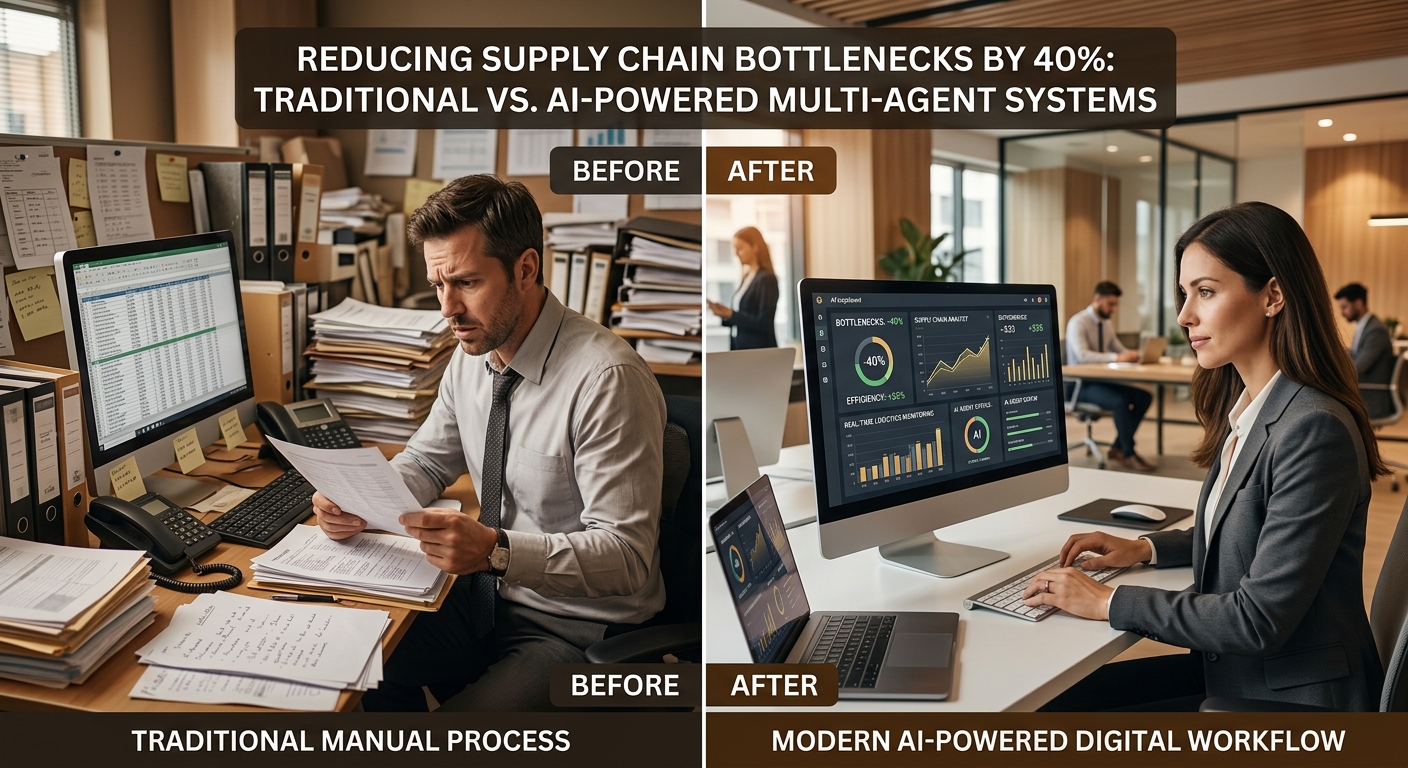
How Multi-Agent AI Systems Reduce Supply Chain Bottlenecks by 40%
Modern global supply chains are marvels of human engineering, yet they remain incredibly fragile. A localized weather event in Southeast Asia, a sudden spike in consumer demand in North America, or a minor logistical delay at a major port can trigger a cascade of disruptions that cost businesses millions. According to industry analyses, supply chain disruptions can erase up to 45% of a company’s profits over the course of a decade.
For years, enterprises have attempted to solve these complex logistical puzzles by throwing rigid software at the problem. Enterprise Resource Planning (ERP) systems, while excellent at maintaining a static ledger of what has already happened, are inherently reactive. They rely on human operators to input data, interpret alerts, formulate contingency plans, and communicate across fragmented networks of suppliers, vendors, and logistics partners. By the time a human operator identifies a supply chain exception and coordinates a response, the optimal window for resolution has often closed.
The root of the problem lies in a mismatch of architectures. Supply chains are inherently distributed, dynamic, and decentralized networks. Traditional supply chain software, however, is centralized and static.
This is where the paradigm of Multi-Agent Systems (MAS) is fundamentally transforming operations. By deploying networks of specialized, cooperative AI agents to run supply chains, businesses are shifting from reactive logging to proactive, autonomous problem-solving. At Versalence AI, we are at the forefront of this transformation, building AI-powered automation and intelligent workflows that allow businesses to navigate supply chain chaos with unprecedented agility.
The Business Impact of Fragmented Supply Chains

To understand the revolutionary impact of Multi-Agent Systems, we must first examine the hidden costs of current operations. In a standard enterprise, the supply chain is managed in silos. Procurement handles supplier relationships and purchasing; inventory management oversees warehousing and stock levels; logistics manages routing and freight; and customer service deals with the downstream impact of fulfillment.
When a disruption occurs—for instance, a critical component supplier announces a two-week delay—the resolution process is agonizingly slow. The supplier emails procurement. Procurement manually updates the ERP. An inventory manager notices the updated lead time and realizes a manufacturing plant will run out of parts. The inventory manager emails production planning. Production planning halts the line and informs sales. Sales informs the customer.
This manual "telephone game" is highly susceptible to the Bullwhip Effect, where small delays amplify into massive structural inefficiencies. The business impact is severe:
- Increased Expediting Costs: Companies are forced to pay exorbitant premium freight fees to rush delayed materials.
- Excess Safety Stock: Because businesses cannot trust their supply chain agility, they tie up millions of dollars in working capital by holding excess buffer inventory.
- Operational Latency: Thousands of human hours are wasted on mundane tracking, email follow-ups, and data entry rather than strategic sourcing and relationship building.
Multi-Agent AI Systems directly address this latency. Instead of relying on human operators to bridge the gap between silos, intelligent agents monitor, communicate, and resolve issues in real-time. They operate at the speed of data, drastically reducing the time between the detection of a problem and the execution of a solution.
The Architecture of a Multi-Agent Supply Chain
What exactly is a Multi-Agent System? In the context of AI, an agent is an autonomous software entity equipped with a Large Language Model (LLM) as its reasoning engine, bound to specific tools, APIs, and instructions. It can perceive its environment (e.g., read emails, monitor API feeds), make decisions based on its programmed objectives, and take action (e.g., update a database, send a message).
A Multi-Agent System is an ecosystem where several of these specialized agents collaborate to achieve a broader organizational goal. By breaking down complex supply chain management into specialized agent roles, we mirror the distributed reality of the physical supply chain.
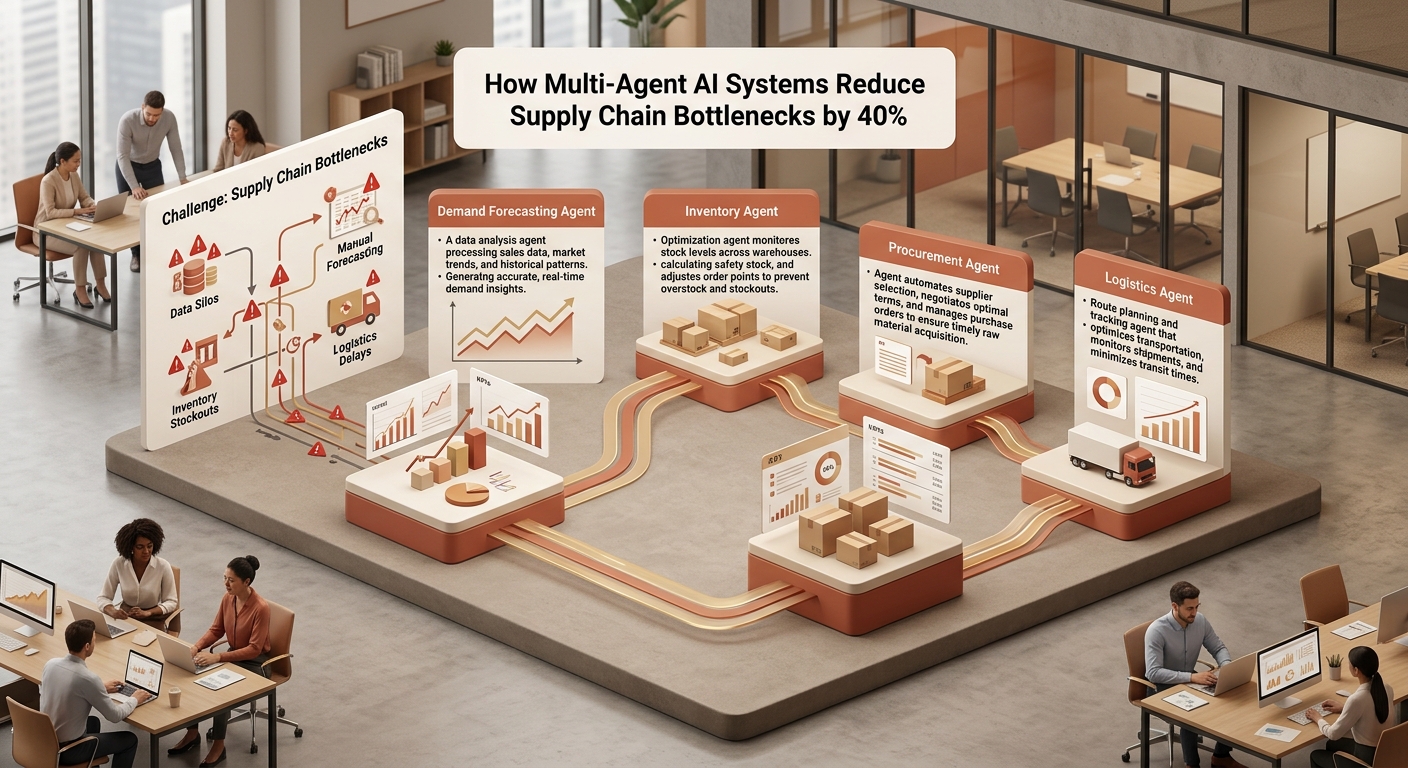
Consider a typical Versalence MAS architecture for an enterprise supply chain:
1. The Demand Forecasting Agent This agent constantly monitors incoming sales orders, historical seasonality, market trends, and even external data like macroeconomic indicators. Its sole purpose is to predict what the company will need and when. When it detects an anomalous spike in demand for a specific SKU, it alerts the broader system.
2. The Inventory & Production Agent Acting as the bridge between sales and manufacturing, this agent maps demand against current on-hand inventory and production schedules. If the Demand Agent signals a spike, the Inventory Agent instantly calculates whether current stock and incoming raw materials are sufficient. If a shortfall is projected, it generates a material requirement signal.
3. The Procurement Agent Triggered by the Inventory Agent, the Procurement Agent springs into action. It reviews the approved vendor list, assesses current contracts, and evaluates historical supplier performance. It can autonomously draft purchase orders or Requests for Quotation (RFQs).
4. The Logistics & Risk Agent This agent is constantly scraping global shipping data, weather patterns, and geopolitical news. If a hurricane threatens a major shipping lane, it calculates the projected delay for all in-transit freight, instantly notifying the Inventory Agent to assess the impact on production.
In a traditional setup, coordinating these four functions takes days of meetings and spreadsheet analysis. In a Multi-Agent System, these specialized agents negotiate and optimize a solution in milliseconds.
The Critical Missing Link: Human-in-the-Loop and Vendor Communication
While internal agents can communicate flawlessly via APIs, supply chains ultimately involve external human beings—vendors, truck drivers, customs brokers, and warehouse staff. The greatest point of failure for AI automation is often the interface between the machine and the external human.
An internal Procurement Agent might know it needs to order 10,000 units of a component from a supplier in Vietnam, but that supplier doesn't have an API. They use email, WhatsApp, and PDF invoices. How does the Multi-Agent System interact with the physical world?
This is where Versalence’s deep expertise in conversational AI and intelligent workflows becomes the linchpin of the operation. To bridge the gap between autonomous backend agents and human suppliers, we heavily utilize our advanced conversational infrastructure, heavily leveraging powerful frameworks like Botpress.
Through our active development and utilization of platforms like the Botpress Cloud—specifically utilizing the @botpress/sdk and @botpress/cli—we build highly specialized Vendor Communication Agents. These are not generic customer service chatbots; they are sophisticated, goal-oriented agents built entirely as code, integrated directly into the broader Multi-Agent System.
How Versalence Delivers This Solution

At Versalence AI, we recognize that off-the-shelf AI tools cannot run a complex supply chain. True automation requires a bespoke, secure, and highly integrated architecture. Here is how we build and deploy Multi-Agent Systems to run supply chains:
1. Designing the Orchestration Layer
The foundation of our solution is the AI orchestration layer. Using advanced LLM frameworks, we define the specific personas, permissions, and operational bounds for each internal agent. We implement strict guardrails to prevent AI hallucinations, ensuring that agents base their decisions solely on verified enterprise data.
We integrate this orchestration layer directly into the client’s existing infrastructure—whether that is SAP, Oracle, NetSuite, or a custom internal ERP. Agents are granted secure, role-based API access to read inventory levels, write purchase orders, and update shipping statuses.
2. Deploying Bots-as-Code for External Interaction
To handle external communications, we utilize the Botpress SDK to deploy "bots-as-code." This developer-centric approach allows us to version-control our conversational agents and integrate them into modern CI/CD pipelines.
When our internal Procurement Agent needs to expedite an order with a human vendor, it triggers a Botpress-powered Communication Agent.
- The Communication Agent drafts a highly contextual, natural language email or WhatsApp message to the vendor: "Hi team, we are projecting a shortage of Part #A123. Can you expedite our PO #98765 to arrive by Tuesday? We are willing to cover the premium airfreight."
- When the human vendor replies ("We can get it there by Wednesday, but it will cost an extra $500"), the Communication Agent parses this unstructured natural language.
- Using LLM-powered extraction, it converts the vendor's reply into structured JSON data:
{ "new_delivery_date": "Wednesday", "additional_cost": 500, "status": "negotiating" }. - It feeds this structured data back to the internal Procurement Agent, which then checks its pre-approved budget rules. If the $500 is within tolerance, it authorizes the charge and the Communication Agent confirms with the vendor.
This seamless translation between unstructured human conversation and structured machine data is the magic that makes Multi-Agent supply chains viable in the real world.
3. Intelligent Exception Handling and Human Escalation
We do not believe in unchecked autonomy. The most successful AI deployments are those that empower human workers rather than attempt to bypass them entirely. Versalence designs Multi-Agent Systems with a robust Human-in-the-Loop (HITL) architecture.
Every action proposed by an agent is assigned a confidence score. If a logistics agent detects a port strike and proposes rerouting a multi-million dollar shipment to a different continent, the financial impact might exceed its authorized threshold. The agent will immediately package all the context—the alert, the financial analysis, and the proposed alternative—and escalate it to a human supply chain manager via a customized dashboard or an integration with Slack/Microsoft Teams.
The human manager reviews the agent's research and clicks "Approve" or "Reject." If approved, the Multi-Agent System resumes autonomous execution, updating the ERP and dispatching the Vendor Communication Agents to notify the freight forwarders.
Related Solutions We've Built
Our approach to intelligent workflows extends across various nodes of the supply chain and logistics sectors. By combining secure backend automation with robust conversational interfaces, Versalence has tackled numerous operational bottlenecks:
Automated Freight Quoting Systems Logistics brokers often spend hours manually cross-referencing carrier rate sheets, spot market boards, and historical data to build quotes for shippers. We engineer AI agents that instantly digest a shipper's request, query multiple internal and external databases, calculate margins, and instantly generate competitive, accurate quotes. This turns a 4-hour turnaround into a 4-second turnaround, drastically increasing win rates.
Warehouse Operations Helpdesks Internal supply chains are just as critical as external ones. We have utilized platforms like Botpress to build internal operational assistants for warehouse floors. When a forklift operator encounters a damaged pallet or a discrepancy in a bin location, they don't need to walk across the 100,000-square-foot facility to find a manager. They interact with an intelligent agent via a handheld scanner or tablet, logging the exception, automatically adjusting the WMS (Warehouse Management System), and triggering a re-count task for the inventory team.
Supplier Onboarding Automation Onboarding a new vendor typically requires endless back-and-forth emails to collect tax documents, compliance certificates, and banking details. We build multi-agent workflows where an AI assistant manages the entire onboarding lifecycle. It reaches out to the vendor, collects the documents, uses Optical Character Recognition (OCR) and LLMs to validate the data (ensuring the name on the W-9 matches the master service agreement), and automatically populates the ERP.
Results & ROI: The Tangible Benefits of AI Orchestration
Transitioning from manual, siloed operations to a Versalence-engineered Multi-Agent System yields profound, measurable returns on investment. While every supply chain is unique, businesses implementing these intelligent workflows typically see dramatic improvements across key performance indicators.
1. 40% Reduction in Supply Chain Bottlenecks By shifting from reactive human intervention to proactive AI monitoring, organizations can identify and resolve exceptions before they cause downstream line-down situations. Faster data processing means faster rerouting, faster re-ordering, and fewer catastrophic delays.
2. 30% Decrease in Manual Operational Overhead Procurement officers and logistics coordinators spend an estimated 40-50% of their day on low-value tasks: sending "where is my order" (WISMO) emails, updating spreadsheets, and doing data entry. By automating vendor communications and ERP updates, enterprises reclaim thousands of human hours, allowing their teams to focus on strategic vendor negotiations and supply chain resilience planning.
3. Optimization of Working Capital Because a Multi-Agent System reduces the volatility and uncertainty of lead times, businesses can operate with leaner safety stocks. Reducing excess inventory frees up massive amounts of working capital while simultaneously reducing warehousing costs and the risk of inventory obsolescence.
4. Drastically Improved Vendor Relations Suppliers prefer working with organized, responsive partners. When an AI agent ensures that RFQs are clear, invoices are processed automatically, and communication is instant and polite, it strengthens the vendor relationship, often leading to better pricing and prioritized service during global shortages.
The Future of Supply Chain is Collaborative Intelligence
The complexities of modern global trade have outgrown the capabilities of manual management and static legacy software. We are entering an era where businesses will not compete based on the size of their supply chain teams, but on the speed, intelligence, and agility of their digital operations.
Multi-Agent Systems are not a theoretical concept of the distant future; they are highly practical, deployable technologies that are generating massive ROI for forward-thinking enterprises today. By combining specialized AI agents with intelligent workflows and powerful conversational interfaces, businesses can tame the chaos of their supply chains and turn operational agility into a primary competitive advantage.
Transform your supply chain from a reactive cost center into an intelligent, proactive asset. At Versalence AI, we specialize in architecting, building, and deploying the secure, scalable automation solutions that modern enterprises demand.
Ready to eliminate supply chain bottlenecks and automate your critical workflows? Visit us at versalence.ai to learn more about our AI automation services, or contact our enterprise solutions team directly at sales@versalence.ai to schedule a consultation. Let’s build the intelligent engine that drives your operations forward.
Work With Versalence
Ready to remove the drag from your business operations? Our AI automation and system integration team delivers measurable results in 30-120 days.
📧 Contact us
✉️ sales@versalence.ai