
Governance-First AI: Deploy Compliant Chatbots 40% Faster
The Paradox of Speed in Enterprise AI
In today’s competitive landscape, the mandate is clear: deploy AI, and do it fast. Business leaders are eager to harness the power of large language models (LLMs) and conversational AI to revolutionize customer service, streamline operations, and unlock new revenue streams. Yet, a powerful undercurrent of anxiety holds many projects back. A 2023 Gartner survey revealed that 40% of organizations have had an AI privacy breach or security incident, and many more are stalled by the fear of one.

This creates a paradox. You’re told to innovate at lightning speed, but the very real risks associated with data privacy, regulatory compliance, and brand reputation act as a powerful brake. For most organizations, governance and compliance are treated as the final, dreaded tollbooth before deployment—a place where promising projects are often delayed for months or scrapped entirely.
The traditional approach is to build first and ask for permission later. A development team spends months creating a sophisticated chatbot, only to have it sent back from the legal and compliance department covered in red ink. The bot handles personally identifiable information (PII) incorrectly, lacks necessary audit trails, uses unapproved language, or fails to meet accessibility standards. The result? Frustrating and expensive rework cycles that obliterate budgets and timelines, turning what should be an agile process into a waterfall of delays.
What if this entire model is backward? What if, instead of being a final hurdle, governance could be the foundational launchpad that actually accelerates your AI deployment? At Versalence AI, we’ve proven that a “Governance-First” model doesn’t just mitigate risk—it makes you faster, more efficient, and more scalable.
The High Cost of "Bolt-On" Compliance
Let's paint a familiar picture. Your product team identifies a perfect use case for a customer-facing chatbot. Maybe it’s an assistant to handle insurance claims, a support bot for a software product, or an e-commerce guide. The development team gets to work, leveraging a powerful open-source platform like Botpress to rapidly prototype and build conversation flows. The demo looks incredible. The bot is smart, responsive, and everyone is excited.
Then comes the pre-launch review.
The security team flags that customer data is being logged in plain text. The legal team points out that the bot doesn't provide the required GDPR consent language for European users. The marketing team is horrified that the bot’s tone is off-brand and it’s making promises the company can’t keep. The support team realizes there’s no defined escalation path for when a user asks a question the bot can't handle.
Suddenly, your three-month project has a new, six-month rework phase. This is the reality of "bolt-on" compliance, and its business impact is devastating:
- Massive Delays: What should be a final check becomes a complete architectural review. Developers have to untangle complex logic to inject compliance measures they never planned for.
- Budget Overruns: Rework is the most expensive part of any software project. Every hour spent fixing foundational issues is an hour not spent on innovation or building new features.
- Inter-departmental Friction: The relationship between innovators and guardians sours. Developers see compliance as a roadblock, while legal and security teams feel they are constantly being forced to play the villain.
- Lost Opportunity: While you’re stuck in rework, your competitors are deploying their own AI solutions, capturing market share and setting customer expectations.
- Unacceptable Risk: The worst-case scenario is that a non-compliant bot slips through the cracks. The resulting data breach, regulatory fine, or PR nightmare can cause irreparable damage to your brand and bottom line.
This reactive approach treats governance as a problem to be solved at the end. The Governance-First model reframes it as the set of principles that enables confident, rapid development from the start.
How Versalence Delivers a Governance-First Framework
The core principle of the Governance-First model is simple: bake compliance, security, and brand standards into the development lifecycle from day one. It’s about creating guardrails, not gates. At Versalence AI, we transform this principle into a practical, technology-driven framework using AI-powered automation and intelligent workflows.
Here’s how we architect this solution, often for clients building sophisticated assistants on platforms like Botpress.
Phase 1: The AI Governance Playbook
Before a single line of code is written, we bring all stakeholders to the table: Legal, Compliance, Security, IT, Marketing, and the business unit leaders. The goal is to co-author a central "AI Governance Playbook." This isn't a 100-page document that gathers dust; it's a living, actionable guide that defines the rules of the road.
This playbook codifies answers to critical questions:
- Data Handling: What constitutes PII or sensitive data? How must it be stored, redacted, and logged? What are the data retention policies?
- Regulatory Adherence: What are the specific requirements for GDPR, HIPAA, CCPA, or other relevant regulations? How will user consent be obtained and recorded?
- Brand & Tone: What is the approved brand voice? What specific phrases are forbidden? What is the approved format for legal disclaimers?
- Security Protocols: How will secrets and API keys be managed? What are the authentication and authorization requirements?
- Escalation & Fallbacks: What is the precise workflow when the AI cannot fulfill a request or encounters a sensitive topic? Who gets notified?
- Testing & Validation: What constitutes a successful, compliant test case? How will we test for bias, hallucinations, and adversarial attacks?
By defining this upfront, we eliminate ambiguity and empower developers to build correctly from the outset.
Phase 2: Building the Intelligent Governance Layer

With the playbook as our blueprint, we construct an automated "Governance Layer" that integrates directly into the development environment. This isn't a manual checklist; it's a set of automated tools and intelligent workflows that enforce the rules defined in the playbook.
1. Compliant-by-Design Templates & Components: We don’t just tell developers the rules; we give them pre-approved building blocks. Within a platform like Botpress, this means creating custom, reusable skills and nodes that are compliant by default.
- Example: A "PII Collection" Skill. Instead of letting every developer build their own logic for collecting a user's name and email, we create a standardized, pre-vetted skill. This skill automatically handles consent, validates the data format, and passes the information to a secure, PII-compliant backend service, never logging it in the primary conversation trace. Developers can simply drag-and-drop this skill into their flows, confident that it meets all security and legal requirements.
2. Automated Policy Enforcement in the CI/CD Pipeline: We use AI to police AI. Our framework integrates automated checks directly into your CI/CD (Continuous Integration/Continuous Deployment) pipeline.
- Example: Content & Tone Scanners. We can deploy a custom AI model that acts as a linter for conversational flows. Before code can be merged, this scanner automatically reads the bot's potential responses. Does it contain promissory language ("I guarantee you will...")? Is it attempting to give medical or financial advice? Is the tone consistent with the brand guidelines? If it detects a violation, the build fails automatically, providing the developer with instant, specific feedback long before it reaches a human reviewer.
3. Policy-as-Code (PaC): We treat your governance rules like software. The policies from the playbook are translated into version-controlled configuration files.
- Example: Managing Disclaimers. If your legal team needs to update a disclaimer across all 15 of your company’s chatbots, you don't have to manually edit each one. We implement a system where the disclaimer text is stored in a central, version-controlled repository. The change is made once, reviewed, approved, and automatically propagated to every bot that references it. This creates a clear, auditable trail of every policy change.
Phase 3: Real-Time Monitoring & Auditing
Governance doesn’t stop at deployment. Our solution provides continuous oversight with intelligent monitoring and auditing tools that give compliance officers the visibility they need without creating manual work.
- Example: The Compliance Dashboard. We build a real-time dashboard that provides a high-level view of the AI's operational health from a governance perspective. It can track metrics like:
- The number of conversations automatically redacted for PII.
- Instances where the bot successfully escalated a conversation to a human agent.
- Flags for conversations that contain anomalous or potentially problematic language, using AI to surface the 1% of interactions that require human review.
This automated oversight frees your compliance team from manually sampling conversations and allows them to focus on true exceptions, making the auditing process exponentially more efficient.
Connecting to a Broader AI Strategy
The Governance-First model we apply to chatbot development is a microcosm of a larger enterprise AI strategy. The principles of defining rules upfront, automating enforcement, and ensuring continuous auditability are universal.
The same framework can be adapted for a wide range of AI initiatives:
- Internal RAG Systems: When building a Retrieval-Augmented Generation system to help employees query internal documents, a governance layer ensures that access controls are respected and that the AI doesn’t surface sensitive HR or financial data to unauthorized users.
- Custom LLM Fine-Tuning: Before fine-tuning a model on your proprietary data, our framework can be used to automatically scan and anonymize the training dataset, preventing sensitive customer or company information from being embedded in the model weights.
- Automated Document Processing: For workflows that extract information from invoices or contracts, a governance-first approach ensures data is classified correctly and routed in compliance with internal controls and external regulations.
By establishing a robust governance framework for one project, you create a scalable pattern that can accelerate the deployment of all future AI initiatives.
The Results: Turning Compliance into a Competitive Advantage
Shifting to a Governance-First model delivers tangible, compounding returns that go far beyond just risk mitigation.
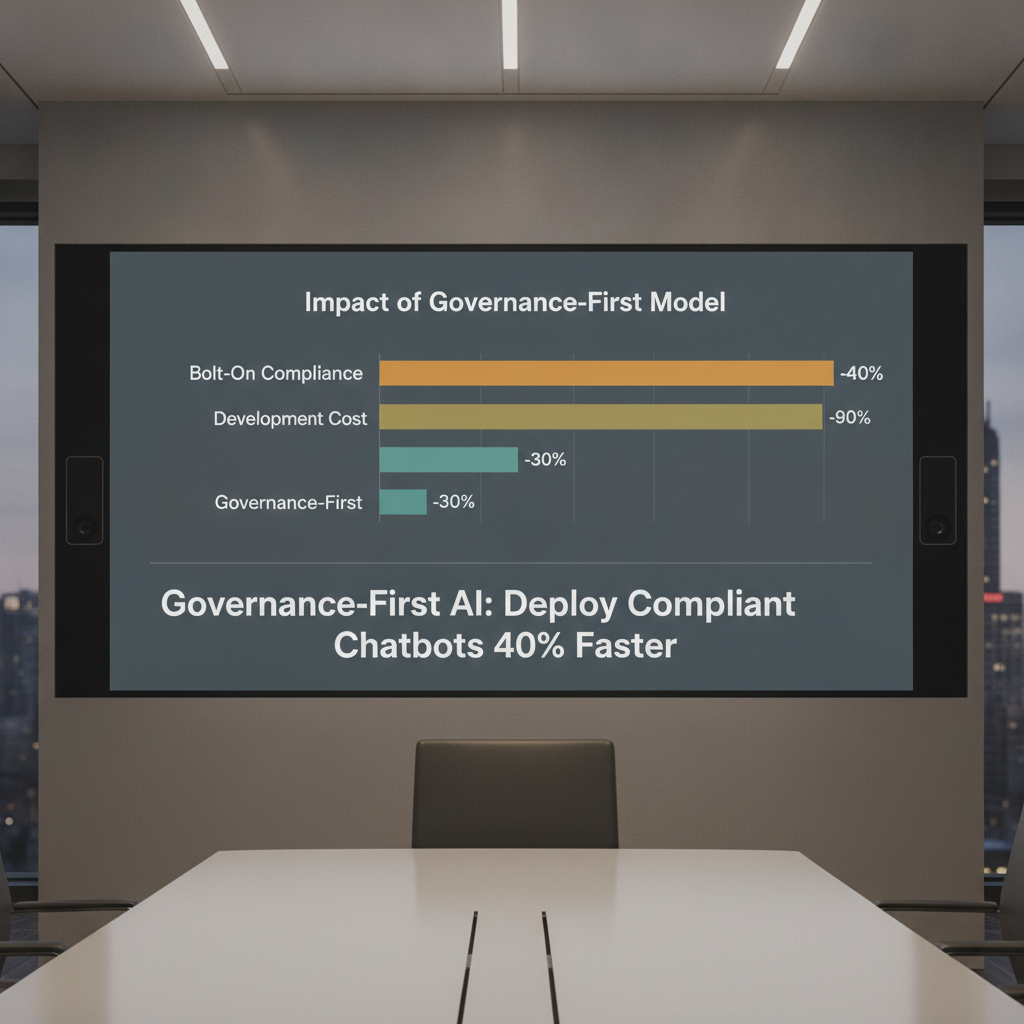
- Accelerated Deployment (Up to 40% Faster): Our clients consistently find that by eliminating the final-gate rework cycle, they dramatically shorten their time-to-market. When developers know the rules and have compliant tools at their disposal, the initial build is the final build. The long, unpredictable review phase is replaced by a quick, streamlined validation process.
- Reduced Development Costs (by 25-30%): Rework is the single biggest driver of budget overruns. By building correctly the first time, you avoid paying developers to fix foundational architectural problems and re-test the entire application. This leads to more predictable project costs and a higher ROI.
- Drastically Lowered Risk Profile: Automated, continuous compliance checks are infinitely more reliable than manual spot-checks. This proactive stance significantly reduces the likelihood of a security incident, data breach, or regulatory fine, protecting both your customers and your company's reputation.
- Enhanced Innovation and Scalability: Perhaps the most significant benefit is that a strong governance framework gives your teams the psychological safety to innovate. When developers are confident they are operating within safe, pre-approved guardrails, they can experiment and build more freely. Furthermore, once the framework is in place, launching the second, third, and tenth AI assistant becomes exponentially faster, as the foundational work is already done.
Build Faster by Building Right
The era of treating compliance as an afterthought is over. In the world of enterprise AI, it's a fatal flaw. The organizations that will win are not the ones that move recklessly, but the ones that build a foundation of trust and safety that allows them to move with confident speed.
The Governance-First model transforms compliance from a perceived bottleneck into a strategic accelerator. It fosters collaboration, reduces costs, and ultimately allows you to deliver more powerful and reliable AI solutions to your customers faster than your competitors.
Ready to stop the rework cycle and turn your governance challenges into a deployment advantage?
Contact the Versalence AI team today for a consultation. Let’s build a framework that allows you to innovate safely and deploy with speed.
Reach out to us at sales@versalence.ai or visit us at versalence.ai to learn more.
Work With Versalence
Ready to remove the drag from your business operations? Our AI automation and system integration team delivers measurable results in 30-120 days.
📧 Contact us
✉️ sales@versalence.ai