Zero-Downtime Migration: Moving 2M Records Without Losing a Customer
The Engineer’s Nightmare: The Dreaded Maintenance Window
Every CTO, engineering lead, and DevOps professional knows the feeling. Your business is scaling, your user base is growing, and the legacy database that once served you faithfully is now groaning under the strain. The decision is made: it's time to migrate. Time to move to a more scalable, performant, and cost-effective system.
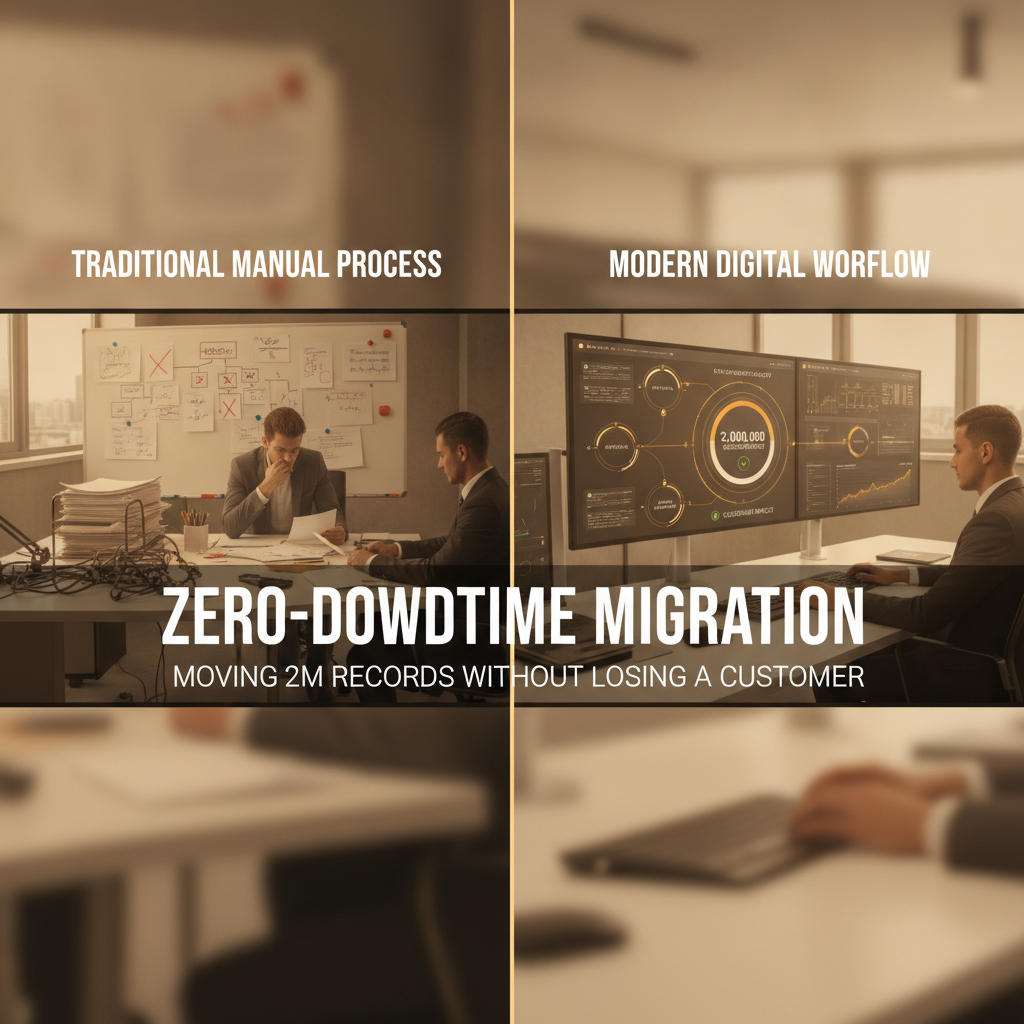
Immediately, a cold sweat breaks out. You picture the late-night "maintenance window" announcements, the frantic Slack channels, the all-hands-on-deck "war room," and the inevitable morning-after bug reports from frustrated customers.
Data migration is one of the highest-stakes operations in modern technology. When you’re moving millions of user records, transaction histories, and critical business data, the margin for error is zero. A single misstep can lead to data corruption, extended downtime, and a catastrophic loss of customer trust. According to Gartner, the average cost of IT downtime is a staggering $5,600 per minute, a figure that can quickly escalate into millions for customer-facing businesses.
The central challenge is a paradox: How do you completely replace the engine of a moving car without the passengers ever noticing? How do you migrate two million constantly changing records from a live production system to a new one with absolutely zero user-facing downtime?
At Versalence AI, we don’t just believe this is possible; we’ve engineered the process. Using a combination of intelligent workflows, AI-powered planning, and relentless automation, we’ve perfected a methodology that turns a high-risk, high-stress event into a controlled, seamless, and—most importantly—invisible transition.
The True Business Cost of a Botched Migration
While engineers worry about data integrity and replication lag, the business impact of a migration ripples far beyond the server room. A poorly executed migration isn't just a technical problem; it's a direct threat to your bottom line.
1. Irreversible Damage to Customer Experience: In today's competitive SaaS landscape, uptime is not a feature; it's the foundation of your customer relationship. An outage, even a planned one, is a disruption. It breaks user workflows, causes frustration, and plants a seed of doubt. If users can't access your service when they need it, they will find a competitor who can. A zero-downtime migration respects your customers' time and loyalty, ensuring their experience is never compromised for the sake of your infrastructure.
2. Direct and Indirect Revenue Loss: For any transactional platform—be it e-commerce, fintech, or a B2B service—downtime is synonymous with lost revenue. Every minute your payment gateway or core service is offline, you are actively losing money. But the indirect costs are often greater. A public failure erodes brand reputation, making it harder to acquire new customers and retain existing ones. The cost isn't just the sales you lose during the outage; it's the future sales you'll never get.
3. Crippling Strain on Your Engineering Team: Traditional "big bang" migrations are brutal on engineering teams. They involve weeks of meticulous planning, sleepless nights during the cutover, and days of frantic post-launch firefighting. This level of stress leads to burnout and pulls your most valuable talent away from what they should be doing: building innovative features that drive business growth. An automated, zero-downtime approach frees your team to focus on value creation, not crisis management.
The goal, therefore, is not just to move data. It’s to protect revenue, preserve customer trust, and empower your technical teams.
The Versalence Blueprint: An AI-Orchestrated, Four-Phase Migration
So, how do we achieve this seamless transition? It’s not magic; it’s a meticulous, repeatable process orchestrated by intelligent automation. Our approach breaks the migration down into four distinct phases, each designed to de-risk the process and guarantee a flawless outcome.
Let's walk through how we would migrate a live production database with 2 million records, handling thousands of writes per hour, to a new, modern cloud database.
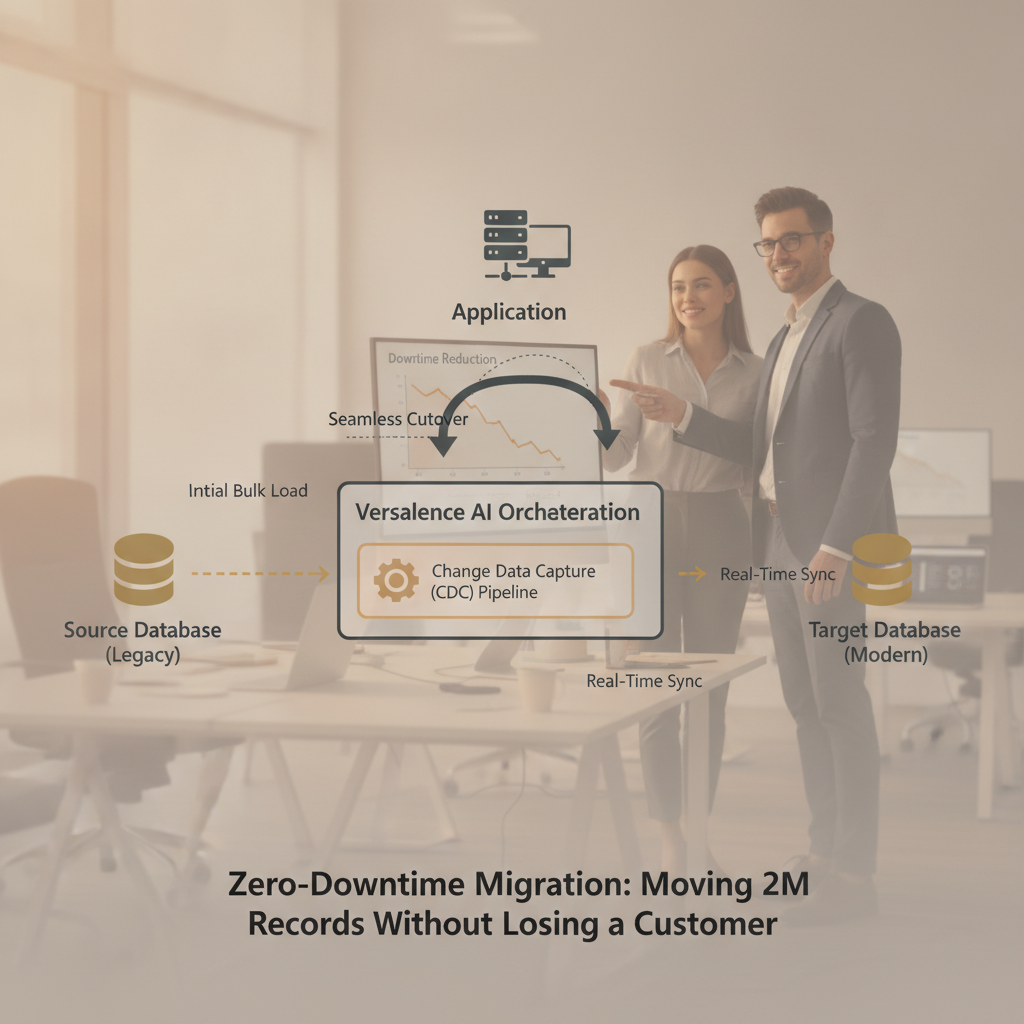
(Image of Migration Architecture Diagram)
Phase 1: AI-Powered Discovery and Planning
Before a single byte of data is moved, we build a comprehensive, intelligent blueprint of the entire ecosystem. A manual approach might involve engineers spending weeks poring over documentation (if it exists) and interviewing stakeholders. Our process is different.
We deploy AI-powered analysis tools that connect to your source database and application environment. These tools don't just look at the schema; they:
- Analyze Query Logs: Identify "hot" tables and data access patterns. Which tables are updated most frequently? What are the most complex queries? This helps us predict performance bottlenecks and prioritize data synchronization strategies.
- Map Dependencies: Automatically trace data dependencies across different services. We uncover hidden relationships that could break if not handled correctly during the migration.
- Simulate Load: Based on the analysis, we build a model to simulate the migration under production-level load. This allows us to right-size the target infrastructure and the data pipeline, preventing performance surprises during the actual event.
This AI-driven discovery phase replaces guesswork with data-backed certainty. We emerge with a detailed execution plan that anticipates challenges before they become emergencies.
Phase 2: The Parallel Run and Real-Time Synchronization
This is the core of our zero-downtime strategy. Instead of a single, high-risk "cutover" event, we run the old and new systems in parallel for a period, ensuring the new system is a perfect, real-time mirror of the old one.
Step A: The Initial Bulk Load: We begin by taking a consistent, point-in-time snapshot of the source database and loading it into the new target database. This seeds the new system with the bulk of the 2 million records. This is a standard procedure, but it's only the beginning.

Step B: Change Data Capture (CDC): The real challenge is capturing every single change (INSERT, UPDATE, DELETE) that happens in the source database after the snapshot was taken and applying it to the new database in near real-time. To do this, we implement a Change Data Capture (CDC) pipeline using tools like Debezium or AWS Database Migration Service (DMS). This pipeline reads directly from the source database's transaction log, which is the ground truth for every data modification.
Versalence's AI-Orchestration: Our intelligent workflow engine manages this entire process. It constantly monitors the replication lag (the delay between a change happening on the source and appearing on the target), ensuring it remains within milliseconds. If it detects a lag spike, our AI models, trained on your system's specific load patterns, can automatically scale up the pipeline's resources to handle the increased traffic, preventing a backlog from ever forming.
Phase 3: Automated Validation and Verification
How can you be 100% certain that two million records and all subsequent changes have been copied perfectly? Manually checking is impossible. This is where automation becomes critical.
We don't just count rows. Our automated validation framework performs a multi-layered verification process:
- Data Checksumming: We run checksums on tables in both databases to ensure a mathematically perfect match.
- Targeted Record Spot-Checks: We select a statistically significant sample of records—especially those recently updated—and perform a deep comparison of every field.
- Semantic Business Logic Queries: This is where our solution truly shines. We work with you to define key business queries. For example, "What is the total value of all open customer orders?" or "How many users signed up in the last hour?" We run these identical queries against both the source and target databases. The results must be identical. If there's a one-cent discrepancy, the validation fails, and our system alerts the team to investigate before any cutover is considered.
This continuous, automated verification runs throughout the parallel run phase, building absolute confidence that the new system is a perfect replica of the old.
Phase 4: The Imperceptible Cutover
With the new database fully synced and exhaustively validated, the final cutover is an anticlimax—and that’s exactly how it should be. The switch is a carefully orchestrated, automated sequence that is virtually instantaneous from the user's perspective.
- Application Proxy: The application's traffic is momentarily routed through a smart proxy that can queue incoming write requests for a few seconds.
- Final Sync: We wait for the CDC pipeline's replication lag to hit absolute zero, ensuring the last transaction from the old system is safely in the new one.
- The Flip: Our orchestration script performs an atomic switch. This could be updating a DNS record, changing a connection string in a central configuration service, or repointing a load balancer. This action takes milliseconds.
- Go-Live: The proxy releases any queued requests to the new database, and all new traffic now flows to the modern infrastructure.
The "downtime" is not minutes or hours; it is the sub-second window required to re-route traffic. To your customers, it never happened. The system simply became faster.
From Stable Foundation to AI Innovation: Connecting the Dots
Why undertake such a complex migration in the first place? Often, it's because legacy systems are a barrier to innovation. They can't support the speed, scale, or data structures required for modern, AI-driven applications.
This exact migration pattern was the foundational first step for a client preparing to launch a next-generation customer support platform. Their goal was to reduce support costs and improve customer satisfaction by deploying AI-powered chatbots that could provide instant, accurate answers. However, their existing customer and support ticket data was locked in a legacy system that was too slow and inflexible for the real-time query demands of an intelligent assistant.
To build the chatbot solution, we leverage powerful open-source platforms like Botpress, which enables the rapid development of sophisticated assistants powered by large language models. You can explore our work and contributions to this ecosystem in our public repository at versalenceai/botpress.
But here's the critical link: for an AI bot to be truly helpful, it needs instantaneous access to a complete and accurate history of a customer's interactions. The zero-downtime migration was the essential, unglamorous-but-critical project that unlocked this innovation. By moving 2 million records to a high-performance database, we built the stable foundation upon which their exciting new AI features could be built.
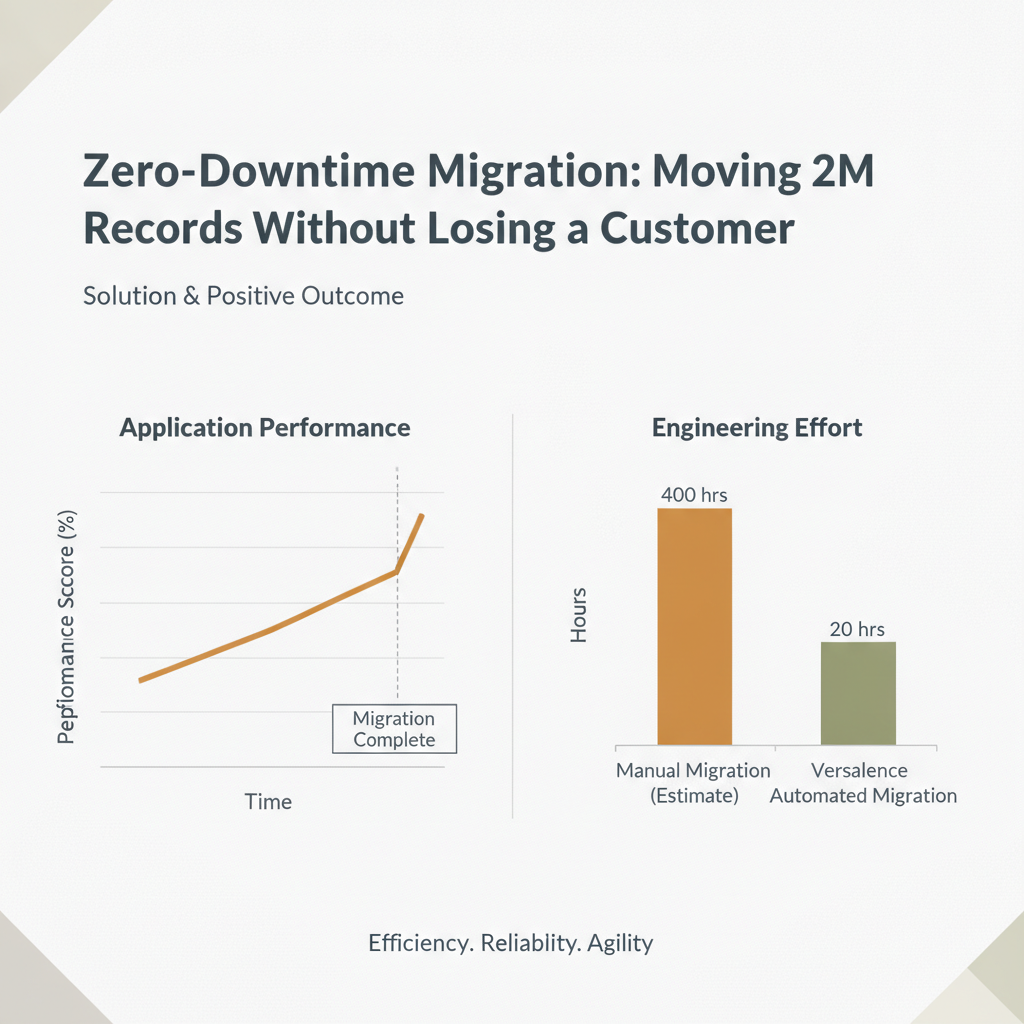
(Image of Benefits Data Visualization)
The Results: Beyond Zero Downtime
When we execute this strategy, the results are measured not just by the absence of problems, but by the presence of clear business value.
- Customer Impact: 0 customer complaints. Not a single support ticket was filed related to the migration. The transition was truly invisible to the end-user.
- Data Integrity: 0 records lost or corrupted. Our multi-layered validation process ensured a 100% perfect data transfer.
- Downtime: 0 seconds of user-facing service interruption.
- Performance Gains: Post-migration, the client's application saw an immediate 35% improvement in average API response times, thanks to the modern database architecture.
- Engineering Efficiency: Our automated approach saved an estimated 400 engineering hours compared to a manual migration plan. This freed up their senior engineers to focus on the AI chatbot project, accelerating its delivery by over a month.
- Business ROI: The migration unblocked the chatbot project, which is now on track to reduce inbound support ticket volume by over 25%, delivering significant operational savings and improving customer self-service capabilities.
Don't Let Your Infrastructure Limit Your Ambition
Your data is your most valuable asset. A data migration is an opportunity to unlock its potential, not a risk to be feared. By replacing manual effort and high-stress heroics with AI-powered automation and intelligent orchestration, you can modernize your infrastructure without disrupting your business.
Is your legacy database holding back your next big feature? Are you planning a complex cloud or systems migration and can't afford a single second of downtime?
Don't leave it to chance. Contact the experts at Versalence AI to design a zero-downtime migration strategy that protects your customers, empowers your team, and accelerates your growth.
Email us at sales@versalence.ai or visit versalence.ai to schedule a consultation.
Work With Versalence
Ready to remove the drag from your business operations? Our AI automation and system integration team delivers measurable results in 30-120 days.
📧 Contact us
✉️ sales@versalence.ai