
AI Pilot to Production: 5 Readiness Questions to Ask Before Scaling
The AI Pilot Purgatory: Why Most AI Projects Never See the Light of Day
The excitement is palpable. Your team has just wrapped up a successful AI pilot. A new chatbot, a predictive analytics model, or an automated workflow has demonstrated incredible potential in a controlled environment. The demo was flawless, the stakeholders are impressed, and the promise of transformation feels within reach.
Then, reality hits.
The leap from a contained pilot to a full-scale, production-level system is not a step—it's a chasm. According to industry analysis from sources like Gartner, as many as 85% of AI projects fail to move past the experimental stage, never delivering their intended business value. They get stuck in "pilot purgatory," a frustrating cycle of endless testing and tweaking, burning through budgets and enthusiasm without ever impacting the bottom line.
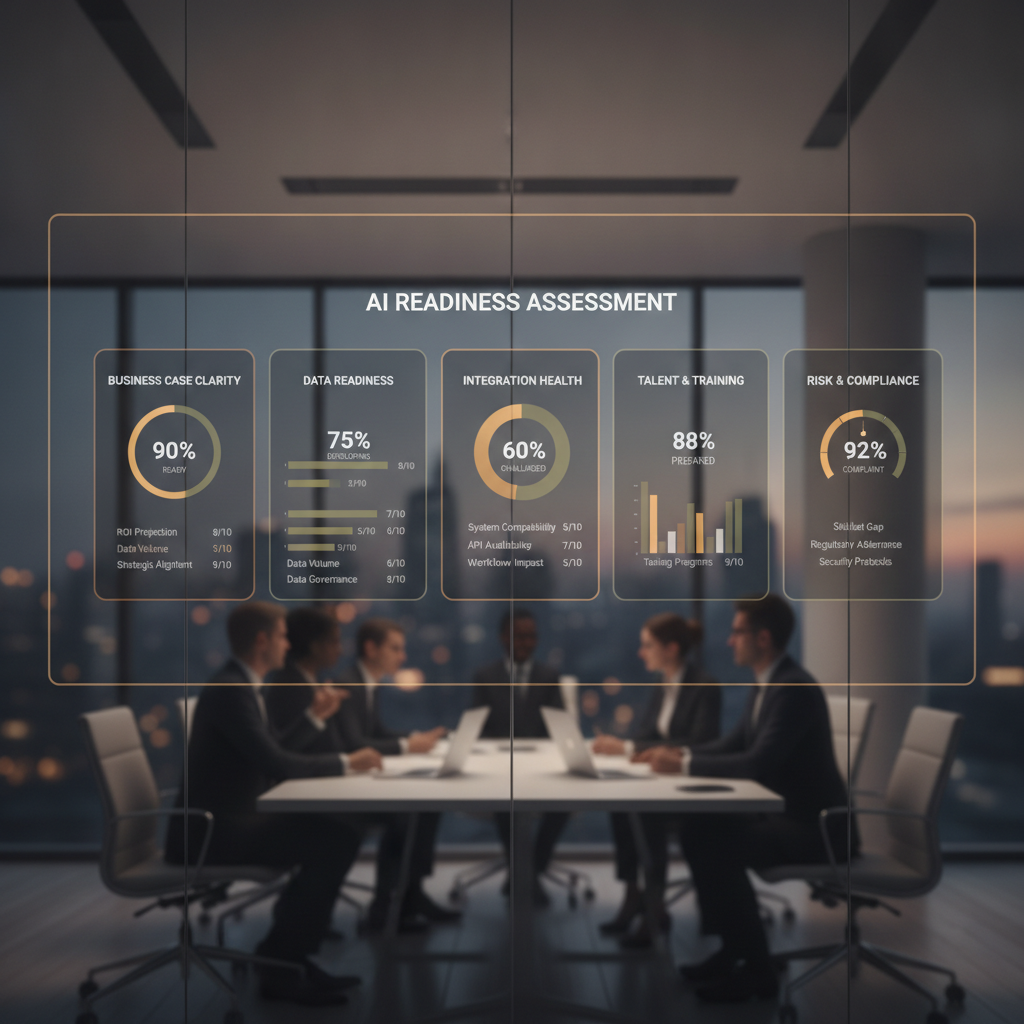
Why is this gap so difficult to cross? Because the skills, infrastructure, and strategies that make a pilot successful are fundamentally different from what's required to run a mission-critical AI system in the real world. A pilot is a proof of concept; production is a promise of performance, reliability, and scale.
At Versalence AI, we specialize in helping businesses navigate this chasm. We've seen firsthand what separates the triumphant successes from the costly failures. It comes down to asking the right questions before you attempt to scale. This AI readiness assessment is the foundation for a successful deployment. Here are the five critical questions that determine if your AI initiative is truly ready for production.
The Business Impact: The High Cost of Unreadiness
Failing to properly assess your AI readiness isn't just a technical misstep; it's a significant business risk. The consequences ripple across the organization:
- Sunk Costs: The resources invested in the pilot—developer hours, data science expertise, cloud computing credits, and management oversight—are effectively lost if the project never scales. This isn't just money down the drain; it's an opportunity cost that could have been invested elsewhere.
- Eroded Confidence: When a high-profile AI project stalls, it creates skepticism. Leadership becomes hesitant to fund future innovation, and talented team members may grow frustrated and disengaged. A single high-profile failure can set a company's AI ambitions back by years.
- Technical Debt: Rushing an ill-prepared pilot into production creates a mountain of technical debt. The "duct tape and string" solution that worked for a demo will break under real-world load, leading to frantic, expensive fixes, system downtime, and a poor user experience.
- Competitive Disadvantage: While your AI project is stuck in purgatory, your competitors are successfully deploying their own. They are the ones capturing the efficiency gains, enhancing customer experiences, and using data-driven insights to pull ahead in the market.
Conversely, a successful transition from pilot to production unlocks transformative value. It automates repetitive tasks, freeing your best people to focus on high-value work. It provides a level of personalization and responsiveness that delights customers and builds loyalty. It uncovers insights from your data that drive smarter, faster business decisions. The goal isn't just to launch AI; it's to build a scalable, reliable engine for continuous improvement and competitive advantage.
The 5 Questions That Separate Pilot from Production
To bridge the gap, your organization needs a framework for self-assessment. These five questions are the pillars of the AI readiness strategy we implement with our clients.
1. Do You Have a Clear, Measurable Business Problem? (Strategy & Scope)
In the pilot phase, the goal is often simply to "prove AI can work." The success metric might be a technical one, like model accuracy or chatbot response correctness. This is insufficient for production.
A production-ready AI system must be tied to a specific, quantifiable business outcome. The question isn't "Can we build a chatbot?" but rather, "How can an intelligent assistant reduce our average customer support handling time by 30% and deflect 50% of Tier-1 inquiries within six months?"
Pilot Mentality: "Let's build a bot to answer FAQs." Production Mentality: "Let's deploy an intelligent workflow that resolves the top 10 customer issues from end-to-end, measured by a decrease in support tickets and an increase in Customer Satisfaction (CSAT) scores."
How Versalence Helps: We work with stakeholders from across your business—operations, sales, finance, and IT—to define a razor-sharp business case. We move beyond vague goals to establish concrete Key Performance Indicators (KPIs) that will be used to measure success long after launch. This clarity of purpose dictates the entire project's architecture, feature set, and integration priorities, ensuring that the final solution delivers tangible ROI.
2. Is Your Data Production-Ready? (Data & Infrastructure)
A pilot can often run on a clean, manually curated dataset—a perfect CSV file or a small, well-structured knowledge base. This is the AI equivalent of a test drive on a closed track. Production is the unpredictable, chaotic reality of rush-hour traffic.
Production AI requires a robust, automated, and governed data pipeline. You must consider:
- Accessibility & Volume: Can your system access data from multiple sources (databases, APIs, document repositories) in real-time? Can it handle the volume and velocity of data that your business generates every day?
- Quality & Cleansing: Real-world data is messy. It has missing fields, incorrect formats, and duplicates. Do you have automated processes to clean, validate, and transform this data before it feeds into your AI models?
- Security & Governance: How will you manage data privacy (like PII), access controls, and compliance with regulations like GDPR and CCPA? A production system requires enterprise-grade security, not an ad-hoc approach.
How Versalence Helps: We design and implement scalable data architectures. This involves setting up data lakes or warehouses, building ETL (Extract, Transform, Load) pipelines, and establishing data governance frameworks. We ensure your AI system has a continuous, reliable supply of high-quality data, which is the lifeblood of any intelligent application.
3. How Will This AI Integrate with Your Existing Systems? (Technology & Integration)

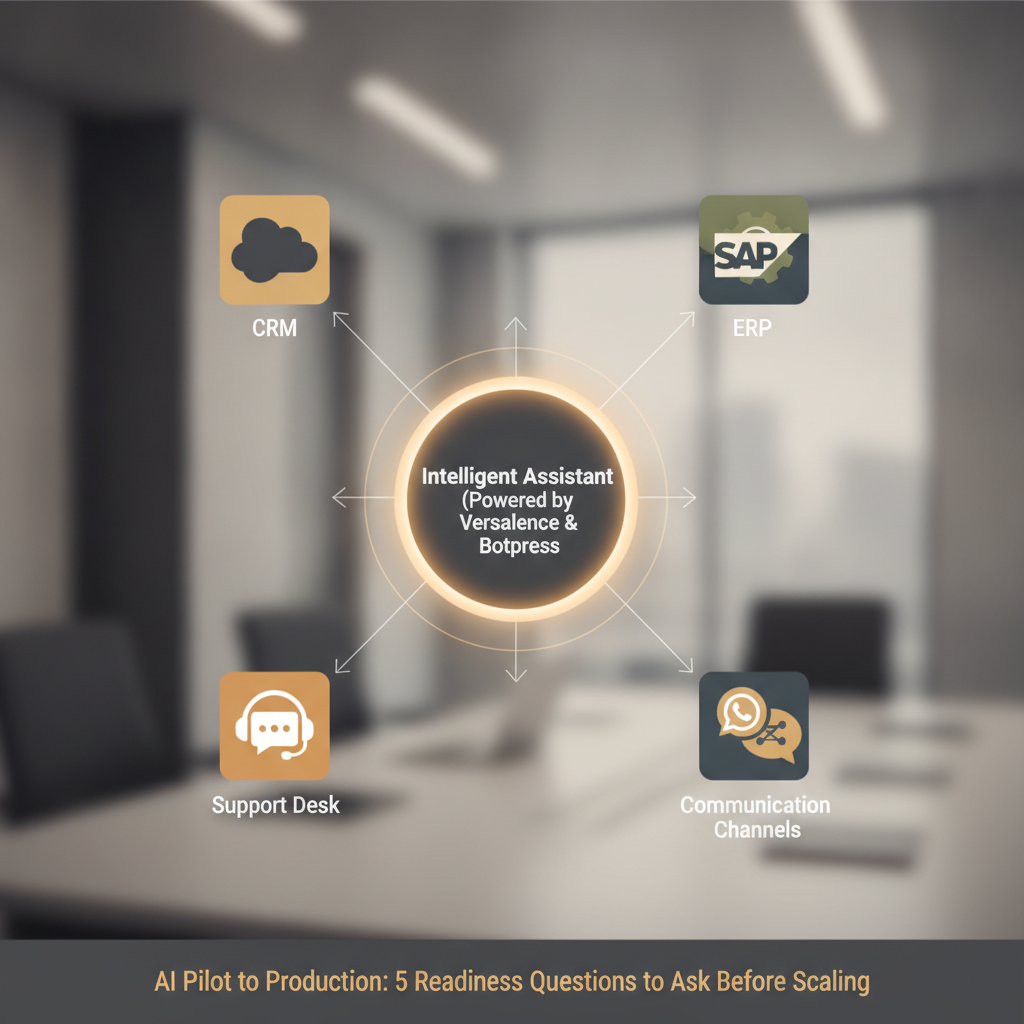
A pilot chatbot that lives in a small widget on your website is an island. A production-grade intelligent assistant is a central hub connected to your entire business ecosystem. To be truly useful, it can't just provide information; it must perform actions.
This means deep, two-way integrations with your core systems:
- CRM (e.g., Salesforce, HubSpot): To look up customer history, create new leads, or update contact information.
- ERP (e.g., SAP, NetSuite): To check inventory levels, track order statuses, or process invoices.
- Support Desks (e.g., Zendesk, ServiceNow): To create, update, and escalate support tickets seamlessly.
- Communication Channels (e.g., WhatsApp, Slack, Teams): To meet your customers and employees where they already are.
How Versalence Helps: This is where our expertise in building intelligent workflows shines. We leverage powerful, extensible platforms like Botpress to create AI solutions that are deeply woven into your operational fabric. As seen in our contributions and work with the versalenceai/botpress repository, we don't just build chatbots; we build intelligent automation engines.
Using the Botpress SDK and its extensive integration hub, we connect your AI assistant to the APIs of your critical business applications. A customer asking "Where is my order?" doesn't get a generic link to a tracking page. They get a real-time status update pulled directly from your ERP, with the option to initiate a return or speak to a human agent, all within the same conversation. This transforms a simple Q&A bot into a powerful, action-oriented workflow that resolves issues, drives sales, and improves efficiency.
4. Do You Have the Right People and Processes? (People & Governance)
Technology is only half the equation. A production AI system requires a fundamental shift in your team's skills and operational processes. The "set it and forget it" approach is a recipe for disaster.
Key considerations include:
- Ownership: Who is ultimately responsible for the AI system's performance, maintenance, and ethical oversight? Is it IT, a specific business unit, or a cross-functional "AI Center of Excellence"?
- Monitoring & Maintenance (LLMOps/MLOps): How will you monitor the AI's performance in real-time? What is the process for identifying performance degradation, model drift, or emerging issues like AI "hallucinations"?
- Human-in-the-Loop: No AI is perfect. What is your workflow for escalating complex or sensitive cases to a human expert? How do you capture the learnings from these escalations to continuously improve the AI?
- Change Management: How will you train your employees to work alongside the new AI system? How will you communicate the changes to your customers to ensure high adoption and a positive experience?
How Versalence Helps: We help you build the human infrastructure around your AI. This includes designing governance models, establishing monitoring dashboards with clear KPIs, and creating human-in-the-loop workflows. We help define roles and responsibilities and provide the training and documentation needed to ensure your team can confidently manage and scale the AI solution long-term.
5. How Will You Measure Success and Scale Responsibly? (Scalability & ROI)
The metrics that define success for a pilot are often narrow. For production, you need a holistic view of performance and a clear roadmap for the future.
This involves:
- Defining Production KPIs: Move beyond technical accuracy. Measure business impact: Cost Per Resolution, Customer Effort Score (CES), lead conversion rates, employee time saved, and overall ROI.
- Scalable Infrastructure: Can your architecture handle 10x or 100x the traffic of the pilot without collapsing? This requires planning for load balancing, auto-scaling, and geographic redundancy.
- Continuous Improvement Loop: A production AI is not a static product; it's a living system. What is your process for gathering user feedback, analyzing conversation logs, and identifying new use cases or features to add to the roadmap?
- Ethical Guardrails: As you scale, the potential for unintended consequences grows. Do you have clear guardrails in place to ensure fairness, transparency, and accountability in your AI's decisions?
How Versalence Helps: We build solutions designed for scale from day one. We implement robust analytics and reporting to track the KPIs that matter to your business, providing a clear view of your return on investment. We also help you build a long-term AI roadmap, identifying adjacent opportunities for automation and intelligence, ensuring that your initial investment becomes a platform for ongoing innovation.
Related Solutions We've Built
Our approach to building production-ready AI extends beyond a single use case. Using platforms like Botpress as a foundation, we've delivered a range of intelligent automation solutions for enterprises:
- Internal HR & IT Helpdesks: Intelligent assistants that integrate with Active Directory, ServiceNow, and internal knowledge bases to automate employee onboarding, password resets, and policy questions, freeing up IT and HR staff for strategic work.
- Proactive Sales & Lead Qualification: AI agents that engage website visitors, qualify leads against criteria in your CRM, book meetings directly on sales reps' calendars, and provide a seamless handoff with full conversational context.
- Advanced Customer Service Automation: Beyond simple FAQs, we build agents that handle complex, multi-turn conversations for tasks like processing returns, modifying subscriptions, and troubleshooting products by integrating with backend order management and logistics systems.
Each of these solutions began with the same rigorous readiness assessment, ensuring they were built on a solid foundation of clear business goals, clean data, robust integrations, and strong governance.
Results & ROI: From Cost Center to Value Creator
When you successfully navigate the journey from pilot to production, the results are dramatic. While outcomes vary by industry and use case, our clients typically see a powerful return on their investment:
- Operational Efficiency: Automating Tier-1 and repetitive inquiries often leads to a 40-60% reduction in ticket volume for customer support and internal helpdesks.
- Cost Reduction: By deflecting common requests, organizations can reduce customer service operational costs by up to 30%, allowing them to reallocate agent time to revenue-generating or complex, high-empathy interactions.
- Improved Customer Experience: Providing 24/7, instant responses to common questions significantly improves CSAT scores. We typically see a 15-25% increase in customer satisfaction metrics post-deployment.
- Accelerated Resolution Times: AI-powered workflows that integrate with backend systems can resolve issues in seconds that would take a human agent minutes to handle, drastically reducing the Average Handling Time (AHT).
Your Next Step: From Pilot to Profit
The journey from an exciting AI pilot to a value-generating production system is challenging, but it is not a mystery. It requires a disciplined, holistic approach that addresses strategy, data, technology, people, and scalability. By asking these five critical questions, you can illuminate the path forward and avoid the common pitfalls that leave so many promising projects stranded.
If you're ready to move your AI initiative out of the lab and into the heart of your business operations, we can help.
Contact Versalence AI today for a complimentary AI Readiness Assessment. Let's build a solution that delivers real results.
Email us at sales@versalence.ai or visit us at versalence.ai to get started.
Work With Versalence
Ready to remove the drag from your business operations? Our AI automation and system integration team delivers measurable results in 30-120 days.
📧 Contact us
✉️ sales@versalence.ai