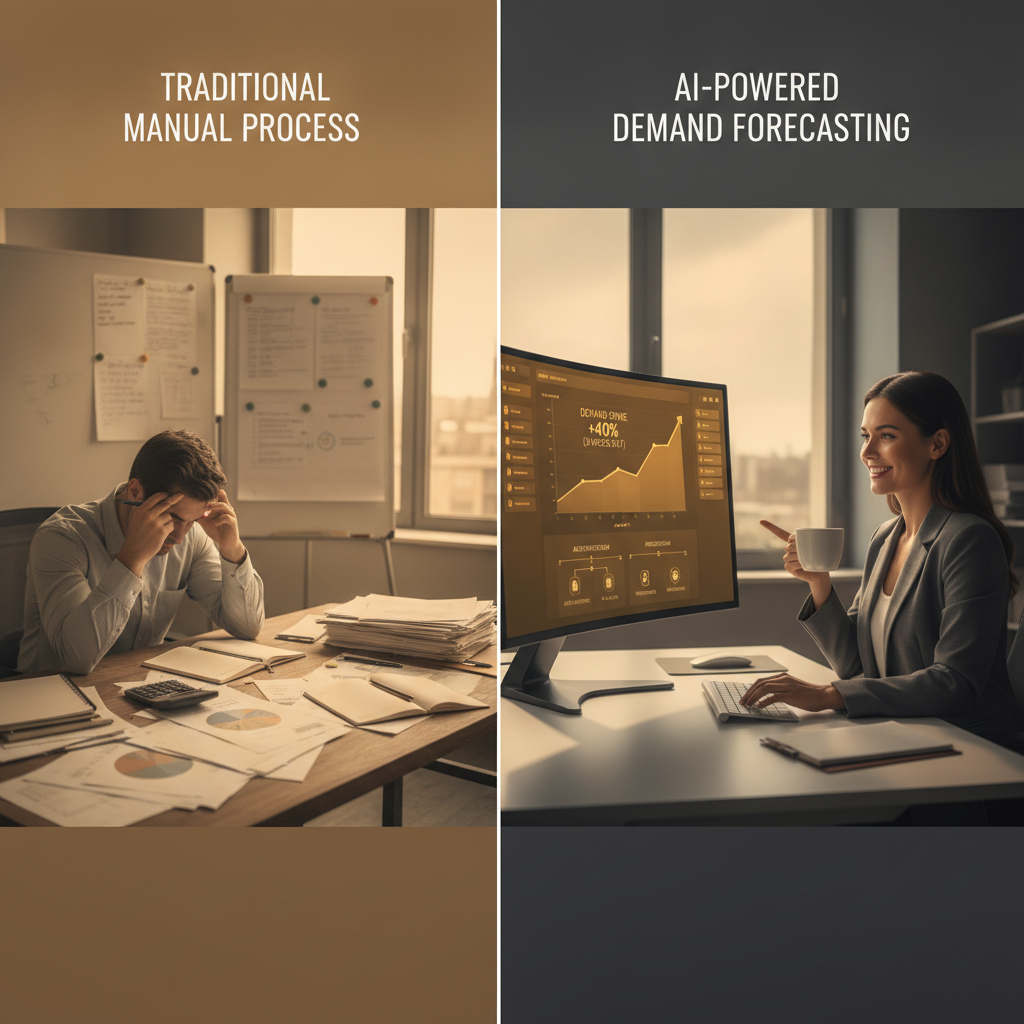
Demand Forecasting: How AI Predicted a 40% Demand Spike 3 Weeks Out
It’s a scenario that keeps supply chain managers and e-commerce leaders awake at night. You’re tracking sales for a key product, and everything looks stable. Your traditional forecasting models, based on historical sales data, predict a modest seasonal uptick. Then, seemingly out of nowhere, demand explodes. Your website is flooded with orders, your inventory evaporates in days, and your fulfillment centers are thrown into chaos. The result? Stockouts, angry customers, and a massive amount of revenue left on the table.
This isn’t a rare occurrence. In fact, according to a 2022 IHL Group study, retailers worldwide lose over $1 trillion annually due to out-of-stocks. The core of the problem lies in an over-reliance on forecasting methods that are fundamentally reactive. They look at what has happened to predict what will happen, failing to account for the complex, fast-moving variables of the modern market.

But what if you could see the spike coming? What if you had a system that alerted you three weeks in advance, predicting a 40% surge in demand with startling accuracy? This isn't science fiction; it's the power of AI-driven demand forecasting, an intelligent workflow that transforms supply chain management from a reactive guessing game into a proactive, data-driven strategy. At Versalence AI, we build these systems, and the impact is transformative.
The Crippling Business Impact of Inaccurate Forecasting
Before we dive into how AI achieves this, it’s crucial to understand the full scope of the problem. A single inaccurate forecast doesn’t just lead to a stockout; it triggers a cascade of costly failures across the entire business.
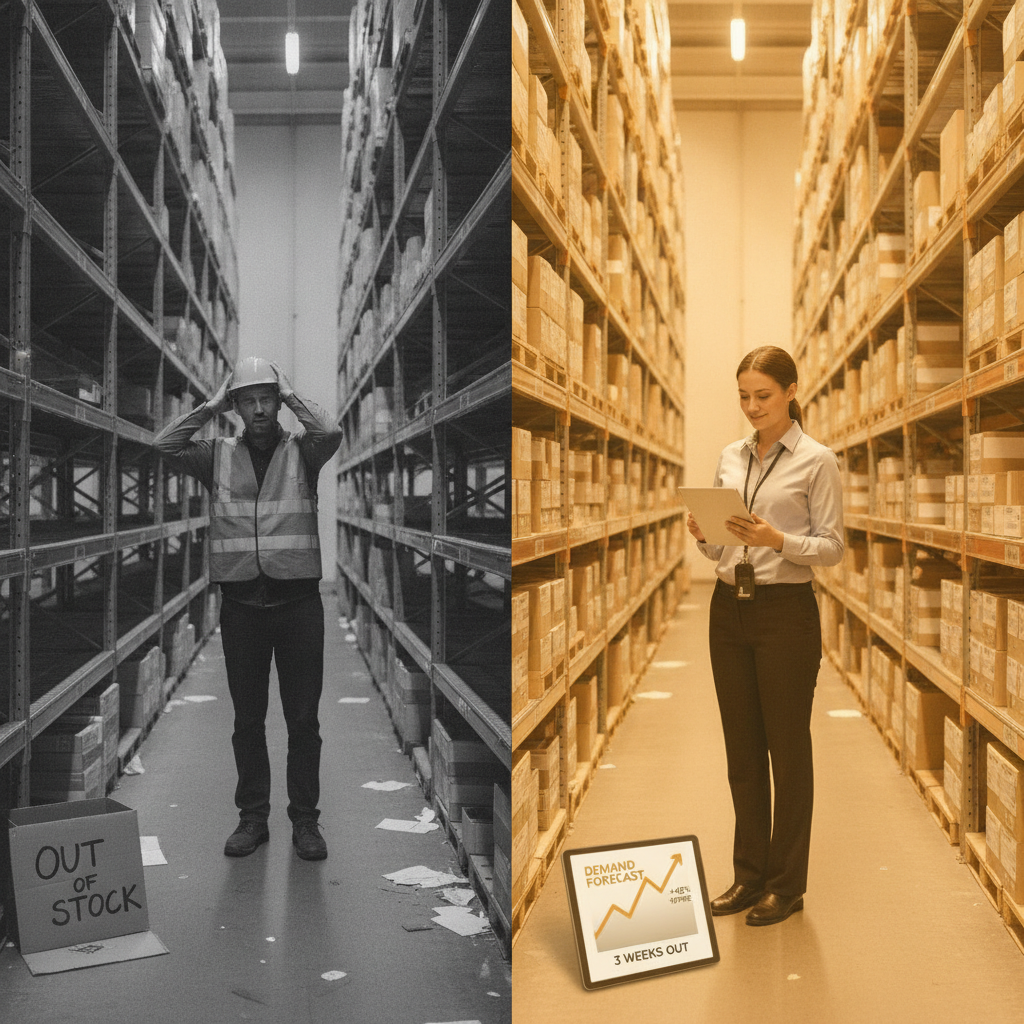
1. Lost Revenue and Market Share: This is the most obvious and immediate consequence. When a customer wants your product and it’s unavailable, they don’t just wait. More often than not, they go to a competitor. A study by the Harvard Business Review found that between 21% and 43% of customers will go to another store to buy a similar item when faced with a stockout. You haven't just lost a single sale; you've potentially lost a customer for life.
2. Inflated Operational Costs: The opposite problem—overstocking—is just as damaging. Guessing high on your forecast leads to warehouses filled with unsold goods. This ties up capital that could be invested elsewhere and incurs significant carrying costs, including storage, insurance, and labor. Eventually, this excess inventory is often sold at a steep discount or written off entirely, crushing profit margins. In a desperate attempt to correct a stockout, businesses resort to expensive expedited shipping and overtime labor, further eroding profitability.
3. Damaged Brand Reputation: In the age of social media and instant reviews, a poor customer experience travels fast. Consistent stockouts lead to public frustration, negative reviews, and a perception of unreliability. Customers who experience fulfillment delays or find their desired items constantly unavailable lose trust in your brand. This long-term reputational damage can be far more costly than the immediate lost sales.
4. Inefficient Marketing Spend: Your marketing team works hard to create campaigns that drive demand. But if their efforts send a flood of customers to a product page that says "Out of Stock," that marketing budget is effectively wasted. Without an accurate forecast, there's a fundamental disconnect between marketing initiatives and supply chain reality, leading to squandered resources and missed opportunities.
Traditional methods, whether they're simple moving averages or more complex statistical models like ARIMA, are inherently limited. They operate within a closed loop, primarily analyzing past sales data. They are blind to the external signals and real-time market shifts that are the true drivers of modern consumer demand.
How Versalence AI Predicts the Future: A Real-World Scenario
Let's walk through a concrete, realistic example of how an AI-powered system can foresee a demand surge that traditional models would miss entirely.
The Product: A mid-range, portable power station designed for outdoor activities and emergency backup. The Timeframe: Early Spring. Traditional Forecast: Based on the last three years of sales, the model predicts a standard 10-15% seasonal increase as people begin planning spring and summer camping trips.
The Versalence AI forecasting engine, however, is designed to look beyond internal sales history. It functions as an intelligent hub, ingesting and analyzing dozens of disparate data sources in real-time.
Step 1: Ingesting External, Unstructured Data
Our system continuously pulls data from a wide array of sources that influence consumer behavior:
- Weather APIs: The model ingests long-range weather forecasts from multiple meteorological services. It detects a high probability of an unusually early and warm spring across several key sales regions.
- Social Media Sentiment: Using Natural Language Processing (NLP), the system scans platforms like Reddit, Instagram, and specialized outdoor forums. It identifies a significant uptick in conversations around "off-grid living," "van life," and "sustainable travel," with our client's brand and product category being mentioned with increasing positive sentiment.
- Search Trend Analysis: The AI monitors Google Trends and other search analytics for keywords like "portable solar generator," "best power station for camping," and "emergency home backup." It flags a 60% week-over-week increase in search volume for these terms, far exceeding typical seasonal patterns.
- Economic & News Data: The system analyzes news articles and economic reports, noting rising energy prices and news coverage of potential grid instability in certain regions, which often correlates with an interest in backup power solutions.
- Competitor Analytics: By monitoring competitor websites and retail channels, the AI notes that two major competing products are experiencing low stock levels or are on backorder.
Step 2: The AI Synthesis & Anomaly Detection
This is where the magic happens. A human analyst would be overwhelmed trying to connect these disparate dots. The AI, however, excels at it. We employ an ensemble of machine learning models:
- Time-Series Models (like Prophet): These form the baseline, analyzing the historical sales data for seasonality and trends.
- Gradient Boosting Machines (like XGBoost or LightGBM): This is the powerhouse. It takes the baseline forecast and layers on all the external variables—weather data, search trends, social sentiment scores, competitor stock levels—treating them as features. It learns the complex, non-linear relationships between these factors and actual sales outcomes.
- Clustering Algorithms: These can identify emerging customer segments or geographic hotspots where demand is likely to concentrate.

The system doesn't just see individual signals; it understands their combined impact. It recognizes that the convergence of an early warm season (driving outdoor activity), rising energy cost concerns (driving backup power interest), and limited competitor availability creates a perfect storm for a demand surge.
Step 3: The Intelligent Workflow Trigger
Three weeks before the projected surge, the system flags a high-confidence anomaly. The output isn't a static, 200-page report. It's a series of automated, actionable alerts:
- Supply Chain Alert: A high-priority notification is sent via Slack and email to the supply chain manager. It includes a dashboard visualizing the prediction: "High-confidence forecast: 40% demand increase for SKU #PS-500, peaking in Week 3. Key drivers: Weather (45%), Search Trends (30%), Competitor Stock (25%)." The system automatically generates a draft purchase order in the ERP for the required additional inventory, awaiting a single click for approval.
- Marketing Alert: The marketing team receives a notification with insights into the drivers. They now know why demand is surging and can tailor their campaigns accordingly, focusing on "early spring adventures" and "energy independence" messaging in the specific regions identified by the AI.
- Customer Support Alert: An alert is sent to the customer service platform, signaling a probable 40-50% increase in inquiry volume. This allows the support team to adjust staffing or, even better, prepare their automated support systems for the spike.
By acting on this three-week lead time, the business orders the necessary stock (avoiding massive expediting fees), adjusts its marketing to capture the new wave of interest, and prepares its support infrastructure. The 40% demand spike arrives, but this time, it’s not a crisis. It's an opportunity, fully captured.
Our Related Solutions: From Forecasting to Fulfillment
A prediction is only as good as the actions it enables. At Versalence, we believe in building holistic, interconnected AI solutions. Predicting a demand spike is the first step; handling it gracefully is the next. This is where our expertise with platforms like Botpress comes into play.
Our work with the versalenceai/botpress repository is a testament to this philosophy. Botpress is a leading platform for building next-generation, AI-powered chatbots and assistants. We leverage it to create intelligent customer support automation that integrates directly with our forecasting and inventory systems.
Imagine the scenario above. Our demand forecast predicts the 40% sales surge. The intelligent workflow doesn't just alert the supply chain team; it also communicates with a Versalence-built Botpress assistant.
- Proactive Knowledge Base Updates: The chatbot's knowledge base is automatically updated with information about the popular product, including real-time shipping estimates based on the newly ordered inventory.
- Scaling to Handle Volume: When the surge hits, customers inevitably have questions: "Where is my order?" (WISMO), "What are the specs on the PS-500?", "Is it back in stock yet?". The Botpress assistant can handle 80% of these routine inquiries instantly, 24/7.
- Intelligent Triage: For the 20% of queries that are more complex, the bot intelligently routes the customer to the right human agent, complete with the full conversation history.
This integration of demand forecasting with customer service automation prevents the support team from being overwhelmed. It ensures that even during a period of massive growth, the customer experience remains smooth and professional. The AI workflow anticipates not just the demand for the product, but the demand for information and support that follows.
Results & ROI: The Tangible Value of AI Forecasting
Migrating from traditional forecasting to an AI-driven intelligent workflow isn't just a technological upgrade; it's a fundamental business transformation with a clear and compelling return on investment. While outcomes vary based on industry and scale, our clients typically experience:
- 15-30% Reduction in Lost Sales from Stockouts: By seeing demand spikes in advance, businesses can ensure product availability, capturing revenue that would have otherwise gone to competitors. In the 40% spike scenario, this translates directly to capturing the full value of that surge.
- 20-50% Reduction in Inventory Carrying Costs: More accurate forecasting means less overstocking and less capital tied up in dormant inventory. The AI’s precision allows for a leaner, just-in-time approach without the risk of stockouts.
- Up to 95% Forecast Accuracy: While 100% accuracy is impossible, our AI models consistently achieve accuracy levels in the 90-95% range for key products, a dramatic improvement over the 60-75% common with traditional methods.
- Improved Operational Efficiency: Automating alerts and generating draft purchase orders saves hundreds of hours for the supply chain team, allowing them to focus on strategic supplier relationships and logistics rather than manual data analysis.
- Enhanced Customer Lifetime Value: A consistently positive experience—where products are in stock and support is readily available—builds brand loyalty and trust, leading to repeat business and higher customer lifetime value.
The initial investment in building a custom AI forecasting engine is often recouped within the first two to three major sales cycles through a combination of increased sales, reduced costs, and improved efficiency.
Are You Ready to Stop Guessing and Start Predicting?
The market is too volatile, and the competition is too fierce to rely on tools that only look in the rearview mirror. The ability to accurately anticipate customer demand is no longer a luxury; it’s a critical capability for survival and growth.
At Versalence AI, we don't just provide software; we build custom, end-to-end intelligent workflows that integrate with your existing systems (ERP, CRM, e-commerce platforms) and are tailored to the unique variables that drive your business. From ingesting and processing your data to deploying machine learning models and automating the resulting actions, we manage the entire lifecycle.
If you're tired of being caught off guard by market shifts and want to transform your supply chain into a proactive, resilient, and highly profitable engine for growth, it's time to talk.
Contact us today for a free consultation and let's discuss how AI can give you a clear view of the future.
Email our team at sales@versalence.ai or visit us at versalence.ai.
Work With Versalence
Ready to remove the drag from your business operations? Our AI automation and system integration team delivers measurable results in 30-120 days.
📧 Contact us
✉️ sales@versalence.ai