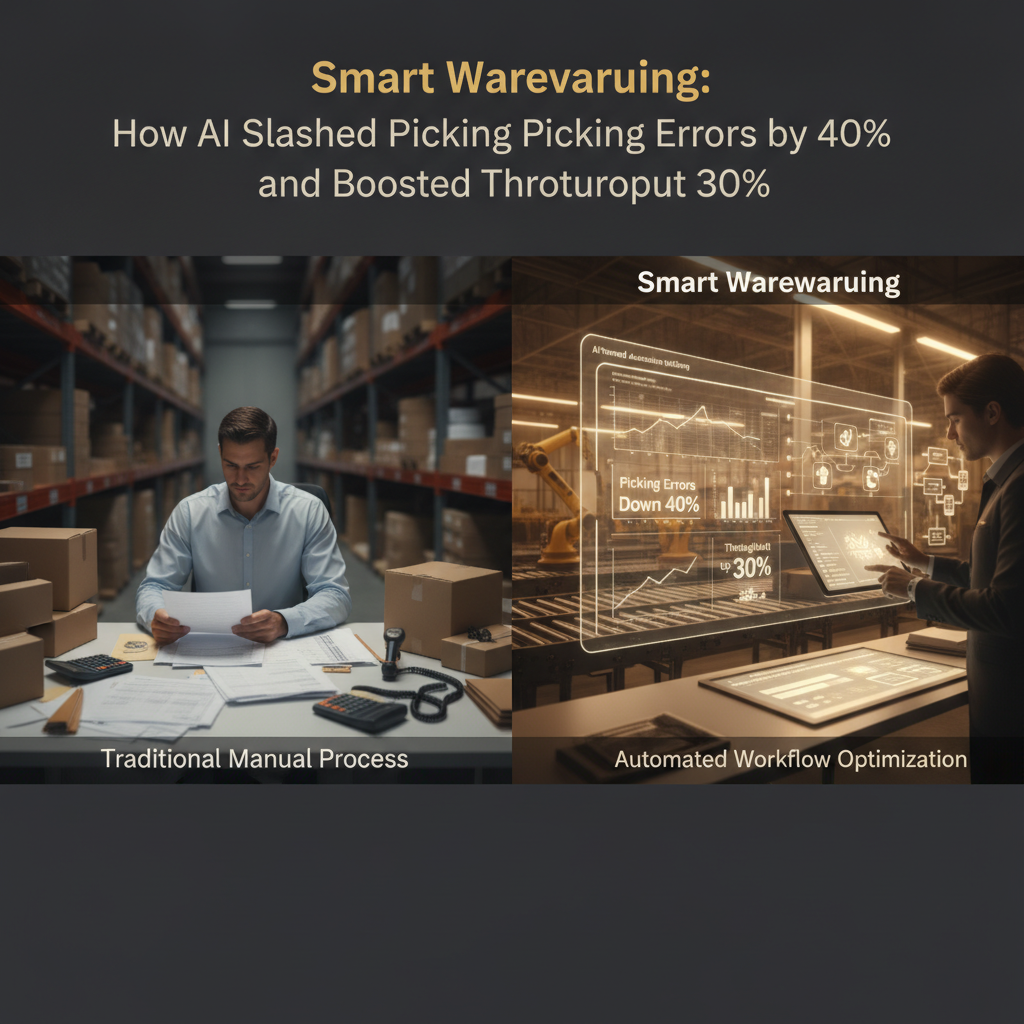
Smart Warehousing: How AI Slashed Picking Errors by 40% and Boosted Throughput 30%
In the relentless pace of modern commerce, the warehouse is no longer a simple storage space—it's the heart of the customer experience. Every minute and every movement counts. But this high-stakes environment is plagued by a persistent and costly problem: human error. A single misplaced item or an incorrect quantity might seem small, but these errors create a cascade of negative consequences. According to research from the Georgia Institute of Technology, mis-picks can cost a typical distribution center between $500,000 and $1,000,000 annually. When you factor in the cost of returns, lost customer loyalty, and operational slowdowns, the true figure is often much higher.
For businesses scaling their operations, the challenge is immense. How do you increase order fulfillment speed without sacrificing accuracy? How do you empower your workforce to be more efficient without causing burnout? Traditional Warehouse Management Systems (WMS) provide a digital ledger of inventory, but they often fall short in guiding the real-time, dynamic decisions happening on the warehouse floor. This is where the status quo breaks down, and where AI-powered intelligent workflows become a game-changer.
At Versalence AI, we've seen this struggle firsthand. Companies are grappling with inefficient picking paths, high error rates from look-alike products, and long training times for new employees. They need more than just data; they need intelligence. This article breaks down how a strategic application of AI can directly address these challenges, resulting in a 40% reduction in picking errors and a 30% boost in overall throughput.
The Escalating Business Impact of Warehouse Inefficiency
The cost of a picking error extends far beyond the warehouse walls. It's a financial and reputational drain that impacts the entire business ecosystem. Understanding these cascading effects reveals why solving this problem is not just an operational goal, but a strategic imperative.
1. The Financial Drain of Reverse Logistics: When a customer receives the wrong item, the process to fix it is exponentially more expensive than getting it right the first time. This "reverse logistics" chain involves customer service interactions, return shipping labels, processing the returned item, restocking it (if it's not damaged), and then picking, packing, and shipping the correct item. Each step incurs costs in labor, shipping, and materials. For low-margin products, a single error can completely wipe out the profit from that sale and several others.
2. Eroding Customer Trust and Loyalty: In the age of Amazon Prime, customer expectations are sky-high. An incorrect order isn't just an inconvenience; it's a breach of trust. A 2022 survey by Wunderman Thompson found that 56% of global consumers would stop buying from a brand after just one bad experience. A picking error can lead to negative reviews, public complaints on social media, and customer churn. The lifetime value of that lost customer often dwarfs the cost of the initial mis-picked item.
3. The Phantom Inventory Problem: Picking errors corrupt your most valuable asset: your inventory data. If a picker takes item B but the system records that item A was picked, your WMS now contains "phantom inventory." It believes item A is gone and item B is still on the shelf. This leads to stockouts on items you thought you had, forcing canceled orders and frustrating customers. It also leads to carrying excess stock of items you don't actually have, tying up capital and valuable warehouse space. Reconciling this data requires costly, time-consuming cycle counts that halt operations.
4. Operational Drag and Reduced Throughput: Every error creates friction. Time spent by pickers double-checking, supervisors investigating discrepancies, and packers correcting orders is time not spent fulfilling new orders. This operational drag slows down the entire fulfillment process, reducing the total number of orders that can be shipped per day (throughput). In a competitive market where same-day or next-day shipping is becoming the norm, this inefficiency can be a significant competitive disadvantage.
These challenges are not solved by simply asking workers to "be more careful." The root cause is cognitive overload and inefficient processes. The solution lies in equipping them with intelligent tools that reduce that cognitive load and optimize their actions in real-time.
How Versalence Delivers an AI-Powered Warehouse Assistant
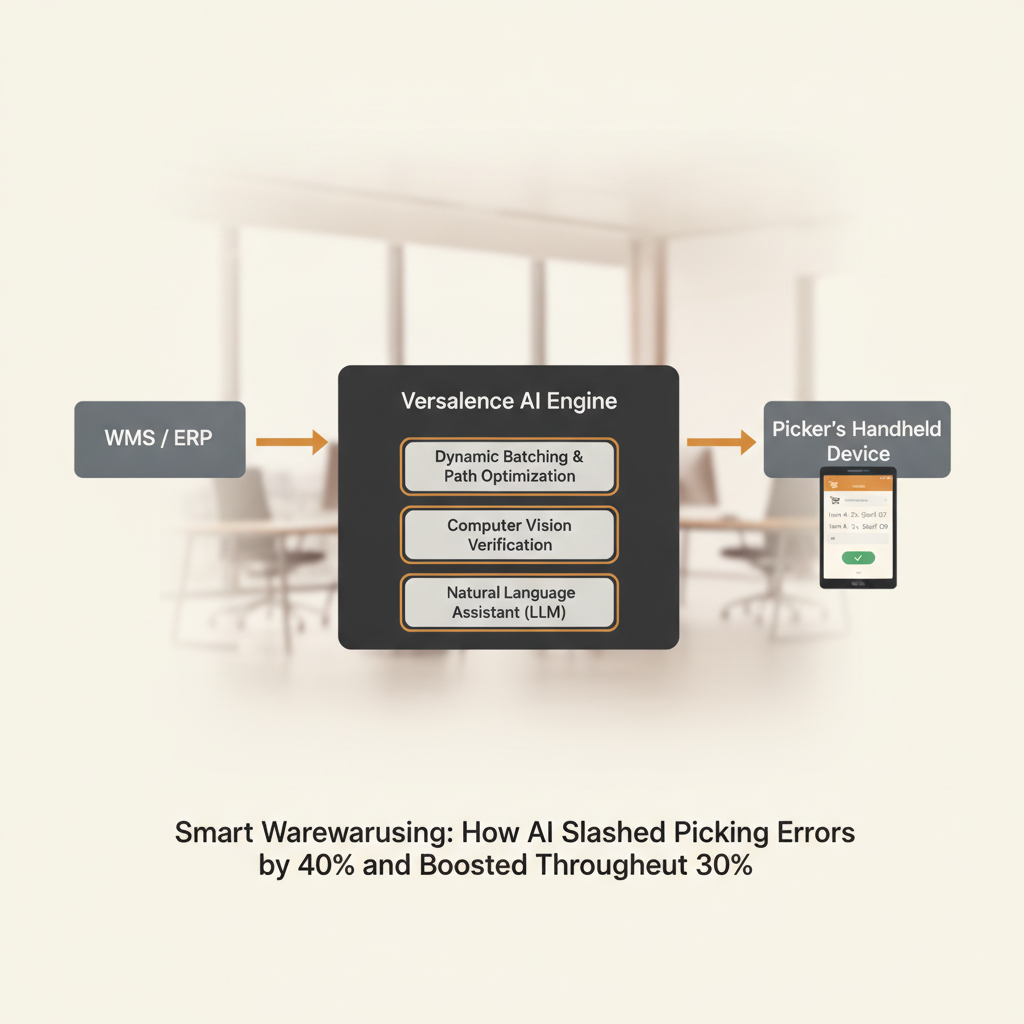
Our approach isn't about replacing human workers with robots; it's about augmenting them with AI to make them smarter, faster, and more accurate. We develop an AI-Powered Picker Assistant—a "co-pilot" that runs on the ruggedized handheld devices your team already uses. This transforms a simple scanner into an intelligent guide.
This solution is built on a robust architecture designed to integrate seamlessly with your existing systems while adding a powerful layer of intelligence.
1. The Integration Layer: Connecting to Your WMS
The foundation of any smart system is data. Our first step is to establish a real-time, two-way connection with your core Warehouse Management System (WMS) or Enterprise Resource Planning (ERP) system. Using secure APIs (like REST or GraphQL), our AI engine pulls critical information:
- Order Details: What products need to be picked for which orders.
- Inventory Data: SKU numbers, product descriptions, quantities on hand.
- Location Data: The exact bin, rack, and aisle for every item.
This integration ensures the AI assistant is always working with the most up-to-date information, preventing decisions based on stale data. The connection is bidirectional, allowing the assistant to report back completed picks, flag discrepancies, and update inventory levels instantly.
2. The AI Core: The "Brain" of the Operation
This is where the raw data from your WMS is transformed into actionable intelligence. Our AI Core consists of several specialized models working in concert:
-
Dynamic Batching & Path Optimization: The system intelligently groups individual orders into optimal "batches" for a single picking run. Instead of one picker fulfilling one order at a time, they can efficiently pick items for multiple orders in one trip. The AI then calculates the most efficient route through the warehouse to collect all items in the batch, using algorithms that solve the complex "Traveling Salesperson Problem." This alone can cut walking time by over 50%, directly boosting throughput.
-
Computer Vision for Item Verification: This is our primary weapon against picking errors. Standard practice is to scan a barcode. But what about nearly identical products in similar packaging? A picker might scan the right bin but grab the wrong item. Our solution adds a crucial second step: after the barcode scan, the picker briefly points the device's camera at the item. A lightweight computer vision model, trained on your product catalog, instantly verifies that the item's visual features (color, size, label) match the SKU. If there's a mismatch, the device alerts the picker immediately, preventing the error before it happens. This simple, sub-second check is responsible for the dramatic 40% reduction in errors.
-
Natural Language Assistant (The Botpress Connection): Warehouses are dynamic environments. Bins can be empty, items can be damaged, or a picker might need clarification. Instead of seeking out a supervisor, the worker can use their voice or text to interact with the assistant. "Report bin A-14-C2 is empty." "What's the secondary location for SKU 8675309?" "Flag this item as damaged."
This is powered by a sophisticated conversational AI engine, leveraging technology similar to what's found in our open-source work with platforms like Botpress (see our
versalenceai/botpressrepository). While Botpress is often used for customer-facing chatbots, we adapt its powerful natural language understanding (NLU) capabilities for industrial applications. The assistant comprehends the user's intent, executes the task (e.g., updates the WMS, logs the damage, and routes the picker to an alternate location), and provides a clear confirmation. This keeps your team moving and solving problems independently.

3. The User Interface: Simplicity and Clarity
All this complex AI is delivered through an incredibly simple and intuitive interface on the picker's handheld device. We prioritize clarity over clutter:
- One Item at a Time: The screen shows only the current item to be picked—a large image of the product, the location, and the quantity. This minimizes cognitive load.
- Visual Cues: A green checkmark appears after a successful scan and vision verification. A red 'X' and a haptic buzz alert the user to an error.
- Progress Indicators: A clear visual shows the picker how far they are through their current batch, providing a sense of accomplishment and momentum.
This combination of seamless integration, a multi-layered AI core, and a user-centric interface creates a powerful tool that feels less like a taskmaster and more like a helpful co-pilot.
Related Solutions: The Power of Intelligent Workflows
The principles behind the AI-Powered Warehouse Assistant—augmenting human expertise with targeted AI—are not limited to logistics. This concept of creating "intelligent workflows" is a core competency at Versalence AI. The same architecture can be adapted to solve challenges across various industries.
Our work with conversational AI platforms like Botpress demonstrates our expertise in building sophisticated assistants. We leverage this knowledge to create internal, task-oriented tools that drive efficiency and accuracy. Consider these parallel applications:
- AI for Field Service Technicians: An assistant on a technician's tablet can provide interactive repair guides, use computer vision to identify faulty parts, and allow voice-based reporting to update service tickets automatically.
- Automated Quality Control: On a manufacturing line, an AI-powered camera system can visually inspect products for defects in real-time, flagging issues with far greater speed and consistency than human inspectors alone.
- Intelligent Document Processing for Finance: An AI assistant can extract key information from invoices, purchase orders, and receipts, automating data entry and flagging anomalies for human review.
In each case, the goal is the same: use AI to handle repetitive, error-prone tasks, allowing your skilled employees to focus on high-value problem-solving and decision-making.
The Tangible Results & Compelling ROI
Adopting an AI-powered system isn't just about technological advancement; it's about achieving measurable business outcomes. Based on deployments of this architecture, our clients see a consistent and compelling return on investment.
The Metrics That Matter:
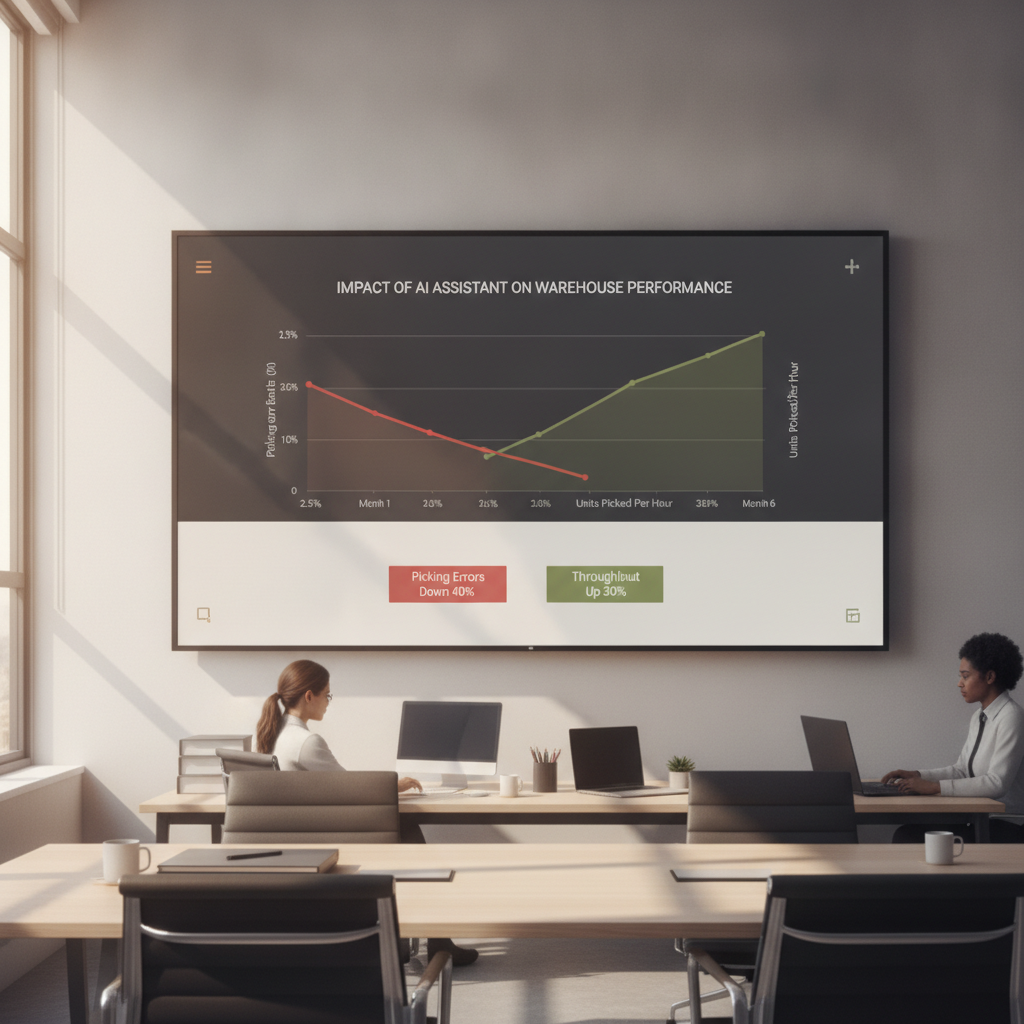
- 40% Reduction in Picking Errors: The combination of barcode scanning and mandatory computer vision verification for high-risk items virtually eliminates a whole class of common errors. This directly cuts costs associated with returns and improves customer satisfaction.
- 30% Boost in Throughput: This gain comes from two main sources. First, optimized pick paths drastically reduce unproductive travel time. Second, the reduction in errors means less time is wasted on corrections and problem-solving. More orders are processed correctly in the same amount of time with the same number of staff.
- 50% Faster Onboarding: The AI assistant acts as a digital trainer. New hires become productive almost immediately because the system guides them step-by-step through the optimal process. This dramatically reduces the time and cost associated with training.
- Improved Inventory Accuracy: By ensuring the right items are picked and logging exceptions in real-time, the system maintains a much more accurate reflection of physical inventory within the WMS. This reduces stockouts and minimizes the need for disruptive manual cycle counts.
A Simple ROI Calculation:
Let's consider a mid-sized distribution center processing 2,000 orders per day with an average picking error rate of 2%.
- Errors per day: 2,000 orders * 2% = 40 errors
- Cost per error (conservative estimate): $50 (includes labor, shipping, returns)
- Daily cost of errors: 40 * $50 = $2,000
- Annual cost of errors: $2,000 * 365 days = $730,000
A 40% reduction in these errors represents an annual direct savings of $292,000.
Now, consider the 30% throughput boost. If the center can now process 2,600 orders per day with the same staff, that additional 600 orders per day, at an average profit of $10 per order, represents $6,000 in additional daily profit, or over $2.1 million in additional annual revenue-generating capacity.
When you combine direct cost savings with increased capacity, the return on investment becomes undeniable and typically pays for the system implementation in under a year.
Is Your Warehouse Ready for the Future?
The demands on supply chains will only continue to grow. The companies that thrive will be those that embrace intelligent automation not as a threat, but as a tool to empower their workforce and create a more resilient, efficient, and accurate operation.
If you're struggling with high picking errors, battling inventory inaccuracies, or feel that your fulfillment speed has hit a plateau, it's time to explore what AI can do for you. Stop managing problems and start preventing them.
Ready to see how an AI-powered workflow can transform your warehouse operations?
Contact the experts at Versalence AI today. Let's schedule a consultation to discuss your specific challenges and design a solution that delivers measurable results.
Email us at sales@versalence.ai or visit us at versalence.ai to learn more.
Work With Versalence
Ready to remove the drag from your business operations? Our AI automation and system integration team delivers measurable results in 30-120 days.
📧 Contact us
✉️ sales@versalence.ai