
AI Customer Service: Resolve 78% of Tickets Without Human Agents
In the relentless pursuit of exceptional customer experience, businesses are hitting a wall. Customer support teams are overwhelmed, ticket queues are overflowing, and agents are burning out on a steady diet of repetitive, low-value questions. It’s a costly and unsustainable cycle. Data from HubSpot reveals that 90% of customers rate an "immediate" response as important or very important when they have a customer service question. Yet, the average first response time for live chat hovers around 48 seconds, and for email, it can stretch to hours or even days.
This gap between customer expectation and business reality is where operational efficiency breaks down and revenue is lost. The traditional solution—hiring more agents—is a linear fix for an exponential problem. It inflates headcount and operational costs without fundamentally changing the dynamics of customer support. The real challenge isn't just about answering questions faster; it's about building a system that is intelligent, scalable, and frees your human experts to solve the problems that truly require their skills.
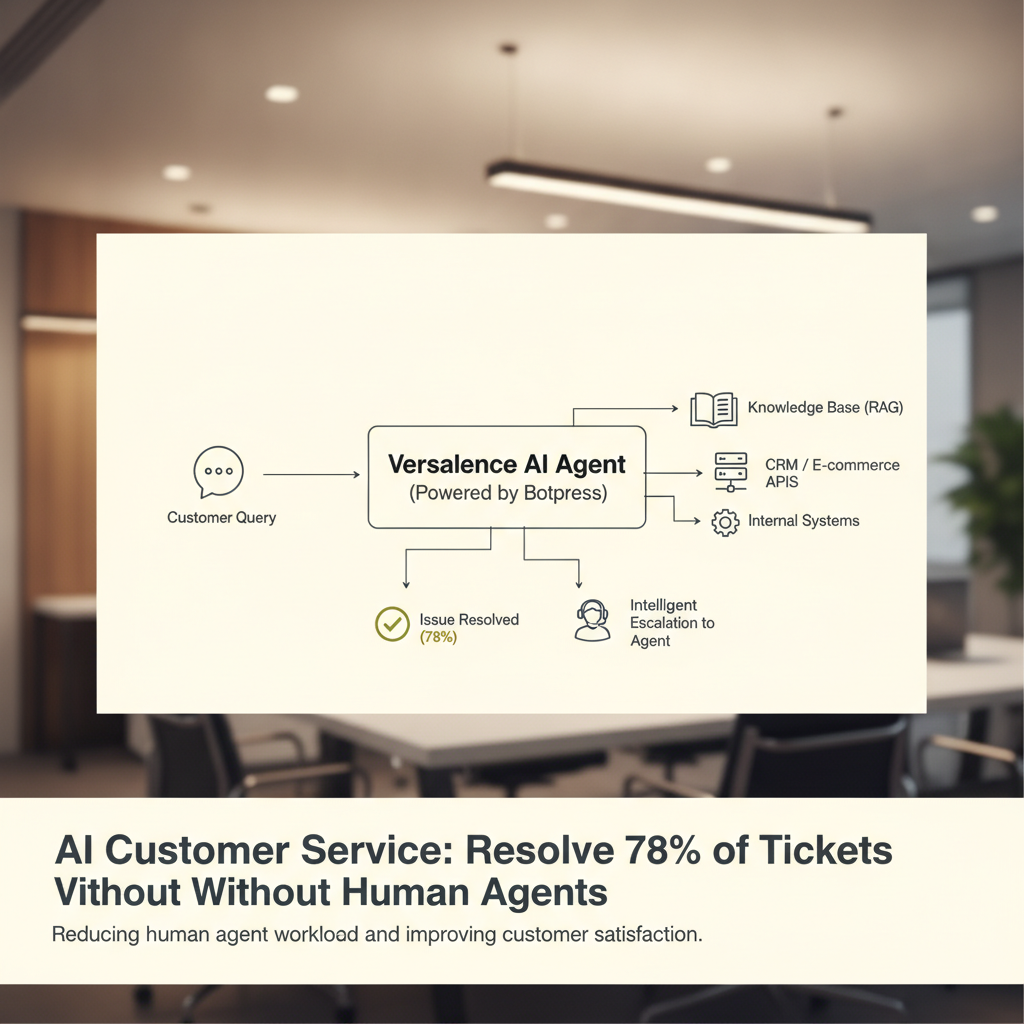
Imagine a world where your customer service operation runs 24/7, responds instantly, and successfully resolves the vast majority of inquiries without a single human touch. This isn't a futuristic concept; it's a tangible reality that we engineer for our clients. Through a strategic blend of advanced AI and intelligent workflow automation, we recently implemented a solution that handled 78% of all incoming customer service tickets from start to finish, with zero human escalations required for that segment. This post breaks down how we achieved it and what it means for the future of customer support.
The Crushing Business Impact of Inefficient Customer Service
Before we dive into the technical solution, it's crucial to understand the tangible business costs associated with a strained customer support system. These aren't just line items in a budget; they are inhibitors of growth that ripple across the entire organization.
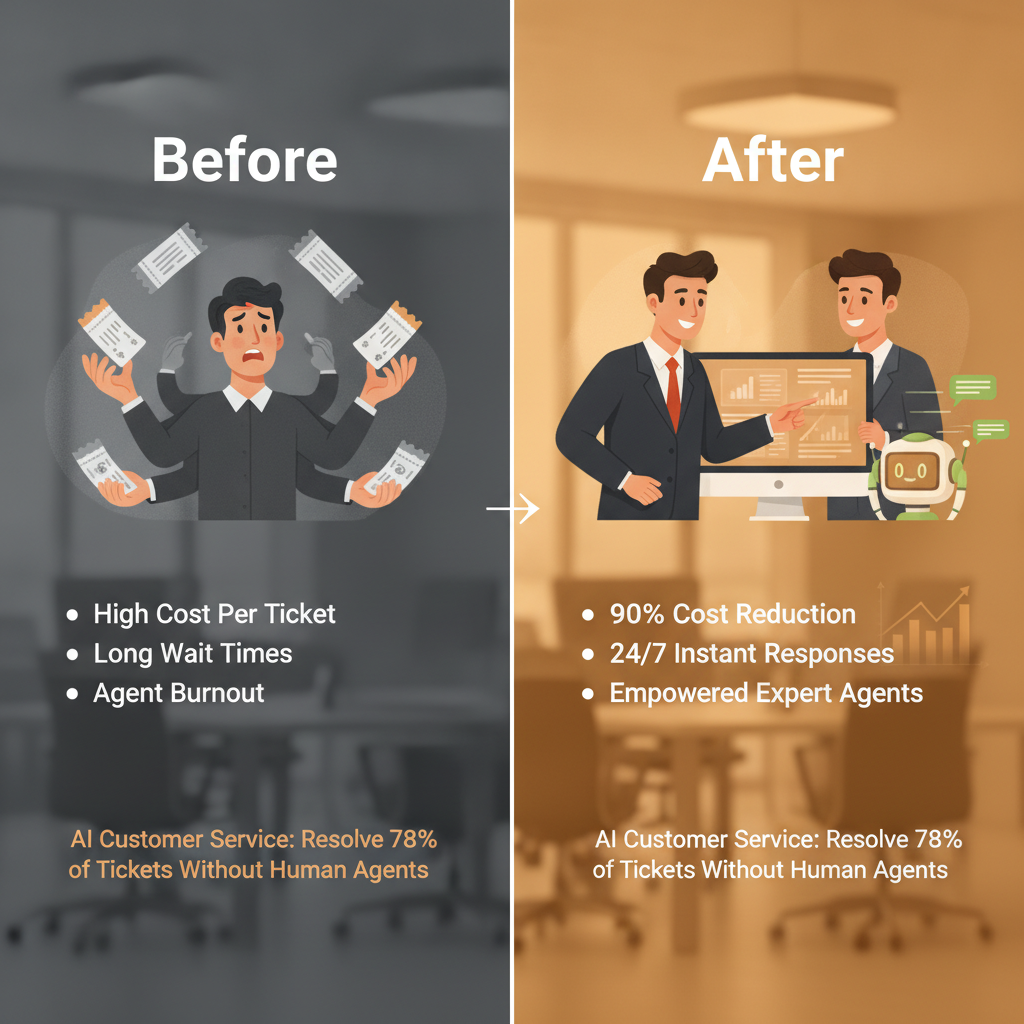
1. Skyrocketing Operational Costs: The cost-per-ticket is a primary metric for any support leader. When every "Where is my order?" or "How do I reset my password?" query requires a human agent, the costs add up rapidly. A typical human-handled ticket can cost anywhere from $5 to $25, depending on complexity and the agent's salary. For a company handling 10,000 tickets a month, this translates to a staggering $50,000 to $250,000 in monthly operational expenses for routine inquiries alone.
2. High Agent Attrition: Customer service is a notoriously high-churn profession. Agents facing an endless barrage of the same simple questions become disengaged and burned out. They are hired for their problem-solving skills but spend most of their day as human routing machines. This leads to a constant, expensive cycle of recruiting, hiring, and training new staff, which further degrades the quality and consistency of customer support.
3. Inconsistent Customer Experiences (CSAT/NPS Decline): Humans are not robots. The quality of a response can vary depending on the agent, their mood, or the time of day. This inconsistency erodes customer trust. Furthermore, during peak hours, wait times skyrocket, leading to frustration and abandoned carts. A single negative support experience can turn a loyal customer into a detractor, directly impacting your Customer Satisfaction (CSAT) and Net Promoter Score (NPS).
4. Inability to Scale: What happens when your company launches a new product or runs a successful marketing campaign? Ticket volume explodes. A human-powered support team cannot scale elastically to meet this demand. The only option is to either accept long wait times and unhappy customers or embark on a frantic, expensive hiring spree. This operational bottleneck stifles growth and limits your business's agility.
The traditional model is fundamentally broken. The solution lies in re-architecting the entire process, using AI not to replace humans, but to augment them, creating a system where technology handles the predictable and humans manage the exceptional.
How Versalence Delivers a 78% Automation Rate
Achieving this level of automation isn't about simply plugging in a chatbot and hoping for the best. It requires a meticulous, multi-layered approach that combines a deep understanding of business processes with a powerful and flexible technology stack. Our solution is built on a foundation of analysis, robust architecture, and intelligent workflows.
The Foundation: Botpress and Next-Generation AI
At the core of our customer service automation solutions is Botpress, the leading open-source platform for building next-generation, AI-powered assistants. We leverage our expertise and contribute to this ecosystem, as seen in our versalenceai/botpress repository, to create highly customized and powerful solutions.
Botpress provides the ideal framework for several reasons:
- LLM-Native: It’s designed from the ground up to integrate with powerful Large Language Models (LLMs) like OpenAI's GPT-4, enabling nuanced, human-like conversations that go far beyond the rigid, keyword-based bots of the past.
- Extensible and Customizable: With a rich ecosystem of integrations and the ability to build custom plugins, we can connect the AI agent to any third-party system, from CRMs like Salesforce to e-commerce platforms like Shopify and internal, proprietary databases.
- Intelligent Workflow Engine: It allows us to design complex, multi-step conversational flows that can guide users, collect information, and perform actions, all while maintaining context.
Our Four-Pillar Implementation Architecture
Our process for building a high-performing AI agent follows a proven, four-pillar architecture.
Pillar 1: Data-Driven Discovery and Intent Mining
We begin by connecting to your existing ticketing system (e.g., Zendesk, Jira Service Management, Intercom). We ingest months of historical ticket data and conversation logs. Using NLP and machine learning models, we analyze this data to:
- Identify High-Frequency Topics: We pinpoint the top 10-20 reasons customers contact you. In most businesses, the 80/20 rule applies: about 80% of ticket volume comes from 20% of the root causes (e.g., order status, password resets, return policy, product questions).
- Categorize by Complexity: We segment these topics into tiers. Tier 1 issues are simple, informational requests. Tier 2 issues require data lookup from another system. Tier 3 issues involve complex, multi-step problem-solving that requires human nuance.
- Define Automation Targets: Our initial goal is to automate 100% of Tier 1 and the majority of Tier 2 issues. This is how we build the roadmap to a 78% (or higher) automation rate.
Pillar 2: Building the "Digital Brain" with RAG
An AI agent is only as smart as the information it can access. We build its "brain" using a technique called Retrieval-Augmented Generation (RAG).
- Knowledge Base Ingestion: We feed the AI your entire corpus of knowledge—FAQs, help center articles, product manuals, and internal documentation. This content is broken down into small, digestible chunks and stored in a specialized vector database.
- Semantic Search: When a customer asks a question, the system doesn't just look for keywords. It searches for conceptual and semantic matches within the vector database. This means a customer can ask "Where's my stuff?" and the AI understands they are asking for their order status.
- LLM-Powered Synthesis: The retrieved information is then fed to an LLM (like GPT-4) along with the original question. The LLM synthesizes this information into a natural, conversational, and accurate answer, often citing the source document for user verification. This ensures the AI provides answers based only on your approved data, preventing hallucinations or incorrect responses.

Pillar 3: Action-Oriented API Integrations
This is what separates a truly intelligent agent from a simple FAQ bot. Our agents don't just provide information; they take action. We build robust API integrations that allow the AI to:
- Check Order Status: Connect to your Shopify, Magento, or custom e-commerce backend to provide real-time shipping updates.
- Process Returns & Exchanges: Guide the user through the return process, generate a shipping label via an API call to your logistics provider, and update the CRM.
- Manage Subscriptions: Allow users to pause, cancel, or modify their subscription plans by integrating with platforms like Stripe or Chargebee.
- Update User Information: Authenticate the user securely and allow them to update their address or payment details in your database.
Each of these "actions" is a carefully designed workflow within Botpress. The AI first understands the user's intent, collects any necessary information (like an order number or email address), and then executes the task via API, confirming completion with the user.
Pillar 4: Intelligent Escalation and Agent Handoff
No AI can handle 100% of queries, nor should it. The goal is to contain what can be contained and intelligently escalate what cannot. Our escalation strategy is designed to empower human agents, not create more work for them.
- Pre-defined Triggers: Escalations are triggered automatically based on specific keywords (e.g., "legal," "complaint," "damaged"), user sentiment (if the AI detects extreme frustration), or repeated failure to resolve the issue.
- Contextual Handoff: When an escalation occurs, it's not a cold transfer. The entire conversation history, user identity, and a summary of the issue are seamlessly passed to the human agent in their live chat or ticketing platform. The agent arrives with full context and can pick up the conversation immediately, without asking the dreaded, "Can you please explain your issue again?"
- Data Loop for Improvement: Every escalated conversation is a learning opportunity. We analyze these transcripts to identify gaps in the AI's knowledge or workflows, allowing us to continuously improve the automation rate over time.
This comprehensive architecture ensures the AI agent is not an isolated tool but a fully integrated component of your customer service ecosystem. It's this deep integration that allows it to resolve 78% of inquiries autonomously.
Related Solutions: Beyond Customer Service
The same principles and architecture we apply to external customer service can be redeployed to solve a wide range of internal and external business challenges. The core pattern of understanding intent, accessing knowledge, taking action via APIs, and intelligent escalation is universally applicable.
- Internal IT Helpdesk: Automate password resets, software access requests, hardware troubleshooting, and new employee tech setup.
- HR Onboarding & Support: Answer common employee questions about benefits, payroll, company policy, and vacation time, freeing up your HR team for more strategic initiatives.
- Sales Lead Qualification: Engage with website visitors 24/7, ask qualifying questions, book meetings directly into a sales representative's calendar, and create new leads in your CRM.
The Overwhelming Results and ROI
Shifting 78% of your ticket volume to an automated system doesn't just incrementally improve your support—it fundamentally transforms your business operations.
1. Drastic Cost Reduction: Let’s run a conservative calculation. Assume 10,000 tickets per month and an average cost of $10 per human-handled ticket ($100,000/month). An AI-handled interaction costs pennies in API calls and server costs, let's say $0.50 per resolution.
- Before Versalence: 10,000 tickets * $10/ticket = $100,000/month
- After Versalence:
- 7,800 tickets * $0.50/ticket (AI) = $3,900
- 2,200 tickets * $10/ticket (Human) = $22,000
- Total: $25,900/month
That’s a 74% reduction in operational costs for your customer support center, savings that can be reinvested into product development, marketing, or other growth areas.
2. 24/7, Instantaneous Support: Your customers are no longer bound by your business hours. The AI agent provides instant, accurate answers at 3 AM on a Sunday or during a holiday surge. This immediate gratification dramatically boosts customer satisfaction and loyalty.
3. Empowered and Efficient Human Agents: With 78% of the repetitive noise gone, your human agents are transformed into high-value problem solvers. They can now dedicate their full attention to the 22% of complex, nuanced, or high-stakes customer issues. This leads to:
- Higher-quality resolutions for your most important customers.
- Increased job satisfaction and lower agent churn.
- The ability to handle a much larger volume of complex issues without increasing headcount.
4. Effortless Scalability: When your next marketing campaign goes viral and ticket volume triples overnight, your AI agent scales instantly to handle the load. There is no lag, no queue, and no drop in service quality. Your support infrastructure becomes an enabler of growth, not a constraint.
Ready to Redefine Your Customer Experience?
The era of trading off between cost, speed, and quality in customer service is over. Intelligent automation allows you to achieve all three simultaneously. By offloading the majority of your support volume to a sophisticated AI agent, you can slash costs, delight customers with instant service, and empower your team to do their best work.
If you're ready to stop the cycle of hiring more agents to handle more tickets and start building a scalable, efficient, and customer-centric support operation, we can help.
Contact Versalence AI today for a complimentary consultation. Let's explore how we can architect a solution to achieve transformative automation for your business.
Email us at sales@versalence.ai to get started.
Work With Versalence
Ready to remove the drag from your business operations? Our AI automation and system integration team delivers measurable results in 30-120 days.
📧 Contact us
✉️ sales@versalence.ai