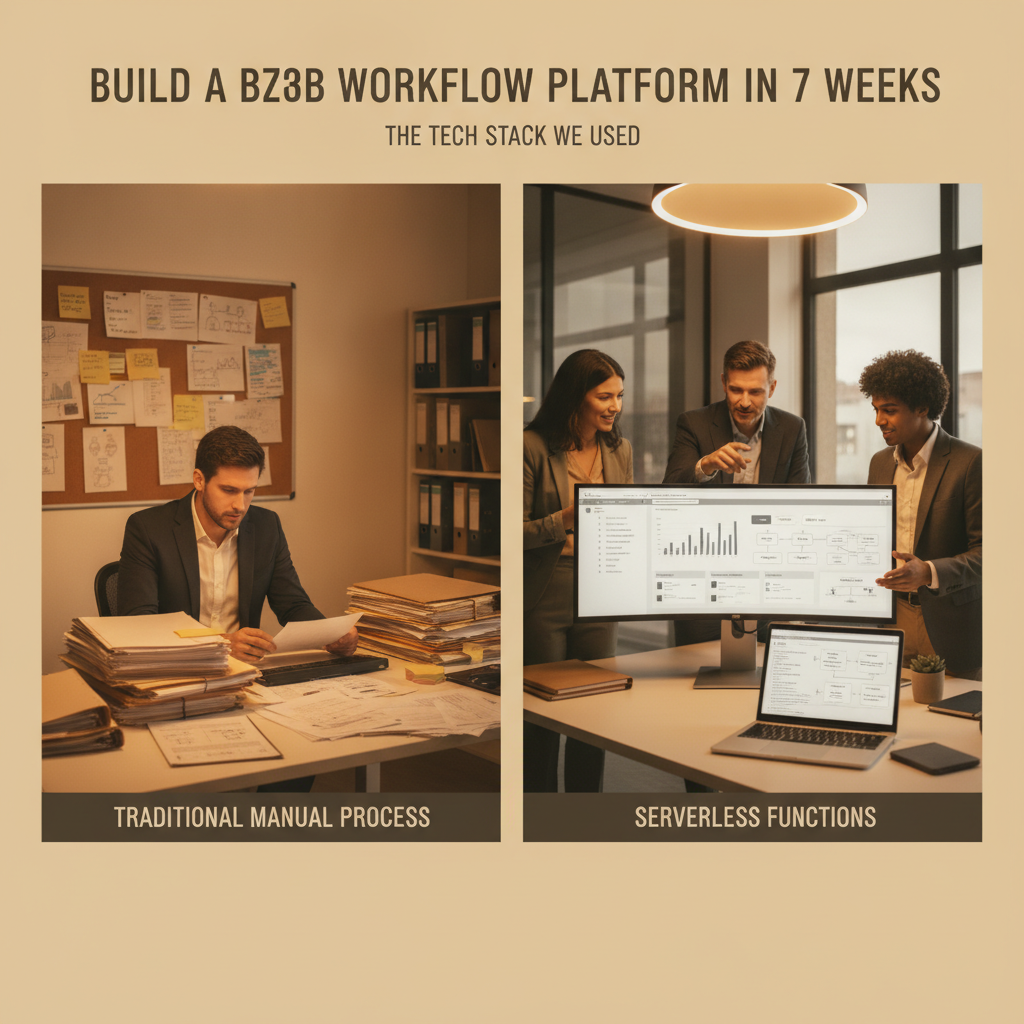
Build a B2B Workflow Platform in 7 Weeks: The Tech Stack We Used
The Unseen Anchor: Why Your Next Big Idea Is Already Behind Schedule
In today’s hyper-competitive B2B landscape, speed is the ultimate currency. You have an innovative idea for a workflow platform that could revolutionize your industry, streamline operations, and deliver unprecedented value to your customers. The problem? The traditional software development lifecycle is a marathon, not a sprint. Market research from sources like Standish Group has consistently shown that large-scale IT projects are notoriously prone to delays, with many taking over a year and a significant percentage failing outright.
Imagine launching your platform in 6 to 9 months, only to find a competitor launched a similar, "good enough" solution four months earlier and captured the market's attention. The cost isn't just the money spent on development; it's the lost opportunity, the squandered first-mover advantage, and the challenge of winning back momentum.
Businesses are caught in a frustrating paradox. They need robust, scalable, and secure custom platforms to solve complex workflow challenges, but the time and resources required to build them from the ground up create an unacceptable level of risk and delay. What if you could collapse that timeline from months to weeks? What if you could build and launch a Minimum Viable Product (MVP) for a sophisticated B2B workflow platform in just seven weeks?
At Versalence AI, we don’t just believe it's possible; we've done it. This isn't about cutting corners. It's about making a series of strategic, high-leverage technical decisions that prioritize velocity without sacrificing quality. This is our blueprint.

The Business Impact of Radical Speed
Why does a 7-week development cycle matter so much? Because it fundamentally changes the business equation.
- Accelerated Time-to-Value: The most obvious benefit is getting your product into the hands of paying customers faster. Every week saved in development is a week you can be generating revenue, gathering feedback, and building your user base.
- De-risked Investment: A shorter cycle significantly lowers the financial risk. Instead of a massive, year-long bet, you're making a smaller, contained investment to validate your core business idea. You can test market fit with a real, working product before committing to a multi-million dollar budget.
- Rapid Feedback Loops: The most valuable insights come from real users. By launching an MVP quickly, you replace internal assumptions with real-world data. This allows you to iterate faster, pivot where necessary, and build a product that your customers actually want, not just what you think they want.
- Competitive Edge: In a crowded market, being first—or being the fastest to adapt—is a powerful advantage. A 7-week launch can put you months ahead of slower-moving competitors, allowing you to establish your brand as the market leader.
Building quickly isn't about being reckless. It's about being relentlessly efficient and intelligent in how you deploy your most valuable resource: engineering time.
How Versalence Delivers: The 7-Week Technical Blueprint
Achieving this level of velocity requires a disciplined approach and a modern tech stack designed for speed and scale. Here are the six critical technical decisions that made our 7-week timeline possible.
1. The Foundation: Leveraging an Open-Source Workflow Engine (Botpress)
The single biggest mistake in platform development is reinventing the wheel. Building a state machine, a queuing system, an event bus, and an integration layer from scratch can consume months of effort before you even write a single line of business logic.
We chose to build on a powerful open-source foundation: Botpress. While often known as a chatbot platform, its underlying architecture is a highly extensible, event-driven workflow engine perfect for B2B automation. Our decision to start with our own fork of Botpress, which you can see at versalenceai/botpress, was pivotal.
Why it mattered:
- Pre-built Core Logic: Botpress provides the essential plumbing out of the box: a visual workflow editor, state management, natural language processing capabilities, and a robust event-handling system. This saved us an estimated 3-4 weeks of foundational backend engineering.
- Extensibility and Integrations: The platform is designed to be extended. The Botpress Hub has a rich ecosystem of existing integrations for common services like Slack, Salesforce, and Zendesk. We could immediately connect to third-party APIs, focusing our efforts on building the unique, proprietary workflows that delivered business value.
- Controlled Customization: By maintaining our own fork, we gained the best of both worlds. We benefit from the innovation of the open-source community while having the freedom to add enterprise-grade security, custom performance optimizations, and features specifically tailored to complex B2B use cases that go far beyond standard chatbots.
This "leverage-and-extend" strategy allowed us to start building on day one, not day sixty.
2. The Architecture: Microservices for Parallel Progress
A monolithic architecture is the enemy of speed. When your entire application is a single, tightly-coupled unit, developers are constantly tripping over each other. A small change in one part of the system can have unintended consequences elsewhere, leading to long testing cycles and deployment bottlenecks.
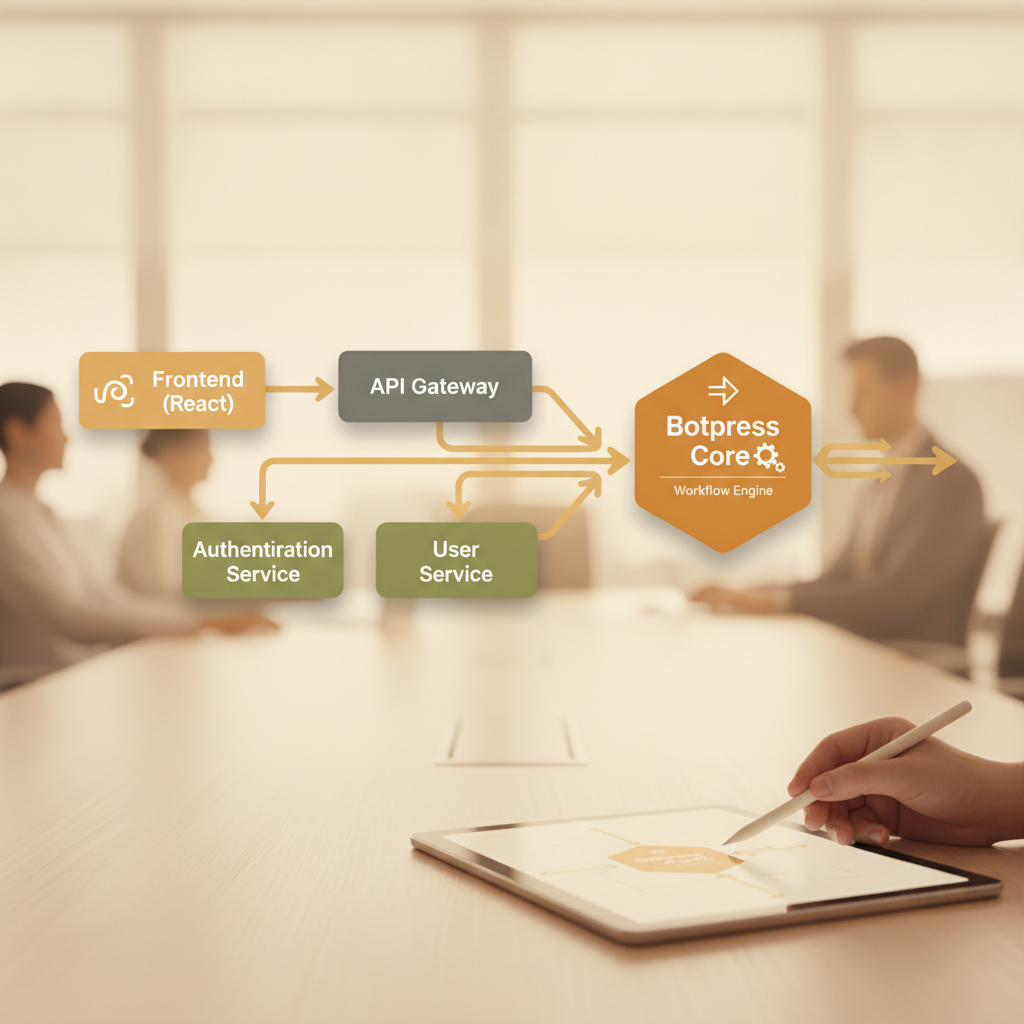
We adopted a microservices-first, API-driven architecture from the outset. Our platform isn't one giant application; it's a collection of small, independent services that communicate over well-defined APIs.
Our high-level architecture included:
- React/Next.js Frontend: A standalone application responsible for the entire user experience.
- API Gateway: A single entry point for all frontend requests, routing them to the appropriate backend service.
- Core Workflow Engine (Botpress Service): The heart of the platform, responsible for executing the automated workflows.
- Authentication Service: A dedicated service for managing user identity, logins, and permissions (e.g., using Auth0 or a custom OpenID Connect provider).
- User Management Service: Handled user profiles, team structures, and tenant-specific data.
Why it mattered:
- Parallel Development: With clear API contracts defined, our frontend team could build the entire UI by mocking the backend responses, while the backend team built the services simultaneously. This effectively cut the development timeline in half.
- Isolation and Stability: A bug in the User Management service wouldn't bring down the core Workflow Engine. This isolation makes the system more resilient and easier to debug, which is crucial when moving fast.
- Technological Flexibility: Each service can use the best technology for its specific job. While most of our services used NodeJS, a future data-intensive service could be written in Python without impacting the rest of the system.
3. The Frontend: Building Interfaces, Not Components
The user interface is where your platform meets the customer. A clunky, slow, or inconsistent UI can kill adoption, no matter how powerful the backend is. However, building a beautiful, responsive UI from scratch—complete with buttons, forms, modals, and data tables—is a time-consuming black hole.
Our strategy was simple: use a high-quality, pre-built component library and focus our efforts on user experience (UX) and data flow.
We chose Next.js as our React framework for its exceptional performance (server-side rendering) and top-tier developer experience. We coupled this with a professional component library like Material-UI (MUI) or Ant Design.
Why it mattered:

- Massive Time Savings: We didn't spend a single hour debating the pixel-perfect styling of a dropdown menu. The component library provided fully accessible, themeable, and production-ready components, allowing us to assemble complex UIs in hours, not weeks.
- Consistency and Quality: Using a component library ensures a consistent look and feel across the entire application. It also provides a baseline of quality and accessibility that is difficult and time-consuming to achieve from scratch.
- Focus on What Matters: By abstracting away the low-level UI details, our frontend developers could concentrate on the hard problems: managing application state, optimizing data fetching, and designing an intuitive workflow for the user.
4. The Backend: Type Safety and Performance with NodeJS & PostgreSQL
For our microservices, we needed a stack that was fast, scalable, and allowed for rapid development. We standardized on a combination of NodeJS, TypeScript, and PostgreSQL.
- NodeJS: Its non-blocking, event-driven architecture makes it a natural fit for an API-centric system that handles many concurrent connections. It excels at I/O-bound tasks, which is the majority of the work for a workflow platform that integrates with various third-party APIs.
- TypeScript: This was a non-negotiable choice. In a fast-paced project with multiple developers, JavaScript's dynamic nature can lead to runtime errors that are hard to trace. TypeScript adds a layer of static typing, catching bugs during development, not in production. It makes code self-documenting and refactoring far safer, which is essential for maintaining velocity.
- PostgreSQL: We chose PostgreSQL for its rock-solid reliability, powerful features, and scalability. Its native support for JSONB data types was particularly valuable, giving us the flexibility of a NoSQL database for storing dynamic workflow data while retaining the transactional integrity and querying power of a relational database.
Why it mattered:
- Developer Velocity: The combination of NodeJS's vast ecosystem (npm) and TypeScript's safety features allowed our team to write robust code quickly and confidently.
- Performance and Scalability: This stack is proven to scale to handle millions of requests. It provided the performance needed for a responsive user experience and the horsepower to run thousands of concurrent workflows.
- Data Integrity: PostgreSQL ensured that our users' critical business data was stored safely and consistently, building trust from day one.
5. The Infrastructure: Automated, Repeatable Deployments with IaC & CI/CD
Speed is not just about writing code; it's about shipping it. A manual deployment process is slow, error-prone, and a major bottleneck. From day one, we invested in a fully automated infrastructure and deployment pipeline.
We used Terraform for Infrastructure as Code (IaC) to define our entire cloud environment on AWS. Our servers, databases, and networking rules were all defined in code, version-controlled in Git, and provisioned automatically. We ran our containerized microservices on AWS Fargate to eliminate the overhead of managing servers.
For deployments, we implemented a Continuous Integration and Continuous Deployment (CI/CD) pipeline using GitHub Actions.
Why it mattered:
- One-Click Environments: With Terraform, we could spin up a complete, production-identical staging environment in minutes. This enabled rigorous testing without impacting the main development environment.
- Effortless Deployments: Every time code was merged into the main branch, the CI/CD pipeline automatically ran tests, built container images, and deployed the changes to production with zero downtime. We could safely deploy multiple times per day.
- Consistency and Reliability: Automation removed the risk of human error from the deployment process. We knew that what we tested in staging was exactly what would run in production, eliminating "it works on my machine" issues.
6. The "AI" in Versalence AI: Adding Intelligence to Workflows
Finally, we didn't just build an automation platform; we built an intelligent workflow platform. This is where the power of modern AI, specifically Large Language Models (LLMs), came into play.
Using the OpenAI API, we embedded intelligence directly into the workflow steps. This transformed the platform from a simple task-doer into a cognitive partner.
Examples of AI-powered steps:
- Intelligent Document Processing: A workflow could receive an unstructured PDF invoice, use an LLM to extract key information (vendor name, invoice number, amount, due date), and route it for approval without any manual data entry.
- Automated Communication: Based on the status of an order, the platform could generate a personalized, human-like email update for the customer, adjusting the tone based on the situation.
- Smart Routing: A customer support ticket could be analyzed for sentiment and intent, and then automatically routed to the correct department (e.g., technical support, billing, or sales) with a pre-populated summary of the issue.
Why it mattered:
- Exponential Value: This decision elevated the entire value proposition. We weren't just saving clicks; we were automating cognitive labor, which is where the most significant operational inefficiencies lie.
- Competitive Differentiation: Any company can build a basic automation tool. By infusing our workflows with AI, we created a powerful differentiator that solved higher-value problems for our customers.
Related Solutions: A Pattern for Rapid Innovation
This 7-week blueprint isn't a one-off trick. It's a repeatable methodology that we apply to a range of custom software development challenges. The core principles—leveraging open-source, a microservices architecture, automated infrastructure, and intelligent AI integration—are the foundation for how we build:
- Custom AI Agents that act as autonomous members of your team.
- Intelligent Data Processing Pipelines that clean, enrich, and analyze complex datasets.
- Next-Generation Customer Support Systems that resolve issues before they ever reach a human agent.
This approach allows businesses to build a "composable enterprise," where new capabilities can be developed and deployed as modular, independent services, enabling unprecedented organizational agility.
Results & ROI: The Tangible Outcomes of Speed
By implementing this technical strategy, the results for a platform of this nature are transformative. While every project is unique, here are the typical, realistic outcomes we enable:
- Time-to-Market: An MVP is launched and in the hands of pilot customers in 7 weeks, compared to an industry average of 6-9 months for similar platforms built from scratch.
- Development Cost Reduction: By leveraging open-source foundations and pre-built components, initial development costs are typically 40-50% lower than a traditional "greenfield" project.
- Operational Efficiency Gains: The resulting platform can automate workflows that previously required dozens of hours of manual work per week, often leading to a 60% or greater reduction in process time for key business operations.
- Future-Proof Scalability: The microservices architecture is built to scale. The platform can handle a 10x or 100x increase in users and workflow executions with predictable, manageable infrastructure changes.
- Foundation for Growth: The initial 7-week build isn't the end; it's the beginning. You have a stable, scalable, and flexible foundation upon which to build new features, respond to customer feedback, and continuously evolve your product.
Build Faster, Smarter, and Better with Versalence AI
The barrier to entry for building powerful, AI-driven B2B software has never been lower, but only for those who make the right technical decisions from the start. A 7-week timeline isn't magic; it's the result of a deliberate, modern engineering strategy designed for velocity.
If you're tired of long development cycles and want to turn your innovative ideas into market-ready products at lightning speed, we can help.
Ready to build your next platform in weeks, not years? Contact us at sales@versalence.ai or visit versalence.ai to schedule a free technical consultation today.
Work With Versalence
Ready to remove the drag from your business operations? Our AI automation and system integration team delivers measurable results in 30-120 days.
📧 Contact us
✉️ sales@versalence.ai