
Unlock Legacy Data for AI Without Replacing Your Core Systems
The Multi-Million Dollar Question: Modernize or Stagnate?
For decades, legacy systems have been the unsung heroes of enterprise operations. These monolithic mainframes, AS/400s, and COBOL-based applications are the bedrock of global finance, logistics, and retail, reliably processing trillions of transactions. But this reliability comes at a steep price. A 2021 report revealed that organizations spend up to 80% of their IT budgets simply maintaining these aging systems. This leaves precious little for innovation, digital transformation, and the AI-powered initiatives that define modern competition.
The conventional wisdom has long been the "big bang" approach: a full-scale, rip-and-replace modernization project. Yet, the landscape is littered with the cautionary tales of these efforts. Industry analysis from the Standish Group consistently shows that large-scale IT projects have a staggering failure rate, with many running over budget, behind schedule, or failing to deliver on their promised value. Businesses are caught in a paralyzing dilemma: risk catastrophic failure with a big bang migration or risk slow obsolescence by doing nothing.
This is not a sustainable choice. The inability to access and utilize the vast treasure troves of data locked within these legacy systems is no longer just a technical debt; it's a critical business liability. Without a modern data strategy, you cannot build intelligent customer experiences, optimize supply chains with predictive analytics, or empower your workforce with AI-driven tools. Fortunately, there is a third way—a strategic, incremental approach that de-risks modernization and delivers value from day one: the Data-First Integration Strategy.
The Business Impact of Data Entrapment

Before we explore the solution, it's crucial to understand the tangible costs of keeping your most valuable asset—your data—trapped in technological silos. The consequences ripple across the entire organization:
- Stifled Innovation: Your development teams want to build modern, cloud-native applications, mobile experiences, and AI models. But if they can't easily access customer history from the mainframe or inventory data from a 30-year-old ERP, every new project becomes a complex, expensive, and slow integration nightmare. Innovation grinds to a halt, limited by the accessibility of your oldest system.
- Operational Inefficiency: Consider a customer service agent who needs to toggle between three different "green screen" terminals and a modern CRM just to answer a single customer query. This is not just frustrating; it's profoundly inefficient. It increases call handling times, creates opportunities for error, and requires extensive, specialized training. This inefficiency is a hidden tax on your daily operations.
- Poor Customer Experience: Today's customers expect seamless, instant, and personalized service. They don't care that your order data is on a mainframe and your loyalty program runs on a separate Oracle database. When they ask a chatbot, "Where is my order and can I apply my loyalty points?" they expect a single, coherent answer. The inability to unify this data results in fragmented, frustrating experiences that drive customers to competitors.
- Security and Compliance Risks: Legacy systems often lack modern security protocols, making them prime targets for cyberattacks. Furthermore, extracting data for compliance and reporting (like GDPR or CCPA) can be a Herculean manual effort, increasing the risk of penalties and data breaches.
A data-first strategy directly confronts these challenges by changing the fundamental question. Instead of asking, "How do we replace this entire system?" we ask, "How do we liberate the data within this system and make it universally accessible?"
How Versalence Delivers: The AI-Powered Data-First Approach
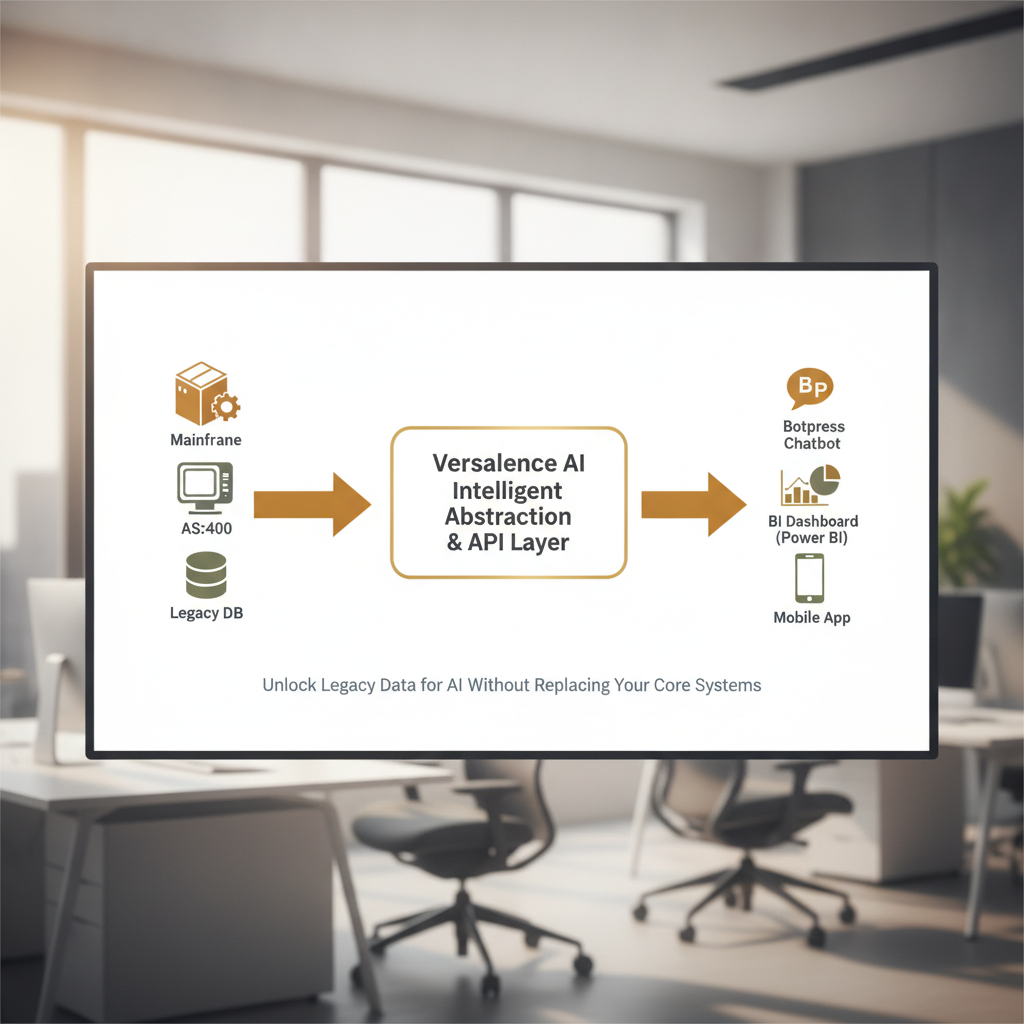
At Versalence AI, we architect solutions that bridge the gap between legacy infrastructure and modern digital ecosystems. Our approach is not about demolition; it's about intelligent construction. We build a sophisticated data and automation layer on top of your existing systems, effectively modernizing from the outside in. This strategy comprises three core pillars: Intelligent Data Abstraction, a Unified API Layer, and AI-Powered Orchestration.
Pillar 1: Intelligent Data Abstraction
You can't use data you can't access. The first and most critical step is to establish a reliable, real-time connection to the data sources within your legacy systems. This is often the biggest hurdle, as these systems were never designed for the interconnected world of APIs.
Our approach uses a combination of techniques, powered by intelligent automation:
- Database Connectors: For legacy systems with accessible databases (e.g., DB2, Oracle), we establish secure connectors that can query and retrieve data without disrupting core operations.
- Robotic Process Automation (RPA) & Screen Scraping: For "headless" systems like mainframes accessible only through terminal emulators, we deploy AI-powered RPA bots. These bots are trained to navigate the legacy interface just as a human would—logging in, querying screens, and extracting data from specific fields. This allows us to "create" an API where none exists.
- File & Message Queue Integration: We tap into batch processing outputs, log files, and message queues (like MQSeries) that are often the primary way these systems communicate, transforming unstructured or semi-structured data into a clean, usable format.
The "intelligent" part of this process involves AI models that can help map cryptic data fields (e.g., "CUST_ID_NBR_8") to a clear, understandable business lexicon (e.g., "customerAccountNumber"). This accelerates the discovery process and ensures the data is ready for business use.
Pillar 2: The Unified API Layer
Once we have a reliable stream of data, we don't just pipe it into another silo. We build a modern, flexible, and secure Unified API Layer. This layer acts as a "universal translator" and a single source of truth for your enterprise data.
Imagine a single, well-documented REST API endpoint called /customer/{id}. When a modern application calls this endpoint, the API layer orchestrates the necessary calls in the background—perhaps querying a mainframe for the customer's core profile, a separate CRM for recent interactions, and a billing system for their account status. It then consolidates this information into a single, clean JSON response.
This abstraction layer is transformative. It decouples your modern applications from the complexity and fragility of the legacy backend. Your developers no longer need to be COBOL experts to get customer data; they just need to call a standard API. This dramatically accelerates development, improves security by centralizing access control, and makes future migrations seamless. If you eventually decide to replace that legacy CRM, you simply update the API layer to point to the new system. The dozens of applications consuming the /customer endpoint don't need to change at all.
Pillar 3: AI-Powered Orchestration and Intelligent Workflows

This is where the true power of modernization is unlocked, and it’s where our expertise with platforms like Botpress shines. With a Unified API Layer in place, your enterprise data is now primed for intelligent automation. We leverage the tools and frameworks from our versalenceai/botpress repository to build next-generation assistants and workflows that consume this newly accessible data.
Botpress, a leading platform for building AI-powered chatbots and assistants, becomes the intelligent front-end for your legacy systems. Powered by state-of-the-art Large Language Models (LLMs) like those from OpenAI, Botpress can understand complex natural language queries, orchestrate multi-step processes, and deliver personalized, context-aware responses.
Here’s how it works in practice:
-
Example: An Internal Sales Assistant
- The Problem: Your sales team spends hours every week hunting for information. They need to check the AS/400 for inventory levels, the legacy CRM for a customer's order history, and a separate system for shipping status.
- The Versalence Solution: We build a chatbot inside Slack or Microsoft Teams using Botpress. A salesperson can now simply type: "What's the stock level for product SKU #12345 in the Dallas warehouse, and what was the last order for ACME Corp?"
- Behind the Scenes:
- The Botpress NLU engine parses the query, identifying the intents (check inventory, get order history) and entities (SKU #12345, Dallas, ACME Corp).
- The bot's workflow engine makes two parallel calls to your new Unified API Layer: one to the
/inventoryendpoint and one to the/customer/ACME_Corp/ordersendpoint. - The API layer retrieves the data from the respective legacy systems.
- The bot receives the structured data, synthesizes it into a human-readable sentence, and replies instantly in Slack: "We have 1,250 units of SKU #12345 in the Dallas warehouse. ACME Corp's last order was for 200 units on May 15th, and it is currently out for delivery."
-
Example: A Customer-Facing Support Bot
- The Problem: Your website's support chatbot is limited to answering basic FAQ questions. For any real account-specific query, it has to hand off to a live agent, leading to long wait times and high support costs.
- The Versalence Solution: We enhance your website bot using Botpress and connect it to the Unified API Layer.
- The New Experience: A customer logs in and asks, "My last payment seems high, can you explain the charges and what's my current balance?"
- Behind the Scenes:
- The Botpress assistant authenticates the user.
- It calls the
/billing/{customerId}/last-invoiceand/accounts/{customerId}/balanceendpoints in your API layer. - The API layer pulls the detailed transaction data from a 25-year-old COBOL-based billing system.
- The bot receives the line-item data, formats it clearly, and presents it to the customer: "I see. Your last invoice included your standard monthly service fee of $50 plus a one-time equipment charge of $120. Your current outstanding balance is $170. Would you like to pay this now?"
In both examples, we haven't replaced a single legacy system. We've wrapped them in an intelligent layer that unlocks their data and makes it available for AI-driven automation, fundamentally transforming a business process.
Related Solutions: Beyond Chatbots
The beauty of the data-first approach is that the Unified API Layer becomes a foundational asset for a wide range of digital transformation initiatives, not just chatbots. The same APIs built for an internal assistant can also power:
- Modern Business Intelligence (BI) Dashboards: Feed real-time data from all your systems into platforms like Power BI or Tableau, providing executives with a holistic, up-to-the-minute view of the business.
- Predictive Analytics & Machine Learning: Use the newly cleaned and structured historical data to train ML models for demand forecasting, customer churn prediction, or fraud detection.
- The Strangler Fig Application Pattern: This is the ultimate de-risking strategy for full modernization. You can begin building new, cloud-native microservices that replace small pieces of legacy functionality one at a time. Each new microservice calls the Unified API Layer. Over time, you "strangle" the old monolith, gradually moving functionality to the new platform until the legacy system can be safely decommissioned, all without a single "big bang" cutover.
Results & ROI: The Tangible Business Value
Adopting a data-first integration strategy with Versalence AI is not just a technical exercise; it's an investment with a clear and compelling return. While specific results vary by industry and implementation, our clients typically see transformative outcomes in four key areas:
-
Drastic Cost Reduction:
- Operational Savings: Automating data retrieval tasks can reduce average call handling time in contact centers by 30-50% and eliminate thousands of hours of manual data entry and reconciliation across departments.
- Development Savings: By building on a reusable API layer, the time and cost to launch new digital features and applications can be reduced by as much as 75%.
- Risk Mitigation: The cost of a failed multi-year, multi-million dollar "rip and replace" project is infinite. The incremental, value-driven approach avoids this catastrophic risk entirely.
-
Radical Improvement in Agility:
- Businesses can now respond to market changes in weeks, not years. Need a new mobile app feature that shows order history? The API is already there. Want to launch a new partner portal? The data is ready to be consumed. This agility is a powerful competitive advantage.
-
Enhanced Customer and Employee Experience:
- Customers get instant, 24/7, personalized answers to their questions, leading to higher CSAT and NPS scores.
- Employees are freed from mundane, repetitive data-hunting tasks, allowing them to focus on higher-value work. This boosts morale, productivity, and retention.
-
Future-Proofing Your Enterprise:
- This strategy creates a modular, flexible architecture. As new technologies like next-generation AI, IoT, or blockchain emerge, you have a simple, standard way to connect them to your core business data, ensuring you're always ready for what's next.
Start Your Modernization Journey—Without the Big Bang
The pressure to modernize is immense, but the fear of a failed project is equally real. The data-first integration strategy offers a pragmatic, proven path forward. It allows you to unlock immediate value from the systems you already own, de-risk your long-term technology roadmap, and build a foundation for an intelligent, automated future.
Stop seeing your legacy systems as an anchor holding you back. With the right strategy, they can become the foundation for your next wave of innovation.
Ready to liberate your data and power your business with AI?
Contact the experts at Versalence AI today for a consultation. Let us show you how we can design and implement a data-first integration strategy tailored to your unique landscape.
Email us at sales@versalence.ai or visit versalence.ai to get started.
Work With Versalence
Ready to remove the drag from your business operations? Our AI automation and system integration team delivers measurable results in 30-120 days.
📧 Contact us
✉️ sales@versalence.ai