
How to Reduce Month-End Close from 5 Days to 18 Hours with AI
The end of the month. For most departments, it’s a time of planning and looking forward. But for the finance team, it often signals the beginning of a frantic, high-pressure ritual: the month-end close. Long nights, manual data entry, endless spreadsheet reconciliations, and the constant threat of human error—it’s a process that consumes the time and energy of some of your most critical talent.
If this sounds familiar, you’re not alone. A survey by financial software firm BlackLine revealed that nearly half of all large companies take more than six days to close their books. This isn't just a minor inefficiency; it's a significant operational bottleneck that stifles growth. In an era where real-time data drives competitive advantage, waiting a week or more for a clear picture of your company's financial health is a critical liability.
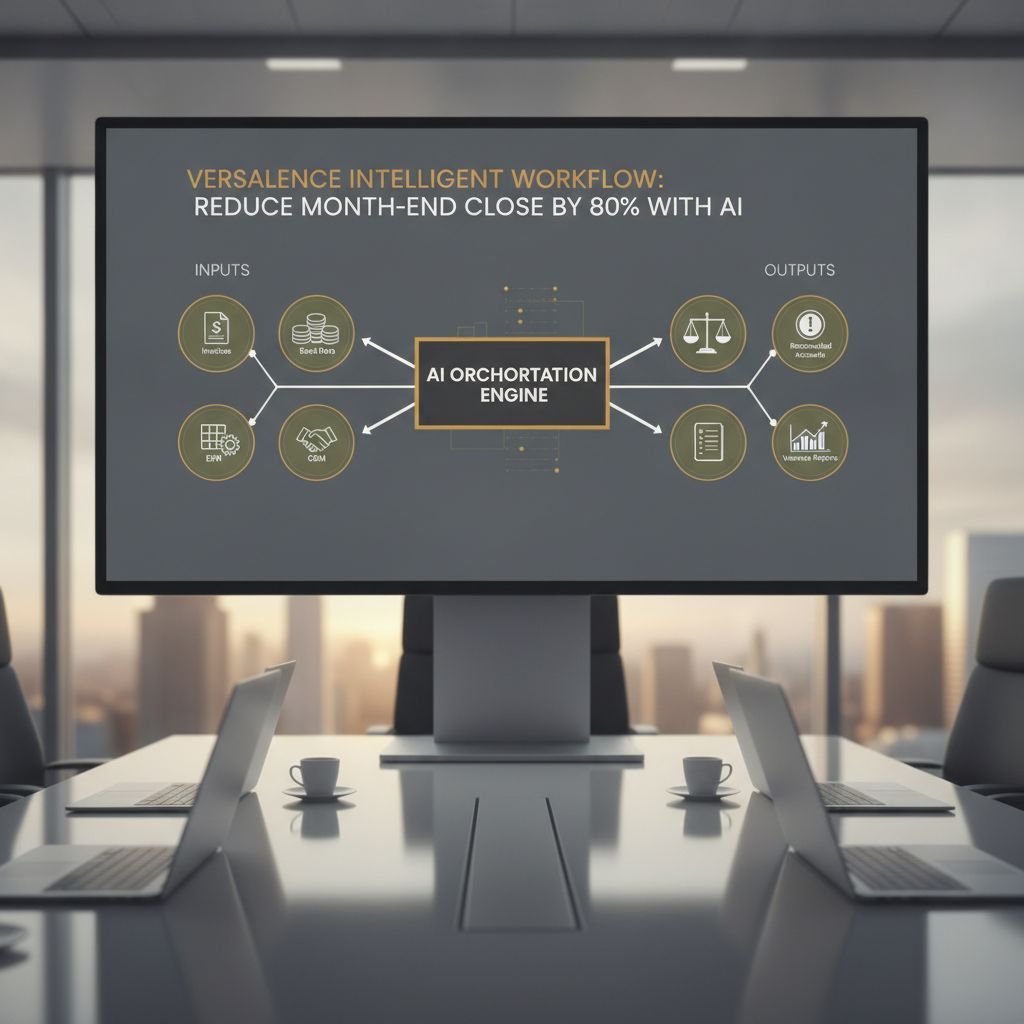
What if you could transform this grueling, week-long marathon into an 18-hour, highly automated sprint? What if your finance team could spend less time chasing numbers and more time analyzing them to guide business strategy? This isn't a far-off vision; it's the tangible reality that AI-powered automation is delivering today. At Versalence AI, we build the intelligent systems that turn this possibility into a standard operating procedure.
The True Business Cost of a Slow Financial Close
The problem with a slow month-end close extends far beyond the frustration of your accounting team. It creates cascading negative impacts across the entire organization, hindering agility and strategic planning.

1. Delayed Decision-Making: When executives have to wait until the 7th or 8th of the following month to get a final P&L statement, they are making critical decisions based on outdated information. In a fast-moving market, this lag can be the difference between capitalizing on an opportunity and missing it entirely. An 18-hour close cycle means leadership gets a clear, accurate financial snapshot while the previous month is still relevant, enabling proactive, data-driven leadership.
2. The Opportunity Cost of Talent: Your finance professionals are highly skilled analysts, not data-entry clerks. Every hour they spend manually ticking and tying transactions in a spreadsheet is an hour they aren't spending on high-value activities like financial planning and analysis (FP&A), cash flow forecasting, building financial models, or partnering with departmental heads to optimize budgets. A 5-day close forces your team into a tactical, reactive role. An 18-hour close empowers them to be strategic advisors to the business.
3. Increased Risk of Errors and Non-Compliance: Manual processes are inherently prone to error. A transposed number, a missed accrual, or an incorrect formula can lead to inaccurate financial statements, requiring costly restatements and damaging investor confidence. Automated systems, by contrast, execute predefined rules flawlessly every time. They create a clear, immutable audit trail for every transaction and journal entry, simplifying compliance and making audits significantly less painful.
4. Inability to Scale: As your company grows, so does the volume and complexity of its financial transactions. A manual closing process that is manageable at 1,000 transactions per month will completely break down at 10,000. Hiring more people is a linear, expensive solution. AI-powered automation provides a scalable foundation that handles increased volume without a proportional increase in headcount or processing time.
The Versalence Blueprint: Automating the Close from End to End
Achieving an 85% reduction in close cycle time—from 120 hours (5 days) to just 18—requires more than just basic RPA bots. It demands a holistic, intelligent system that orchestrates data, applies machine learning for complex tasks, and provides a simple interface for human oversight. Here’s how we architected this solution.
We began by deconstructing the month-end close into its core components and applied a specific AI-driven approach to each.
Image Prompt 1: Process Diagram

Stage 1: Intelligent Data Ingestion and Validation
The first challenge is gathering data from a multitude of disconnected systems: your ERP (like NetSuite or SAP), CRM (Salesforce), bank portals, expense management tools (Expensify), and countless invoices and receipts arriving as PDFs via email.
- Our Solution: We deploy a combination of API connectors and AI-powered data extraction agents.
- API Integration: For structured systems like your ERP and CRM, direct API calls pull transactional data in real-time, eliminating manual exports and imports.
- Intelligent Document Processing (IDP): For unstructured documents like vendor invoices or bank statements, our AI uses Optical Character Recognition (OCR) to digitize the text and Natural Language Processing (NLP) to understand it. It can identify key fields like invoice number, date, amount, and line items with super-human accuracy, regardless of the document's layout.
- Automated Validation: As data is ingested, the system automatically runs validation checks. Does the PO number on the invoice match a PO in the ERP? Do the invoice totals add up? This catches errors at the source, before they contaminate your general ledger.
Stage 2: AI-Powered Reconciliation
This is often the most time-consuming part of the close. Manually matching thousands of transactions between bank statements, accounts receivable ledgers, and accounts payable ledgers is tedious and soul-crushing.
- Our Solution: We implement a machine learning-based reconciliation engine.
- Initial Rules-Based Matching: The engine starts by clearing the easy matches—exact amount, similar date, matching reference number. This handles 70-80% of transactions instantly.
- Learned Pattern Recognition: For the remaining complex matches, the AI model analyzes historical data to learn how your team has previously resolved discrepancies. It understands patterns like bundled payments, minor currency fluctuations, or common abbreviations in transaction descriptions.
- Exception-Based Workflow: The system’s goal is not 100% automation, but 100% confidence. It automates what it knows and flags only the true exceptions—transactions it cannot match with high certainty—for human review. Instead of reviewing 10,000 transactions, your accountant reviews 50.
Stage 3: Automated Journal Entry Generation

Many standard journal entries—like accruing for prepaid expenses, recognizing deferred revenue, or calculating asset depreciation—are rule-based and perfect candidates for automation.
- Our Solution: An intelligent workflow orchestrator triggers and posts these entries automatically.
- Accruals & Deferrals: The system scans invoices and contracts for terms related to pre-payments or multi-month services. It then automatically calculates the correct monthly expense or revenue recognition and generates the corresponding journal entries.
- Depreciation Schedules: Connected to your fixed asset register, the system automatically runs depreciation calculations based on predefined schedules (e.g., straight-line over 5 years) and posts the entries without any human touch.
Stage 4: The Conversational AI Command Center
Power is useless without control. Instead of forcing the finance team to navigate a complex dashboard, we provide a simple, intuitive conversational interface for them to manage and monitor the entire process.
- Our Solution: We build a custom AI assistant using powerful open-source platforms like Botpress. Our contributions and work with the
versalenceai/botpressrepository allow us to create robust, enterprise-grade conversational AIs that serve as the "front door" to our automation engine.
Image Prompt 2: Conversational AI Interface

With this interface, a Financial Controller can simply type or ask:
- "Kick off the month-end close sequence."
- "What is the status of the bank reconciliation for the main operating account?"
- "Show me all un-accrued invoices over $20,000."
- "Notify me when the preliminary trial balance is ready."
The AI assistant provides real-time answers, executes commands, and proactively alerts users when their input is needed to resolve an exception. This transforms the user experience from actively doing the work to passively supervising the automated work.
Expanding the Automation Framework: Related Solutions
The core architecture—an intelligent workflow orchestrator, AI-powered data processing, and a conversational interface—is incredibly versatile. The same framework we use to revolutionize the month-end close can be adapted to streamline other critical business functions. Our expertise, demonstrated in our work on open-source projects like versalenceai/botpress, allows us to rapidly deploy these solutions.
- Procure-to-Pay (P2P) Automation: We can automate the entire lifecycle of an invoice, from intelligent capture and 3-way matching (PO, goods receipt, invoice) to automated approval routing and payment processing.
- Order-to-Cash (O2C) Automation: AI can automate sales order creation from customer emails or portals, perform automated credit checks, generate invoices, and manage collections by sending intelligent reminders.
- Intelligent HR Onboarding: A conversational assistant can guide new hires through paperwork, provision system access, and answer common questions, creating a seamless Day 1 experience while freeing up HR staff.
The foundational technology is the same; only the business logic and data sources change. This allows our clients to see compounding returns on their investment in automation.
The Tangible Results: Beyond Just Speed
Transforming a 5-day process into an 18-hour one delivers a powerful and multifaceted return on investment. The outcomes we typically see are nothing short of game-changing.
- Drastic Cycle Time Reduction (85%): The headline result. Reducing the close from 120 calendar hours to 18 hours means financial statements are ready for review on the first business day of the new month, not the second week.
- Near-Perfect Accuracy: By removing manual data entry and reconciliation from the equation, we’ve seen clients reduce post-close adjustments and errors by over 90%. The books are not only closed faster, but they are also more accurate and reliable.
- Reclaimed Strategic Hours: A finance team of five might collectively spend 150 hours on a manual close. With our solution, that can be reduced to under 20 total hours, primarily focused on reviewing exceptions and performing high-level analysis. This frees up over 130 hours of highly skilled labor every single month to be re-invested in activities that drive business growth.
- Enhanced Auditability and Compliance: Every automated action is logged, time-stamped, and traceable. This creates a perfect digital audit trail that drastically reduces the time and effort required to prepare for an external audit, often cutting preparation time by 40-50%.
- Improved Employee Morale: Removing the most tedious, repetitive, and stressful part of their job leads to a happier, more engaged finance team. It helps you retain top talent by offering them more meaningful and strategic work.
It's Time to Close the Books on Manual Processes
The month-end close doesn't have to be a source of dread and inefficiency. It can be a streamlined, automated, and strategic process that empowers your business with timely, accurate financial intelligence. By leveraging a cohesive system of AI-powered workflows, intelligent data processing, and user-friendly conversational interfaces, the transformation is not only possible but essential for any forward-looking organization.
Is your finance team still buried in spreadsheets at the end of every month? Are you making critical decisions with last week's data?
Let Versalence AI show you how intelligent automation can redefine your financial operations.
Schedule a free consultation with our automation experts today.
For direct inquiries, please email our team at sales@versalence.ai.
Work With Versalence
Ready to remove the drag from your business operations? Our AI automation and system integration team delivers measurable results in 30-120 days.
📧 Contact us
✉️ sales@versalence.ai