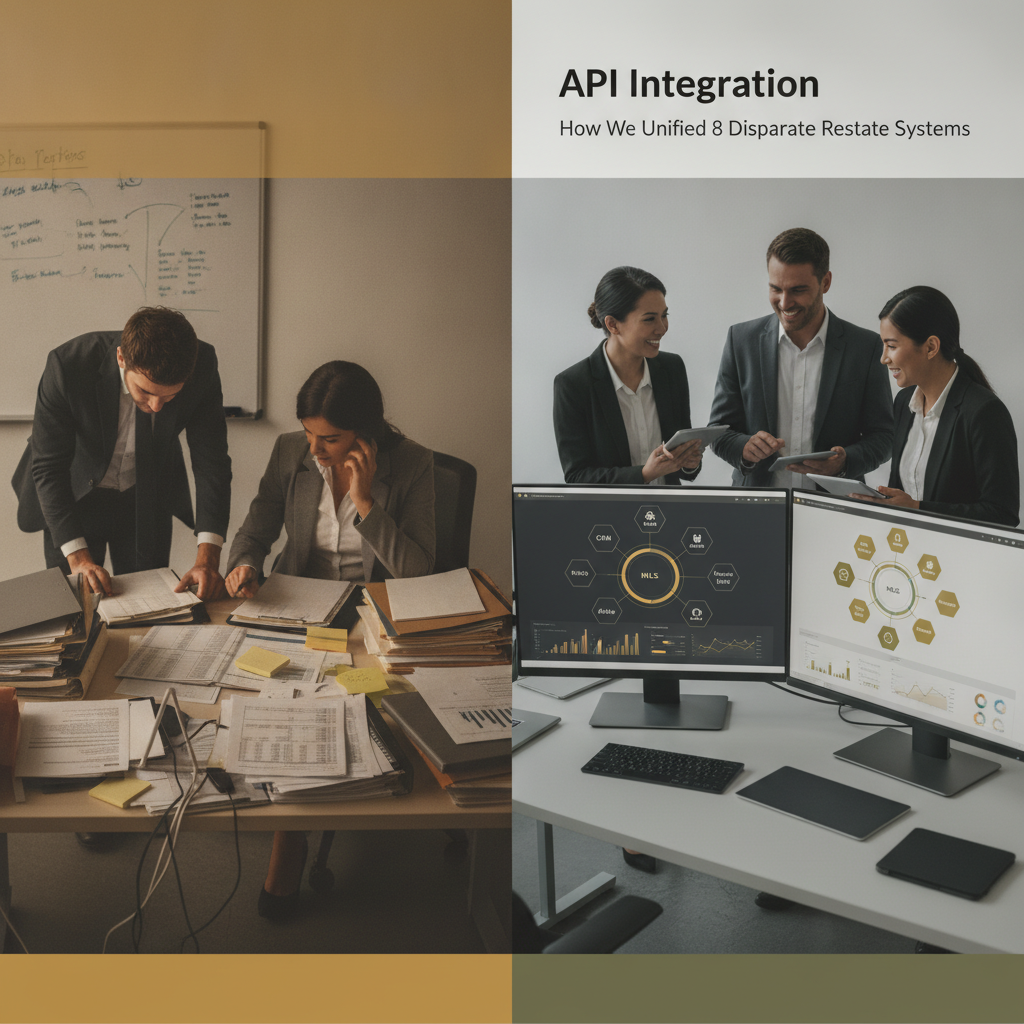
API Integration: How We Unified 8 Disparate Real Estate Systems
In the fast-paced world of commercial and residential real estate, data is the most valuable asset. It’s the bedrock of every property valuation, client relationship, and market forecast. Yet for many large-scale firms, this critical asset is fragmented, locked away in a maze of disconnected software systems. A recent study by MuleSoft found that the average enterprise uses 976 different applications, but only 28% of them are integrated. This creates digital friction, slows down operations, and ultimately, costs millions in lost opportunities.
Imagine an agent trying to prepare for a high-value client meeting. They need to pull client history from the CRM, check current listings from the MLS, review past transactions from the accounting system, and access legal documents from a separate repository. This simple task becomes a time-consuming ordeal of logging into four different systems, manually cross-referencing information, and praying the data is consistent. Now, multiply that inefficiency by thousands of agents across a national or global enterprise. The scale of the problem becomes staggering.
This was the exact challenge facing one of our clients, a real estate giant with a portfolio spanning multiple continents. Their growth, fueled by acquisitions and diversification, had led to a complex and unwieldy tech stack. Eight critical systems, each a specialist in its domain, operated in near-total isolation. This wasn’t just an inconvenience; it was a fundamental barrier to their strategic goals of providing seamless client service and empowering their agents with real-time, data-driven insights.
At Versalence AI, we specialize in transforming this kind of operational chaos into a streamlined, intelligent ecosystem. This is the story of how we applied an API-first strategy, powered by AI-driven automation, to connect eight disparate systems, creating a single source of truth that revolutionized how our client does business.
The Crippling Cost of Disconnected Data

Before we dive into the solution, it’s crucial to understand the business impact of the problem. For this real estate leader, the data silos weren't just a technical headache; they were a direct drain on profitability and competitive advantage.
- Agent Inefficiency and Burnout: Agents spent an estimated 20-30% of their time on non-revenue-generating activities, primarily hunting for information and performing manual data entry. This repetitive, low-value work led to frustration and detracted from what they do best: building relationships and closing deals.
- Poor Customer Experience: When a client called with a query, getting a complete answer was a multi-step process. An agent might have to put them on hold to consult with accounting or the property management team. This delay eroded client trust and made the firm appear disorganized.
- Inaccurate Reporting and Forecasting: With data scattered across different platforms, generating accurate, consolidated reports for leadership was a monumental, manual task prone to human error. Strategic decisions were being made based on stale or incomplete information, creating significant business risk.
- Operational Bottlenecks: The process of onboarding a new property, from listing to final sale, involved multiple, disjointed workflows. A simple typo in one system could cause a cascade of errors downstream, delaying closing dates and impacting cash flow.
The core issue was a lack of a unified data language. Each system—from the CRM to the property management software—had its own data structure, its own terminology, and its own API (if it had one at all). A "client" in the CRM might be a "tenant" in the property management system and a "payer" in the accounting software. Bridging these gaps manually was simply unsustainable.
The Versalence Solution: An AI-Powered Integration Fabric
Our approach was not to rip and replace the client's existing systems. These were best-in-class tools that their teams relied on. Instead, we designed and built an intelligent integration fabric—a central nervous system that would allow these applications to communicate seamlessly. This was accomplished through an API-first methodology, where we treated every data point and every business function as a service that could be accessed through a well-defined, secure API.
Here’s a breakdown of the eight systems we integrated and the architecture that brought them together:
- Salesforce (CRM): The central hub for all client, lead, and opportunity data.
- Proprietary MLS Aggregator: A custom-built tool that pulled data from dozens of regional Multiple Listing Services.
- Yardi (Property Management): Managed leasing, maintenance, and operational data for their commercial portfolio.
- SAP (Financials/ERP): The system of record for all accounting, invoicing, and financial reporting.
- HubSpot (Marketing Automation): Handled email campaigns, lead nurturing, and marketing analytics.
- DocuSign (Document Management): The repository for all contracts, lease agreements, and legal paperwork.
- Custom Agent Portal (Internal Platform): The primary daily interface for the company's thousands of agents.
- Zendesk (Customer Support): Managed all incoming support tickets and client communications.
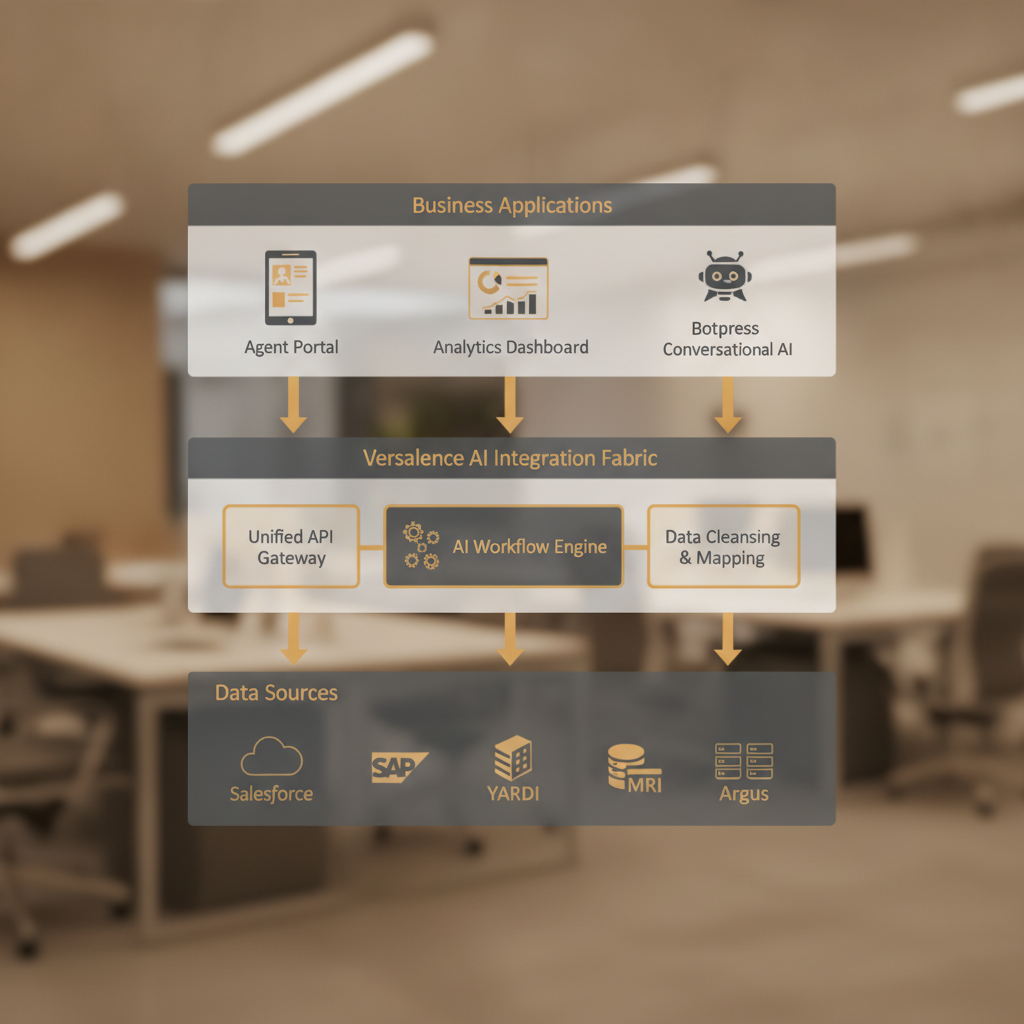
Our solution architecture was built on three core pillars: a Unified API Gateway, an AI-Powered Workflow Engine, and a Conversational AI Interface.
Pillar 1: The Unified API Gateway
The first step was to create a single, consistent point of access to all the data. We developed a central API Gateway that acted as a translator. An application, like the Agent Portal, no longer needed to know the specific, complex details of how to query Salesforce, Yardi, and SAP individually. It simply made one clean request to our Unified API, such as: GET /properties/{property_id}/full_details.
Behind the scenes, the gateway would intelligently:
- Fetch the core property details from the MLS Aggregator.
- Retrieve the tenant and lease information from Yardi.
- Pull the latest financial performance data from SAP.
- Gather related client communications from Salesforce.
It would then consolidate, standardize, and return this information in a single, easy-to-use JSON object. This dramatically simplified front-end development and ensured that every application was working from the same, real-time data.
Pillar 2: The AI-Powered Workflow Engine

With the data now accessible, the next step was to automate the business processes that spanned multiple systems. This is where our AI capabilities came into play. We built an intelligent workflow engine that could orchestrate complex, multi-step processes based on specific triggers.
- Intelligent Data Mapping: One of the most time-consuming parts of any integration project is mapping fields between systems (e.g.,
cust_IDin one system tocustomer_identifierin another). We used machine learning models trained on millions of data schemas to suggest and, in many cases, automate these mappings, reducing manual configuration time by over 70%. - Automated "New Listing" Workflow: When a new property was added to the MLS feed, our engine would trigger a multi-step workflow:
- Create a new "opportunity" record in Salesforce.
- Automatically generate a marketing package draft in HubSpot.
- Create a folder structure and placeholder contracts in DocuSign.
- Notify the assigned agent team via the internal portal.
- Schedule a "30-day review" task to assess initial performance.
- AI-Driven Data Cleansing: The engine also incorporated AI models to clean and enrich data in transit. It could standardize addresses to a single format, automatically flag duplicate client records across systems, and even use external data sources to append missing information, like school district ratings for a residential property.
Pillar 3: Conversational AI for Unprecedented Access
The final, and perhaps most transformative, layer of our solution was a conversational AI assistant, built for the agents and accessible directly within their internal portal. With a unified backend, we could now provide a natural language interface to their entire data universe.
For this, we leveraged powerful open-source platforms like Botpress, which provides the foundation for building sophisticated, next-generation chatbots. By connecting a Botpress-powered assistant to our Unified API Gateway, we enabled agents to ask complex questions in plain English:
- "Show me all available office spaces in the downtown core over 5,000 sq ft with a lease expiring in the next 6 months."
- "What was the final sale price for 123 Main Street and who was the client?"
- "Generate a Q3 performance report for my top five clients."
The AI assistant would parse the natural language query, translate it into the necessary API calls to our integration fabric, and return the answer in seconds. This eliminated the need for agents to navigate complex dashboards or learn how to use multiple software interfaces. It put the full power of the company's data directly at their fingertips, accessible through a simple chat window.
Related Solutions: A Pattern of Integration Excellence
The principles we applied for this real estate giant are not unique to the industry. The challenge of integrating disparate systems is universal, and our AI-powered approach is highly adaptable. We've built similar integration fabrics for clients in other complex sectors:
- E-commerce: Connecting Shopify, NetSuite (ERP), a 3PL logistics provider, and Zendesk to create a seamless order-to-fulfillment-to-support lifecycle.
- Healthcare: Integrating an Electronic Health Record (EHR) system with a billing platform, a patient communication portal, and a pharmacy management system to improve patient care and streamline revenue cycle management.
- Manufacturing: Linking a MES (Manufacturing Execution System) with a supply chain management platform, a CRM, and a quality control system to provide a real-time view of the entire production floor.
The core components—a unified API, intelligent workflows, and often a conversational AI layer—form a repeatable blueprint for digital transformation in any data-intensive enterprise.
Results & ROI: From Fragmentation to a Force Multiplier
The implementation of the Versalence AI integration fabric delivered tangible, measurable results for our client within the first six months.
- 80% Reduction in Manual Data Entry: By automating workflows like new property onboarding and client report generation, we freed up thousands of hours of agent time per month.
- 35% Increase in Agent Productivity: With instant access to unified data through the portal and the AI assistant, agents could respond to client needs faster and manage a larger portfolio of opportunities effectively.
- 15-Day Reduction in Average Deal Cycle: Streamlining the documentation and financial verification processes by connecting DocuSign and SAP directly to the workflow engine eliminated key bottlenecks, accelerating the time from offer to close.
- 99.8% Data Accuracy: The AI-powered data cleansing and standardization rules virtually eliminated the errors that arose from manual data transfer, leading to more reliable reporting and increased trust in the data.
Perhaps the most significant outcome was a cultural shift. Data was no longer seen as a barrier but as an enabler. Agents felt more empowered, leadership had a clear and accurate view of the business, and the IT department could focus on innovation instead of maintaining brittle, point-to-point integrations. The client transformed from a collection of high-performing but siloed departments into a truly integrated, data-driven enterprise.
Is Your Business Ready for a Unified Future?
If your teams are spending more time fighting with their software than serving your customers, it’s time to consider a new approach. The challenges of integrating disparate systems are complex, but the solution doesn't have to be a multi-year, rip-and-replace nightmare.
By adopting an API-first strategy and leveraging the power of AI-driven automation, you can create a flexible, scalable integration fabric that unlocks the true value of your data. You can empower your employees, delight your customers, and build a sustainable competitive advantage for the future.
At Versalence AI, we build the intelligent connections that power modern business. If you’re ready to break down your data silos and build a more connected enterprise, we’re here to help.
Contact us today at sales@versalence.ai or visit versalence.ai to schedule a free consultation and discover what's possible.
Work With Versalence
Ready to remove the drag from your business operations? Our AI automation and system integration team delivers measurable results in 30-120 days.
📧 Contact us
✉️ sales@versalence.ai