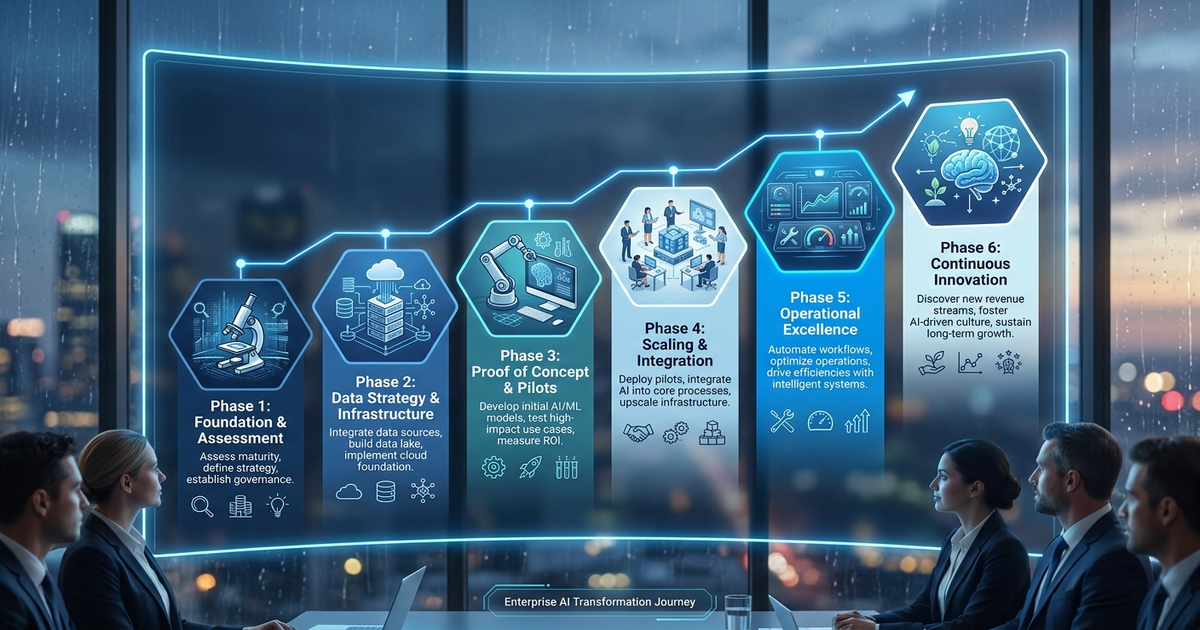
From Pilots to Production: The 6-Phase Enterprise AI Implementation Framework
By 2025, 88% of enterprises now deploy AI in some form. Yet 70% to 85% of AI projects fail to meet expectations. The difference between the 12% who scale successfully and the majority who stall is not technology selection. It is implementation discipline.
Enterprise AI transformation follows predictable patterns. Organizations that achieve 300-500% ROI within 24 months do not stumble into success. They follow structured frameworks validated across Fortune 500 deployments. This guide presents the six-phase implementation framework that separates transformative AI initiatives from costly experiments.
The data tells a clear story. Companies with C-suite sponsorship report 78% ROI rates versus 72% without executive backing. Organizations that purchase specialized AI applications see 67% success rates, while those building in-house succeed only 33% of the time. Top performers achieve $10.30 return per dollar invested, while average organizations see $3.70. The framework in this article explains how to join the top tier.
Phase 1: Strategic Assessment and Use Case Prioritization (Weeks 1-3)
Business Readiness Evaluation
Successful AI transformation begins with honest assessment. Before selecting models or writing code, evaluate organizational readiness across four dimensions: leadership commitment, financial resources, technical infrastructure, and cultural appetite for change.
Leadership commitment requires more than budget approval. It demands active sponsorship from C-level executives who understand AI capabilities and limitations. Organizations with comprehensive executive backing report 78% ROI rates compared to 72% for those without such support. The executive sponsor must navigate organizational politics, unblock resources, and maintain momentum when projects face inevitable setbacks.
Financial assessment examines not just initial investment but total cost of ownership. Enterprise AI spending reached $37 billion in 2025, up 3.2x from 2024. Budget planning must cover model licensing, infrastructure, talent acquisition, change management, and ongoing optimization. Organizations that underestimate total costs by focusing only on pilot expenses face funding shortfalls during scaling.
Use Case Identification and Prioritization
The most successful implementations focus on 3-5 high-impact use cases rather than spreading efforts across dozens of experiments. High-performing companies concentrate resources on opportunities with clear P&L impact rather than pursuing AI for its own sake.
Effective prioritization uses an impact-feasibility matrix. High-impact, high-feasibility use cases become Phase 1 priorities. High-impact, low-feasibility projects enter a research pipeline. Low-impact projects receive no resources regardless of feasibility. This disciplined approach prevents the scattered efforts that characterize failed implementations.
High-value use cases in 2025 include customer service automation with first-contact resolution improvements, content operations that produce 10x output in 80% less time, software delivery acceleration through AI-assisted development, and document processing workflows with structured extraction and validation.
Success Metrics Definition
Define success before beginning implementation. Target metrics should include 70% adoption rate within 90 days, time-to-value under 90 days, and 200%+ ROI within 12 months. Without clear metrics, projects drift and stakeholders lose interest.
Phase 2: Technical Architecture and Infrastructure Design (Weeks 4-6)

Build vs Buy vs Partner Decisions
The 2025 data is clear: 76% of successful AI solutions are purchased, not built. Organizations trying to build everything in-house succeed only 33% of the time. This does not mean abandoning customization. It means leveraging proven platforms while focusing internal resources on integration and domain-specific adaptation.
Platform selection depends on existing infrastructure. Microsoft-centric organizations benefit from Copilot integration. Google Cloud users leverage Gemini Enterprise with native Workspace connectivity. AWS environments favor Amazon Q and Bedrock services. The goal is minimizing integration complexity while maximizing capability.
Data Foundation Requirements
AI systems require clean, accessible, and governed data. Organizations often discover significant technical debt during this phase. Data quality issues that seemed manageable for reporting become blockers for AI deployment.
Data readiness spans four areas. Catalog sources and establish lineage tracking. Implement purpose limitation and retention policies. Create unified data models for AI consumption. Build monitoring and quality frameworks. Organizations that skip this phase face production delays and unreliable AI outputs.
Security and Compliance Architecture
Security concerns top the list of AI adoption barriers, cited by 35% of organizations. Data privacy ranks as the primary consideration when evaluating LLM providers for 37% of enterprises. Architecture decisions made in this phase determine whether the organization can deploy at scale or remains stuck in pilot purgatory.
Adopt secure-by-default guardrails from the start. Implement secrets handling, encrypted token storage, and model permissioning. Establish incident playbooks before deployment. For regulated industries, design audit trails and human oversight workflows that satisfy compliance requirements.
Phase 3: Data Pipeline Development (Weeks 7-10)
Data Engineering for AI Consumption
AI implementations consume 40-60% of their timeline and budget on data engineering. This surprises organizations that underestimate the gap between raw enterprise data and AI-ready formats. Plan for this investment from the start.
Pipeline development includes three core components. Ingestion pipelines extract data from source systems. Transformation workflows clean, normalize, and enrich data for AI consumption. Quality frameworks validate outputs and flag anomalies before they reach production models.
Vector Database and RAG Infrastructure
Retrieval-Augmented Generation has become standard for enterprise AI. RAG systems ground LLM outputs in organizational knowledge, reducing hallucinations and enabling responses based on proprietary data. Implementation requires vector database selection, embedding model integration, and retrieval optimization.
Vector database options include Pinecone for managed simplicity, Weaviate for open-source flexibility, and pgvector for PostgreSQL integration. Embedding model selection balances cost and quality, with OpenAI text-embedding-3-large leading on benchmarks and open alternatives like BGE and E5 providing cost-effective options.
Phase 4: AI System Development (Weeks 11-16)
Agent Architecture Patterns
The shift from generative AI to agentic AI represents a fundamental change in how organizations deploy intelligent systems. Generative AI provides power tools that augment human capabilities. Agentic AI deploys autonomous systems that execute entire workflows with minimal supervision.
Three architecture patterns dominate enterprise deployments. Single agents with tool access handle focused tasks like research or calculations. Supervisor-worker architectures coordinate specialized agents for complex workflows. Multi-agent systems enable peer-to-peer collaboration on distributed problems.
Pattern selection depends on use case complexity. Simple automation tasks suit single agents. Enterprise workflows requiring multiple capabilities benefit from supervisor architectures. Research and analysis tasks that explore multiple paths simultaneously leverage multi-agent designs.
Human-in-the-Loop Integration
Not all AI actions should execute automatically. Financial transactions, data deletions, and external communications require human approval. Design interrupt points where execution pauses for human review.
Effective approval workflows provide clear context about intended actions and their implications. Support both approval and rejection paths with appropriate follow-up. Log all decisions for audit and compliance. Organizations that neglect human oversight face regulatory scrutiny and operational risk.
Phase 5: Pilot Deployment and Validation (Weeks 17-20)

Controlled Rollout Strategy
Deploy AI systems to pilot user groups before organization-wide rollout. Time-box pilots to 30-60 days to maintain stakeholder interest. Extended pilots lose momentum and executive attention.
Pilot group selection matters. Choose enthusiastic, tech-savvy departments with measurable outputs. Engineering and marketing often serve as effective pilot groups. Ten to fifty users provides sufficient feedback without overwhelming support capacity.
Performance Monitoring and Feedback Loops
Track metrics that demonstrate business value, not just technical performance. Monitor task completion rates, time savings, output quality, and user satisfaction. Compare results against baseline measurements taken before AI deployment.
Implement feedback mechanisms that improve the system over time. Capture user corrections and satisfaction ratings. Use this data to refine prompts, adjust retrieval strategies, and identify additional training needs. Organizations that treat pilots as learning opportunities rather than pass/fail tests achieve better long-term outcomes.
Phase 6: Production Rollout and Continuous Improvement (Week 21+)
Phased Organization-Wide Deployment
Roll out successful AI systems to all users in phases rather than big-bang deployments. Add one department every 2-4 weeks, starting with the most enthusiastic adopters. This approach limits risk exposure and allows iterative refinement based on real-world usage patterns.
Establish champions programs that convert pilot users into internal AI experts. These champions support new users, share best practices, and identify opportunities for improvement. Organizations with formal champions programs achieve 78% user adoption rates compared to 45% for those without such support.
Governance Evolution and Risk Management
Update governance policies based on real-world usage, new AI capabilities, and changing regulations. The EU AI Act, NIST AI RMF, and ISO/IEC 42001 provide frameworks for responsible AI deployment. Align internal policies with these standards to demonstrate trustworthy AI practices.
Gartner projects that 40% of agentic AI projects will fail by 2027 due to escalating costs, unclear business value, and inadequate risk controls. Organizations that establish governance frameworks from Phase 1 avoid these pitfalls. Those that treat governance as an afterthought join the failure statistics.
Innovation Pipeline and Advanced Integration
Dedicate resources to exploring emerging AI tools and experimental use cases. The AI landscape evolves rapidly. Capabilities that seem cutting-edge today become baseline expectations within quarters. Organizations without innovation pipelines fall behind competitors who continuously adapt.
Advanced integration moves beyond individual productivity to team workflows, custom integrations, and autonomous agent deployments. By month 13-24, leading organizations deploy AI agents that execute complete workflows, integrate across enterprise systems, and deliver measurable P&L impact.
Critical Success Factors
Beyond the six-phase framework, five factors separate successful implementations from failed projects.
Executive Sponsorship: AI transformation requires C-level champions who can unblock resources and navigate organizational politics. Three times higher success rate correlates directly with executive commitment.
Cross-Functional Teams: Do not silo AI in IT or data science. Build teams including business stakeholders, domain experts, engineers, and operations leaders. Diversity of perspective prevents blind spots that derail projects.
Start Small, Scale Fast: Pick one high-value use case for first implementation. Prove ROI quickly, then expand to adjacent use cases. Organizations that attempt too much simultaneously achieve nothing.
Change Management Investment: Technical excellence means nothing if users resist adoption. Plan comprehensive training, communication, and support. Organizations with structured change management programs achieve 65% faster implementation and 78% user adoption.
Build for Scale from Day One: Even pilots should use architectures that handle enterprise deployment without rework. The cost of rebuilding after pilot success exceeds the cost of building correctly from the start.
Conclusion
Enterprise AI implementation is not a technology challenge. It is an organizational transformation challenge. The 12% who scale successfully follow frameworks that address both dimensions. They invest in data foundations, select appropriate platforms, build cross-functional teams, and govern responsibly.
The six-phase framework in this article provides a roadmap from initial assessment through production deployment. Each phase builds on the previous, reducing risk while accelerating time-to-value. Organizations that skip phases or rush through them join the 70-85% who fail to meet expectations.
The AI market grows at 44.6% CAGR toward $199 billion by 2034. Agentic AI will contribute $2.6-4.4 trillion annually to global GDP by 2030. These numbers represent opportunity for organizations that implement effectively and threat for those that fall behind. The framework in this article provides the discipline required to capture that opportunity.
Work With Versalence
We help small businesses navigate the transition from public AI to private, sovereign AI systems:
- AI Infrastructure Assessment — Evaluate systems and identify high-ROI opportunities
- Custom Deployment AI Services — Enterprise grade platform development and deployment
- RAG Implementation — Vector & Graph DB to elevate your AI's ability to provide precise and accurate results
📧 versalence.ai/contact.html | sales@versalence.ai