
Zero-Touch Claims Processing: How We Automated 68,000 Claims a Month
The Silent Killer of Scaling: Manual Claims Processing
In the world of high-growth SaaS, logistics, and insurance, there's an operational bottleneck that quietly strangles efficiency and inflates costs: manual claims processing. For one of our clients, a leading SaaS provider in the supply chain industry, this bottleneck had become a crisis. They were processing over 68,000 shipping insurance claims every month, and their manual workflow was buckling under the pressure.
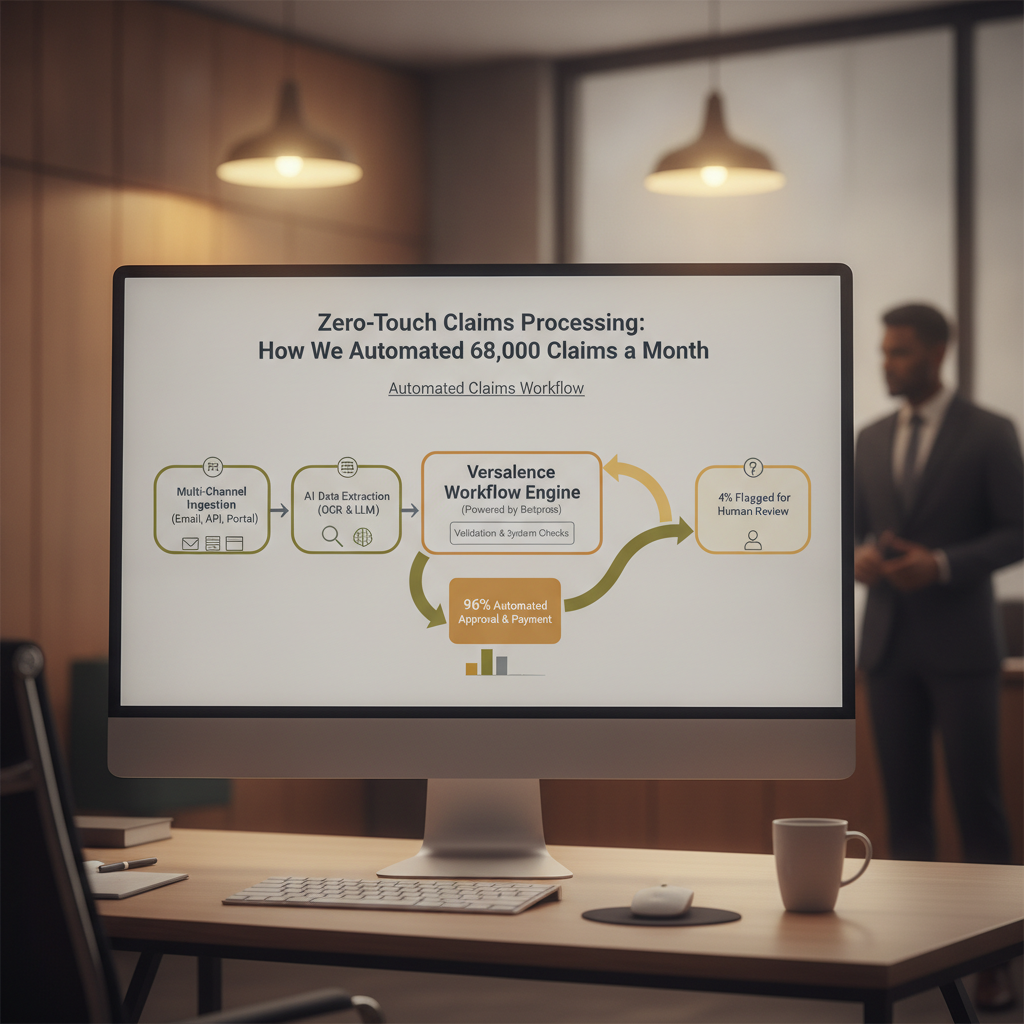
The process was a familiar one. A team of dozens of specialists would manually open emails, download PDFs and images, decipher claim forms, cross-reference data in multiple internal systems, and finally, approve or deny the claim. Each touchpoint was a potential source of delay and error.
This isn't an isolated problem. Industry data consistently shows that manual data entry has an error rate of up to 4%. While that sounds small, for a company processing 68,000 claims, it translates to over 2,700 errors every single month—errors that lead to incorrect payouts, compliance risks, and frustrated customers. The cost isn't just in errors; it's in time. The average cost to manually process a single invoice or simple claim can range from $5 to $15. For our client, that meant an operational expenditure approaching half a million dollars every month, just to keep their heads above water.
They faced a classic scaling dilemma: hire more people, which is slow and expensive, or watch customer satisfaction plummet as processing times stretched from days into weeks. They needed a third option—a way to decouple their growth from their operational headcount. They needed to automate.
The True Business Impact of an Outdated Workflow
Before we dive into the solution, it's crucial to understand the deep, systemic damage that manual claims processing inflicts on a business. It’s not just about a cluttered inbox; it’s about a direct impact on the bottom line and competitive positioning.
1. Unsustainable Operational Costs: The most immediate pain is financial. A dedicated team for claims processing represents a significant payroll expense. This cost scales linearly with claim volume. If business doubles, the team size and its associated costs must also double. This model creates a permanent drag on profitability, consuming resources that could be invested in product development, marketing, or customer success. Our client was spending over 8,000 person-hours per month on this repetitive task, a staggering figure that was simply not sustainable.
2. The Inevitable Scalability Ceiling: A business can only grow as fast as its least efficient process. When your back-office operations rely on human speed, you hit a hard ceiling. Onboarding and training new team members takes weeks, if not months. During peak seasons or periods of rapid growth, the backlog explodes. This inability to scale dynamically means turning down business, failing to meet service level agreements (SLAs), and ceding ground to more agile competitors.
3. The Compounding Effect of Human Error: Humans are brilliant at complex problem-solving, but we are notoriously poor at high-volume, repetitive data entry. Fatigue, distraction, and simple mistakes lead to errors. In a claims environment, these errors have severe consequences:
- Overpayments: Directly impact revenue.
- Underpayments: Create angry customers and potential legal challenges.
- Data Entry Mistakes: Corrupt your core business data, leading to flawed analytics and poor decision-making.
- Compliance Breaches: Failure to follow specific validation rules can result in hefty fines and reputational damage.
4. A Damaging Customer Experience (CX): In today's market, customer experience is a key differentiator. A slow, opaque, and error-prone claims process is a recipe for customer churn. When a customer submits a claim, they are often already in a stressful situation. A lengthy and frustrating resolution process adds insult to injury. Conversely, a fast, transparent, and accurate process builds immense trust and loyalty. Our client knew that their average 5-7 day processing time was a major point of friction for their users.
How Versalence Built a Zero-Touch Automation Engine
To solve this monumental challenge, we didn't just apply a patch; we engineered a comprehensive, end-to-end intelligent automation solution. Our approach combined cutting-edge AI for data extraction with a powerful workflow engine to create a system that could handle the entire process with zero human intervention for the vast majority of claims.
The architecture was designed for resilience, accuracy, and scalability. Here’s how it works:
Step 1: Omni-Channel Ingestion
Claims don't arrive in a single, neat package. They come from everywhere: emails with PDF attachments, images of receipts sent from a mobile app, structured data from a web portal, or direct API calls from a partner system. Our solution first establishes a unified ingestion point that captures and standardizes all incoming claims, regardless of their source. This ensures no claim is lost and that every piece of data enters the same robust processing pipeline.
Step 2: Intelligent Document Processing (IDP) with AI
This is where the magic begins. Once a document (like a claim form, invoice, or bill of lading) is ingested, our AI-powered IDP module takes over.
- Optical Character Recognition (OCR): The system first digitizes the document, converting images and PDFs into machine-readable text with near-perfect accuracy.
- Data Extraction via LLMs: We then leverage state-of-the-art Large Language Models (LLMs), similar to the technology powering ChatGPT, but fine-tuned for document analysis. The LLM reads the text and intelligently identifies and extracts key pieces of information—claimant name, policy ID, date of loss, itemized costs, tracking numbers, and more. It understands context, meaning it can differentiate between a "shipping date" and a "delivery date" without being explicitly programmed for every possible document layout.
This step alone eliminates the most time-consuming and error-prone part of the manual process: re-keying data from a document into a system.
Step 3: The Brain - A Versalence Workflow Engine Powered by Botpress

With structured, validated data in hand, the claim enters the core of our solution: the intelligent workflow engine. At Versalence, we build these powerful and flexible engines using platforms like Botpress, an open-source framework for creating sophisticated AI assistants and chatbots. While you might think of a "chatbot" as just a customer-facing tool, the underlying technology is perfect for orchestrating complex back-end processes.
Our use of the Botpress SDK and integrations, as seen in our own versalenceai/botpress repository, allows us to build a custom "Claims Processing Assistant" that operates entirely behind the scenes. This AI-powered agent executes a series of critical tasks in milliseconds:
- Business Rule Validation: The engine checks the extracted data against the client’s predefined business rules. Is the claim amount within the approved threshold? Was the claim filed within the 30-day window? Is the required documentation present?
- Cross-System Verification: This is where true automation shines. Using secure API integrations, the Botpress-powered workflow communicates with the client's existing software stack. It can:
- Query the CRM to confirm the claimant's identity and policy status.
- Check the ERP or financial system to verify transaction details.
- Ping a shipping provider's API to validate a tracking number and confirm a delivery failure.
- Automated Decision-Making: Based on the results of the validation and verification steps, the AI engine makes an instant decision. Over 95% of incoming claims for our client were simple, compliant, and could be automatically approved without any ambiguity.
Step 4: Closing the Loop - Action and Communication
Once a decision is made, the workflow engine completes the process:
- For Approved Claims: It triggers an API call to the finance system to schedule the payment.
- System of Record Update: It updates the central claims database or CRM with the decision, rationale, and a full audit trail.
- Proactive Communication: It sends an automated, personalized email or SMS to the customer, informing them that their claim has been approved and payment is on its way. This final step turns a multi-day waiting game into a minutes-long, positive customer experience.
Step 5: The "Human-in-the-Loop" Safety Net
No automation is complete without an intelligent way to handle exceptions. For the small percentage (~4-5%) of claims that are highly complex, contain conflicting information, or fail a critical business rule, our system doesn't just fail. Instead, it automatically creates a ticket in the human review queue (e.g., Zendesk, Jira).
This ticket is pre-populated with all the extracted data, a summary of the validation checks that passed and failed, and a direct link to the original documents. This transforms the role of the claims team. They are no longer data-entry clerks; they are expert investigators, focusing their skills on the few cases that truly require human judgment.
Beyond Claims: The Versatility of Intelligent Workflow Automation
The same core technology stack—AI-powered data extraction combined with a Botpress-driven workflow engine—is not limited to claims processing. This powerful combination can be applied to countless back-office and customer-facing processes. The principles of ingesting data, understanding it, validating it against business logic, and taking action are universal.
At Versalence, we've deployed similar solutions for:
- Automated Invoice Processing: Extracting data from vendor invoices and processing payments, slashing accounts payable cycle times.
- Customer Onboarding: Verifying KYC (Know Your Customer) documents and automatically setting up new accounts.
- HR & Recruitment: Screening resumes, extracting candidate information, and scheduling interviews.
- Intelligent Customer Support: Creating AI assistants that can understand a user's problem, query knowledge bases, and resolve complex issues without human intervention.
The foundation is a platform approach. By leveraging versatile tools like Botpress, we build a central "brain" that can be taught to handle any number of business processes, creating a compounding return on investment.
The Results: A Transformation of Speed, Cost, and Scale
Implementing this zero-touch workflow led to a complete operational transformation for our client. The results were not just incremental improvements; they were game-changing.
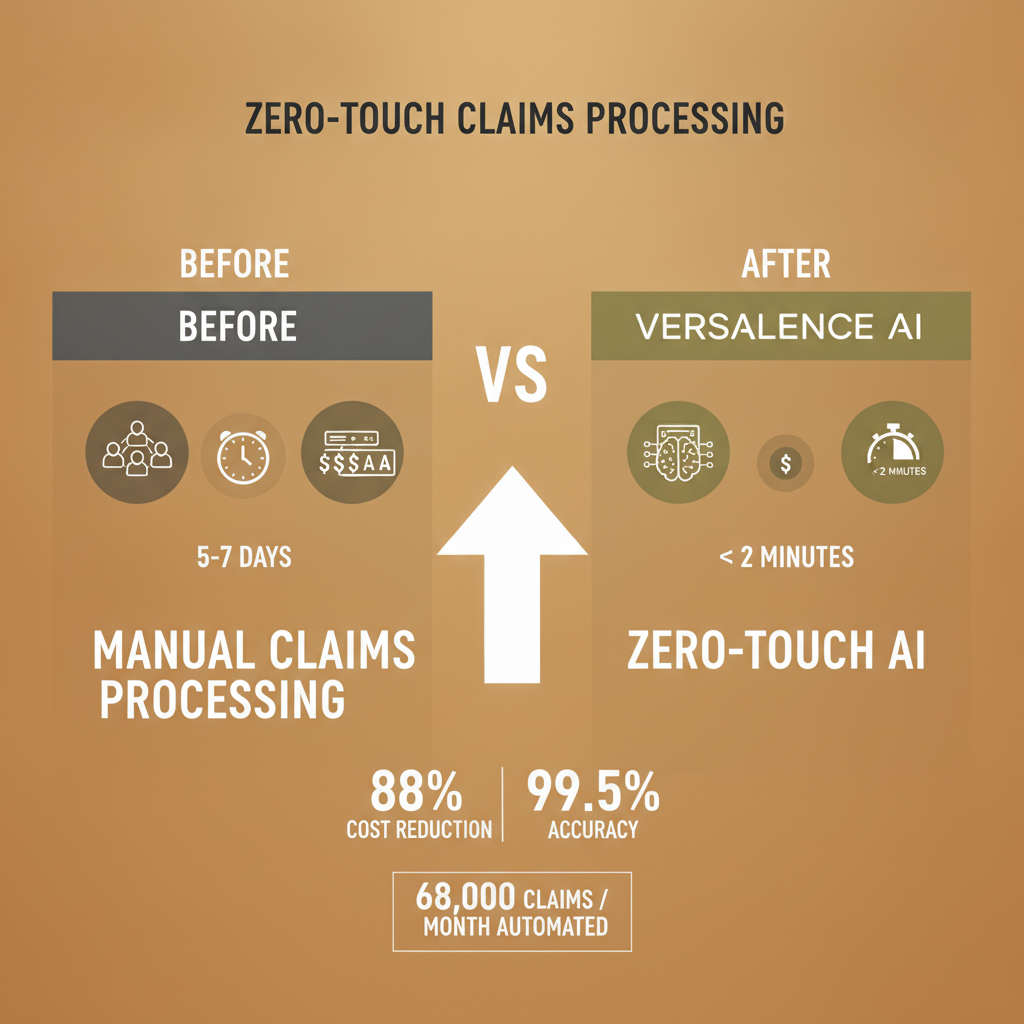
- Automation Rate: 96% of the 68,000 monthly claims are now processed with zero human touch.
- Processing Time: The average processing time for an automated claim dropped from 5-7 days to under 2 minutes.
- Operational Cost Reduction: The client achieved an 88% reduction in their claims processing costs, reallocating their specialist team to focus on customer success and fraud prevention. The monthly operational savings ran into the hundreds of thousands of dollars.
- Error Rate: The data entry error rate was virtually eliminated, falling to less than 0.5%, primarily on the few complex cases handled by humans.
- Infinite Scalability: The cloud-based system can now scale to handle hundreds of thousands of claims per month with no degradation in performance and negligible increase in cost. The business is now free to grow without its operational processes holding it back.
- Improved Customer Satisfaction: With near-instant claim resolutions, customer satisfaction scores (CSAT) related to the claims process increased by over 40%.
Stop Processing, Start Automating
The story of this SaaS company is a powerful illustration of what is possible when intelligent automation is applied to a core business challenge. Manual, repetitive processes are a tax on your growth, your profitability, and your customer experience.
If your business is struggling with high-volume, rule-based tasks like claims, invoices, or customer onboarding, it's time to consider a new approach. The technology to build a faster, smarter, and more efficient organization is here.
Let us show you how.
Ready to see how AI-powered workflow automation can transform your operations? Contact the Versalence AI team for a personalized demo and let's design your zero-touch future.
Reach out today at sales@versalence.ai or visit us online.
Work With Versalence
Ready to remove the drag from your business operations? Our AI automation and system integration team delivers measurable results in 30-120 days.
📧 Contact us
✉️ sales@versalence.ai