The Art of Possible with AI Automation
AI is not failing businesses, thinking is. Most conversations around AI still start in the wrong place: tools, models, or the latest breakthrough that promises to "change everything." But in real businesses, transformation rarely begins with technology; it begins with a shift in imagination. The real question is not what AI can do, but what can be done differently, what can be removed, accelerated, or entirely rethought when intelligence is no longer scarce. This is the only conversation that matters in AI automation, not features, not prompts, but possibility. And the companies that grasp this early won’t just adopt AI, they will redefine how work itself gets done.
From Tasks to Systems: A Fundamental Shift
Traditional automation was about reducing effort.
-
Move data from A to B
-
Trigger emails
-
Update systems
-
Generate reports
It operated within predefined logic.
If X happens → Do Y.
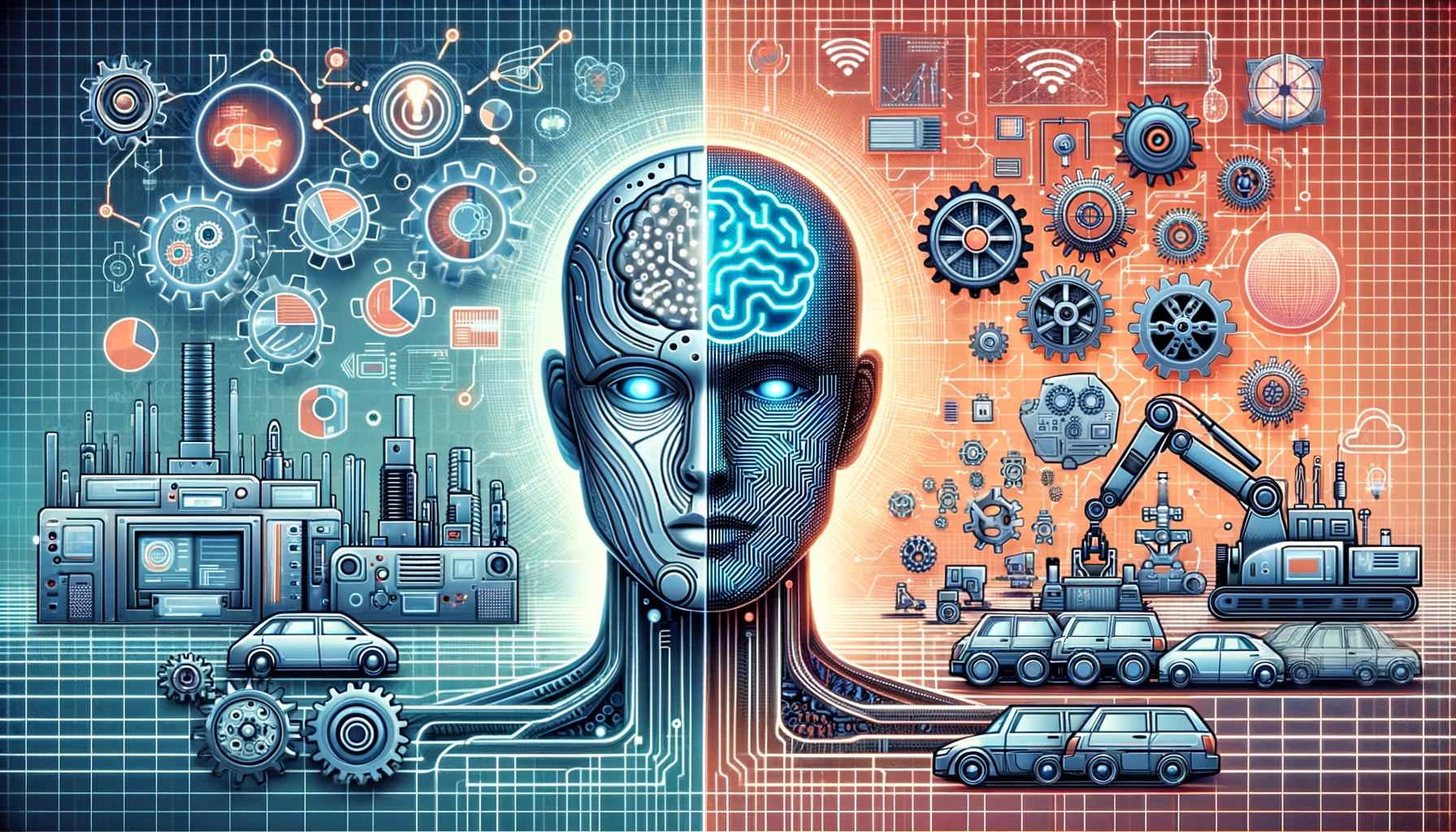
AI automation changes that paradigm.
It introduces systems that can:
-
Interpret context
-
Make decisions
-
Adapt responses
-
Handle ambiguity
This is not just automation.
This is operational intelligence embedded into workflows.
And that distinction matters.
Because when intelligence becomes part of the system, the question shifts from:
👉 “What can we automate?”
To:
👉 “What can we eliminate, redesign, or own end-to-end?”
In short: Stop optimizing tasks. Start designing systems.
The Layers of AI Possibility
To understand the art of possible, you need to see AI not as a tool—but as a stack of capabilities.
Each layer unlocks a different level of business impact.
1. Assistance Layer: Speed and Support
AI helps humans do the same work, faster.
Examples:
-
Drafting content
-
Summarizing documents
-
Answering FAQs
-
Translating communication
What it really does: Compresses time
Value created: Efficiency gains
2. Automation Layer: Workflow Execution
AI starts executing defined workflows.
Examples:
-
Customer onboarding flows
-
Ticket routing and classification
-
Data extraction and structuring
-
Lead qualification
What it really does: Removes manual effort
Value created: Consistency + scale
3. Augmentation Layer: Decision Support
AI begins influencing decisions with context and pattern recognition.
Examples:
-
Pricing recommendations
-
Risk scoring
-
Fraud detection
-
Sales prioritization
What it really does: Improves decision quality
Value created: Better outcomes, not just faster work
4. Agentic Layer: Outcome Ownership
AI systems take responsibility for outcomes—not just steps.
They can:
-
Plan multi-step workflows
-
Interact across systems
-
Handle exceptions
-
Continuously improve
Examples:
-
End-to-end lead conversion agents
-
Customer resolution systems
-
Financial close automation
-
Service orchestration agents
What it really does: Replaces fragmented execution with owned outcomes
Value created: Business transformation
What This Looks Like in the Real World
Directional impact seen across deployments: 30–60% reduction in manual effort, 20–40% faster cycle times, and 10–25% lift in conversion or resolution outcomes when systems are designed end-to-end rather than as isolated tools.
To move from theory to clarity, let’s ground this in actual business scenarios.
Scenario 1: Lead Management
Before AI:
-
Leads come from multiple channels
-
SDRs manually qualify
-
Follow-ups are inconsistent
-
Conversion depends on individual effort
After AI System Design:
-
Leads captured across channels automatically
-
AI qualifies based on intent, profile, and behavior
-
Personalized follow-ups triggered instantly
-
High-intent leads routed to sales
-
Low-intent leads nurtured autonomously
👉 Result: A conversion system, not a sales dependency
Typical impact: 25–40% increase in lead-to-meeting rates, 15–30% improvement in conversion consistency, and near-zero lead leakage.
Scenario 2: Customer Support
Before AI:
-
Tickets raised
-
Agents respond
-
Escalations delayed
-
Resolution time varies
After AI System Design:
-
AI understands issue context instantly
-
Resolves known problems automatically
-
Triggers backend actions (refunds, resets, updates)
-
Escalates only when necessary with full context
👉 Result: A resolution engine, not a support queue
Typical impact: 40–70% ticket deflection, 30–50% reduction in average resolution time, and higher CSAT due to faster, context-aware responses.
Scenario 3: Finance Operations
Before AI:
-
Manual reconciliation
-
Delayed reporting
-
Reactive decision-making
After AI System Design:
-
Transactions categorized in real time
-
Anomalies flagged instantly
-
Cash flow projected continuously
-
Insights delivered proactively
👉 Result: A real-time financial intelligence system
Typical impact: 50–80% reduction in reconciliation effort, real-time visibility into cash flow, and faster decision cycles for finance teams.
Reimagining Business Functions Through AI

Every business function is a system of inputs, decisions, and outputs.
AI reshapes each of these layers.
Sales & Marketing
👉 From campaigns → continuous conversion systems
Customer Onboarding
👉 From forms → guided, adaptive journeys
Customer Service
👉 From responses → resolution engines
Operations
👉 From monitoring → autonomous systems
Finance
👉 From reporting → real-time intelligence
Human Resources
👉 From administration → experience design
Supply Chain
👉 From planning → adaptive networks
IT & Data
👉 From support → intelligence infrastructure
The Real Leverage: Connecting the Dots
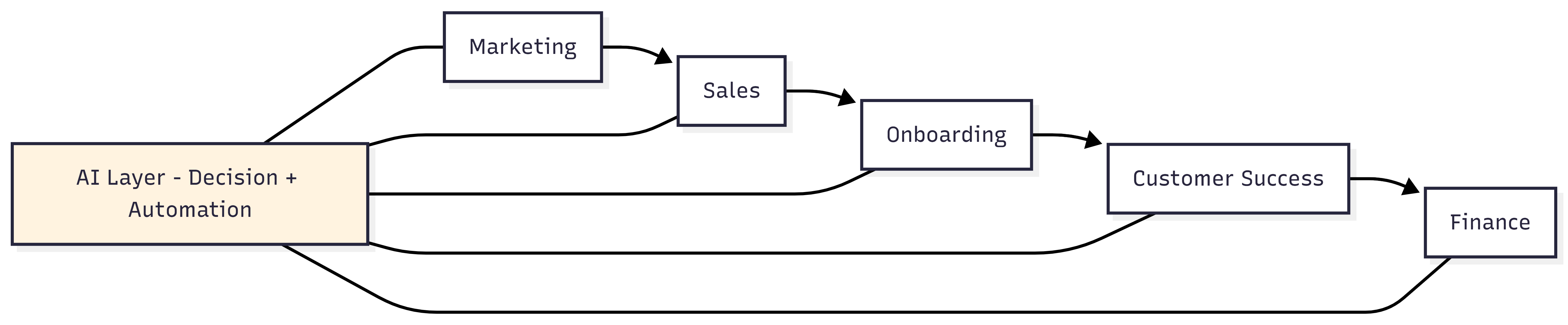
The compounding effect is where the real ROI emerges: organizations that connect systems typically see 2–3x higher impact compared to isolated automations.
Most companies stop at function-level automation.
But the real value lies in connecting systems.
Example:
-
Lead captured in marketing
-
Qualified by AI
-
Converted in sales
-
Onboarded automatically
-
Supported through AI
This is not multiple automations.
This is a unified business system.
And this is where compounding value begins.
Disconnected AI creates activity. Connected AI creates outcomes.
The Constraints You Must Design Around
Possibility without constraints leads to failure.
1. Data Quality
AI scales whatever you feed it.
2. Process Clarity
Broken processes don’t get fixed—they get amplified.
3. Human Oversight
AI shifts effort—it doesn’t eliminate accountability.
4. System Integration
Siloed systems kill compounding value.
Case 1: B2C Lead Conversion (Consumer Durables)
Problem:
High lead volume, low conversion consistency, delayed follow-ups
Intervention:
-
WhatsApp conversational AI for instant engagement
-
AI qualification using intent + behavior
-
Automated nurturing for low-intent leads
-
CRM sync for high-intent routing
Outcome:
-
32% increase in lead-to-meeting conversion
-
48% reduction in response time
-
0% lead leakage across channels
Case 2: Service Operations (HVAC / Field Service)
Problem:
Manual issue logging, delayed technician assignment, inconsistent diagnosis
Intervention:
-
Voice AI assistant for issue capture
-
AI-based diagnosis using structured inputs
-
Automated ticket creation + prioritization
-
Integrated service scheduling
Outcome:
-
45% faster ticket resolution
-
60% reduction in manual triage effort
-
Improved first-time fix rate
Case 3: Financial Workflow Automation (SMB)
Problem:
Delayed reconciliation, lack of real-time visibility, manual categorization
Intervention:
-
AI-based transaction classification
-
Real-time anomaly detection
-
Continuous cash flow projection
Outcome:
-
70% reduction in reconciliation effort
-
Real-time financial visibility
-
Faster decision cycles
The Versalence View: Designing for Outcomes
Across implementations, the shift from fragmented automation to outcome-driven systems consistently drives measurable business gains within the first 6–12 weeks when scoped correctly.
At Versalence, AI is not deployed—it is designed.
AI Automation
Streamline workflows and remove operational friction
Conversational AI
Enable natural, scalable engagement across channels
Agentic AI
Build systems that own outcomes end-to-end
The goal is not to use AI.
The goal is to change how work happens.
Where Leaders Should Actually Start
If you’re serious about AI, don’t start with ideas or tools.
Start with business friction.
Ask:
-
Where does revenue slow down?
-
Where does decision-making get delayed?
-
Where do customers experience friction?
Then:
-
Identify the full workflow (not just tasks)
-
Map inputs, decisions, and outputs
-
Introduce intelligence at key points
-
Connect systems end-to-end
-
Iterate continuously
Think like a system designer, not a tool adopter.
What This Means for You
If you’re evaluating AI today, the question is not whether to adopt it.
The question is whether you will:
-
Experiment with disconnected tools
-
Or design systems that create compounding value
The gap between these two approaches is not marginal.
It is exponential.
At Versalence, we work with businesses to move beyond pilots and proofs-of-concept into real, outcome-driven AI systems—across AI Automation, Conversational AI, and Agentic AI.
Not by adding more tools.
But by redesigning how your business operates.
Final Thought
AI automation is not about doing more.
It’s about doing differently.
The companies that win will not be the ones experimenting with the most tools.
They will be the ones that understand the art of possible—and design systems accordingly.
Because in the end:
**AI is not a feature.
It is a capability.
And capabilities reshape businesses.**
The Versalence Advantage
If you're exploring how AI can move beyond experiments into real business impact, Versalence works with teams to design and implement outcome-driven systems across:
-
AI Automation
-
Conversational AI
-
Agentic AI
Not by adding more tools.
But by redesigning how your business operates.
Start with a workflow. Scale into a system.