
The Productivity Paradox: Why Faster AI Tools Aren't Solving the Real Problem (And What Will)
Introduction: The $154 Billion Question
In 2025, businesses poured $154 billion into generative AI. The promise was irresistible: work faster, produce more, stay ahead. Yet a March 2026 survey of 1,000 U.S. full-time workers by Novorésumé reveals a troubling reality—while 47% of AI users say the technology helps them complete tasks faster, many are spending that saved time on personal activities while still on the clock. The productivity gains aren't materializing. The time saved isn't being reinvested.
This is the productivity paradox of the AI era. And it points to a fundamental misunderstanding about what AI is actually for.
The current generation of AI tools—ChatGPT, Microsoft Copilot, Claude—are essentially digital assistants. They respond to prompts. They generate drafts. They accelerate individual tasks. But they don't fundamentally change how work gets done. The human is still the orchestrator, the decision-maker, the bottleneck.
Gartner's latest forecast cuts through the noise: by the end of 2026, 40% of enterprise applications will incorporate task-specific AI agents, up from less than 5% in 2025. These aren't copilots. They're autonomous systems that understand goals, create plans, and execute workflows with minimal human intervention.
The shift from generative AI to agentic AI isn't incremental. It's categorical. And it may be the only way to break the productivity paradox.
---
The Productivity Paradox: What the Data Actually Shows
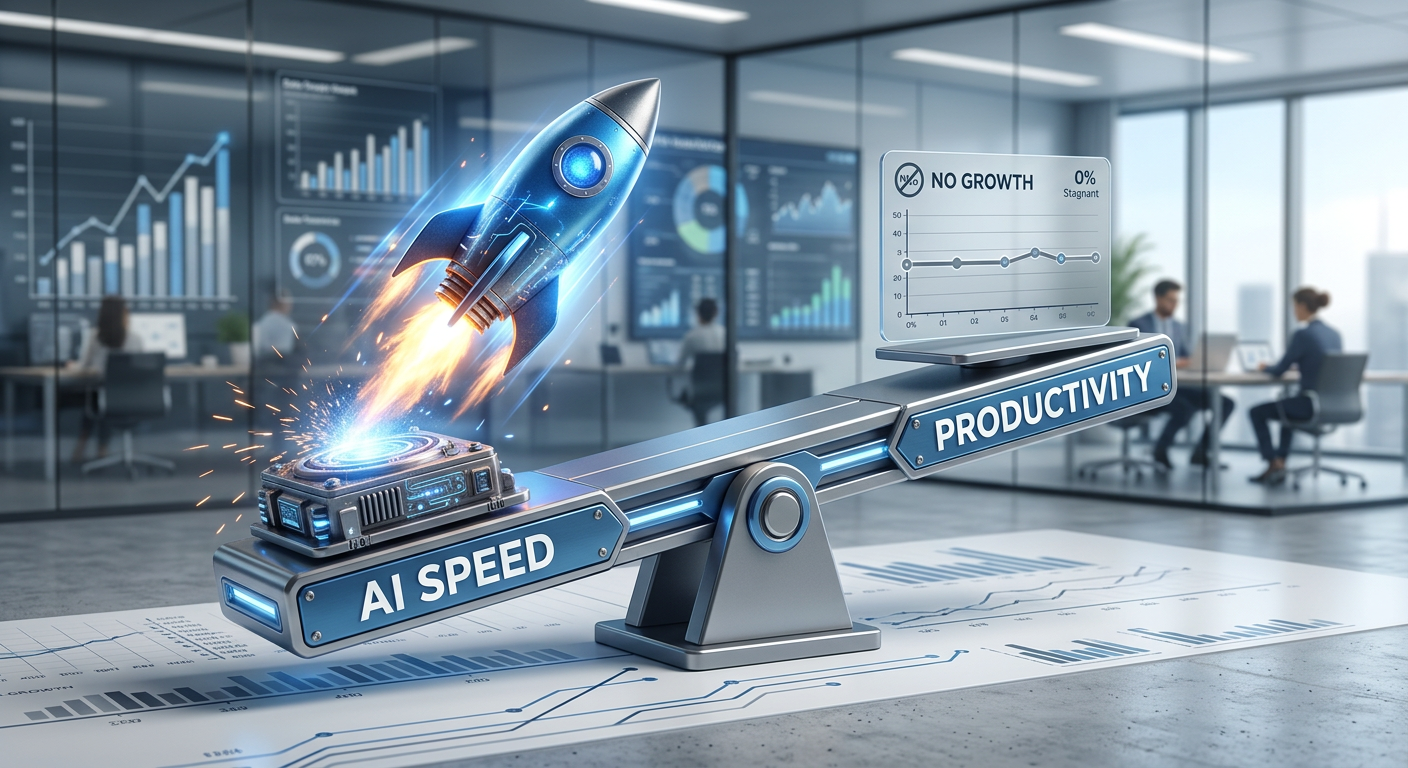
The Novorésumé survey released March 13, 2026, tracks with what economists and workplace researchers have suspected for months: AI adoption and productivity gains are not the same thing.
Key Findings:
- 47% of AI users report completing tasks faster with AI assistance
- A significant portion reinvest that time in personal activities rather than professional output
- Corporate restructuring driven by AI is accelerating, with Atlassian laying off 10% of its workforce (1,600 workers) on March 11, 2026, as it pivots toward AI and enterprise sales
The pattern is becoming clear across industries. Companies deploy AI tools. Employees use them to work faster. But the efficiency doesn't compound. Instead of three people doing the work of five, you have three people finishing their work by 2 PM and spending the afternoon on non-work activities—or worse, being laid off because executives believe AI makes their roles redundant.
The problem isn't the AI. It's the workflow.
Current AI tools are designed to assist humans within existing processes. A marketing manager uses ChatGPT to draft emails faster. A developer uses Copilot to write code more quickly. An analyst uses Claude to summarize reports. Each task accelerates. But the workflow itself—receive request, process through human, deliver output—remains unchanged.
The human is still the router. Still the quality checker. Still the one who must context-switch between twenty different applications, twenty different conversations, twenty different priorities.
AI saves time on individual tasks. But it doesn't eliminate tasks. And it certainly doesn't eliminate the cognitive overhead of managing them.
---
Why Current AI Tools Hit a Ceiling
To understand why productivity gains plateau, consider what generative AI actually does.
Generative AI is reactive. It waits for a prompt. It produces output based on that prompt. It has no memory of your business context unless you provide it in every interaction. It cannot take initiative. It cannot navigate between systems. It cannot handle the 90% of work that happens between the drafts and the deliverables—the coordination, the follow-ups, the edge cases, the exceptions.
A McKinsey analysis from late 2025 found that while 88% of organizations now use AI for at least one function, only 6% report significant, measurable results from that adoption. The gap between experimentation and production deployment is massive. Most businesses are stuck in pilot purgatory, deploying AI for discrete tasks while the core workflows remain untouched.
The result: AI becomes a nice-to-have rather than a must-have. Employees use it when convenient. They skip it when the friction of integrating AI into complex, multi-step processes exceeds the time savings on any single step.
Consider the typical workflow for processing a customer support ticket:
1. Ticket arrives in Zendesk 2. Agent reads and categorizes 3. Agent searches knowledge base 4. Agent drafts response 5. Agent checks with supervisor for edge cases 6. Agent sends response 7. Agent updates CRM 8. Agent logs resolution notes
Generative AI can accelerate steps 3 and 4. It can help draft the response. But it cannot handle step 2 (categorization requires business judgment), step 5 (escalation decisions), step 7 (CRM updates across systems), or step 8 (documentation in the right format).
So the agent saves 10 minutes on drafting but still spends 20 minutes on everything else. The 30-minute ticket becomes a 20-minute ticket. That's a 33% improvement. But it doesn't transform the workflow. It doesn't let one agent handle three times the volume. It doesn't eliminate the need for human attention at every step.
Multiply this across every workflow in every department, and you understand why AI investment isn't translating to productivity miracles.
---
Agentic AI: From Assistance to Autonomy
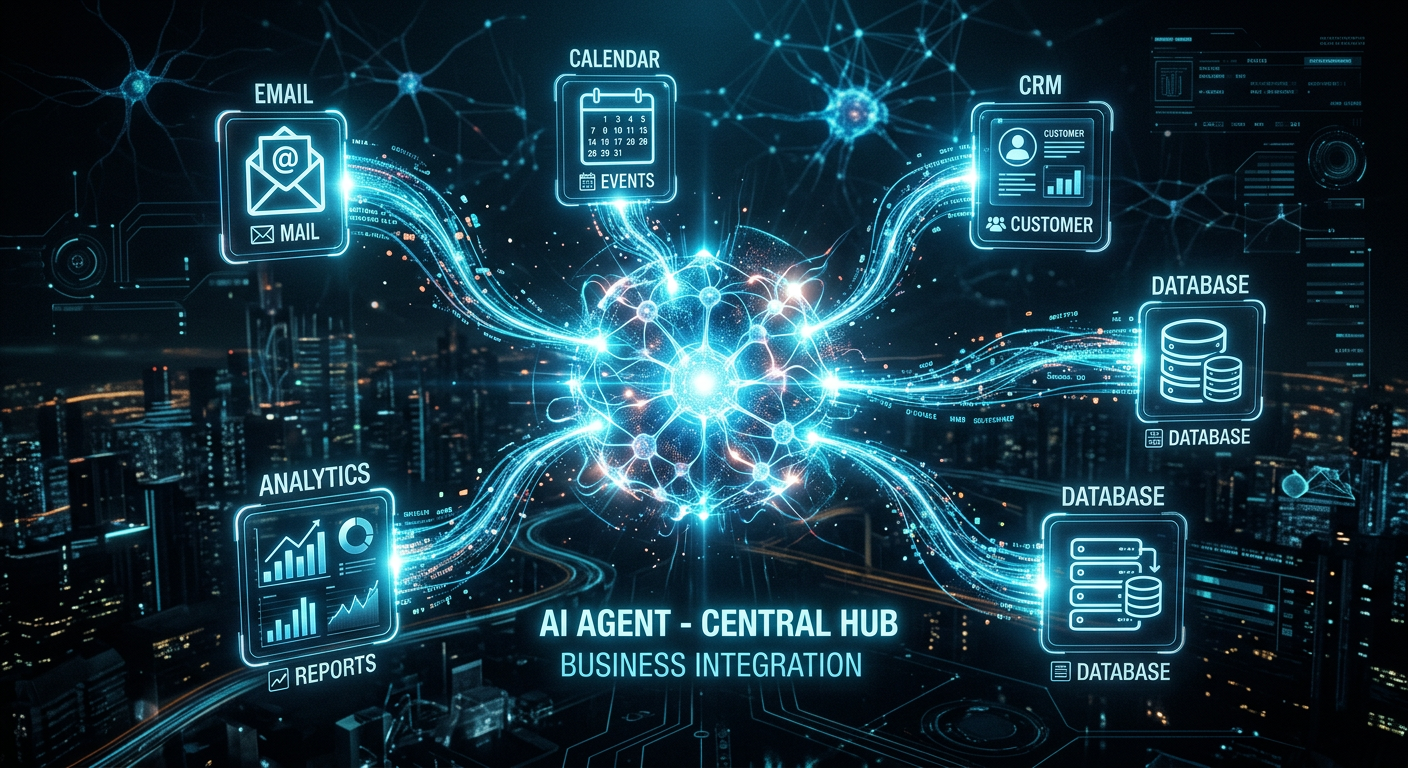
The shift to agentic AI changes the equation entirely.
Gartner defines agentic AI as systems that "can independently plan, reason, and take action to achieve goals." Unlike generative models that respond to prompts, agentic AI understands overarching objectives, breaks them into strategic steps, and executes across multiple tools and systems with minimal human oversight.
The key capabilities that differentiate agentic AI:
| Capability | Generative AI | Agentic AI |
|---|---|---|
| Planning | Single-turn responses | Multi-step strategy execution |
| Tool Use | None (generates content only) | Integrates with APIs, databases, applications |
| Context | Session-based, limited memory | Persistent memory of business logic |
| Decision-Making | None (outputs text) | Makes decisions within defined parameters |
| Human Oversight | Required for every interaction | Required only for exceptions and approvals |
Microsoft's "Copilot Cowork" initiative, launched in early 2026, exemplifies this shift. The software is designed not as an assistant that helps with tasks but as a virtual team member that manages entire workflows. An agentic AI doesn't draft an email response—it monitors the inbox, categorizes incoming messages, identifies which require human attention, drafts responses for routine inquiries, sends them pending approval, updates the CRM, and schedules follow-up tasks.
The human manager reviews and approves. The AI does everything else.
---
What Agentic AI Looks Like in Practice
Consider that same customer support ticket workflow, now handled by an agentic AI:
1. Ticket arrives → AI reads and categorizes based on business rules (refund request, technical issue, billing question) 2. AI searches knowledge base → Retrieves relevant articles and past resolutions 3. AI checks customer history → Pulls CRM data, order history, prior interactions 4. AI determines resolution path → For routine issues, drafts response; for complex issues, flags for human review 5. AI processes refund/technical fix → Directly interfaces with payment systems or creates technical tickets 6. AI updates CRM → Logs interaction, updates customer record, schedules follow-up if needed 7. Human reviews → For non-routine cases; routine cases auto-resolve
The result: A 30-minute ticket becomes a 2-minute human review. One agent can oversee the AI handling fifty routine tickets while personally managing the five complex ones that actually require human judgment.
This isn't theoretical. Companies implementing agentic AI for support ticket triage in early 2026 report 60-80% reductions in average handling time for routine inquiries. Not because humans are working faster, but because humans are only touching the exceptions.
---
The Agentic AI Forecast: Gartner's 40% Prediction
Gartner's forecast that 40% of enterprise applications will incorporate task-specific AI agents by end of 2026 represents a watershed moment. In 2025, that figure was under 5%. The adoption curve isn't just steep—it's vertical.
What's driving this acceleration?
1. Plunging inference costs. Running powerful AI models has become dramatically cheaper. Gemini 3.1 Flash-Lite, released in March 2026, operates at $0.25 per million input tokens—a price point that makes enterprise-scale deployment economically viable for small and mid-sized businesses, not just Fortune 500 companies.
2. Improved reasoning capabilities. New models like Google's Gemini 3.1 Pro and Anthropic's Claude Opus 4.6 feature "adaptive thinking"—the ability to dynamically assess prompt complexity and allocate computational resources accordingly. Complex problems get more processing time. Simple queries get instant responses. The reliability gap is closing.
3. Massive context windows. Models now support 1 million+ token context windows, allowing AI to digest entire case histories, codebases, or document repositories in a single prompt. This enables agentic systems to operate with genuine organizational memory rather than session-based amnesia.
4. Enterprise integration maturity. APIs, webhooks, and middleware have evolved to the point where AI agents can actually interact with legacy systems—not just modern cloud-native applications. The integration tax is falling.
---
Breaking the Paradox: Why Agentic AI Solves What Generative AI Couldn't
The productivity paradox exists because generative AI saves time on tasks while leaving workflows intact. Agentic AI transforms the workflows themselves.
When a human spends 30 minutes on a task and AI reduces that to 20 minutes, you get incremental gains. When AI handles the entire workflow and the human spends 2 minutes reviewing, you get transformational gains.
The math is stark:
| Scenario | Time per Task | Daily Tasks per Person | Productivity Multiple |
|---|---|---|---|
| Human + Generative AI | 20 minutes | 24 | 1.5x |
| Human + Agentic AI | 2 minutes (review) | 240 | 15x |
The 15x productivity multiple isn't theoretical. Early adopters in legal document review, financial analysis, and customer support are reporting exactly these kinds of efficiencies.
But the real breakthrough isn't volume—it's cognitive load. When humans are no longer the routers and orchestrators, they can focus on the work that actually requires human intelligence: creative problem-solving, relationship building, strategic thinking. The productivity paradox dissolves not because people work faster, but because the AI handles the work that was never supposed to consume human attention in the first place.
---
The Shadow AI Problem: Governance in the Agentic Era
The rush toward agentic AI creates a new challenge: governance. As employees adopt AI tools faster than IT departments can establish frameworks, companies face "Shadow AI"—unsanctioned AI use that creates data leakage, compliance risks, and security vulnerabilities.
A 2026 survey by Accenture found that 73% of employees use AI tools not officially approved by their employers. Many don't even realize they're creating risk—they're just trying to work more efficiently.
Agentic AI amplifies this risk. A generative AI tool that drafts emails is relatively contained. An agentic AI that integrates with your CRM, payment systems, and email platform has broad access and broad potential for misuse.
The governance imperative for 2026:
- Establish clear policies on data privacy and AI tool approval
- Implement secure, compliant AI environments rather than blocking AI entirely
- Train employees on prompt engineering and AI collaboration as core competencies
- Create cross-functional AI governance committees
Companies that solve the governance puzzle will capture the productivity benefits. Companies that ignore it will face security breaches, regulatory penalties, and competitive disadvantage.
---
What This Means for Small Businesses
The shift to agentic AI isn't just for enterprises with massive IT budgets. The plunging cost of inference and the rise of no-code AI platforms means small businesses can deploy agentic systems for specific workflows without enterprise-scale investment.
High-impact starting points for SMBs:
1. Email triage and response. Agentic systems can monitor inboxes, categorize incoming messages, draft responses to routine inquiries, and escalate exceptions—all within defined parameters that match your business voice.
2. Appointment scheduling and follow-up. Integrate with calendar systems and CRM to automatically schedule meetings, send reminders, and handle rescheduling without human intervention.
3. Invoice processing and accounts payable. Extract data from invoices, match against purchase orders, route for approval, and process payments for routine transactions.
4. Social media monitoring and response. Track brand mentions, categorize sentiment, draft responses to common inquiries, and escalate negative feedback to human managers.
5. Lead qualification and routing. Score incoming leads based on behavior and profile, enrich data from external sources, and route hot prospects to sales while nurturing cold leads automatically.
Each of these workflows represents 5-20 hours of human labor per week that can be reduced to 1-2 hours of oversight. For a small team, that's the difference between drowning in operational tasks and having bandwidth for growth initiatives.
---
The Path Forward: From Experimentation to Operation
The businesses that will thrive in the agentic AI era are those that move beyond pilot programs and integrate autonomous systems into core operations. This requires:
1. Process audit. Map your workflows. Identify the 20% of processes that consume 80% of operational time. These are your agentic AI candidates.
2. Start narrow, then expand. Deploy agentic AI for a single, well-defined workflow. Measure results rigorously. Expand only after proving ROI.
3. Invest in governance early. Shadow AI is already in your organization. Bring it into the light with clear policies and secure platforms.
4. Reskill your team. The most valuable employees in 2026 aren't those who work faster—they're those who can effectively collaborate with AI systems, breaking down complex objectives into logical steps that agents can execute.
5. Stay agile. The AI landscape is evolving weekly. Build flexible architectures that let you swap underlying models as better, cheaper options emerge.
---
Conclusion: The Real Productivity Revolution
The productivity paradox wasn't a failure of AI. It was a failure of expectations. Generative AI was never going to transform workflows—it was designed to assist within them.
Agentic AI is different. It doesn't just make humans faster. It handles the workflows that never needed human attention in the first place, freeing people to focus on the judgment, creativity, and relationships that actually drive business value.
Gartner's 40% forecast by end of 2026 isn't just a prediction about technology adoption. It's a prediction about competitive advantage. The companies that deploy agentic AI will operate at fundamentally different economics than those that don't.
The productivity paradox ends where agentic AI begins.
---
Work With Versalence
We help small businesses navigate the transition from generative AI experimentation to agentic AI operation:
- AI Workflow Audit — Identify the 20% of processes that consume 80% of operational time and are candidates for agentic automation
- Agentic AI Implementation — Deploy autonomous systems that integrate with your existing tools and handle end-to-end workflows
- AI Governance Framework — Establish secure, compliant environments that capture productivity gains without security risks
- Team Reskilling Programs — Train your workforce on prompt engineering, AI collaboration, and managing autonomous systems
📧 versalence.ai/contact.html | sales@versalence.ai