Multi-Agent Systems: A Deep Dive for Thursday
Introduction - Hook with real problem
Imagine you're leading the logistics optimization team at a major e-commerce retailer. Your team is tasked with minimizing delivery costs while maintaining a 99.9% on-time delivery rate. Currently, you're using a centralized route optimization system that struggles to adapt to real-time disruptions like traffic accidents, unexpected order surges in specific zones, and sudden weather events. The existing system, while mathematically optimal in a static environment, fails miserably when reality throws curveballs. You're facing increasing customer complaints, rising fuel costs, and stressed-out drivers. The pressure to find a more resilient and adaptive solution is mounting. A multi-agent system (MAS) promises distributed decision-making and real-time adaptation, but past attempts have been plagued by complexity, communication overhead, and emergent, often undesirable, behavior. What actually works in 2026 to make MAS a viable solution for this logistics nightmare?
The Current Landscape - What's happening in 2026
By 2026, the hype around "AI agents" has matured into a more pragmatic understanding of multi-agent systems. We've moved beyond naive implementations of LLM-based agents blindly collaborating. Instead, successful MAS deployments leverage specialized agents with clearly defined roles and responsibilities, often augmented by traditional AI techniques like reinforcement learning and constraint satisfaction.
Key trends shaping the MAS landscape:
- Hybrid Architectures: The integration of LLMs for high-level planning and communication with more specialized AI models (e.g., for sensor data analysis, control systems) is prevalent. The "agent" is no longer solely an LLM.
- Formal Verification & Safety: Increased emphasis on formal methods to verify the safety and reliability of MAS, particularly in safety-critical applications like autonomous vehicles and industrial automation. This includes model checking, runtime monitoring, and formal specification languages tailored for MAS.
- Federated Learning & Privacy: Advancements in federated learning enable agents to learn collaboratively without sharing raw data, addressing privacy concerns and allowing for MAS deployment in sensitive domains like healthcare.
- Standardized Agent Communication: The emergence of more robust and widely adopted agent communication languages (ACLs) and protocols, facilitating interoperability between different MAS platforms. Think of it as the standardization of APIs for agents.
- Simulation & Emulation: Advanced simulation environments are crucial for testing and validating MAS before deployment, especially for emergent behavior. These simulations incorporate realistic environmental models and agent interactions.
The successful MAS deployments in 2026 aren't about replacing existing systems entirely, but rather augmenting them with intelligent, distributed decision-making capabilities.
Deep Dive: Core Concepts - Frameworks and analysis
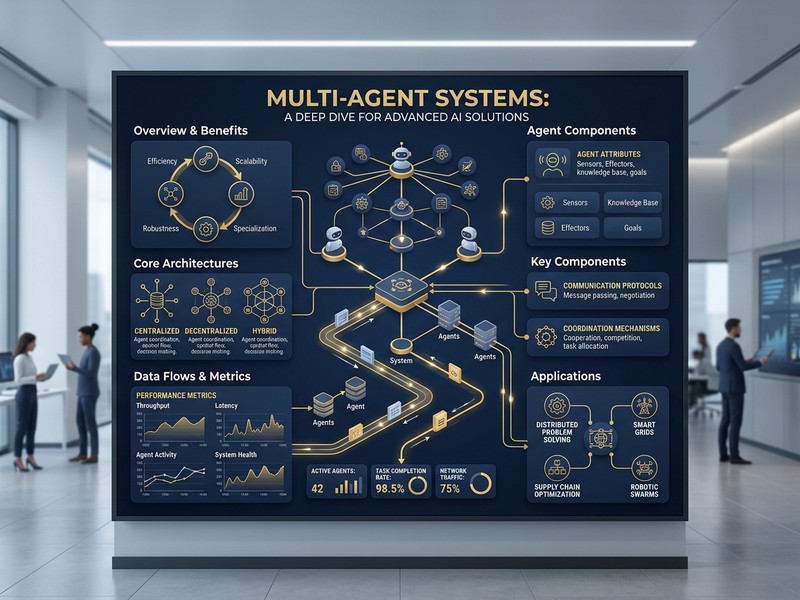
The core of a functioning MAS lies in understanding the interplay between agent architecture, communication protocols, and coordination mechanisms.
Agent Architecture:
- Deliberative Agents: Employ symbolic reasoning and planning algorithms. Suitable for tasks requiring complex decision-making and long-term planning. (e.g., a logistics agent responsible for optimizing delivery routes over a multi-day horizon).
- Reactive Agents: Act based on immediate sensory input. Suitable for tasks requiring fast responses to changing conditions. (e.g., a driver agent reacting to real-time traffic updates).
- Hybrid Agents: Combine deliberative and reactive capabilities. This is the most common and often most effective architecture in 2026, allowing agents to balance long-term goals with immediate needs.
Communication Protocols:
- ACL (Agent Communication Language): Standardized language for exchanging messages between agents. FIPA-ACL remains relevant, but customized protocols tailored to specific domains are more common.
- Gossip Protocols: Agents share information with a subset of their neighbors, spreading information throughout the network. Useful for disseminating information quickly and reliably, even in the presence of failures.
- Message Queues (e.g., RabbitMQ, Kafka): Robust and scalable infrastructure for asynchronous communication between agents.
Coordination Mechanisms:
- Contract Net Protocol: Agents bid on tasks, and the agent that can best perform the task is awarded the contract. Useful for task allocation in dynamic environments.
- Auctions: Similar to contract net, but with more complex bidding strategies. Suitable for scenarios where agents have different preferences and capabilities.
- Voting: Agents vote on different options, and the option with the most votes is selected. Useful for reaching consensus in decentralized environments.
- Reinforcement Learning (RL) Based Coordination: Agents learn to coordinate their actions through trial and error, optimizing for a shared reward function. This approach is particularly effective in complex, dynamic environments where explicit coordination rules are difficult to define.
A crucial concept is the utility function for each agent. Carefully crafting utility functions that align individual agent goals with the overall system objective is essential for preventing undesirable emergent behavior. For example, in the logistics scenario, the driver agent's utility function shouldn't solely focus on minimizing personal driving time, but should also consider on-time delivery performance and fuel efficiency.
Comparison and Trade-offs - Tables with pros/cons
Table 1: Agent Architectures Comparison
| Architecture | Pros | Cons | Use Case Example |
|---|---|---|---|
| Deliberative | Complex planning, symbolic reasoning, goal-oriented | Computationally expensive, slow response time, brittle in dynamic environments | Strategic resource allocation in a supply chain |
| Reactive | Fast response time, simple implementation, robust to failures | Limited planning, unable to handle complex tasks, prone to oscillations | Autonomous drone avoiding obstacles in real-time |
| Hybrid | Combines strengths of deliberative and reactive, adaptable to dynamic environments | More complex implementation, requires careful design to balance deliberative and reactive components | Autonomous vehicle navigating city streets with both strategic route planning and reactive obstacle avoidance |
Table 2: Communication Protocols Comparison
| Protocol | Pros | Cons | Use Case Example |
|---|---|---|---|
| FIPA-ACL | Standardized, facilitates interoperability, well-defined semantics | Can be verbose, overhead can be significant, may not be suitable for real-time applications | Negotiation between agents in a supply chain to agree on prices and delivery schedules |
| Gossip Protocols | Robust to failures, scalable, efficient dissemination of information | Unreliable delivery, potential for information inconsistencies, difficult to control propagation | Spreading sensor data among agents in a distributed sensor network |
| Message Queues | Asynchronous communication, decoupling of agents, robust to failures, scalable | Requires infrastructure, potential for message delays, adds complexity to the system | Communication between microservices in a distributed application |
Implementation Framework - Step-by-step guide
Implementing a successful MAS involves a systematic approach:
- Problem Decomposition: Clearly define the overall problem and decompose it into sub-problems that can be handled by individual agents. Identify the key tasks and responsibilities of each agent.
- Agent Design: Choose the appropriate agent architecture (deliberative, reactive, hybrid) for each agent based on its role and responsibilities. Define the agent's state, actions, and utility function.
- Communication Protocol Selection: Select a suitable communication protocol based on the communication requirements of the agents. Consider factors such as message size, reliability, and latency.
- Coordination Mechanism Design: Choose a coordination mechanism that allows agents to effectively coordinate their actions to achieve the overall system objective. Consider factors such as the complexity of the environment, the level of autonomy of the agents, and the communication bandwidth.
- Implementation: Implement the agents, communication protocols, and coordination mechanisms using a suitable programming language and MAS framework (e.g., JADE, Repast).
- Testing and Validation: Thoroughly test and validate the MAS using simulations and real-world experiments. Pay particular attention to emergent behavior and potential failure modes.
- Deployment and Monitoring: Deploy the MAS in the real world and continuously monitor its performance. Adapt the MAS as needed to address changing conditions and emerging challenges.
Specific Implementation Advice:
- Start Small: Don't try to solve the entire problem with a MAS at once. Start with a small, well-defined subset of the problem and gradually expand the scope.
- Use Existing Frameworks: Leverage existing MAS frameworks to reduce development time and complexity.
- Focus on Scalability: Design the MAS to be scalable to handle a large number of agents and increasing data volumes.
- Prioritize Security: Implement appropriate security measures to protect the MAS from unauthorized access and malicious attacks.
Decision Guide - How to choose
Choosing the right components for your MAS requires careful consideration of the problem domain and the specific requirements of your application.
Decision Framework:
- Complexity of the Problem:
- Simple Problem: Reactive agents, simple communication protocols (e.g., direct communication).
- Complex Problem: Hybrid agents, sophisticated communication protocols (e.g., FIPA-ACL), advanced coordination mechanisms (e.g., reinforcement learning).
- Dynamism of the Environment:
- Static Environment: Deliberative agents, centralized coordination.
- Dynamic Environment: Reactive or hybrid agents, distributed coordination.
- Communication Bandwidth:
- High Bandwidth: Complex communication protocols (e.g., FIPA-ACL).
- Low Bandwidth: Simple communication protocols (e.g., gossip protocols).
- Security Requirements:
- High Security: Secure communication protocols (e.g., encrypted communication), authentication and authorization mechanisms.
- Low Security: Simple communication protocols.
- Real-time Requirements
- Strict Real-time: Reactive agents, low-latency communication
- Non Real-time: Deliberative agents, asynchronous communication
Example: For the logistics optimization problem described in the introduction, a hybrid agent architecture with a combination of deliberative planning for route optimization and reactive adjustments based on real-time traffic data would be a suitable choice. A message queue based communication system would allow for asynchronous communication between agents and the central system. Reinforcement learning could be used to optimize coordination between driver agents in congested areas.
Case Study or Real Example
Consider the use of MAS in optimizing the energy grid. A real-world example involves managing distributed energy resources (DERs) such as solar panels, wind turbines, and battery storage systems. Each DER can be represented as an agent with its own objectives (e.g., maximizing energy production, minimizing cost). These agents communicate and coordinate with each other to optimize the overall energy grid performance, balancing supply and demand, and ensuring grid stability. This is particularly relevant with the proliferation of prosumers (consumers who also produce energy) who need to be integrated seamlessly into the grid. Successful implementations often involve a hierarchical structure, with local agents managing individual DERs and higher-level agents coordinating across larger regions. Reinforcement learning is used to adapt to fluctuating energy demand and intermittent renewable energy sources.
30-Day Action Checklist
Here's a practical checklist to get started with MAS:
Week 1: Problem Definition and Scope
- [ ] Define the specific problem you want to solve with a MAS.
- [ ] Identify the key stakeholders and their requirements.
- [ ] Define the scope of the MAS and the boundaries of the system.
- [ ] Identify the key performance indicators (KPIs) for the MAS.
Week 2: Agent Design and Communication
- [ ] Define the roles and responsibilities of each agent.
- [ ] Choose the appropriate agent architecture for each agent.
- [ ] Select a suitable communication protocol.
- [ ] Design the agent communication language (ACL).
Week 3: Implementation and Testing
- [ ] Implement the agents, communication protocols, and coordination mechanisms.
- [ ] Set up a simulation environment for testing the MAS.
- [ ] Conduct thorough testing and validation of the MAS.
- [ ] Identify and fix any bugs or performance issues.
Week 4: Deployment and Monitoring
- [ ] Deploy the MAS in a pilot environment.
- [ ] Monitor the performance of the MAS.
- [ ] Collect data on the KPIs.
- [ ] Make adjustments to the MAS as needed.
Bottom Line - Key takeaways
In 2026, successful MAS deployments are characterized by:
- Pragmatism: Focusing on specific, well-defined problems rather than trying to build general-purpose AI agents.
- Hybrid Architectures: Combining LLMs with specialized AI models and traditional algorithms.
- Robust Communication: Using standardized or well-defined communication protocols.
- Careful Coordination: Implementing coordination mechanisms that align individual agent goals with the overall system objective.
- Rigorous Testing: Thoroughly testing and validating the MAS using simulations and real-world experiments.
The key is to avoid the trap of over-engineering and to focus on building a system that is both effective and maintainable.
Work With Versalence - CTA paragraph
Navigating the complexities of multi-agent systems requires deep expertise and a practical understanding of the available technologies. Versalence specializes in designing, developing, and deploying cutting-edge MAS solutions tailored to your specific needs. Whether you're looking to optimize logistics, manage distributed energy resources, or automate complex workflows, we can help you harness the power of multi-agent systems to achieve your business goals.
Contact us today to discuss your project and learn how Versalence can help you succeed.
📧 versalence.ai/contact.html | sales@versalence.ai