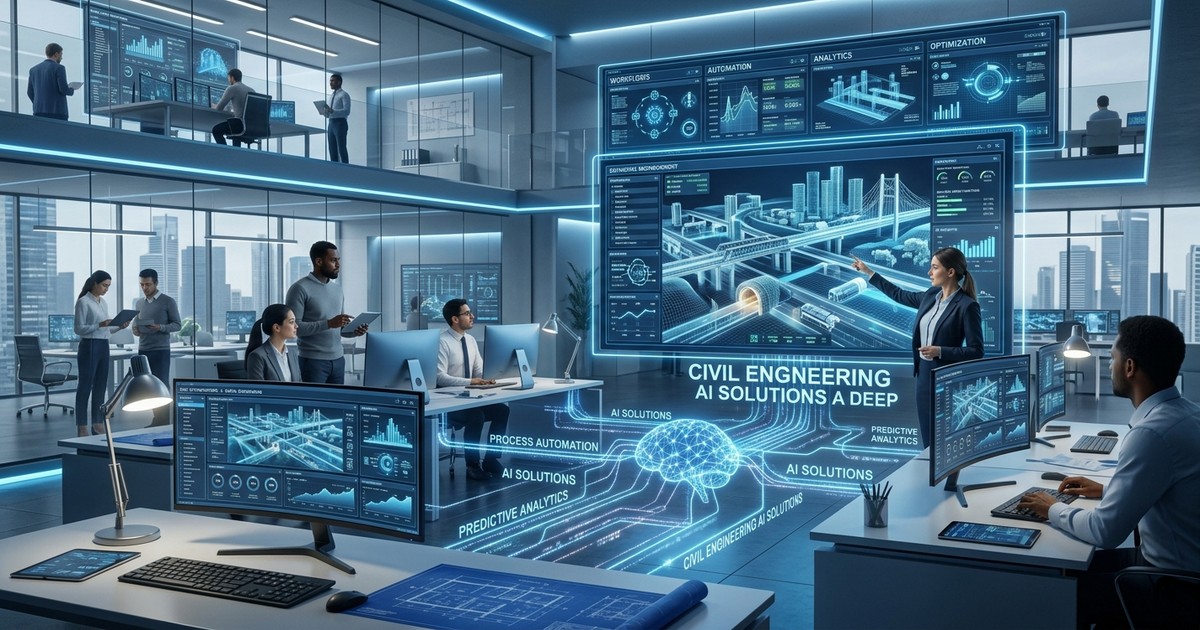
Civil Engineering Ai Solutions: A Deep Dive for Friday
Introduction - Hook with real problem
Imagine this: You're a project manager overseeing the construction of a massive bridge spanning a crucial river crossing. It's 2026. The project is already three months behind schedule, material costs are escalating due to unpredictable supply chain disruptions, and the risk of structural failure due to subtle design flaws is keeping you up at night. Traditional methods of analysis and project management are failing to keep pace with the increasing complexity and volatility. The pressure to deliver a safe, on-time, and within-budget project is immense. This is where AI solutions for civil engineering, mature and battle-tested by 2026, become not just helpful, but essential for survival. The question isn't if you should use AI, but how to deploy the right AI solutions effectively.
The Current Landscape - What's happening in 2026
By 2026, AI in civil engineering has moved beyond the hype and into practical application. We're seeing three distinct trends:
-
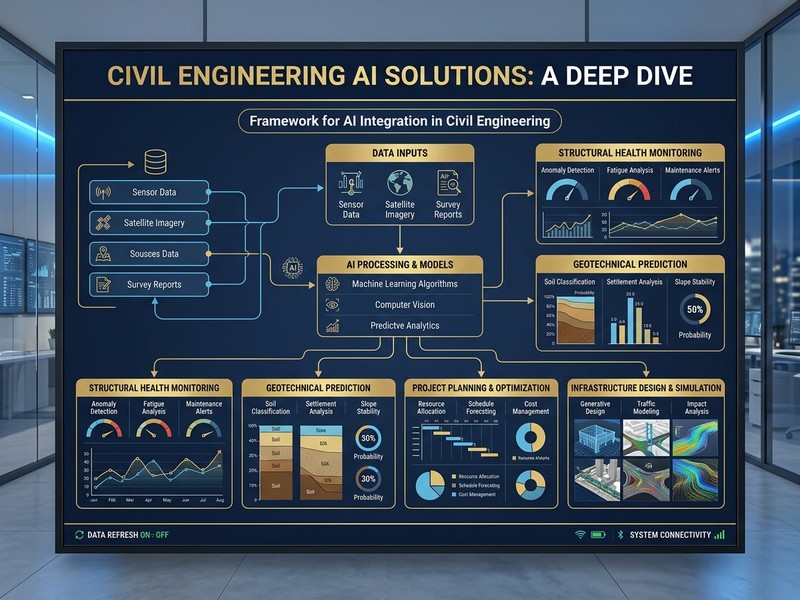
Specialized AI Models: Gone are the days of generic AI. We now have highly specialized models trained on vast datasets of civil engineering projects, material properties, and environmental conditions. These models excel at specific tasks like structural analysis, geotechnical risk assessment, and predictive maintenance of infrastructure.
-
Integration with Existing Tools: AI is no longer a standalone solution. It's deeply integrated with existing CAD/BIM software, project management platforms, and sensor networks. This seamless integration allows for real-time data analysis and automated workflows.
-
Edge Computing and Real-Time Analysis: The rise of edge computing allows for AI models to be deployed directly on-site, enabling real-time analysis of sensor data and immediate response to potential problems. Imagine a bridge equipped with sensors that detect subtle vibrations indicative of structural fatigue, triggering an immediate alert and initiating automated maintenance procedures.
The focus is now squarely on demonstrating ROI and delivering tangible benefits, leading to wider adoption beyond early adopters.
Deep Dive: Core Concepts - Frameworks and analysis
To understand which AI solutions actually work, we need to delve into the core concepts driving their success:
-
Generative Design Optimization: AI algorithms can explore thousands of design iterations, optimizing for factors like material usage, structural integrity, and environmental impact. This goes beyond simple parametric modeling, allowing for truly innovative and efficient designs. The key here is the fitness function - the set of criteria that the AI uses to evaluate each design. A well-defined fitness function is crucial for achieving desired outcomes.
-
Predictive Maintenance: AI models can analyze sensor data from infrastructure assets to predict potential failures before they occur. This allows for proactive maintenance, reducing downtime and extending the lifespan of critical infrastructure. The effectiveness of predictive maintenance relies heavily on the quality and quantity of sensor data, as well as the accuracy of the AI model.
-
Automated Construction Monitoring: AI-powered drones and robots can monitor construction progress in real-time, identifying potential delays, safety hazards, and quality control issues. This provides project managers with a comprehensive overview of the construction site and allows for timely intervention. Computer vision and machine learning algorithms are essential for accurately interpreting visual data from the construction site.
-
Risk Assessment and Mitigation: AI can analyze historical data, environmental factors, and design parameters to identify potential risks and recommend mitigation strategies. This helps to reduce the likelihood of project delays, cost overruns, and safety incidents. Bayesian networks and Monte Carlo simulations are often used in conjunction with AI to quantify and manage risks.
Comparison and Trade-offs - Tables with pros/cons
Here are some key AI solutions with a breakdown of their pros and cons:
Table 1: Generative Design vs. Traditional Design
| Feature | Generative Design (AI-Powered) | Traditional Design |
|---|---|---|
| Design Exploration | Explores thousands of design options | Limited by human creativity and time |
| Optimization | Optimizes for multiple objectives simultaneously (cost, performance, environmental impact) | Primarily focuses on performance and cost |
| Innovation | Can generate novel and unexpected designs | Relies on existing knowledge and experience |
| Time to Design | Significantly faster | Can be time-consuming |
| Implementation Cost | Higher upfront investment | Lower upfront investment |
| Expertise Required | Requires expertise in AI and design | Requires expertise in traditional design principles |
| Pros | Increased efficiency, innovative solutions, optimized designs | Established workflows, readily available expertise |
| Cons | Requires specialized knowledge, potential for unexpected outcomes, initial investment | Can be time-consuming, limited design exploration, potential for suboptimal designs |
Table 2: Predictive Maintenance: Sensor-Based vs. Traditional
| Feature | Sensor-Based (AI-Powered) | Traditional (Time-Based) |
|---|---|---|
| Maintenance Scheduling | Based on real-time condition monitoring | Based on fixed intervals |
| Failure Prediction | Predicts potential failures before they occur | Reactive maintenance after failure |
| Downtime | Reduced downtime due to proactive maintenance | Increased downtime due to reactive maintenance |
| Maintenance Costs | Lower maintenance costs due to targeted interventions | Higher maintenance costs due to unnecessary or delayed maintenance |
| Data Requirements | Requires comprehensive sensor data and AI models | Requires historical maintenance records |
| Implementation Complexity | Higher implementation complexity | Lower implementation complexity |
| Pros | Reduced costs, improved reliability, extended asset lifespan | Simple to implement, predictable maintenance schedule |
| Cons | Requires significant investment in sensors and AI, data security concerns | Can lead to unnecessary maintenance or delayed repairs, less efficient |
Implementation Framework - Step-by-step guide
Implementing AI solutions requires a structured approach:
-
Identify the Problem: Clearly define the problem you want to solve with AI. Be specific and measurable. For example, "Reduce bridge inspection costs by 20%."
-
Data Assessment: Evaluate the availability and quality of data. Do you have enough historical data to train an AI model? Are your sensors providing accurate and reliable data?
-
Solution Selection: Choose the AI solution that best fits your needs and budget. Consider factors like accuracy, scalability, and integration with existing systems. Refer to the Decision Guide section below.
-
Pilot Project: Start with a small-scale pilot project to test the AI solution and validate its effectiveness. This allows you to identify potential problems and fine-tune the model before deploying it on a larger scale.
-
Integration and Deployment: Integrate the AI solution with your existing systems and deploy it to the relevant infrastructure assets. Ensure that the system is properly configured and that data is flowing correctly.
-
Monitoring and Evaluation: Continuously monitor the performance of the AI solution and evaluate its impact on your business. Make adjustments as needed to optimize performance and maximize ROI.
-
Training and Support: Provide adequate training and support to your staff to ensure that they can effectively use the AI solution.
Decision Guide - How to choose
Selecting the right AI solution requires careful consideration of several factors. Here's a framework to guide your decision:
Decision Framework: AI Solution Selection
-
Problem Definition: What specific problem are you trying to solve? (e.g., Reducing construction delays, improving structural integrity, optimizing material usage)
-
Data Availability: Do you have sufficient and high-quality data to train an AI model? (Assess data volume, accuracy, and relevance)
-
Technical Expertise: Do you have the in-house expertise to implement and maintain the AI solution? (Consider hiring AI specialists or partnering with a vendor)
-
Budget: What is your budget for implementing the AI solution? (Consider upfront costs, ongoing maintenance costs, and potential ROI)
-
Integration Requirements: How easily can the AI solution be integrated with your existing systems? (Ensure compatibility with CAD/BIM software, project management platforms, and sensor networks)
-
Scalability: Can the AI solution be scaled to meet your future needs? (Consider the potential for expanding the solution to other projects or infrastructure assets)
-
Security: Are there any security risks associated with using the AI solution? (Ensure that data is properly protected and that the system is secure from cyberattacks)
Example: If you're facing frequent construction delays due to unforeseen site conditions and have access to detailed geological survey data, an AI-powered risk assessment tool that integrates with your project management software would be a good fit. However, if you lack the data or the technical expertise, a simpler, rule-based system might be a more practical starting point.
Case Study or Real Example
Let's consider the use of AI in optimizing bridge maintenance for a large metropolitan area. The city's Department of Transportation (DOT) was struggling to keep up with the increasing maintenance demands of its aging bridge infrastructure. Traditional inspection methods were time-consuming and costly, and often failed to detect subtle signs of structural degradation until it was too late.
The DOT implemented an AI-powered predictive maintenance system that analyzed data from sensors installed on the bridges, including vibration sensors, strain gauges, and corrosion sensors. The AI model was trained on historical data of bridge failures and maintenance records.
Results:
- Reduced Maintenance Costs: The AI system identified potential problems before they escalated, allowing the DOT to perform targeted maintenance interventions and avoid costly repairs. Maintenance costs were reduced by 15% in the first year.
- Improved Bridge Safety: The AI system detected subtle signs of structural degradation that were not visible to the human eye, preventing potential bridge failures and improving public safety.
- Extended Bridge Lifespan: By proactively addressing potential problems, the AI system helped to extend the lifespan of the bridges, reducing the need for costly replacements.
- Optimized Resource Allocation: The AI system provided the DOT with a prioritized list of bridges that required immediate attention, allowing them to allocate their resources more effectively.
30-Day Action Checklist
Here's a checklist to get you started with AI in civil engineering:
Week 1: Assessment & Planning
- [ ] Identify a specific problem area in your current workflows.
- [ ] Research potential AI solutions that address the identified problem.
- [ ] Assess the availability and quality of data relevant to the problem.
- [ ] Define clear, measurable goals for the AI implementation.
Week 2: Solution Evaluation & Selection
- [ ] Contact potential AI vendors and request demos.
- [ ] Evaluate different AI solutions based on the Decision Framework (above).
- [ ] Select a pilot project for initial AI implementation.
- [ ] Develop a detailed project plan for the pilot project.
Week 3: Implementation & Integration
- [ ] Install and configure the selected AI solution.
- [ ] Integrate the AI solution with your existing systems.
- [ ] Train your staff on how to use the AI solution.
- [ ] Begin collecting data and monitoring system performance.
Week 4: Monitoring & Optimization
- [ ] Analyze the data collected during the pilot project.
- [ ] Evaluate the performance of the AI solution against your goals.
- [ ] Identify areas for improvement and optimization.
- [ ] Make necessary adjustments to the AI model or system configuration.
Bottom Line - Key takeaways
AI in civil engineering is no longer a futuristic concept; it's a practical reality that can deliver significant benefits in terms of cost savings, improved safety, and increased efficiency. The key to success is to focus on specific problems, select the right AI solutions, and implement them in a structured and data-driven manner. By embracing AI, civil engineering professionals can build a more sustainable and resilient infrastructure for the future. The era of reactive maintenance and inefficient design processes is ending. Embrace the change.
Work With Versalence - CTA paragraph
Versalence specializes in providing cutting-edge AI solutions tailored for the civil engineering industry. We understand the unique challenges you face and offer customized AI models and integration services to help you optimize your projects, reduce costs, and improve safety. Our team of experienced AI engineers and civil engineering experts will work closely with you to develop and implement solutions that meet your specific needs. Contact us today to learn more about how Versalence can help you leverage the power of AI to transform your business. 📧 versalence.ai/contact.html | sales@versalence.ai