
Market Research Automation: A Deep Dive for Friday
Introduction - Hook with real problem
Imagine you're Sarah, VP of Marketing for a rapidly expanding DTC brand selling sustainable activewear. Two years ago, identifying underserved customer segments was relatively easy. Now, the market is saturated, consumer preferences are changing faster than ever, and traditional market research feels like trying to steer a speedboat with a rusty anchor. Every new product launch feels like a gamble. Sarah's team is drowning in data from surveys, social media, and website analytics, but they're struggling to extract actionable insights quickly enough to stay ahead. They need to understand evolving customer needs, identify unmet desires, and predict market trends before their competitors do. The old methods are failing. This is the reality for many businesses in 2026, and the solution lies in strategically implementing market research automation. But what actually works, and how do you avoid the pitfalls of automation for automation's sake? This isn't about replacing researchers; it's about augmenting their capabilities and freeing them to focus on strategic analysis.
The Current Landscape - What's happening in 2026
In 2026, market research automation isn't just a buzzword; it's a necessity for survival. We're seeing a convergence of several key trends:
- AI-Powered Insights Generation: AI is no longer just for data cleaning; it's actively generating hypotheses, identifying patterns, and predicting future trends with increasing accuracy. Natural Language Processing (NLP) is analyzing unstructured data from social media, reviews, and customer support tickets to uncover hidden insights.
- Hyper-Personalization: Consumers expect personalized experiences, and market research is adapting to deliver granular insights at the individual level. This means moving beyond broad demographic segments to understand the nuances of individual preferences and behaviors.
- Real-Time Data Streams: The traditional survey-based approach is being supplemented by real-time data streams from IoT devices, mobile apps, and online behavior tracking. This provides a continuous flow of information about customer interactions and preferences.
- Democratization of Research: Self-service platforms and AI-powered tools are making market research more accessible to smaller businesses and individual entrepreneurs. This levels the playing field and fosters innovation.
- Ethical Considerations: With increased data collection and analysis capabilities, ethical considerations around data privacy, security, and bias are paramount. Companies are investing in responsible AI and transparent data practices.
The challenge isn't access to data; it's the ability to process it efficiently and extract meaningful insights. This is where strategic automation comes in.
Deep Dive: Core Concepts - Frameworks and analysis
To effectively implement market research automation, you need to understand the core concepts driving its success. Here are three key frameworks:
-
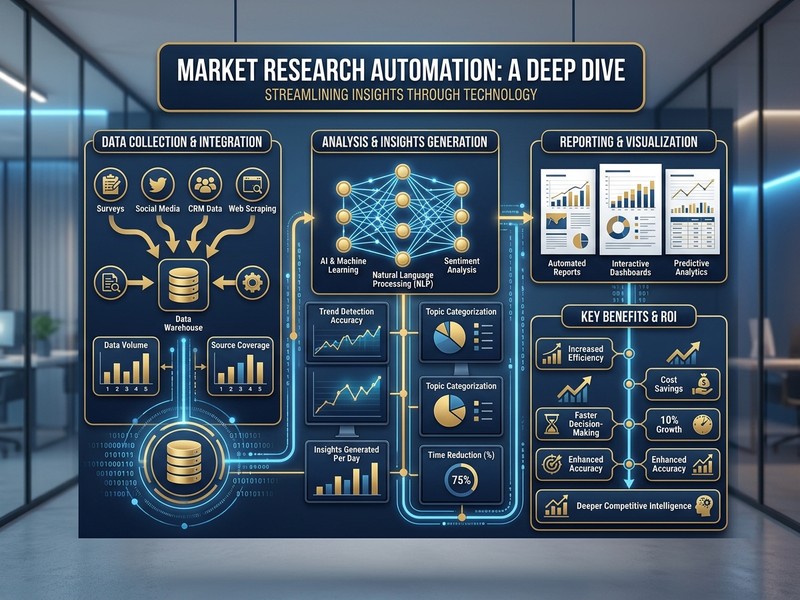
The Data-to-Insights Pipeline: This framework outlines the steps involved in transforming raw data into actionable insights:
- Data Collection: Automating data collection from various sources (e.g., social media APIs, web scraping, CRM integration).
- Data Cleaning & Preprocessing: Automating data cleaning, standardization, and transformation using AI algorithms.
- Data Analysis: Applying machine learning models to identify patterns, trends, and anomalies in the data.
- Insights Generation: Translating the results of data analysis into actionable insights and recommendations.
- Visualization & Reporting: Creating interactive dashboards and reports to communicate insights effectively.
-
The Automation Spectrum: This framework helps you assess the level of automation required for different research tasks:
- Basic Automation: Automating repetitive tasks like data entry, survey distribution, and basic reporting.
- Advanced Automation: Using AI to automate data analysis, sentiment analysis, and trend prediction.
- Autonomous Research: Developing AI-powered systems that can independently conduct research, generate hypotheses, and make recommendations.
-
The Customer Journey Framework: This framework helps you map the customer journey and identify opportunities for automation at each stage:
- Awareness: Automating social listening to understand brand perception and identify emerging trends.
- Consideration: Automating competitor analysis and product comparison research.
- Decision: Automating price sensitivity analysis and customer review analysis.
- Purchase: Automating post-purchase feedback collection and analysis.
- Retention: Automating customer churn prediction and personalized marketing campaigns.
Understanding these frameworks allows you to strategically apply automation to specific areas of your market research process.
Comparison and Trade-offs - Tables with pros/cons
Choosing the right automation tools and techniques involves understanding the trade-offs between different approaches. Here are two comparison tables:
Table 1: Automation Tool Comparison
| Tool Category | Examples | Pros | Cons | Use Case |
|---|---|---|---|---|
| Survey Automation | Qualtrics, SurveyMonkey, Typeform | Easy to use, wide range of question types, built-in analytics. | Can be expensive at scale, limited customization, potential for survey fatigue. | Gathering structured data about customer opinions and preferences. |
| Social Listening | Brandwatch, Mention, Sprout Social | Real-time insights into brand perception, competitor analysis, trend identification. | Can be noisy, requires careful filtering and analysis, potential for bias. | Monitoring brand reputation, identifying emerging trends, and understanding customer sentiment. |
| Web Analytics | Google Analytics, Adobe Analytics | Comprehensive data on website traffic, user behavior, and conversion rates. | Can be complex to configure, requires technical expertise, potential for data privacy concerns. | Understanding website performance, identifying user behavior patterns, and optimizing conversion rates. |
| AI-Powered Insights | Versalence, Market Logic, ThinkNow Research | Automates data analysis, identifies hidden patterns, and generates actionable insights. Can be integrated with other data sources. | Requires high-quality data, potential for bias in algorithms, can be expensive. Requires expertise to interpret results properly. | Discovering unmet needs, predicting market trends, and developing personalized marketing campaigns. |
Table 2: Data Source Comparison
| Data Source | Pros | Cons | Best For |
|---|---|---|---|
| Surveys | Direct feedback from customers, can be tailored to specific research questions. | Can be time-consuming and expensive, potential for response bias, limited sample size. | Understanding customer opinions, preferences, and satisfaction levels. |
| Social Media | Real-time insights into customer sentiment, wide reach, can identify emerging trends. | Can be noisy, potential for bias, requires careful filtering and analysis. | Monitoring brand reputation, identifying emerging trends, and understanding customer sentiment. |
| Website Analytics | Detailed data on user behavior, can identify areas for improvement, track conversion rates. | Can be complex to configure, requires technical expertise, potential for data privacy concerns. | Understanding website performance, identifying user behavior patterns, and optimizing conversion rates. |
| CRM Data | Comprehensive data on customer interactions, purchase history, and demographics. | Can be incomplete or inaccurate, requires careful data cleaning and integration. | Understanding customer behavior, identifying customer segments, and personalizing marketing campaigns. |
| IoT Data | Real-time data on product usage, environmental conditions, and customer behavior. | Can be complex to collect and analyze, potential for data privacy concerns, requires specialized expertise. | Understanding product performance, identifying usage patterns, and developing predictive maintenance strategies. |
Implementation Framework - Step-by-step guide
Implementing market research automation requires a structured approach. Here's a step-by-step guide:
- Define Your Research Objectives: Clearly define what you want to achieve with market research automation. What questions are you trying to answer? What decisions are you trying to inform?
- Assess Your Current Capabilities: Evaluate your existing data sources, tools, and expertise. Identify gaps in your capabilities and areas where automation can have the biggest impact.
- Choose the Right Tools: Select tools that align with your research objectives and budget. Consider factors like ease of use, scalability, and integration capabilities.
- Develop a Data Strategy: Define a clear data strategy that outlines how you will collect, clean, and analyze data. Consider data privacy and security implications.
- Implement Automation Gradually: Start with small-scale automation projects and gradually expand your efforts as you gain experience.
- Train Your Team: Provide your team with the training they need to use the new tools and techniques effectively.
- Monitor and Optimize: Continuously monitor the performance of your automation systems and make adjustments as needed.

Decision Guide - How to choose
Choosing the right level of automation and the right tools depends on several factors. Here's a decision framework:
Decision Point 1: Level of Automation
- If: You have limited resources and a small team, focus on basic automation to streamline repetitive tasks.
- If: You have a larger team and more complex research needs, consider advanced automation using AI-powered tools.
- If: You have the resources and expertise to develop custom solutions, explore autonomous research using AI and machine learning.
Decision Point 2: Tool Selection
- If: You need to gather structured data from customers, choose a survey automation tool.
- If: You need to monitor brand reputation and identify emerging trends, choose a social listening tool.
- If: You need to understand website performance and user behavior, choose a web analytics tool.
- If: You need to automate data analysis and generate actionable insights, choose an AI-powered insights platform like Versalence.
Decision Point 3: Data Source Prioritization
- If: You need direct feedback from customers, prioritize surveys.
- If: You need real-time insights into customer sentiment, prioritize social media.
- If: You need detailed data on user behavior, prioritize website analytics.
- If: You need comprehensive data on customer interactions, prioritize CRM data.
- If: You need real-time data on product usage, prioritize IoT data.
Case Study or Real Example
Let's revisit Sarah at the sustainable activewear brand. After implementing Versalence to automate social listening and customer review analysis, she discovered a growing demand for activewear designed for specific body types (e.g., petite, plus-size). Traditional research methods had missed this niche market. This insight led to the launch of a new product line that quickly became a best-seller, increasing revenue by 20% in the first quarter. By automating these processes, Sarah's team could focus on understanding the why behind the data, developing effective marketing strategies, and improving product design. They moved from reactive problem-solving to proactive opportunity identification.
30-Day Action Checklist
Here's a practical checklist to get you started with market research automation:
Week 1: Assessment & Planning
- [ ] Define your top 3 market research objectives.
- [ ] Identify your key data sources (CRM, social media, website analytics, etc.).
- [ ] Assess your current market research tools and capabilities.
- [ ] Research potential automation tools and platforms.
Week 2: Tool Selection & Data Strategy
- [ ] Choose a pilot automation tool (e.g., a free social listening tool or a trial of an AI insights platform).
- [ ] Develop a basic data strategy outlining how you will collect, clean, and analyze data.
- [ ] Identify potential data privacy and security risks.
Week 3: Implementation & Training
- [ ] Implement the pilot automation tool.
- [ ] Train your team on how to use the new tool.
- [ ] Start collecting and analyzing data.
Week 4: Analysis & Optimization
- [ ] Analyze the data collected by the pilot tool.
- [ ] Identify actionable insights.
- [ ] Implement changes based on those insights.
- [ ] Evaluate the success of the pilot project and plan for future automation efforts.
Bottom Line - Key takeaways
Market research automation in 2026 is about augmenting human capabilities, not replacing them. It's about strategically applying AI and other technologies to streamline repetitive tasks, generate actionable insights, and make better decisions faster. By understanding the core concepts, comparing the trade-offs, and following a structured implementation framework, you can unlock the full potential of market research automation and gain a competitive edge. Remember to focus on ethical considerations and prioritize data privacy and security. The future of market research is intelligent, automated, and driven by a deep understanding of customer needs.
Work With Versalence - CTA paragraph
Ready to unlock the power of AI-driven market research and stay ahead of the curve? Versalence offers cutting-edge solutions that automate data analysis, identify hidden patterns, and generate actionable insights, helping you make smarter decisions and achieve your business goals. Contact us today to learn how Versalence can transform your market research process. 📧 versalence.ai/contact.html | sales@versalence.ai