
How We Launched a SaaS and Onboarded 15 Customers in 60 Days
From Idea to Revenue: Our 60-Day SaaS Build Diary
The dream of building a Software-as-a-Service (SaaS) company is a powerful one. You envision a brilliant idea, a sleek interface, and a stream of recurring revenue. But the reality is often a brutal wake-up call. According to Startup Genome, a staggering 92% of startups fail within three years. A primary culprit, as cited by CB Insights, is a lack of market need—a problem that plagues 42% of failed ventures. Many founders spend 6-12 months and tens of thousands of dollars building a product in isolation, only to launch to the sound of crickets.
At Versalence AI, we believe in a different approach. We believe that speed, intelligent automation, and relentless validation are the keys to de-risking a new venture. We preach this philosophy to our clients, but we also live by it.
To prove it, we gave ourselves a challenge: could we go from a raw concept to a market-ready SaaS product with paying customers in just 60 days?
This isn't just a hypothetical exercise. This is the detailed diary of how we built a functional, revenue-generating SaaS application, leveraging the power of AI-powered workflows and platforms like Botpress to achieve a timeline most would consider impossible.
The Business Impact of Speed: Why 60 Days Matters
In today's hyper-competitive market, time isn't just money; it's survival. The traditional "waterfall" approach to software development—long planning cycles, extensive feature building, and a "big bang" launch—is a luxury few new products can afford. Every month spent building without customer feedback is a month you’re burning cash on unvalidated assumptions.
The opportunity cost is immense. While you're perfecting a feature no one asked for, a competitor is already in the market, learning from real users, and capturing market share. The core principle of the Lean Startup methodology is to shorten this development cycle. The goal is to get a Minimum Viable Product (MVP) into the hands of early adopters as quickly as possible to start the feedback loop.
Our 60-day challenge was designed to compress this loop to its absolute limit. The goal wasn't to build a perfect, feature-complete product. The goal was to answer the single most important question for any new business: Will people pay for this? By achieving this in two months, we could validate the core business model and gain critical insights to guide future development, all while minimizing financial risk and maximizing our learning velocity.
How We Did It: The 60-Day Build Diary
Our chosen concept was an "AI Appointment Setter" for local service businesses. Think of dental clinics, real estate agencies, or boutique law firms. Their primary challenge is capturing and qualifying leads efficiently. A phone call can go unanswered, and a simple "contact us" form is passive. We envisioned an intelligent chatbot that could engage website visitors 24/7, answer common questions, qualify their intent, and book them directly into a calendar.
Here’s the day-by-day breakdown of our sprint.
Phase 1: Validation & Foundation (Days 1-10)
Before writing a single line of code, we hit the phones. We weren't selling; we were learning. We spoke to 20 local business owners to understand their pain points.
- "I miss leads that come in after hours."
- "My front desk staff spends too much time answering the same five questions."
- "Website contact forms feel impersonal and have a slow response time."
This feedback was gold. It confirmed our core hypothesis and helped us define the MVP. It needed to do three things exceptionally well:
- Answer frequently asked questions (e.g., "What are your hours?", "Do you offer free consultations?").
- Qualify the lead (e.g., "Are you a new or existing client?", "What service are you interested in?").
- Integrate with a calendar to book an appointment.
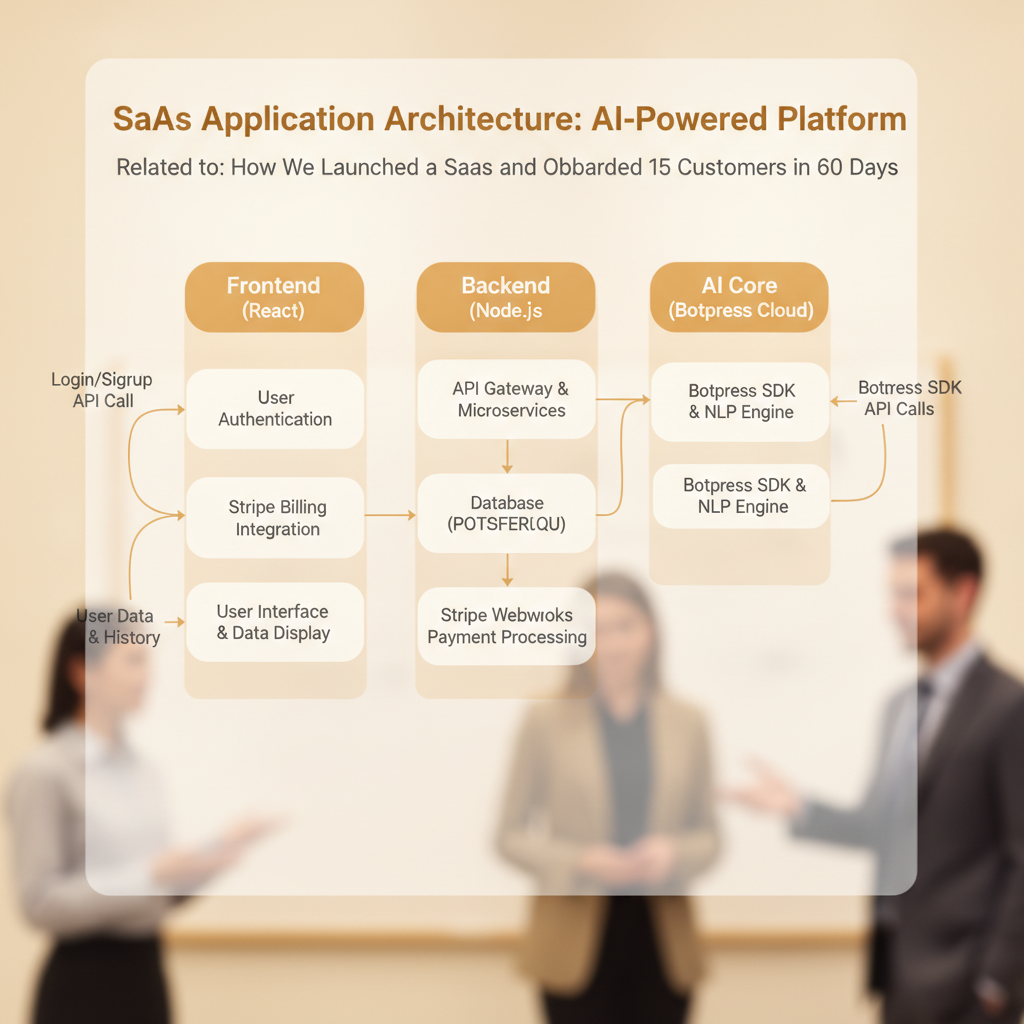
With a clear scope, we laid the technical foundation. We chose a modern, scalable stack designed for speed:
- AI Core: Botpress Cloud. This was the most critical decision. Building a Natural Language Understanding (NLU) engine, conversation state management, and integration framework from scratch would take months. Botpress, powered by OpenAI's LLMs, provides all of this out of the box. Its visual flow builder and extensive integration hub meant we could focus on the business logic, not the underlying AI infrastructure. Our public versalenceai/botpress repository contains the tools and integrations we use to extend its capabilities.
- Frontend: Next.js (React) for a fast, modern customer-facing dashboard.
- Backend: Node.js with Express for handling user accounts, authentication, and business logic.
- Payments: Stripe for subscription management. It's developer-friendly and trusted.
- Deployment: Vercel for the frontend and a managed database provider for the backend to minimize our DevOps overhead.
This architecture is simple, robust, and designed for rapid iteration. By leveraging managed services and a powerful AI platform like Botpress, we offloaded a massive amount of development work.
Phase 2: The Core Build Sprint (Days 11-30)
This was the "heads-down" coding phase. The team split into two streams.
Stream 1: The SaaS Application. This team focused on the customer-facing shell:
- User Authentication: Secure sign-up and login for business owners.
- Stripe Integration: Setting up subscription plans ($99/month was our target price).
- The Dashboard: A simple interface where a business owner could input their specific information (business name, hours, services offered, calendar link) and receive a JavaScript snippet to embed the chatbot on their website.
Stream 2: The AI Chatbot Template. This team lived inside Botpress Studio.
- Conversation Flows: We designed the core conversation paths visually. We created flows for greeting, FAQ handling, lead qualification, and appointment booking.
- AI Knowledge Bases: We utilized Botpress's knowledge base feature, allowing the bot to answer questions from an uploaded document. This meant a dental clinic could upload a PDF of their services, and the bot could instantly answer questions about them without us having to code a single new intent.
- Integrations: We built a standard integration with Calendly. The bot would guide the user to the correct booking page based on their needs.
- The "Magic" - The Botpress SDK: Here’s where Versalence’s workflow automation expertise came in. When a new customer signed up through our dashboard, our Node.js backend used the
@botpress/sdkto programmatically create a new, dedicated bot for them in our Botpress Cloud workspace. It would then inject the business-specific information (hours, services, etc.) into the bot's configuration. This automated onboarding process was the key to making the solution scalable from day one.
By the end of day 30, we had a working end-to-end product. A new user could sign up, pay, configure their bot, and deploy it to their website in under 10 minutes, with zero manual intervention from our team.

Phase 3: Alpha Testing & Rapid Iteration (Days 31-45)
We now had an MVP, but it was untested in the wild. We went back to our initial list of business owners and offered five of them free, hands-on "alpha" access for 30 days in exchange for honest feedback.
This phase was invaluable. We learned:
- The onboarding instructions in the dashboard were slightly confusing. We rewrote the copy and added a short video tutorial.
- The bot sometimes struggled with industry-specific jargon. We fine-tuned the AI prompts and added more examples to the knowledge base.
- One user wanted to get lead notifications via SMS. While this was out of scope for the MVP, we noted it as a high-priority feature for V2.
This direct feedback loop allowed us to make dozens of small but critical improvements. We weren't guessing what users wanted; they were telling us directly. This is the agility that a compressed development cycle enables.
Phase 4: Public Launch & First Customers (Days 46-60)
With a polished and validated MVP, it was time to launch. Our "launch" wasn't a big press release; it was targeted, methodical outreach.
- Landing Page: We created a simple, benefit-driven landing page explaining the problem and our solution.
- Initial Outreach: We re-engaged the 15 other business owners from our initial validation calls who hadn't participated in the alpha. We showed them a live demo of the now-polished product.
- The "Founder-Led" Sale: We offered a special launch price and a direct line to our team for support. This personal touch is crucial for early adopters.
The response was immediate. Because we had built a solution for a pain point they had personally described to us, the value proposition was crystal clear. By day 60, we had converted 15 of those initial prospects into paying customers.
Related Solutions: The Power of a Platform Approach
The success of this 60-day sprint wasn't a fluke; it was the result of a repeatable methodology that we apply to various business challenges. The core components—leveraging a powerful AI platform, automating workflows, and building a minimal viable product—are universally applicable.
The technology at the heart of our AI Appointment Setter is the same engine we use to build more complex solutions for larger enterprises. Our work with the versalenceai/botpress repository is a testament to this. We develop and maintain public integrations for platforms like WhatsApp, Slack, and Microsoft Teams, allowing businesses to deploy intelligent assistants across any channel.
Whether we are building:
- Internal Support Bots: An AI agent that integrates with a company's internal knowledge base to answer employee questions about HR policies or IT support.
- E-commerce Assistants: A chatbot that helps customers track orders, process returns, and get product recommendations.
- Complex Automation Workflows: Systems that can triage customer support tickets, analyze sentiment, and route them to the correct human agent with full context.
The underlying principle remains the same: start with a focused problem, use a powerful AI foundation to accelerate development, and iterate based on real-world feedback.
The Results & ROI: More Than Just Revenue
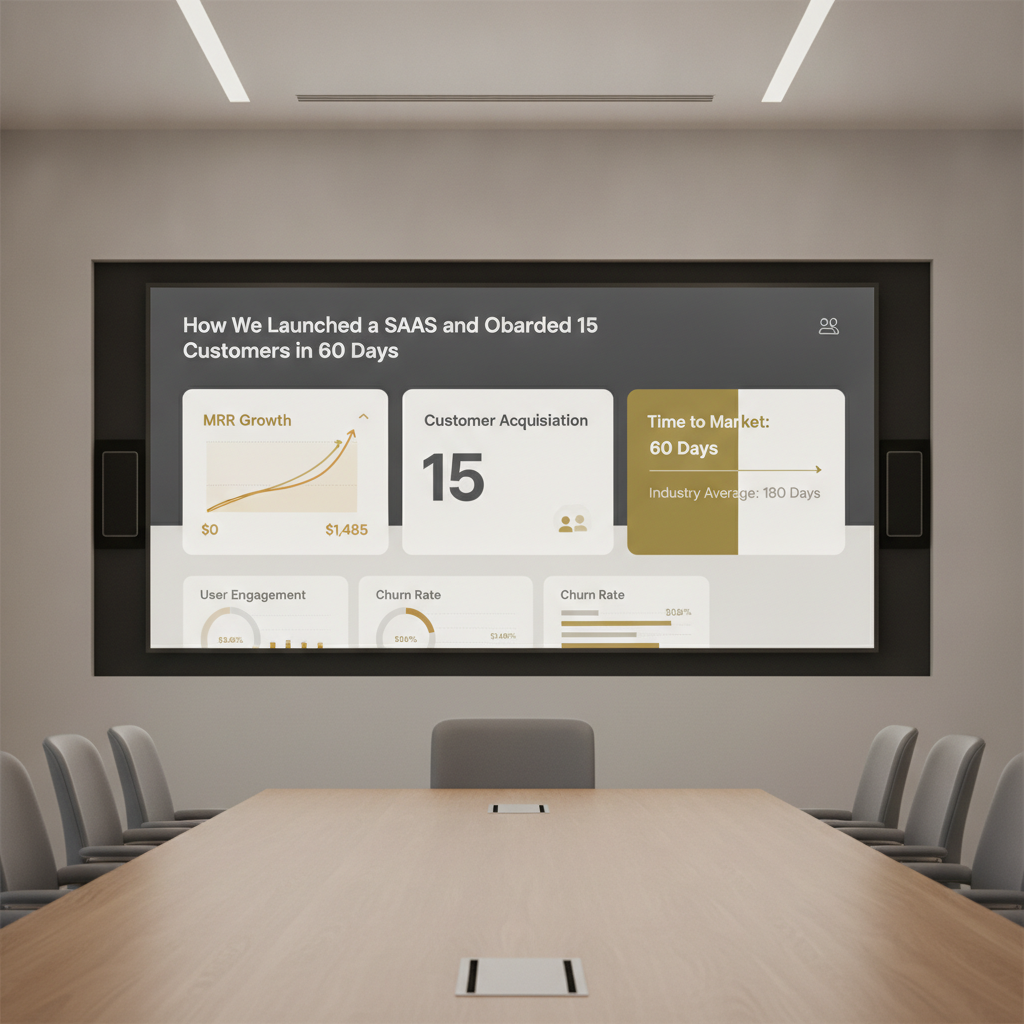
On day 61, we took a step back to assess the results. The numbers were compelling.
- Paying Customers: 15
- Monthly Recurring Revenue (MRR): $1,485 ($99/mo x 15)
- Time to First Revenue: 52 days
- Total Development Time: ~800 man-hours (vs. a potential 2000+ for building from scratch)
While the initial MRR is modest, it's the story behind the numbers that truly defines the ROI:
- Market Validation: We proved, with real dollars, that there is a market need for our product. This is the single most valuable asset for a new venture. We now have a clear mandate to invest further in development.
- Product Roadmap: Our backlog is now filled with feature requests from actual paying users, not from our own internal brainstorming. We know exactly what to build next.
- Massive Risk Reduction: We invested two months, not a year, to get to this point. If the idea had failed, we would have learned quickly and pivoted with minimal losses.
- Competitive Advantage: We went from concept to a competitive product in the market in a fraction of the time of our potential competitors, establishing a crucial foothold.
Turn Your AI Vision into Reality, Faster.
This 60-day journey from a simple idea to a revenue-generating SaaS product demonstrates the power of modern AI platforms and a lean, validation-focused development process. It's a testament to the fact that you no longer need massive teams or year-long development cycles to bring a powerful AI-driven solution to market.
What it requires is the right expertise in architecture, AI implementation, and intelligent workflow automation. That’s what we do at Versalence AI. We are not just consultants; we are builders who thrive on turning complex business problems into elegant, efficient, and market-ready solutions.
Are you sitting on an idea for an AI-powered application but are daunted by the timeline and complexity? Let us be your technical co-founder.
Contact us to schedule a free consultation and learn how we can help you build and launch your MVP at startup speed.
Visit us at versalence.ai or email our team directly at sales@versalence.ai.
Work With Versalence
Ready to remove the drag from your business operations? Our AI automation and system integration team delivers measurable results in 30-120 days.
📧 Contact us
✉️ sales@versalence.ai