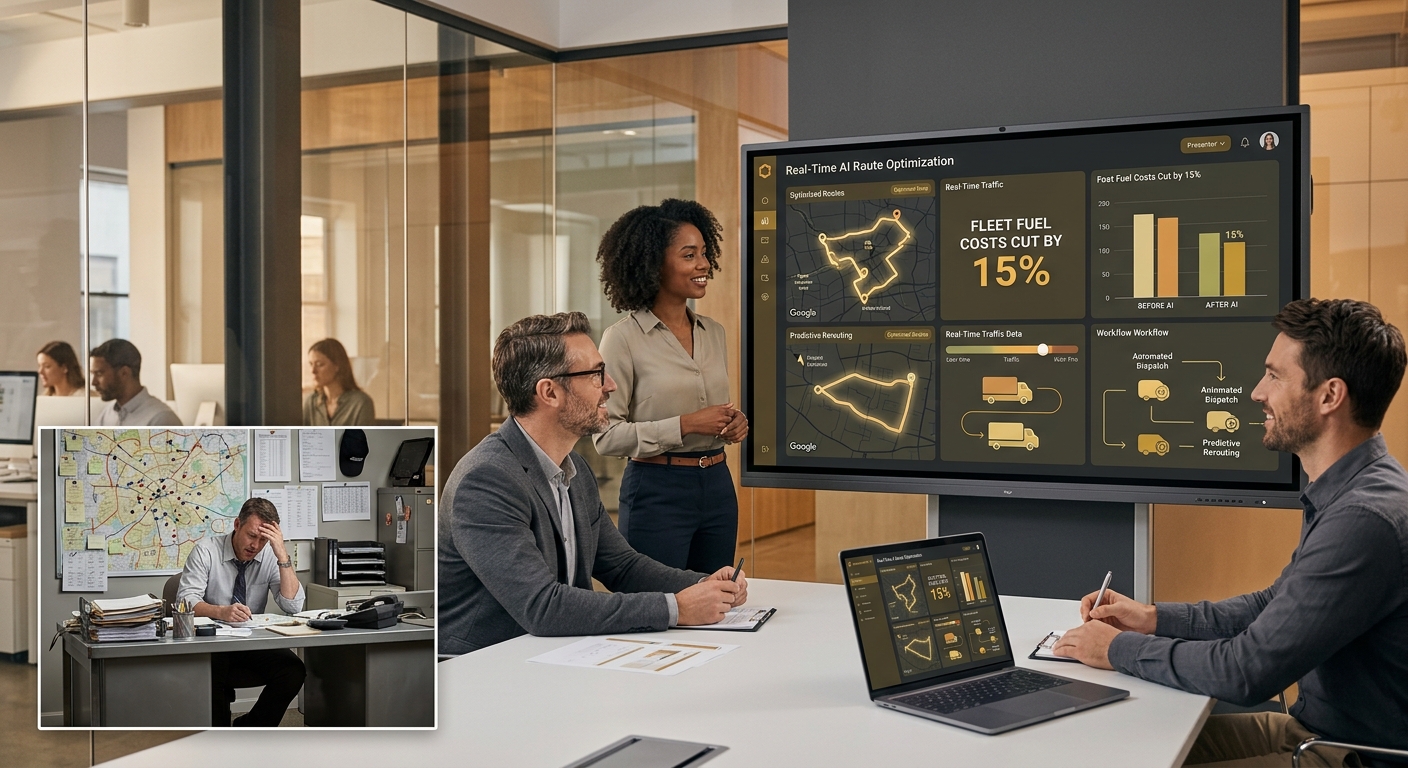
How Real-Time AI Route Optimization Cuts Fleet Fuel Costs by 15%
In the logistics and transportation industry, profit margins are notoriously razor-thin. For most fleet operators, operational costs dictate survival, and at the very top of those expenses is fuel. When global events, supply chain bottlenecks, and volatile crude oil markets intersect, a bad month at the fuel pump can erase a quarter’s worth of profit.
For years, fleet managers have relied on static routing systems and basic GPS to get drivers from point A to point B. But as delivery windows shrink and urban congestion worsens, these legacy systems are no longer enough. The traditional approach to the Vehicle Routing Problem (VRP)—planning routes hours or days in advance based on historical data—is structurally flawed because the real world is not static. Traffic accidents happen, weather shifts rapidly, and last-minute delivery requests disrupt carefully laid plans.
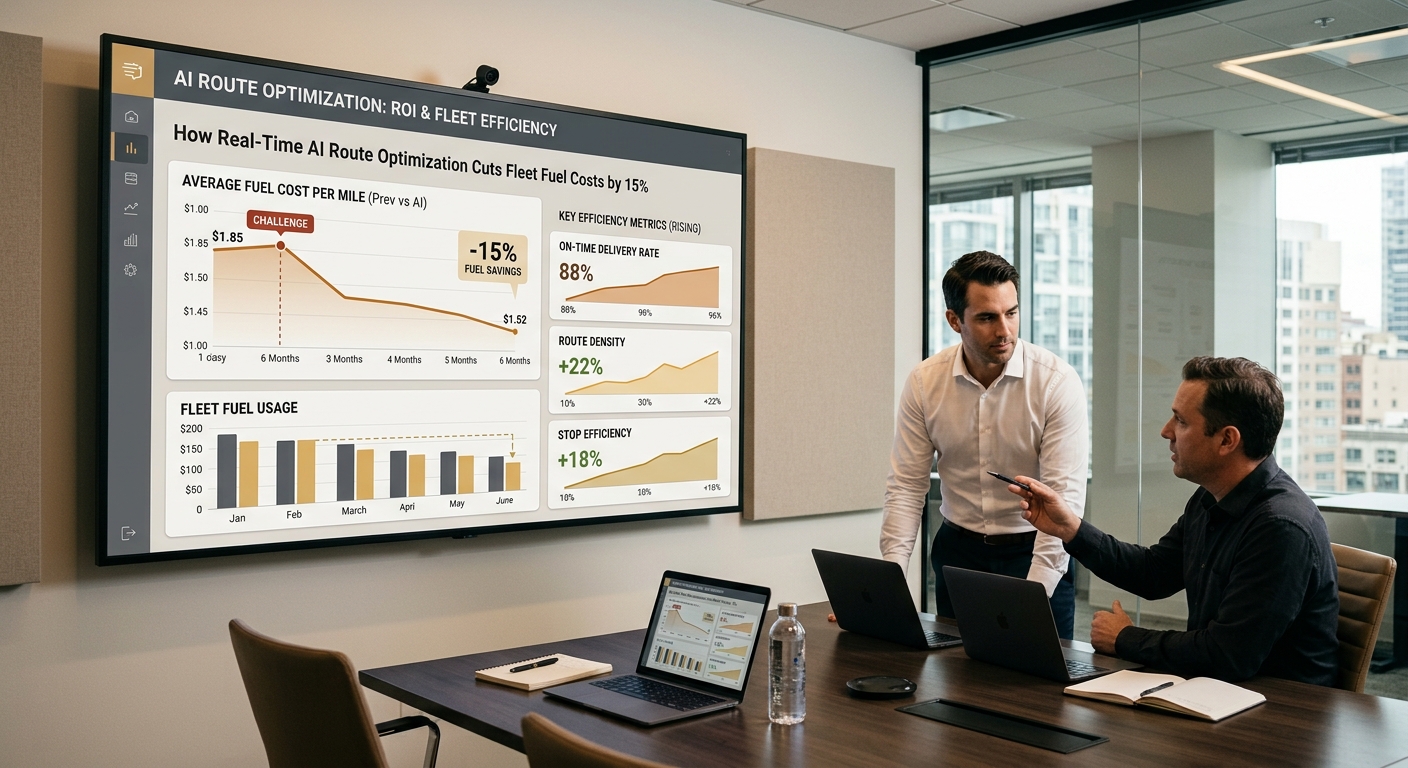
The modern solution isn't just better mapping; it is intelligent, predictive, and highly adaptable automation. The shift from static planning to real-time AI route optimization is transforming the logistics sector. In this article, we will explore the profound business impact of inefficient routing, how Versalence AI engineers real-time dynamic solutions to combat these challenges, and how integrating conversational AI frameworks can streamline fleet communication, ultimately leading to a 15% reduction in fuel consumption for a mid-sized logistics fleet.
The Business Impact: The Hidden Costs of Legacy Routing
To understand the magnitude of saving 15% on fuel costs, we must first break down how fleets lose money to inefficiency every single day. The challenges go far beyond just taking a longer physical route.
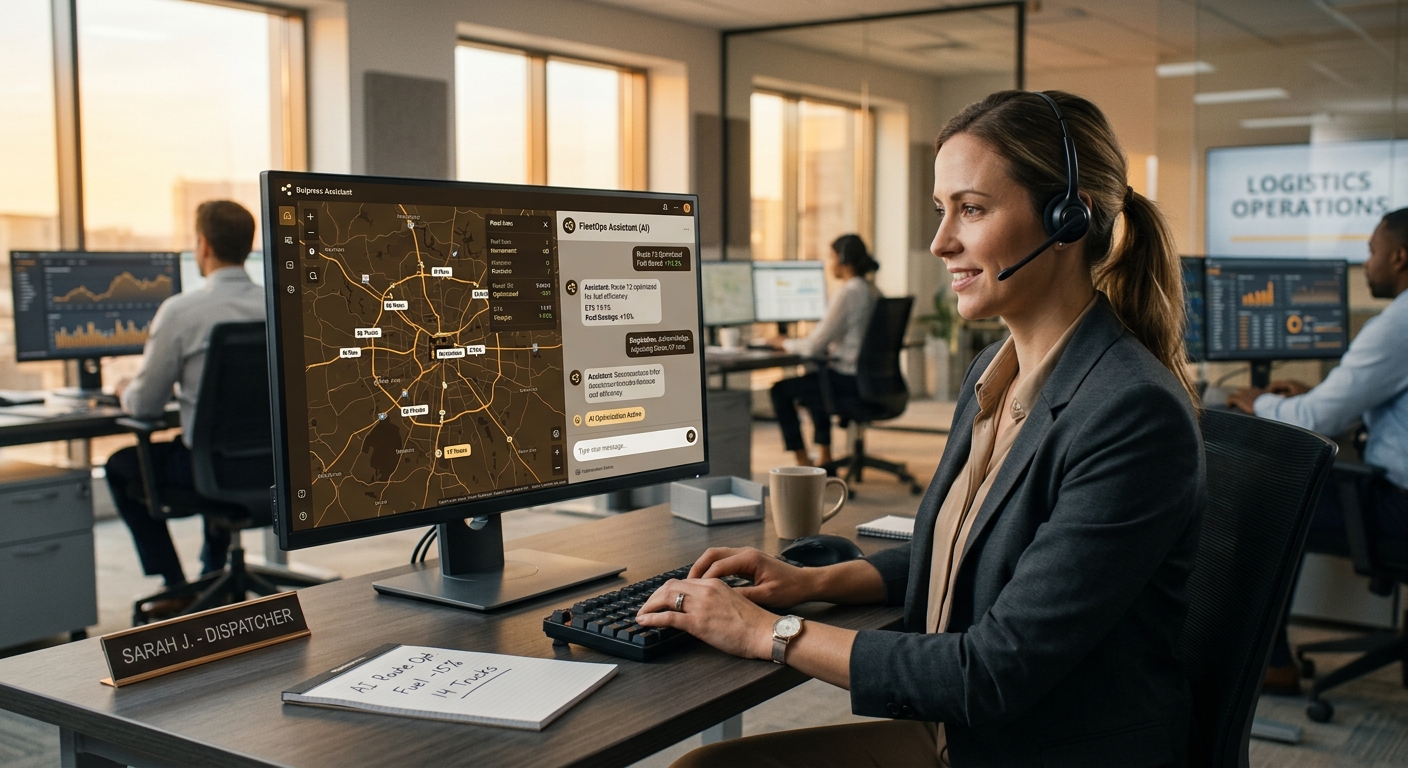
1. The Idling Epidemic and Fuel Burn
According to industry studies, heavy-duty trucks burn about 0.8 gallons of fuel per hour while idling. If a fleet relies on static routing that inadvertently sends drivers into rush-hour gridlock or unexpected construction zones, those trucks sit idle. For a fleet of 100 trucks idling just one unnecessary hour a day, that translates to 80 gallons of wasted fuel daily. Over a year, this inefficiency costs hundreds of thousands of dollars. Real-time AI prevents this by redirecting drivers long before they hit the bottleneck.
2. Wear and Tear on Fleet Assets
Inefficient routing doesn't just drain fuel; it destroys hardware. Stop-and-go traffic, poorly maintained secondary roads chosen by flawed algorithms, and unnecessary mileage drastically accelerate the wear and tear on brakes, tires, and engines. A 15% reduction in unnecessary mileage directly correlates to a prolonged lifespan for vehicle components, spacing out preventative maintenance schedules and keeping trucks on the road generating revenue rather than sitting in the shop.
3. Missed SLAs and Customer Dissatisfaction
We live in the era of the "Amazon Effect." Customers—whether they are B2B partners waiting for raw manufacturing materials or consumers waiting for a package—expect pinpoint accuracy in delivery times. When a fleet uses a legacy routing system that fails to adapt to real-time delays, Service Level Agreements (SLAs) are breached. This results in financial penalties, lost contracts, and reputational damage. Real-time AI not only predicts accurate ETAs but recalculates them dynamically, allowing businesses to manage customer expectations proactively.
4. Driver Burnout and Retention Rates
There is a massive driver shortage in the logistics industry. High turnover is incredibly expensive; recruiting, hiring, and training a new commercial driver can cost a company upwards of $10,000. Drivers are highly susceptible to burnout, and one of their primary frustrations is dealing with terrible dispatching and routing. Sitting in avoidable traffic or being sent on convoluted routes reduces their earning potential (if paid by the mile) and increases their stress. Empowering drivers with AI-optimized, frictionless routing directly improves job satisfaction and retention.
How Versalence AI Delivers Real-Time Route Optimization
At Versalence AI, we recognize that true route optimization is not a mapping problem; it is a complex data orchestration and predictive machine learning problem. When we architect solutions to help fleets achieve double-digit fuel savings, we deploy a multi-layered AI ecosystem that thinks miles ahead of the driver.
Here is how our AI-powered automation and intelligent workflows execute real-time route optimization:
Phase 1: Comprehensive Data Ingestion
Legacy routing engines look at two variables: distance and speed limits. Versalence AI builds systems that ingest a massive, continuous stream of real-time data. This includes:
- Telematics Data: Live GPS coordinates, current speed, and engine diagnostic data pulled directly from the fleet's Electronic Logging Devices (ELDs).
- Live Traffic & Weather APIs: Integrating real-time feeds to monitor congestion, accidents, road closures, and weather anomalies (like flash floods or heavy snow) that will impact driving speed.
- Vehicle Parameters: AI algorithms factor in the specific weight, height, and class of the vehicle. A route that works for a sprinter van may have a bridge with a weight limit that prohibits a Class 8 semi-truck.
- Delivery Constraints: Strict time windows, required loading dock equipment, and driver shift hours (Hours of Service regulations).
Phase 2: Predictive Machine Learning Models
Rather than just reacting to traffic data, our AI solutions utilize predictive analytics. By leveraging historical traffic patterns combined with real-time anomalies, the AI predicts what the traffic will look like at the exact moment the truck arrives at that specific coordinate.
For example, a route might look clear when the truck departs at 6:00 AM, but the AI knows that by the time the truck reaches a specific interstate junction at 7:45 AM, traffic volume will have spiked by 300%. The system optimizes the route based on future predictive states, not just present conditions.
Phase 3: Dynamic Recalculation Engine
The core of the 15% fuel savings lies in continuous, dynamic recalculation. Powered by advanced graph neural networks and reinforcement learning algorithms, the routing engine evaluates thousands of potential route permutations per second.
If an accident occurs on the highway 20 miles ahead of a driver, the system instantly identifies the disruption. It calculates the fuel cost of sitting in the resulting traffic versus the fuel cost of taking a longer, but moving, detour. If the detour is more efficient, the system instantly executes an intelligent workflow to reroute the driver.
Phase 4: Intelligent Workflows and Automated Dispatch
Optimization algorithms are useless if the data cannot be quickly and safely communicated to the driver and dispatch team. This is where automation replaces manual intervention. Instead of a dispatcher noticing a delay on a screen, calling the driver, and manually figuring out a new route, the Versalence AI system automates the entire sequence. The system pushes the updated route directly to the driver’s navigation interface, while simultaneously updating the ETA in the customer-facing portal and the company's Transport Management System (TMS).
Related Solutions We've Built: Conversational AI with Botpress
A critical challenge in modernizing fleet operations is the human-computer interface. Logistics operations involve people who are constantly on the move, operating heavy machinery, or managing chaotic dispatch boards. Complex software dashboards can sometimes hinder rather than help.
To bridge this gap, Versalence AI leverages platforms like Botpress to build robust conversational interfaces that integrate directly with our AI routing engines.

Botpress is a powerful platform for building next-generation chatbots and assistants powered by large language models (LLMs). By utilizing the @botpress/sdk and @botpress/cli, Versalence engineers custom, AI-driven conversational agents that act as the connective tissue between complex route optimization algorithms and the human workforce.
Here is how we integrate Botpress-powered assistants into fleet optimization workflows:
Natural Language Dispatch Interfaces
Instead of forcing dispatchers to click through five different screens on a TMS to find the status of a delayed truck, we deploy a Botpress AI assistant within the company’s internal communication tools (like Slack, Microsoft Teams, or a custom web dashboard).
A dispatcher can simply type: "Where is Truck 42, and what is the impact of the storm in Chicago?"
The Botpress agent, integrated securely via API with the Versalence routing engine, queries the real-time telematics and predictive weather data, instantly replying: "Truck 42 is currently on I-90, 40 miles outside Chicago. The storm has reduced average speeds by 25%. The AI routing engine has automatically rerouted them via US-20 to avoid a major pile-up. New ETA is 14:30. Fuel impact is minimal. Would you like me to notify the customer?"
Hands-Free Driver Communication via WhatsApp
Safety is paramount. Drivers cannot read complex emails or navigate new software while driving. Using Botpress, we build automated, conversational SMS or WhatsApp integrations. When the AI routing engine detects a major delay and calculates a new route, the Botpress assistant can automatically send a voice-to-text or brief message to the driver’s approved device: "Accident ahead on I-84. Routing engine recommends Exit 12 for an optimized bypass. Your navigation is updated."
Furthermore, drivers can use voice commands to interact with the bot to report issues: "Bot, I'm delayed at the loading dock by 45 minutes." The Botpress assistant parses this natural language, updates the routing engine to recalculate the rest of the day’s deliveries, and automatically adjusts ETAs across the board.
Automated Maintenance Ticketing
Because our route optimization AI tracks vehicle wear and idling times, we can use Botpress to automate maintenance workflows. If the AI detects that a truck's engine diagnostics are showing signs of reduced fuel efficiency, the Botpress assistant automatically messages the fleet maintenance manager: "Truck 17's fuel efficiency dropped by 4% this week, and idle vibrations suggest a filter issue. Should I schedule a maintenance bay for Friday?"
By turning raw algorithmic data into conversational workflows, Botpress allows Versalence AI to ensure that the cutting-edge route optimization tech is easily adopted and utilized by the entire workforce, maximizing the ROI of the technology.
Results & ROI: What a 15% Fuel Reduction Actually Means
When a mid-sized regional logistics fleet implemented a comprehensive real-time AI routing and automated communication architecture, the headline metric was a 15% reduction in overall fuel costs. But to truly understand the ROI of AI in logistics, we have to look at how that 15% cascades across the entire business model.
1. Direct Financial Savings
Consider a fleet of 150 heavy-duty trucks. A conservative estimate suggests a single truck might consume 15,000 gallons of diesel fuel annually. At an average cost of $4.00 per gallon, that is $60,000 in fuel per truck, totaling $9,000,000 in annual fuel expenditures for the fleet.
A 15% reduction in fuel consumption yields $1,350,000 in pure bottom-line savings per year. This is capital that goes directly back into the business, allowing the company to acquire new vehicles, increase driver pay, or outbid competitors on tight-margin contracts.
2. Radical Reduction in Dispatch Overhead
By automating the rerouting process and utilizing Botpress conversational agents for status updates, the manual workload on the dispatch team plummets. Dispatchers no longer spend hours on the phone playing "telephone" between drivers and customers. Instead, the AI handles the routine data flow, allowing dispatchers to manage edge cases and focus on high-level strategic planning. This often allows fleets to scale their operations and take on 20-30% more capacity without needing to proportionally increase back-office headcount.
3. Slashing Preventative Maintenance Costs
The 15% drop in fuel consumption is inextricably linked to a drop in engine hours and unnecessary mileage. Trucks spend less time idling in traffic and less time traversing inefficient routes. This leads to a measurable decrease in the frequency of required oil changes, brake replacements, and tire realignments. Fleet managers typically see a 5% to 8% reduction in total maintenance expenditures as a secondary benefit of AI route optimization.
4. Greener Operations and ESG Compliance
Environmental, Social, and Governance (ESG) criteria are no longer just buzzwords; they are requirements for winning large corporate contracts. Major retailers are increasingly demanding that their logistics partners prove they are taking steps to reduce their carbon footprint. Saving 15% on fuel means an equivalent 15% reduction in CO2 emissions. Through Versalence AI’s automated reporting dashboards, fleets can instantly generate verifiable emissions reductions reports, turning a cost-saving measure into a powerful sales and marketing tool.
The Future of Fleet Operations is Automated
The logistics industry is standing at a critical juncture. The days of treating dispatching and routing as a manual, intuition-based process are over. As fuel prices remain unpredictable and the demands for faster, more accurate deliveries rise, fleets that rely on static routing will simply be priced out of the market by more efficient competitors.
Real-time AI route optimization is not a futuristic concept—it is a viable, high-ROI solution available right now. By combining deep predictive machine learning algorithms with frictionless conversational AI interfaces like Botpress, Versalence AI delivers solutions that empower your drivers, streamline your back office, and dramatically reduce your operational costs.
Don’t let inefficiencies burn your profit margins at the pump. Transform your logistics operations with intelligent, automated workflows that adapt to the real world in real time.
Ready to see how AI automation can cut costs and scale your fleet’s capabilities? Contact Versalence AI today.
Reach out to our experts at sales@versalence.ai or visit versalence.ai to schedule a consultation and discover the untapped potential hidden in your fleet’s data.
Work With Versalence
Ready to remove the drag from your business operations? Our AI automation and system integration team delivers measurable results in 30-120 days.
📧 Contact us
✉️ sales@versalence.ai