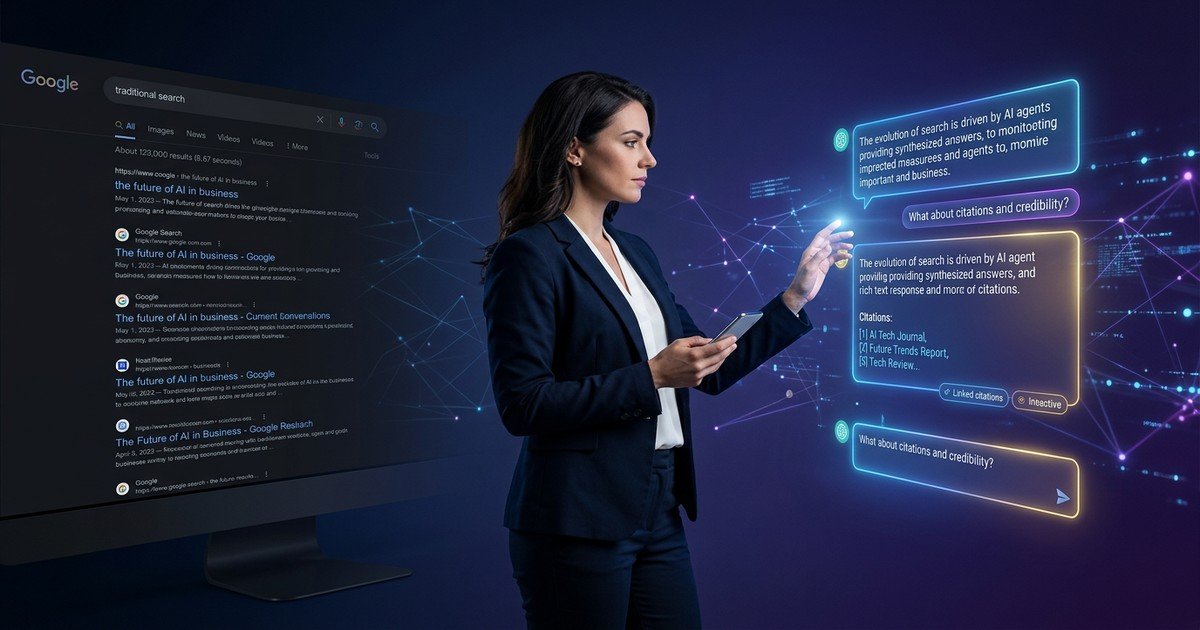
GEO (Generative Engine Optimization) Is the New SEO: How to Rank in ChatGPT, Perplexity, and Google AI Overviews
40% of searches now happen through conversational AI interfaces, not Google. If you're still optimizing for blue links, you're optimizing for the past. GEO is how brands get cited inside AI-generated answers — and most businesses haven't started yet.
The Search Landscape Has Fundamentally Shifted
Google still dominates overall search volume, but the picture changes dramatically when you look at specific demographics and use cases. By Q1 2026, AI Overviews appear in 50%+ of all Google searches. Google's market share dropped below 90% for the first time since 2015. The rules of visibility are being rewritten in real time.
Key Statistics Driving the GEO Revolution:
- 40% of all search queries happen via AI engines (ChatGPT, Perplexity, Claude, Gemini)
- 50%+ of Google searches show AI Overviews by Q1 2026
- 65% of Google searches in 2025 ended without a click (SparkToro)
- 600%+ growth in Reddit traffic since 2023 — AI systems favor UGC over generic content
- 86% of SEO professionals now use AI in their workflows

What Is GEO (Generative Engine Optimization)?
GEO (Generative Engine Optimization) is the practice of optimizing content for AI-powered search engines like ChatGPT, Claude, Perplexity, and Google SGE. While traditional SEO focuses on ranking high in Google's search results, GEO focuses on being cited and referenced in AI-generated answers.
When a user asks ChatGPT "What are the best SEO practices in 2026?" or queries Perplexity about "How to optimize for AI search," these engines synthesize information from across the web and provide direct answers with citations. The goal of GEO is to structure your content so that AI engines cite you as a source.
GEO vs. SEO: Understanding the Difference
| Traditional SEO | GEO (Generative Engine Optimization) |
|---|---|
| Rank high in Google search results | Be cited in AI-generated answers |
| Optimize for keywords and backlinks | Optimize for AI citations and recommendations |
| Focus on click-through rates | Focus on being the cited source in zero-click answers |
| Compete for position in 10 blue links | Compete to be the answer itself |
How AI Search Engines Work (And Why GEO Matters)
AI search engines don't just index pages — they understand, synthesize, and generate answers. This fundamental difference requires a completely different optimization approach.
The RAG Architecture (Retrieval-Augmented Generation)
Most enterprise AI search systems now use RAG — a technical architecture that combines a language model's generative capabilities with real-time document retrieval. In RAG systems, your content is literally pulled into the AI's context window before it generates a response. This makes technical content quality and structured data more important than ever.
What AI Systems Look For:
- Clear, structured answers to specific questions
- Authoritative, evidence-backed content with citations
- Recent, fresh information (3-month citation cliff effect)
- Unique information not already in training data
- Proper schema markup and structured data
5 GEO Strategies That Work in 2026
1. Structure Content for AI Extraction
AI systems prefer clearly structured information with logical headings and paragraphs. Direct, concise answers to specific questions are preferentially cited.
# Bad: Buried information
Our company offers various services including consulting, implementation, and support for AI systems. We have been in business for 10 years and work with many enterprise clients...

# Good: Clear, extractable answer
What is GEO (Generative Engine Optimization)?
GEO is the practice of optimizing content to be cited by AI search engines like ChatGPT, Perplexity, and Google AI Overviews. Unlike traditional SEO which targets rankings, GEO targets being the source cited in AI-generated answers.
2. Implement Schema Markup and Structured Data
Structured data helps AI systems understand your content's context and relevance:
<script type="application/ld+json">
{
  "@context": "https://schema.org",
  "@type": "Article",
  "headline": "GEO Optimization Guide 2026",
  "author": {
    "@type": "Organization",
    "name": "Versalence"
  },
  "datePublished": "2026-03-11",
  "dateModified": "2026-03-11",
  "mainEntity": {
    "@type": "FAQPage",
    "mainEntity": [{
      "@type": "Question",
      "name": "What is GEO?",
      "acceptedAnswer": {
        "@type": "Answer",
        "text": "Generative Engine Optimization is..."
      }
    }]
  }
}
</script>
3. Build E-E-A-T Signals
Experience, Expertise, Authoritativeness, and Trustworthiness remain critical quality factors for AI systems:
- Include author bios with credentials
- Cite authoritative sources
- Show original research and data
- Build topical authority through comprehensive coverage
4. Optimize for Zero-Click Search
65% of Google searches in 2025 ended without a click. GEO flips this challenge into an opportunity: if your brand is the source cited in that zero-click answer, you gain awareness and authority even without a visit.
Strategies for zero-click optimization:
- Provide clear, definitive answers to common questions
- Use lists, tables, and structured formats
- Include brand mentions in key definitions and explanations
5. Distribute Across High-Value Platforms
AI systems train on diverse data sources. Being cited on authoritative platforms increases your chances of appearing in AI answers:
- Reddit: 600%+ traffic growth — AI systems favor authentic discussions
- Quora: 380%+ growth — question-answer format matches AI training data
- LinkedIn: Professional context signals authority
- Industry publications: Third-party validation matters

GEO Tools and Tracking in 2026
To succeed with GEO, you need to track AI visibility, not just traditional rankings:
Top GEO Tracking Tools:
- OmniSEO: Track brand mentions across AI platforms
- Otterly.ai: AI search performance monitoring
- Ahrefs Brand Radar: Track brand visibility in AI citations
- Perplexity Analytics: See when your content is cited
Key GEO Metrics to Track:
- Brand mention frequency in AI-generated answers
- Citation accuracy (is the AI representing you correctly?)
- Share of voice vs. competitors in AI responses
- Query types where your brand appears
Common GEO Mistakes to Avoid
Mistake 1: Ignoring AI Search Entirely
Most businesses are still optimizing only for Google. Early GEO adopters see 60-120% increases in AI-driven traffic within 2-3 months. The window for competitive advantage is closing.
Mistake 2: Over-Optimizing for Keywords
AI systems understand semantic meaning, not just keyword density. Focus on topical depth and clear answers, not keyword stuffing.
Mistake 3: Neglecting Content Freshness
AI systems increasingly favor fresh information. The "3-month citation cliff" means content older than 90 days is less likely to be cited. Regular content updates are essential.
Mistake 4: Publishing Generic AI Content
Search engines are increasingly favoring user-generated content over generic AI-written articles. Only information outside training data is reliably cited. Focus on unique insights, original research, and genuine expertise.
The Future of GEO: 2026 and Beyond
The GEO landscape is evolving rapidly. Key trends to watch:
- Voice and conversational search dominance: Optimize for natural language queries, not just typed keywords
- Multimodal GEO: Video, images, and audio content optimization becomes critical
- Platform loyalty formation: Users will stick to preferred AI platforms — optimize where your audience lives
- GEO and SEO convergence: The disciplines are merging — successful strategies integrate both
Getting Started with GEO
30-Day GEO Action Plan:
Week 1: Audit
- Search for your brand and key terms on ChatGPT, Perplexity, Gemini
- Check if your content appears in Google AI Overviews
- Identify content gaps where competitors are cited
Week 2: Structure
- Add FAQ schema to key pages
- Restructure content with clear question-answer formats
- Implement comprehensive schema markup
Week 3: Create
- Publish definitive guides on key topics
- Create original research and data-driven content
- Build out topical clusters with internal linking
Week 4: Distribute
- Engage in relevant Reddit communities
- Answer questions on Quora with links to your content
- Build relationships with industry publications
The Bottom Line
Generative Engine Optimization is not a distant future concern — it is an urgent present reality. The brands that are visible in AI-generated answers today are building compounding competitive advantages that will be exponentially harder to overcome as AI search continues to grow.
Traditional SEO isn't dead — but it's no longer enough. Users are increasingly getting AI-generated answers when they try to understand markets, compare options, and decide who to trust. Even when a search starts on Google, it often ends with an AI-curated summary.
The five GEO strategies in this guide — AI-driven keyword research, E-E-A-T content optimization, technical SEO for AI accessibility, multi-platform distribution, and genuine authority building — form a comprehensive framework for AI-first search success. Implement them together, not in isolation, for maximum impact.
The brands winning in AI-powered search are not waiting. They are publishing authoritative content with proper structure, distributing it strategically across high-value platforms, earning genuine credibility signals, and actively monitoring how AI represents them. Every month you delay is market share you are ceding to competitors who are already executing.
Work With Versalence
We help businesses navigate the shift from SEO to GEO:
- AI search readiness assessments
- GEO-optimized content strategy and creation
- Schema markup and structured data implementation
- Multi-platform distribution strategy
- AI visibility tracking and optimization