
Future Of Work With Ai: A Deep Dive for Monday
Introduction - Hook with real problem
Imagine you're Sarah, the CTO of a rapidly scaling SaaS company. In 2023, you were mostly focused on feature velocity and securing funding. Now it's 2026. Your competitors are leaner, faster, and delivering personalized experiences that leave your once-loyal customers wondering if you’ve fallen behind. The board is breathing down your neck, demanding to know why your engineering team is still bogged down in manual testing while "AI-powered" competitors are releasing daily updates. You've tried throwing AI tools at the problem, but they feel like band-aids, not solutions. You need a strategic, holistic approach to AI integration that actually delivers tangible results, not just buzzwords. You need to understand what actually works in 2026, not what the marketing hype promises. This blog post is for Sarah, and for anyone facing similar challenges.
The Current Landscape - What's happening in 2026
By 2026, AI is no longer a novelty; it's a foundational layer of the modern business. We've moved beyond simple automation and chatbots. Here’s what’s changed:
* AI-powered Platforms are Dominant: Standalone AI tools are largely obsolete. Instead, businesses leverage integrated platforms that provide a unified AI experience across various functions, from customer service to product development. Think of it as an "AI operating system" for your company.
Generative AI is Everywhere: Generative AI powers content creation, code generation, and even product design. The challenge is no longer if you use generative AI, but how effectively* you integrate it while maintaining quality and brand consistency.
* Hyper-Personalization is Expected: Customers expect AI-driven personalized experiences. Generic marketing and support are no longer acceptable. AI analyzes user data to tailor every interaction, from product recommendations to customer service responses.
* AI Governance is Critical: Data privacy regulations are tighter than ever. Companies face significant penalties for misusing data or deploying biased AI models. Robust AI governance frameworks are essential for ethical and compliant AI adoption.
* The Talent Gap Remains, but Shifts: The demand for pure AI scientists is plateauing, while the need for "AI translators" – people who understand both AI and business – is skyrocketing. These individuals bridge the gap between technical capabilities and business needs.
Deep Dive: Core Concepts - Frameworks and analysis
To truly leverage AI in 2026, you need a framework for understanding its impact. We propose the "AI Value Chain":
1. Data Acquisition & Management: This is the foundation. High-quality, well-governed data is crucial for training effective AI models. Think beyond just collecting data; focus on cleaning, labeling, and enriching it.
2. Model Development & Training: Select the right AI model architecture for your specific needs. Consider pre-trained models and fine-tuning them with your own data to reduce costs and development time.
3. Deployment & Integration: Seamlessly integrate AI models into your existing systems and workflows. This requires careful planning and robust APIs.
4. Monitoring & Optimization: Continuously monitor AI model performance and retrain them as needed. Drift in data or changing business conditions can degrade model accuracy.
5. Governance & Ethics: Implement robust AI governance policies to ensure responsible and ethical use of AI. This includes addressing bias, ensuring data privacy, and maintaining transparency.
Understanding this chain allows you to identify bottlenecks and focus your efforts on the areas that will deliver the greatest impact. For example, if your data quality is poor, investing in model development is a waste of time.
Another useful framework is the "AI Maturity Model":
* Level 1: Ad-hoc AI: Experimenting with AI on a project-by-project basis, without a clear strategy.
* Level 2: Functional AI: Implementing AI within specific departments or functions, such as marketing or sales.
* Level 3: Integrated AI: Connecting AI systems across different departments to create a more cohesive AI experience.
* Level 4: Enterprise AI: Embedding AI into the core business processes and using it to drive strategic decision-making.
* Level 5: Autonomous AI: Creating self-learning and self-optimizing AI systems that can operate with minimal human intervention.
Knowing where your company stands on this model allows you to set realistic goals and prioritize your AI initiatives.
Comparison and Trade-offs - Tables with pros/cons
Here's a comparison of different approaches to AI model development:
| Approach | Pros | Cons | Use Case |
| ----------------- | -------------------------------------------------------------------- | --------------------------------------------------------------------- | --------------------------------------------------------------------- |
| Build from Scratch | Maximum control, tailored to specific needs | High cost, long development time, requires specialized expertise | Highly unique problems, proprietary algorithms |
| Fine-Tune Pre-Trained Model | Faster development, lower cost, leverages existing knowledge | Requires labeled data, potential for overfitting, limited control over architecture | Image classification, natural language processing, sentiment analysis |
| AI-as-a-Service (AIaaS) | Lowest cost, easiest to implement, no infrastructure management required | Limited customization, potential for vendor lock-in, data privacy concerns | Basic tasks, proof-of-concept projects, limited data sensitivity |
And here's a comparison of different AI governance frameworks:
| Framework | Pros | Cons | Best For |
| ---------------------- | ------------------------------------------------------------------- | -------------------------------------------------------------------- | ----------------------------------------------------------------------- |
| Internal Governance Board | Custom-tailored, deep understanding of business context | Requires significant investment, potential for bias, slow to adapt | Companies with complex AI needs and strong internal expertise |
| External Audit & Certification | Independent validation, increased trust, compliance with regulations | High cost, may not be fully aligned with business goals, limited flexibility | Highly regulated industries, companies seeking external validation of AI ethics |
| Open-Source AI Governance Tools | Low cost, community support, transparency | Requires technical expertise, limited customization, potential for security vulnerabilities | Companies with limited budgets and a strong technical team |
Implementation Framework - Step-by-step guide
Here's a step-by-step guide to implementing AI effectively in 2026:
1. Identify Business Needs: Don't start with AI. Start with a business problem. What are the biggest pain points? Where are you losing customers? Where are your competitors outperforming you?
2. Assess Data Readiness: Do you have the data needed to train AI models? Is it clean, labeled, and accessible? If not, invest in data infrastructure and governance.
3. Choose the Right Approach: Decide whether to build, buy, or fine-tune AI models. Consider the trade-offs outlined in the previous section.
4. Develop a Proof-of-Concept: Start small with a pilot project to validate your approach and demonstrate the value of AI.
5. Integrate AI into Workflows: Seamlessly integrate AI models into your existing systems and processes. This may require API development and workflow automation.
6. Train Employees: Equip your employees with the skills they need to work effectively with AI. This includes training on how to use AI tools, interpret AI results, and address ethical concerns.
7. Monitor and Optimize: Continuously monitor AI model performance and retrain them as needed. Establish clear metrics for measuring the success of your AI initiatives.
8. Establish AI Governance: Develop and enforce AI governance policies to ensure responsible and ethical use of AI.

Decision Guide - How to Choose
Choosing the right AI approach depends on several factors:
* Business Need: What problem are you trying to solve? The complexity of the problem will dictate the complexity of the AI solution.
* Data Availability: Do you have enough data to train AI models? The amount and quality of data will influence the choice of AI model and training approach.
* Technical Expertise: Do you have the in-house expertise to build and maintain AI models? If not, consider outsourcing or using AI-as-a-Service.
* Budget: How much are you willing to spend on AI? The cost of AI solutions can vary widely depending on the approach.
* Time to Market: How quickly do you need to deploy AI? The time required to develop and deploy AI models can range from weeks to months.
Use a simple decision matrix. List your criteria (Business Need, Data Availability, Expertise, Budget, Time to Market) in the rows. List your potential solutions (Build, Fine-Tune, AIaaS) in the columns. Score each solution against each criterion (e.g., 1-5, with 5 being the best fit). Total the scores for each solution. The solution with the highest score is likely the best fit for your needs.
Case Study or Real Example
Imagine a large e-commerce company, "ShopSphere," struggling with high customer service costs and long response times. In 2023, they used a basic chatbot that could only answer simple questions. By 2026, they've implemented a comprehensive AI-powered customer service platform based on a fine-tuned large language model (LLM).
* AI-powered Chatbot: The chatbot can now understand complex questions, provide personalized recommendations, and resolve issues without human intervention.
* AI-driven Ticket Routing: AI analyzes customer inquiries and automatically routes them to the appropriate agent, reducing wait times and improving agent efficiency.
* AI-generated Knowledge Base: AI automatically generates and updates the knowledge base by analyzing customer interactions and identifying common issues.
* AI-powered Sentiment Analysis: AI monitors customer sentiment in real-time and alerts agents to potentially unhappy customers.
The result? ShopSphere reduced customer service costs by 30%, improved customer satisfaction scores by 20%, and increased sales by 10%. The key was not just implementing AI, but strategically integrating it into the customer service workflow and continuously monitoring and optimizing its performance.
30-Day Action Checklist
Here’s a 30-day checklist to kickstart your AI transformation:
* Week 1:
* [ ] Identify 3-5 key business problems that AI could solve.
* [ ] Conduct a data readiness assessment.
* [ ] Identify potential AI champions within your organization.
* Week 2:
* [ ] Research different AI solutions and vendors.
* [ ] Develop a proof-of-concept plan for one of your identified business problems.
* [ ] Begin building a cross-functional AI team.
* Week 3:
* [ ] Launch your proof-of-concept project.
* [ ] Develop a basic AI governance framework.
* [ ] Start training employees on AI basics.
* Week 4:
* [ ] Evaluate the results of your proof-of-concept project.
* [ ] Refine your AI strategy based on the results.
* [ ] Prepare a presentation for senior management outlining your AI plans.
Bottom Line - Key takeaways
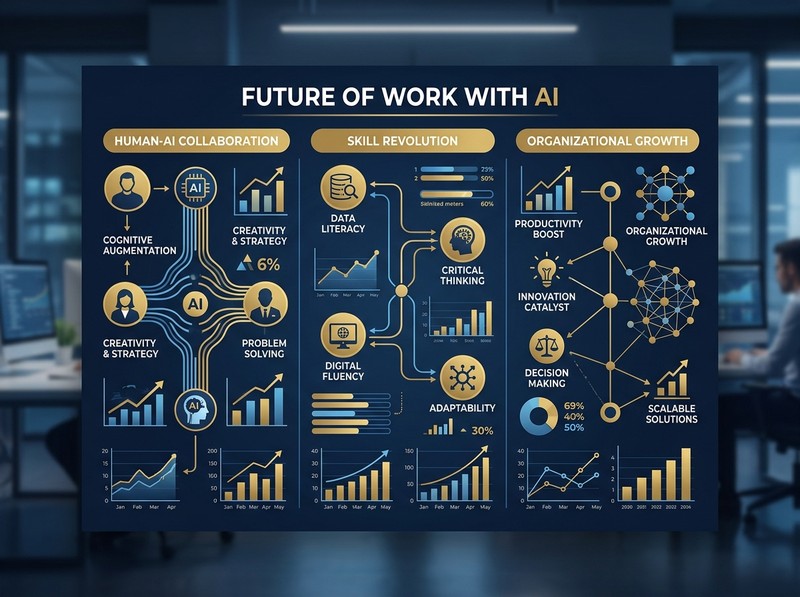
The future of work with AI in 2026 is not about replacing humans, but about augmenting their capabilities. To succeed, you need a strategic, holistic approach that focuses on:
* Data-driven decision-making: Invest in high-quality data and robust data governance.
* Seamless integration: Integrate AI into your existing systems and workflows.
* Continuous learning: Continuously monitor and optimize AI model performance.
* Ethical considerations: Implement robust AI governance policies.
* Employee empowerment: Equip your employees with the skills they need to work effectively with AI.
Don't fall for the hype. Focus on solving real business problems with practical AI solutions.
Work With Versalence - CTA paragraph
Navigating the complexities of AI adoption can be challenging. At Versalence, we help businesses like yours unlock the full potential of AI by providing tailored solutions that address your specific needs. From AI strategy development to model implementation and ongoing support, we're your trusted partner in the AI revolution. Let us help you transform your business and stay ahead of the competition.
📧 versalence.ai/contact.html | sales@versalence.ai