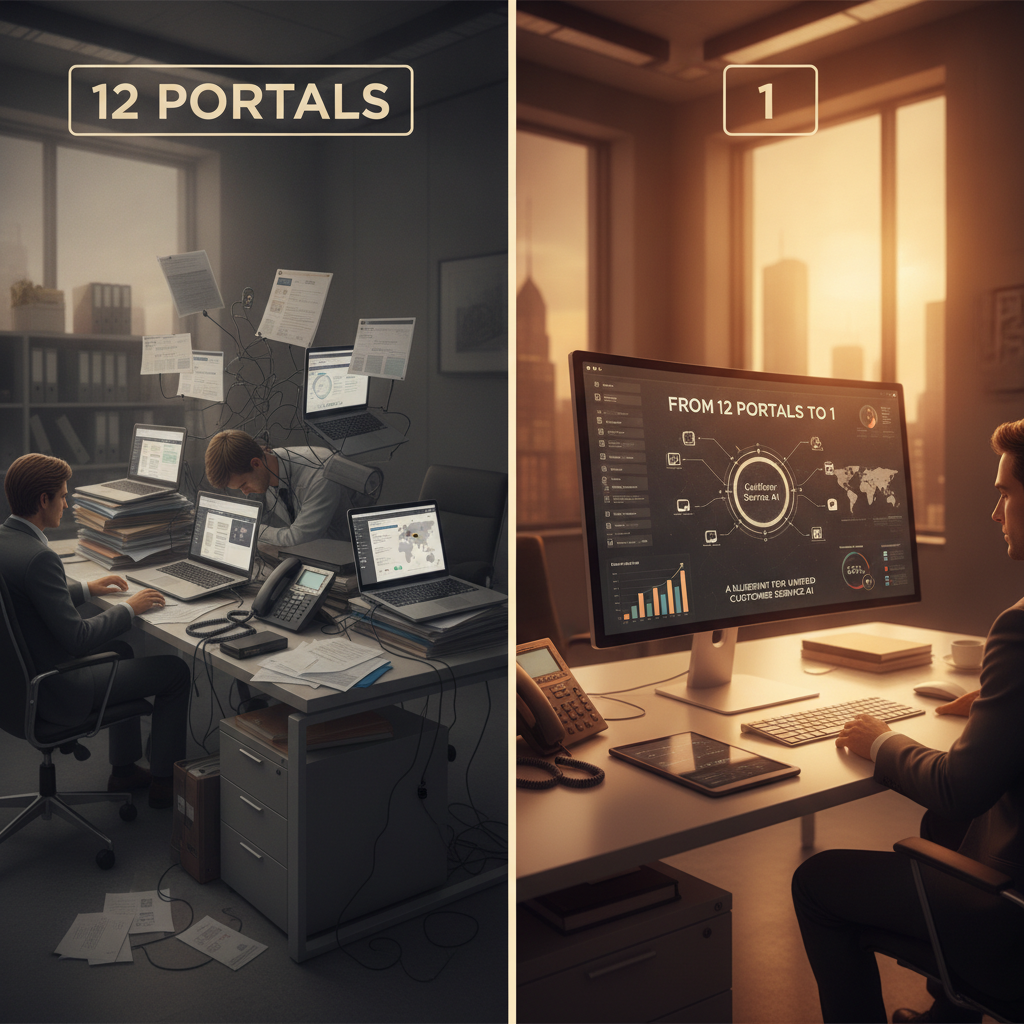
From 12 Portals to 1: A Blueprint for Unified Customer Service AI
The Silent Killer of Customer Experience: Data Silos
In today's hyper-competitive market, customer experience (CX) is the ultimate battleground. Yet, many enterprises are fighting with one hand tied behind their back, crippled by an internal enemy they helped create: data silos. Imagine a customer trying to check the status of a repair for a product they recently purchased. They first log into the main company website, then get redirected to a separate "service portal," which then asks them to check a third-party "shipping portal." Each system requires a different login, has a different interface, and possesses only one small piece of the customer's story.
This isn't a hypothetical nightmare; it's the daily reality for customers of countless global organizations. A recent study by Mulesoft found that less than a third of companies can provide a truly connected user experience across all channels. The result? Frustration, churn, and a staggering amount of operational waste.
This challenge is precisely what a global engineering and technology giant like Bosch faced. With a vast portfolio of products and services, their customer support was fragmented across 12 different, siloed portals. Each portal was a world unto itself, leading to inconsistent customer journeys, immense internal complexity, and missed opportunities for growth.
For any business leader, this story is uncomfortably familiar. Your CRM doesn't talk to your ERP. Your support desk can't access order history from your e-commerce platform. Your agents spend more time switching between browser tabs than they do solving customer problems.
This fragmentation isn't just an inconvenience; it's a direct threat to your bottom line. But what if you could dissolve these digital walls? What if you could create a single, intelligent interface that unifies all your backend systems, providing one seamless experience for customers and one source of truth for your teams?
At Versalence AI, we don't just believe this is possible; we build it. Using the power of AI-driven automation and intelligent workflows, we create a unified "conversation layer" that orchestrates data across your entire technology stack. This post provides a blueprint for how to dismantle your silos, using the Bosch challenge as our guide, and demonstrates how Versalence AI delivers this transformative solution.
The True Business Cost of a Disconnected Customer View
Before diving into the solution, it's critical to understand the full scope of the problem. Siloed systems are more than a technical headache; they inflict deep, compounding damage across the organization.
1. Skyrocketing Operational Costs When data is fragmented, inefficiency becomes the default operating mode.
- Redundant Processes: Teams in different departments manually re-enter the same customer data into different systems, wasting countless hours and introducing errors.
- Extended Training: New support agents must be trained on a dozen different platforms, each with its own quirks and login credentials. This extends onboarding time and increases cognitive load.
- Increased Handle Times: Agents place customers on hold while they hunt for information across multiple disconnected applications. This drives up Average Handle Time (AHT), a key contact center metric, and requires more staff to handle the same volume of inquiries.
2. A Fractured and Frustrating Customer Experience Customers don't care about your internal org chart or your technology stack. They expect a single, coherent conversation with your brand, regardless of the channel they use.
- The "Start Over" Syndrome: A customer explains their issue to a chatbot, only to be transferred to a live agent who asks them to repeat everything. This is a top driver of customer frustration.
- Inconsistent Information: A customer might get one answer from a knowledge base article, a different one from a chatbot, and a third from a human agent, all because these channels pull from different, unsynchronized data sources.
- Lack of Personalization: Without a 360-degree view of the customer—their purchase history, past support tickets, and recent website activity—providing a truly personalized and proactive experience is impossible.
3. Data Blindness and Missed Insights Perhaps the most significant long-term cost is the inability to learn from your own data.
- No Single Source of Truth: You can't analyze customer journeys, identify common pain points, or spot emerging trends when your data is scattered across a dozen databases.
- Impaired Decision-Making: Business leaders are forced to make strategic decisions based on incomplete or conflicting reports from different departments.
- Missed Cross-Sell/Up-Sell Opportunities: An agent handling a support ticket for Product A has no visibility into the customer's interest in Product B, losing a valuable opportunity to add value and drive revenue.
The challenge Bosch faced with its 12 portals is a masterclass in these issues. They knew that to deliver the world-class service their brand promised, they couldn't just patch the old systems. They needed a new approach—a single, intelligent front door for all customer interactions.

The Versalence AI Blueprint: Building an Intelligent Integration Layer
Many companies, when faced with this problem, mistakenly believe the only solution is a massive, multi-year "rip and replace" project to migrate everything to a single platform. This approach is incredibly expensive, risky, and disruptive.
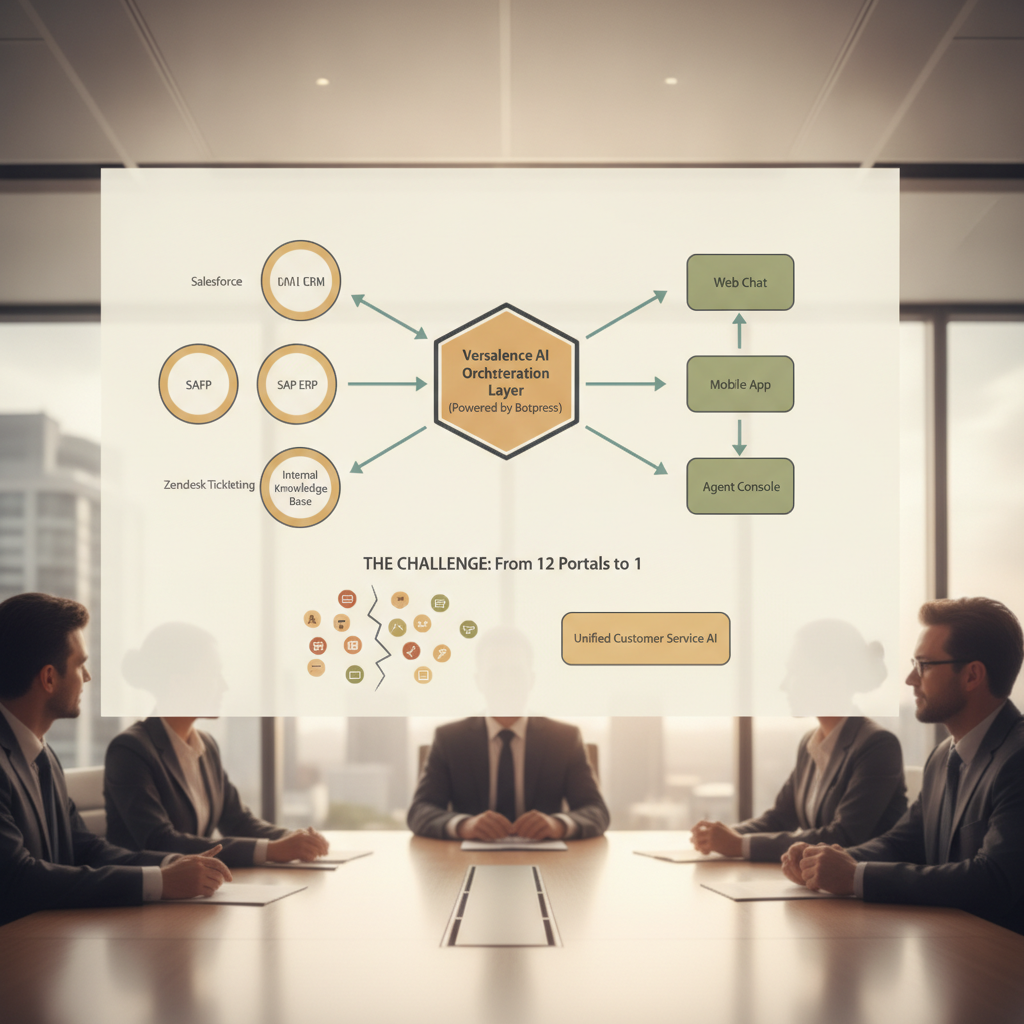
Our philosophy at Versalence AI is different. We build a flexible, AI-powered integration layer that sits on top of your existing systems. It doesn't replace them; it unifies them. This intelligent layer acts as a central nervous system, orchestrating the flow of information and automating workflows between your siloed applications.
Our core technology platform for building these next-generation assistants is Botpress, an open-source framework designed for creating sophisticated, AI-powered conversational experiences. As seen in our work with the versalenceai/botpress repository, we leverage its robust, extensible architecture to build enterprise-grade solutions that are both powerful and scalable.
Here’s how we architect the solution:
Step 1: The AI as a Central API Orchestrator At the heart of our solution is a master AI assistant built on Botpress. This assistant serves as the single point of entry for all customer queries, whether they come from a website chat widget, a mobile app, or an internal agent console.
This AI is more than a simple FAQ bot. It’s an orchestrator. Using advanced Natural Language Understanding (NLU), it first deciphers the user's intent. Is the user asking for an "order_status," a "technical_support_request," or a "product_return"?
Step 2: Designing Intelligent, Conditional Workflows Once the intent is identified, the AI triggers a pre-defined, intelligent workflow. This is where the magic happens. The workflow is a sequence of logic and actions that knows exactly which siloed system holds the necessary information.
- For an "order_status" query: The workflow executes a secure API call to your ERP (like SAP or Oracle).
- For a "technical_support_request": It might first search a knowledge base (like Zendesk Guide or a custom database) for a relevant article. If no article is found, it proceeds to create a new ticket in your ITSM platform (like Jira or ServiceNow).
- For a "billing_inquiry": It connects to your payment gateway or billing system (like Stripe or Zuora) to fetch invoice details.

Botpress's integration capabilities are key here. Its hub of pre-built integrations and its powerful SDK allow us to connect to virtually any system with an API, whether it's a modern SaaS platform or a legacy on-premise database.
Step 3: Real-Time Data Aggregation and Synthesis The AI doesn't just fetch data; it synthesizes it. If a customer asks, "What's the status of the replacement part for the ticket I opened yesterday about my recent order?", a traditional bot would fail.
Our intelligent assistant executes a multi-step workflow:
- It queries the ticketing system to find the ticket from "yesterday."
- From that ticket, it extracts the "recent order" number.
- It queries the ERP with the order number to find the "replacement part" shipment.
- It queries the logistics system with the shipment number to get the delivery status.
- Finally, it synthesizes all this information into a single, natural language response: "I see you're asking about replacement part #6789 for order #1234. It shipped this morning via FedEx and is scheduled for delivery tomorrow by 5 PM. Here is the tracking link."
The customer experiences one seamless interaction. The AI did the heavy lifting of navigating four different systems in the background.
Step 4: The "Single Pane of Glass" for Human Agents AI automation is powerful, but a seamless handoff to human experts is essential for complex or sensitive issues. Our approach transforms the agent's role from a data hunter to a problem solver.
When a conversation is escalated, the AI doesn't just transfer the chat. It transfers the entire context. It presents the agent with a "single pane of glass" view inside their existing console (e.g., Zendesk, Salesforce Service Cloud). This view includes:
- The full transcript of the conversation with the AI.
- A summary of the customer's issue and intent.
- Relevant data pulled from all backend systems in real-time: contact details from the CRM, recent orders from the ERP, and past support tickets from the helpdesk.
The agent has everything they need, instantly. No more "Can you give me your order number again?" No more putting the customer on hold. This drastically reduces AHT and dramatically improves both the agent and customer experience.
Related Solutions: Unifying More Than Just Customer Service
This powerful architecture of an AI-driven integration layer isn't limited to customer-facing portals. The same principles and technology can be applied to solve complex internal fragmentation challenges:
- Unified Employee Helpdesks: Imagine a single Slack or Microsoft Teams bot where an employee can ask, "How many vacation days do I have left, where can I find my latest payslip, and how do I reset my VPN password?" The AI would orchestrate API calls to your HRIS (Workday), payroll system (ADP), and IT service desk (Jira) to provide instant, unified answers.
- Intelligent Sales Enablement: A sales representative preparing for a client meeting could ask a bot, "Give me a summary of my account with Acme Corp, including open support tickets, recent marketing engagement, and outstanding invoices." The AI would pull data from Salesforce, Marketo, and SAP to generate a complete brief in seconds.
- Supply Chain Visibility: A logistics manager could use a conversational interface to track a shipment across multiple carriers and internal systems, getting a consolidated view without logging into four different portals.
By leveraging a flexible platform like Botpress, Versalence AI can design and deploy these sophisticated orchestration solutions to break down silos across your entire enterprise.

The Tangible Results: Measuring the ROI of Unification
Moving from a fragmented, multi-portal system to a unified, AI-driven model delivers clear and measurable returns across the business. While every implementation is unique, our clients typically see transformative results in four key areas:
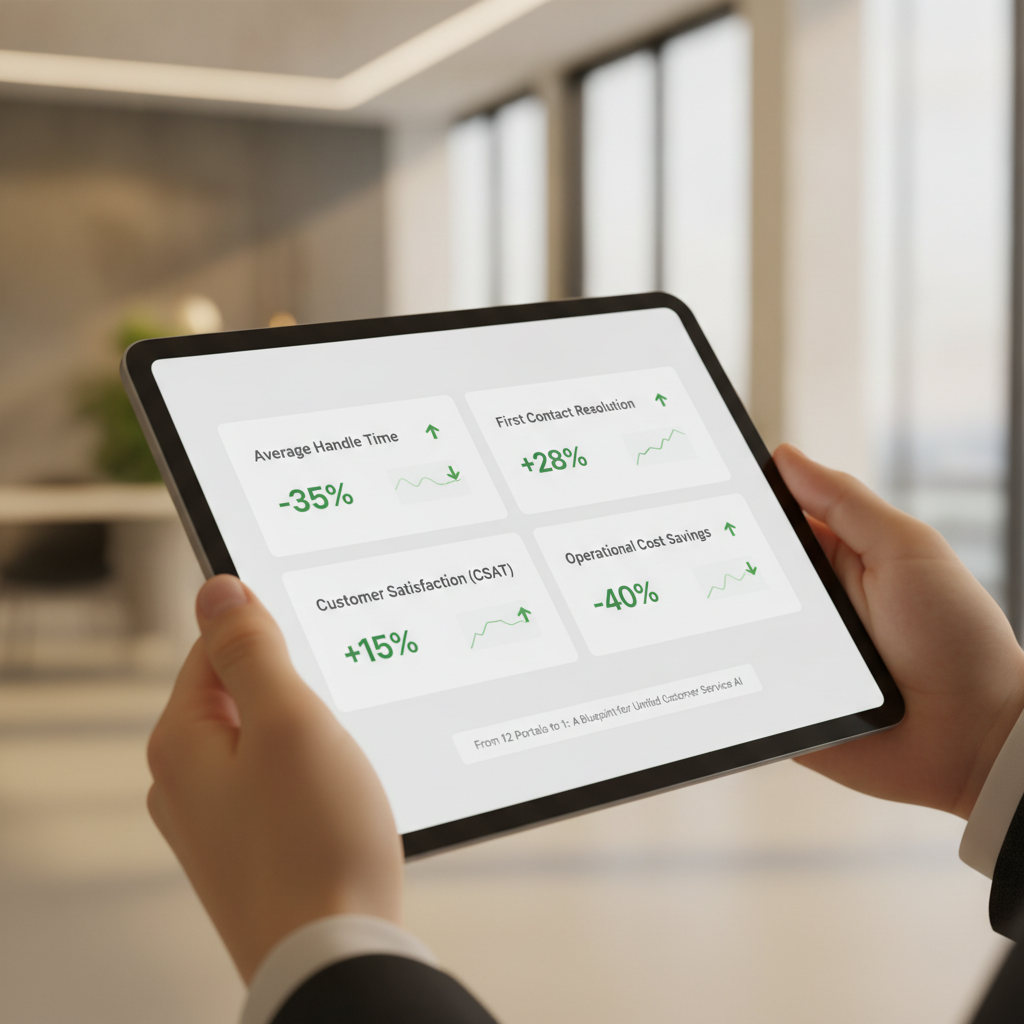
1. Drastic Reduction in Operational Costs (25-40%)
- Ticket Deflection: By automating the resolution of Tier-1 and repetitive inquiries, you can deflect a significant percentage of tickets from your human agents, allowing you to scale support without scaling headcount.
- Reduced Average Handle Time (AHT): When agents do get involved, the "single pane of glass" provides them with all necessary information upfront, slashing research time and allowing them to resolve issues 30-50% faster.
- Lower Training Overhead: New agents only need to be trained on one unified interface, not a dozen legacy systems, reducing onboarding time from weeks to days.
2. Significant Improvement in Customer Metrics (CSAT/NPS)
- 24/7 Instant Service: Customers get immediate answers to their most common questions, any time of day, without waiting in a queue.
- Increased First Contact Resolution (FCR): With access to complete information, both the AI and the human agents are far more likely to resolve the customer's issue on the very first interaction.
- A Consistent, Effortless Experience: Providing a single, simple front door for all inquiries removes friction and frustration, leading to a direct and measurable increase in Customer Satisfaction (CSAT) and Net Promoter Score (NPS).
3. Empowered and More Efficient Teams
- Reduced Agent Churn: By eliminating the most tedious, repetitive parts of their jobs and empowering them with better tools, you reduce agent burnout and improve employee satisfaction.
- Focus on High-Value Work: With AI handling the simple queries, your expert agents can focus their time on complex, high-empathy customer issues where their skills make the biggest impact.
4. A Unified Data Asset for Business Intelligence For the first time, all customer interaction data flows through a single, central system. This creates an invaluable data asset that can be used to:
- Identify recurring product issues and customer pain points.
- Analyze trends in customer behavior to inform product development.
- Optimize support processes and knowledge base content based on what customers are actually asking for.
Don't Rebuild Your Foundation—Build a Smarter Front Door
The story of Bosch’s journey from 12 siloed portals to one unified system is a powerful lesson for any modern enterprise. The goal isn't to embark on a painful, multi-year migration project. The goal is to be smarter, more agile, and more customer-centric.
By building an intelligent, AI-powered integration layer, you can keep your trusted backend systems while completely transforming the front-end experience for both your customers and your employees. You can turn your tangled web of applications into a powerful, orchestrated ecosystem that delivers efficiency and delight.
If your organization is struggling under the weight of data silos and fragmented systems, it's time for a new approach.
Ready to unify your customer experience and unlock new levels of efficiency?
Contact the experts at Versalence AI for a complimentary consultation. Let's discuss your unique challenges and design a blueprint for your own transformation.
Email us today at sales@versalence.ai or visit us at versalence.ai to get started.
Work With Versalence
Ready to remove the drag from your business operations? Our AI automation and system integration team delivers measurable results in 30-120 days.
📧 Contact us
✉️ sales@versalence.ai