
Edge AI Predictive Maintenance: Cut Fleet Downtime by 35%
The Silent Killer of Profitability: Unplanned Downtime
In the world of logistics, transportation, and heavy industry, assets in motion are assets earning revenue. The moment a truck, a generator, or a piece of heavy machinery grinds to a halt unexpectedly, the clock starts ticking on losses. Unplanned downtime isn't just an inconvenience; it's a direct assault on the bottom line. According to a study by Deloitte, unscheduled downtime can cost industrial manufacturers an estimated $50 billion annually, with asset failures being one of the primary culprits.

For decades, fleet and operations managers have fought this battle with two main strategies: reactive maintenance (fixing things after they break) and preventive maintenance (fixing things on a fixed schedule, whether they need it or not). Reactive maintenance leads to catastrophic failures, costly emergency repairs, and significant operational disruption. Preventive maintenance, while an improvement, is often inefficient, leading to the unnecessary replacement of perfectly good parts and still failing to catch every potential issue before it occurs.
But what if you could know a critical component was going to fail before it happened? What if you could transition from a reactive or scheduled approach to a truly predictive one, turning costly, unplanned stops into efficient, planned service appointments? This isn't a future fantasy; it's the reality made possible by Edge AI, and it’s how one forward-thinking fleet operator transformed their operations and slashed vehicle downtime by an incredible 35%.
The Ripple Effect: Why Downtime Costs More Than Just Repairs
When a delivery truck breaks down on a highway miles from the nearest service center, the initial tow and repair bill is just the tip of the iceberg. The true cost of that single event ripples throughout the entire business:
- Lost Revenue: The cargo isn't moving, which means delivery deadlines are missed. This can result in financial penalties, lost contracts, and frustrated customers who may take their business elsewhere.
- Cascading Logistical Nightmares: A single downed vehicle disrupts carefully planned schedules. Other drivers and vehicles must be re-routed, dispatchers scramble to manage the chaos, and the entire supply chain feels the tremor.
- Inflated Labor Costs: Emergency roadside repairs command premium labor rates. Overtime is often required for both the repair technicians and the operational staff working to mitigate the fallout.
- Safety Risks: A vehicle failure on a busy road poses a significant safety hazard to the driver and other motorists. Preventing these incidents isn't just good for business; it's a critical responsibility.
- Brand Damage: In a competitive market, reliability is a key differentiator. Frequent delays and service interruptions erode customer trust and damage your company's reputation.
Traditional maintenance strategies are ill-equipped to prevent these cascading failures effectively. They operate on historical averages and manufacturer recommendations, not the real-time health of the actual asset. To truly get ahead of failure, you need to listen to what the machines are telling you, second by second. That requires a new approach to data processing and intelligence.
The Versalence Solution: Intelligent Workflows Powered by Edge AI
The core challenge of predictive maintenance for a mobile fleet isn't a lack of data; modern vehicles are rolling data centers. They are equipped with dozens of sensors monitoring everything from engine temperature and oil pressure to wheel speed and exhaust emissions. The problem is threefold: volume, velocity, and location.
Sending a constant stream of high-frequency sensor data from hundreds of vehicles to a central cloud for analysis is often impractical. It consumes massive amounts of cellular data, incurs significant costs, and is unreliable in areas with poor connectivity. Furthermore, by the time the data is sent, processed, and an alert is returned, the critical window to act may have already passed.
This is where Versalence’s Edge AI architecture changes the game. Instead of shipping raw data, we ship the intelligence to the data.
Our Edge-to-Cloud Architecture: A Technical Breakdown
Our solution is built on a robust, hybrid model that combines the immediacy of on-device processing with the analytical power and workflow automation of the cloud.
1. Data Ingestion at the Source: It begins with tapping into the vehicle’s nervous system. We install a ruggedized, compact Edge computing device that interfaces directly with the vehicle’s On-Board Diagnostics (OBD-II) port and a suite of high-fidelity sensors, including:
- Vibration Sensors: Placed on key components like the engine block, transmission, and wheel hubs to detect subtle changes in vibration patterns that signal bearing wear, imbalance, or gear tooth damage.
- Acoustic Sensors: Listen for anomalies in sound signatures that are imperceptible to the human ear but are clear indicators of developing issues like fluid leaks or friction.
- Temperature & Pressure Sensors: Monitor critical fluids and components, flagging overheating or pressure drops that precede major failures.
- GPS & Accelerometer Data: Provide operational context—is the vehicle on a rough road? Is the driver braking harshly? This context is crucial for distinguishing between normal operational stress and a genuine mechanical anomaly.
2. On-Device AI: The Edge Model in Action: The raw data from these sensors is processed in real-time on the Edge device, right inside the vehicle. This is the heart of our solution. A lightweight, highly optimized machine learning model—often a sophisticated anomaly detection algorithm like an autoencoder—runs continuously.
- Learning the "Normal": During an initial training phase, the model learns the unique operational fingerprint of that specific vehicle under various conditions (e.g., highway driving, city traffic, laden vs. unladen).
- Real-Time Anomaly Detection: Once trained, it constantly compares incoming sensor data against its learned baseline of "normal." When it detects a deviation—a subtle, persistent increase in engine vibration, a slight drop in oil pressure under load—it flags it as a potential precursor to failure.
- Predictive Forecasting: The model doesn't just flag anomalies; it forecasts a potential failure window. By analyzing the rate of deviation, it can predict, for example, that "Brake pad integrity is at 15%; failure is likely within the next 300-400 miles of operation."
3. Intelligent, Low-Bandwidth Communication: Because the heavy lifting of data analysis happens on the Edge, there’s no need to send a constant, expensive stream of data to the cloud. The device only transmits small, information-rich alert packets when a potential issue is detected. This packet contains the essential information: Vehicle ID, component at risk, predicted failure window, and supporting data points. This approach ensures reliability even in areas with spotty cellular coverage.
4. Versalence Cloud Platform: Orchestration and Automation: The alert is received by the Versalence Cloud Platform, which serves as the central command center for the entire fleet. Here, the data is aggregated on a user-friendly dashboard, allowing fleet managers to see the health status of every asset at a glance.

But our platform does more than just display data; it triggers intelligent, automated workflows:
- Automated Work Order Generation: Upon receiving a critical alert, the system automatically creates a work order in the company’s existing Computerized Maintenance Management System (CMMS) or ERP, pre-populated with the vehicle details, suspected issue, and required parts.
- Smart Parts Procurement: The workflow can check real-time parts inventory. If a specific alternator or brake caliper is needed, it can be flagged for the maintenance team or even trigger an automated purchase order with a preferred supplier.
- Intelligent Technician Scheduling: The system checks technician availability and certifications, scheduling the right person for the job before the vehicle even arrives at the depot.
- Proactive Notifications: The fleet manager, the driver, and the service manager are all notified simultaneously via their preferred channels (email, SMS, or a dedicated app), ensuring everyone is in the loop.
This seamless integration of Edge AI with cloud-based automation is what closes the loop, turning a predictive insight into a decisive, cost-saving action.
Beyond Maintenance: Our Expertise in Intelligent Automation
The principles of building robust, event-driven, and intelligent workflows are at the core of everything we do at Versalence AI. The same architectural philosophy that powers our predictive maintenance solution also applies to other complex business automation challenges.
Our work in conversational AI, for instance, leverages similar concepts. As demonstrated in our public versalenceai/botpress repository, we build sophisticated systems that can understand user intent, interface with backend systems, and automate complex tasks. In the context of our maintenance solution, this expertise could be extended to create a Maintenance Assistant Chatbot.
Imagine a scenario where a predictive alert is triggered. Our workflow could activate a chatbot that:
- Engages the on-duty technician via a messaging app, presenting the diagnostic data from the vehicle.
- Guides the technician through a standardized troubleshooting checklist.
- Allows the technician to verbally request schematics or order parts directly through the conversational interface.
This illustrates our core belief: AI is most powerful when it’s not just an analytical tool, but an integrated engine for intelligent action. Whether it's predicting a mechanical failure or automating a customer service inquiry, the goal is the same—to use data to drive efficient, automated, and intelligent outcomes.
The Results: A Case Study in Transformation
We implemented this Edge AI predictive maintenance solution for a mid-sized logistics company with a fleet of 250 commercial trucks. Their operations were plagued by the classic symptoms of a reactive maintenance culture: frequent and costly roadside breakdowns, delivery penalties, and high driver turnover due to frustration.
The "Before" State:
- Maintenance Strategy: A mix of reactive repairs and a rigid, time-based preventive schedule.
- Average Unplanned Downtime: Approximately 40 hours per vehicle, per year.
- Key Pain Points: High emergency repair costs, missed delivery windows impacting key accounts, and excessive spending on parts that were replaced prematurely.
The "After" State (12 Months Post-Implementation): We deployed our Edge devices across their fleet and integrated the Versalence Cloud Platform with their existing CMMS and dispatch software. The results were transformative.
| Metric | Before Versalence AI | After Versalence AI | Improvement |
|---|---|---|---|
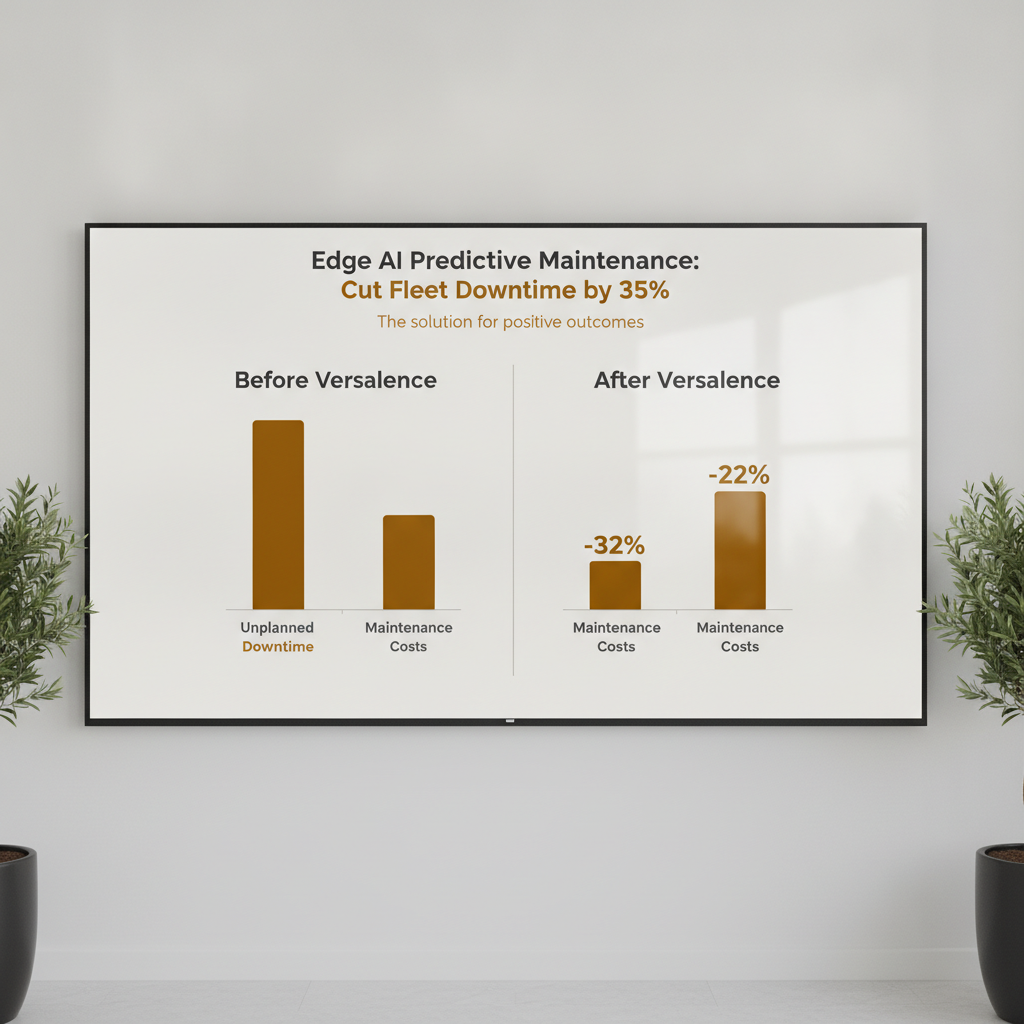
| Unplanned Downtime Hours | ~10,000 hours/year | ~6,500 hours/year | -35% |
| Overall Maintenance Costs | ~$1.8M/year | ~$1.4M/year | -22% |
| Roadside Failure Incidents | 115 incidents/year | 18 incidents/year | -84% |
| Asset Lifespan | - | +15% (projected) | +15% |
How was this achieved?
- Downtime Reduction (35%): The system began catching issues days or even weeks in advance. For example, it detected subtle voltage fluctuations from an alternator on one truck, allowing for a scheduled replacement during planned downtime. Previously, this would have resulted in a dead battery and a stranded vehicle. These proactive interventions converted dozens of potential roadside failures into quick, efficient bay repairs.
- Maintenance Cost Reduction (22%): By shifting to condition-based maintenance, the company stopped replacing components based on mileage alone. They serviced parts when the data showed they needed it, eliminating waste and reducing both parts and labor costs.
- Safety and Reliability: The dramatic reduction in on-road failures not only improved their safety record but also significantly boosted their reputation for reliability with their clients, helping them secure two new major contracts.
The return on investment was realized in under nine months, proving that investing in predictive intelligence is one of the most effective ways to protect and enhance operational profitability.
Stop Reacting. Start Predicting.
The technology to eliminate most unplanned downtime is no longer a distant vision; it's a practical, deployable, and ROI-positive reality. By combining the power of Edge AI with intelligent cloud-based automation, Versalence provides a comprehensive solution that transforms maintenance from a costly necessity into a strategic advantage.
Don't wait for the next breakdown to disrupt your business. It's time to empower your fleet with the foresight to act before failure strikes.
Ready to turn your maintenance data into your most valuable operational asset?
Schedule a free consultation with our AI strategists at versalence.ai or email our team directly at sales@versalence.ai to discover how we can tailor a predictive maintenance solution for your fleet.
Work With Versalence
Ready to remove the drag from your business operations? Our AI automation and system integration team delivers measurable results in 30-120 days.
📧 Contact us
✉️ sales@versalence.ai