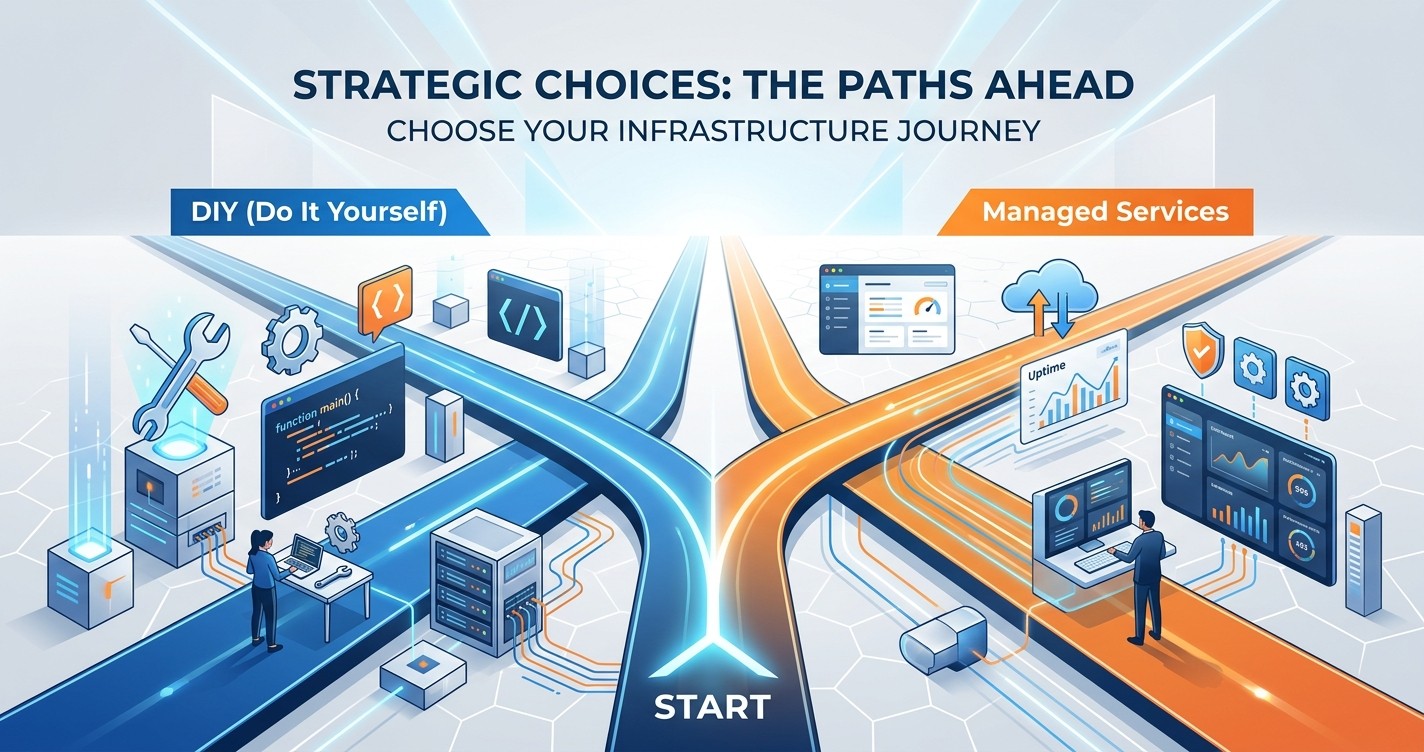
Technical Deep Dive: DIY AI vs. Managed AI: What Small Businesses Are Actually Building in 2026
Technical Deep Dive: DIY AI vs. Managed AI: What Small Businesses Are Actually Building in 2026
The AI infrastructure decision for small businesses is no longer theoretical. Two approaches are running in production today, handling real customers, generating real revenue. They solve the same problem from opposite directions, and the differences matter before you invest either time or money.
This is not a product pitch. Both approaches are valid. This is a technical decomposition of two real bets about what the hard problem of small business AI actually is.
DIY AI is the self-hosted, self-managed approach. Its central abstraction is the control plane — you own the infrastructure, the models, the data pipeline, and the integration logic. The AI model is pluggable. The control is absolute.
DIY AI's bet: the hard problem is data sovereignty and cost control. Who owns your customer data, under what conditions, at what price per token. The approach is opinionated about ownership and flexible about implementation.
Managed AI is the platform-as-a-service approach. Its central abstraction is the outcome layer — you specify the business result, and the platform handles the infrastructure, model selection, security, and scaling. Built by vendors who specialize in small business automation, it's designed for operators who want results without engineering overhead.
Managed AI's bet: the hard problem is time-to-value and maintenance burden. A business owner who can deploy AI in hours rather than weeks gets ROI faster than one who spends months building infrastructure.
DIY AI Architecture
Infrastructure sits at the top — your own servers, cloud VMs, or local machines. Every customer interaction flows into your control plane: an orchestration layer that handles authentication, rate limiting, data routing, model selection, and integration with your existing systems (CRM, email, payments).
The AI model — OpenAI, Anthropic, local LLaMA, or any configured provider — is pluggable at the bottom. Swap the model and your business logic is untouched.
Core components:
| Layer | Function | Technology |
|---|---|---|
| Gateway | Request routing, auth, rate limiting | Node.js, Python, or Go API |
| Context Manager | Session state, conversation history | Redis, PostgreSQL, or SQLite |
| Model Router | Provider selection, failover, cost optimization | OpenRouter, LiteLLM, or custom |
| Integration Layer | CRM, email, calendar, payment hooks | REST APIs, webhooks, MCP |
| Memory Store | Long-term customer context, preferences | Vector DB (Pinecone, Chroma, local) |
| Security | PII handling, encryption, audit logs | Self-managed certificates, local encryption |
Three entry points feed the system:
- Customer-facing chat — website widget, WhatsApp, SMS
- Internal dashboard — staff interface for overrides and monitoring
- API endpoints — for integration with your existing software stack
All three route into the AI Core, the orchestration layer that handles prompt construction, tool dispatch, context management, response generation, and memory persistence.
Managed AI Architecture
Business outcomes sit at the top — lead qualification, appointment booking, customer support, content generation. Every business process flows into the platform's abstraction layer, which handles infrastructure, security, compliance, and scaling automatically.
The implementation details — which model, which hosting region, which security certificates — are managed by the vendor. You configure the behavior, not the infrastructure.
Core components:
| Layer | Function | Your Responsibility |
|---|---|---|
| Interface Layer | Customer touchpoints (chat, voice, email) | Configure branding, tone, escalation rules |
| Workflow Engine | Business logic, decision trees, integrations | Define the process, not the code |
| AI Core | Model selection, prompt engineering, context | Provide examples, review outputs |
| Integration Hub | CRM, calendar, payment platform connections | Authenticate and map fields |
| Analytics | Performance metrics, conversation review | Monitor and iterate |
| Compliance | GDPR, SOC2, data residency | Vendor handles; you verify |
The Real-World Tradeoffs
Cost Structure
DIY AI:
- Infrastructure: 0-500/month (VPS, database, storage)
- Model API costs: Variable per token
- Engineering time: 20-100 hours initial setup, 5-10 hours/month maintenance
- Total Year 1: ,000-25,000 (including labor at modest rates)
Managed AI:
- Platform subscription: 00-1,000/month
- Usage overages: Variable by volume
- Setup time: 5-20 hours
- Total Year 1: ,000-15,000
The DIY approach wins at scale (10,000+ conversations/month) and if you already have technical staff. Managed wins on speed and if your team is non-technical.
Decision Framework
Choose DIY AI if:
- You have technical staff — a developer or engineer on your team
- Data sovereignty is critical — healthcare, legal, financial with strict compliance
- Your use case is unique — no managed platform supports your specific workflow
- You plan to scale dramatically — 100K+ conversations, where per-token costs add up
- You enjoy building — the engineering is a feature, not a cost
Choose Managed AI if:
- You need results this week — not in three months
- Your team is non-technical — no developer available
- Standard use cases apply — customer support, lead qualification, appointment booking
- You prefer operational expenses — predictable monthly costs vs. engineering salaries
- You want to focus on your business — not infrastructure maintenance
The Bottom Line
The DIY vs. Managed AI decision is not about technology. It's about resource allocation.
- If your scarcest resource is time, buy managed.
- If your scarcest resource is budget, build DIY.
- If your scarcest resource is technical talent, buy managed.
- If your scarcest resource is control over data, build DIY.
Most small businesses in 2026 are best served by starting with managed, proving ROI on one use case, then selectively moving custom workloads to DIY as they scale and their needs clarify.
The businesses winning with AI are not the ones with the most sophisticated infrastructure. They're the ones who deployed fastest, learned fastest, and iterated based on real customer interactions.
Start there.
Ready to implement AI in your business? Versalence helps small businesses deploy managed AI solutions in days, not months. Book a free consultation →
P.S. If you're technical and want to explore DIY AI, we also offer infrastructure audits to help you avoid the pitfalls we've seen across hundreds of deployments.