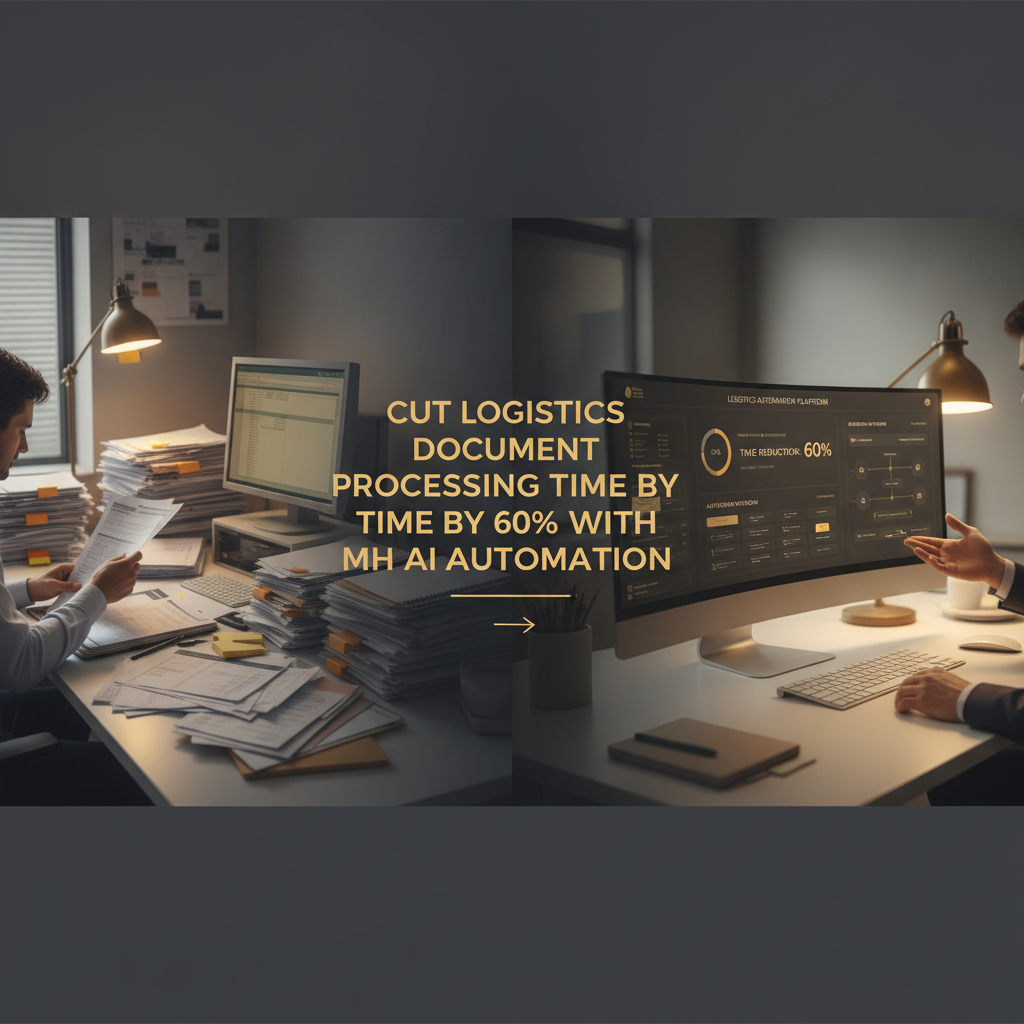
Cut Logistics Document Processing Time by 60% with AI Automation
In the world of logistics, the flow of goods is inextricably linked to the flow of information. Every pallet, container, and package is accompanied by a shadow of paperwork: bills of lading, proofs of delivery, commercial invoices, customs declarations, and packing lists. For many mid-sized logistics companies, this paper shadow has become a storm cloud, slowing down operations, introducing costly errors, and creating a bottleneck that stifles growth.
The numbers are staggering. Industry analysis from groups like the Freightos Group suggests that administrative overhead can consume up to 20% of the total cost of shipping. This isn’t just the price of paper and ink; it’s the human cost of manual data entry, the financial fallout from clerical errors, and the opportunity cost of delayed shipments and payments. Staff spend countless hours deciphering scanned documents, manually keying information into Transportation Management Systems (TMS) and ERPs, and chasing down corrections. It’s a repetitive, low-value task that drains resources and morale.
For one of our clients, a rapidly growing mid-sized freight forwarder, this problem had reached a critical point. Their team was processing thousands of documents each week, and the manual workflow was buckling under the pressure. Processing a single shipment’s document set could take an employee 10-15 minutes, and with shipment volumes increasing by 25% year-over-year, their only solution seemed to be hiring more data entry clerks—a linear, expensive, and ultimately unsustainable strategy. They knew they needed a digital transformation, not just more headcount.
The True Cost of Manual Document Processing
Before we dive into the solution, it’s crucial to understand the multifaceted business impact of relying on outdated, manual processes. The pain points extend far beyond the time spent on data entry.
1. Crippling Operational Inefficiency: In logistics, timing is everything. A delay in processing a Bill of Lading (BOL) can mean a truck and driver sit idle at a distribution center, incurring detention fees and disrupting tight schedules. An incorrectly processed customs form can leave a container stuck at port for days, ruining customer relationships and racking up demurrage charges. These individual delays create a cascade effect, rippling through the supply chain and causing friction at every touchpoint. The entire operational tempo of the company is dictated by the speed and accuracy of its back office.
2. Financial Drain from Errors and Delays: Human error is an unavoidable consequence of manual data entry. A single misplaced decimal in an invoice, a transposed digit in a container number, or an incorrect address can lead to:
- Billing Disputes: Incorrect invoices must be re-issued, delaying payment and straining client relationships.
- Lost or Misdirected Shipments: The direct cost of a lost shipment is significant, but the damage to a company’s reputation can be even greater.
- Compliance Penalties: Errors in customs or regulatory documents can result in hefty fines and legal complications.
- Delayed Cash Flow: The longer it takes to process a Proof of Delivery (POD) and generate an accurate invoice, the longer it takes to get paid. This directly impacts working capital and financial stability.
3. Barriers to Scalability: For an ambitious mid-sized company, the inability to scale efficiently is a death knell. When your processes are tied to manual labor, growth in business volume requires a proportional growth in administrative staff. This model is not only costly but also difficult to manage. Onboarding and training new employees takes time, and during peak seasons, the team is perpetually overwhelmed, leading to burnout and high turnover. True scalability comes from systems and processes that can handle a 2x or 3x increase in volume with only a marginal increase in operational cost.
How Versalence Delivers a 60% Reduction in Processing Time
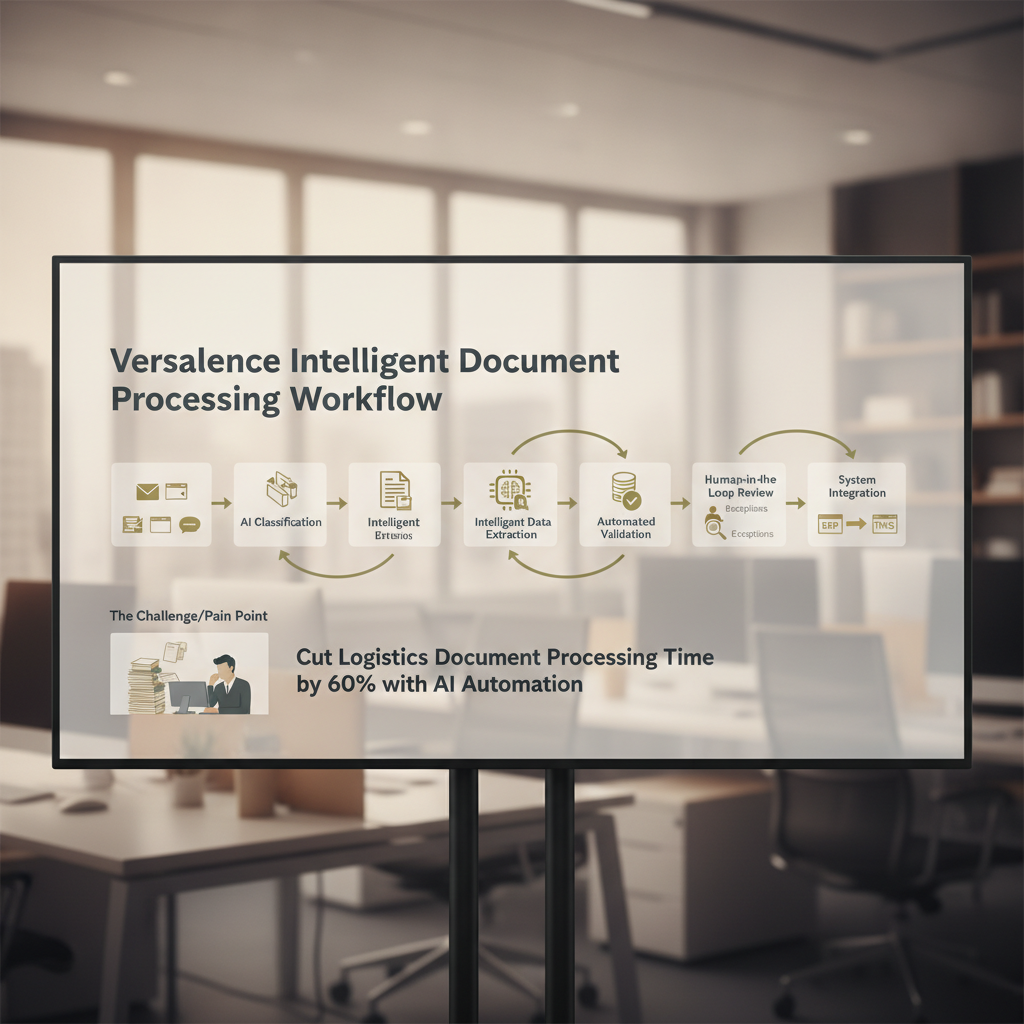
To solve this challenge, we didn't just digitize the existing process; we fundamentally re-architected it with an intelligent automation workflow. Our solution isn't a single piece of software but an integrated system designed to ingest, understand, validate, and act on document data with minimal human intervention.
Here’s a breakdown of our AI-powered approach:
(Body Image 1 - Solution Architecture Diagram)
Step 1: Omni-Channel Ingestion
Documents arrive from various sources: as attachments in dedicated email inboxes (e.g., invoices@clientlogistics.com), uploads to a client portal, or even through internal collaboration tools. We consolidate these channels into a single ingestion point.
For this project, we also built a conversational AI assistant using the powerful and flexible Botpress framework. This assistant serves as a simple, user-friendly interface for the operations team. An employee can simply drag-and-drop a new POD file into the chat window, or ask, "What's the status of invoice #58921?" The bot provides an immediate, natural-language interface to the entire complex backend workflow. This approach dramatically reduces training time and increases user adoption. You can explore the building blocks of such assistants in our Botpress repository, which contains the integrations and tools needed to connect a conversational front-end to powerful enterprise systems.
Step 2: AI-Powered Classification and Pre-Processing Once a document enters the system, the first task is to understand what it is. Is it a multi-page BOL, a single-page invoice, or a signed POD? Our AI model, trained on hundreds of thousands of logistics documents, instantly classifies the document type. Simultaneously, the system performs image pre-processing—straightening skewed scans, removing background noise, and enhancing contrast to ensure optimal data extraction quality.
Step 3: Intelligent Data Extraction (OCR 2.0) This is where the magic happens. We move beyond simple Optical Character Recognition (OCR), which just turns an image of text into machine-readable characters. Our solution uses advanced Natural Language Processing (NLP) and computer vision models to understand the context and structure of the document.

Instead of just "reading" the text, the AI identifies and extracts specific, meaningful data fields:
- Shipper Name & Address
- Consignee Details
- PRO Number / Tracking Number
- Invoice Number and Date
- Line Items (Quantity, Description, Price)
- Signatures and Timestamps on PODs
This contextual extraction is incredibly robust and can handle a wide variety of document layouts and formats, even from different carriers and clients, without needing rigid templates.
Step 4: Automated Validation and Data Enrichment Extracted data is never trusted blindly. This is a critical step that many off-the-shelf solutions miss. Our workflow automatically validates the information against the client’s "single source of truth"—their TMS or ERP system.
- Does the Purchase Order number on the invoice match an open PO in the system?
- Does the carrier name on the BOL correspond to an approved carrier in their database?
- Is the total amount on the invoice consistent with the quoted rate for that shipment?
If all data points match, the document can be processed automatically—a "touchless" transaction. This validation layer catches errors before they ever enter the core business systems.
Step 5: Human-in-the-Loop (HITL) for Exception Handling No AI is perfect. For documents where the model has low confidence in its extraction (e.g., due to messy handwriting on a POD) or where validation fails, the system doesn't just fail. It intelligently routes the document to a human operator through a simple review interface.
The operator is presented with the document image and the AI-extracted data side-by-side, with low-confidence fields highlighted. They can quickly make corrections, which takes a fraction of the time of full manual entry. Crucially, every correction they make is captured and used as training data to fine-tune the AI model. This creates a continuous improvement loop where the system gets smarter and more accurate over time, further reducing the number of exceptions.
Step 6: Seamless System Integration Once the data is verified (either automatically or via HITL review), it is seamlessly pushed into the destination systems. The validated invoice data populates the accounting software to schedule payment, the POD confirmation updates the TMS to mark a job as complete, and the shipment details are logged in the CRM for customer visibility. This final step closes the loop, triggering the next required business action without any manual intervention.
Beyond Document Processing: Related Solutions We've Built
The core technologies behind this solution—intelligent data extraction, workflow automation, and conversational AI interfaces—are foundational building blocks that can be applied to solve other pressing challenges in the logistics industry.
- Automated Customer Service for Shipment Tracking: Imagine a customer being able to ask a chatbot on your website, "Where is my shipment ABC-123?" and getting an instant, detailed response pulled directly from your TMS. This frees up your customer service representatives to handle complex escalations rather than repetitive status updates.
- AI-Powered Freight Quoting: By analyzing historical shipment data, carrier rate sheets, fuel price indices, and lane history, we can build AI models that generate highly accurate freight quotes in seconds. This allows you to respond to customer requests faster than competitors who are still calculating quotes manually.
- Compliance and Safety Automation: The same document processing engine can be used to automatically read and verify driver logs, vehicle maintenance records, and insurance certificates, flagging non-compliant items for review and ensuring your fleet meets all regulatory requirements.
The Results: Tangible ROI and a Foundation for Growth
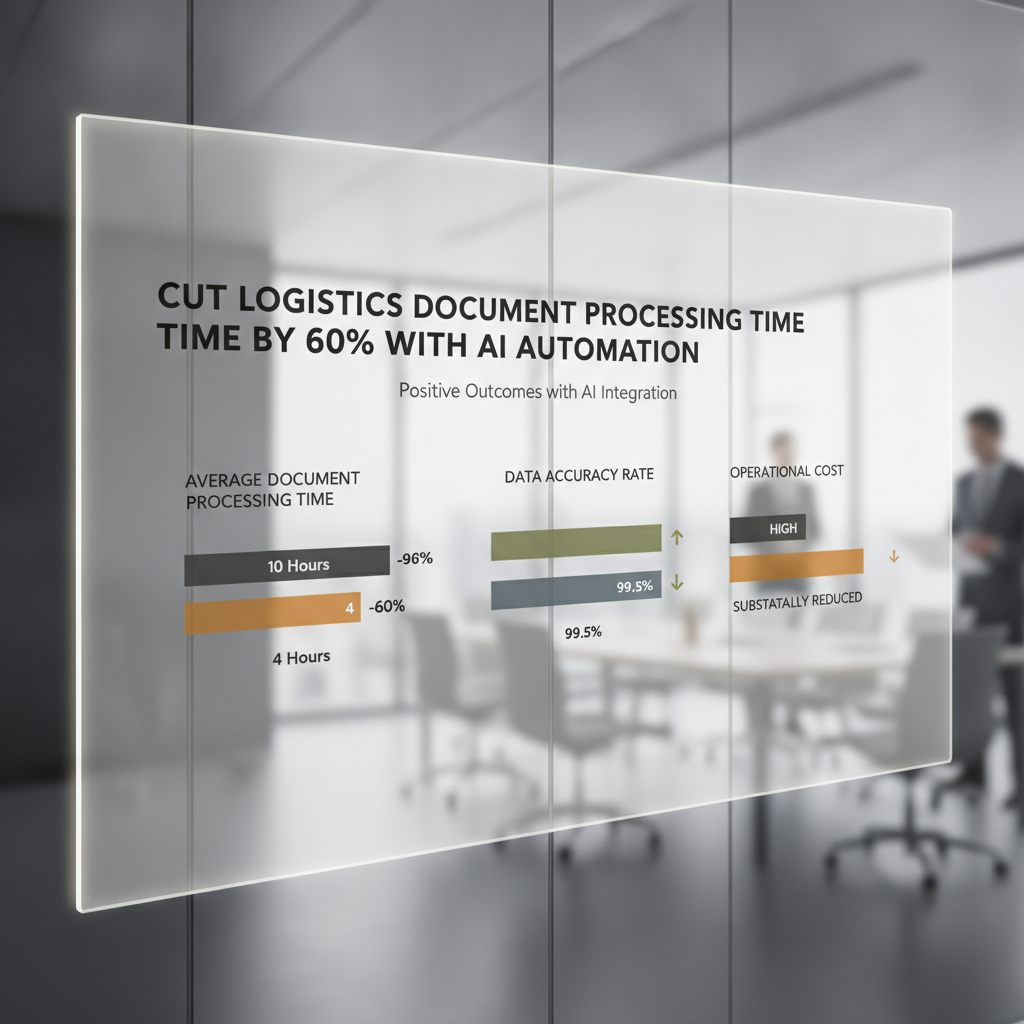
By implementing this intelligent workflow, our client achieved transformative results that went far beyond the initial goal.
(Body Image 2 - Results/ROI Infographic)
- 60% Reduction in Average Document Processing Time: A task that previously took a skilled operator 10 minutes now happens in seconds for over 85% of documents. The remaining 15% that require HITL review are cleared in just 1-2 minutes. The blended average processing time across all documents fell by over 60%.
- 99.5% Data Accuracy: By eliminating manual data entry and implementing automated validation rules, the error rate plummeted from an estimated 4% to less than 0.5%. This virtually eliminated billing disputes related to data entry mistakes.
- Accelerated Cash-to-Cash Cycle: With PODs and invoices processed on the same day they were received, the average invoice-to-payment cycle was reduced by 7 days. This had a direct and significant positive impact on the company's working capital.
- Empowered Employees: The operations team was freed from the monotony of data entry. They were retrained to manage the automation system, handle more complex customer exceptions, and focus on proactive problem-solving. This led to higher job satisfaction and lower employee turnover.
- Unlocked Scalability: The company is now able to take on new clients and handle a 50% increase in shipment volume with its existing administrative team. The AI workflow scales on demand, providing a competitive advantage and a clear path for future growth.
Are You Ready to Automate?
The logistics industry runs on data. The companies that succeed in the next decade will be those that can process that data with the greatest speed, accuracy, and efficiency. Continuing with manual, paper-based workflows is no longer a viable option; it’s a competitive liability.
If your team is struggling under the weight of manual document processing and you're looking for a way to reduce costs, improve accuracy, and build a scalable foundation for growth, AI-powered automation is the answer.
Stop drowning in paperwork. Let's discuss how Versalence AI can build an intelligent workflow tailored to your unique operational needs. Contact us today for a consultation at sales@versalence.ai or visit us at versalence.ai.
Work With Versalence
Ready to remove the drag from your business operations? Our AI automation and system integration team delivers measurable results in 30-120 days.
📧 Contact us
✉️ sales@versalence.ai