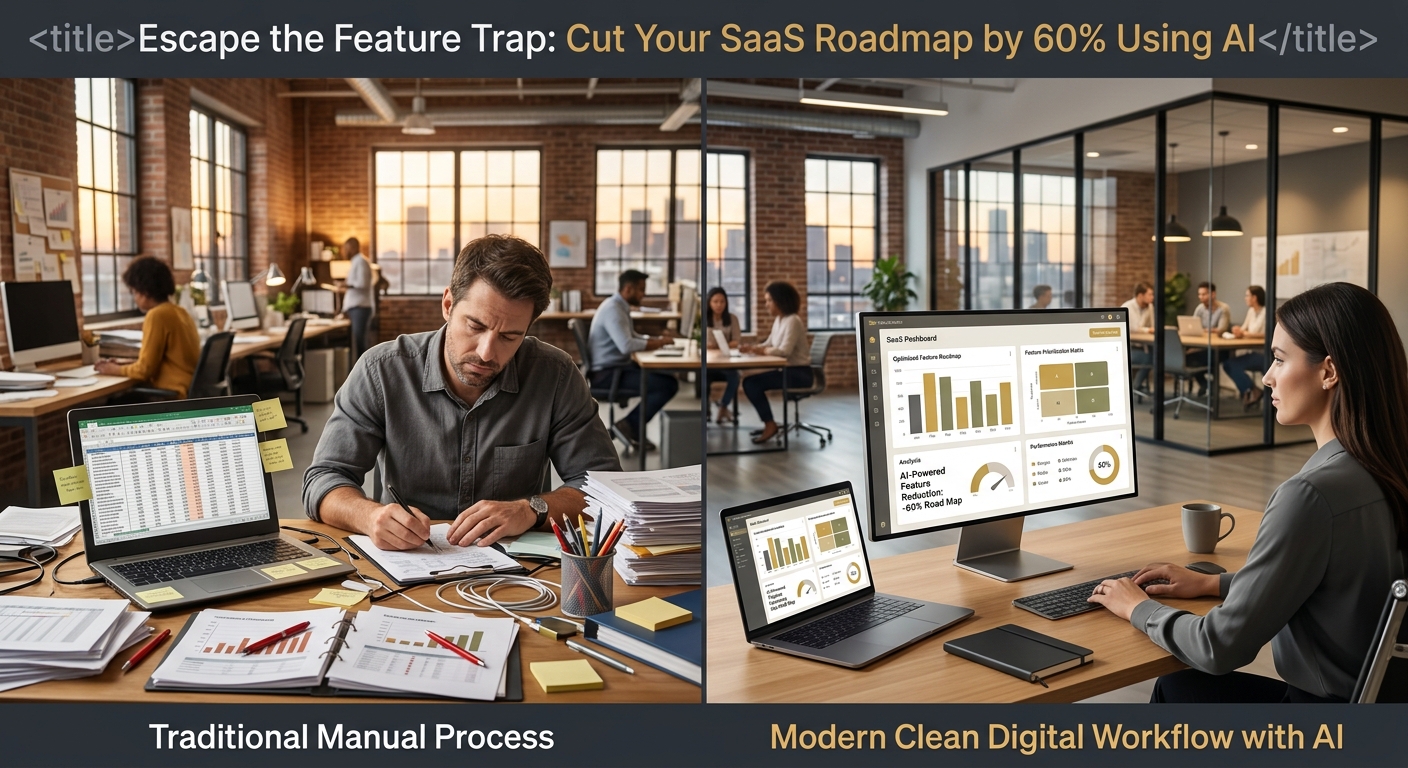
Escape the Feature Trap: Cut Your SaaS Roadmap by 60% Using AI
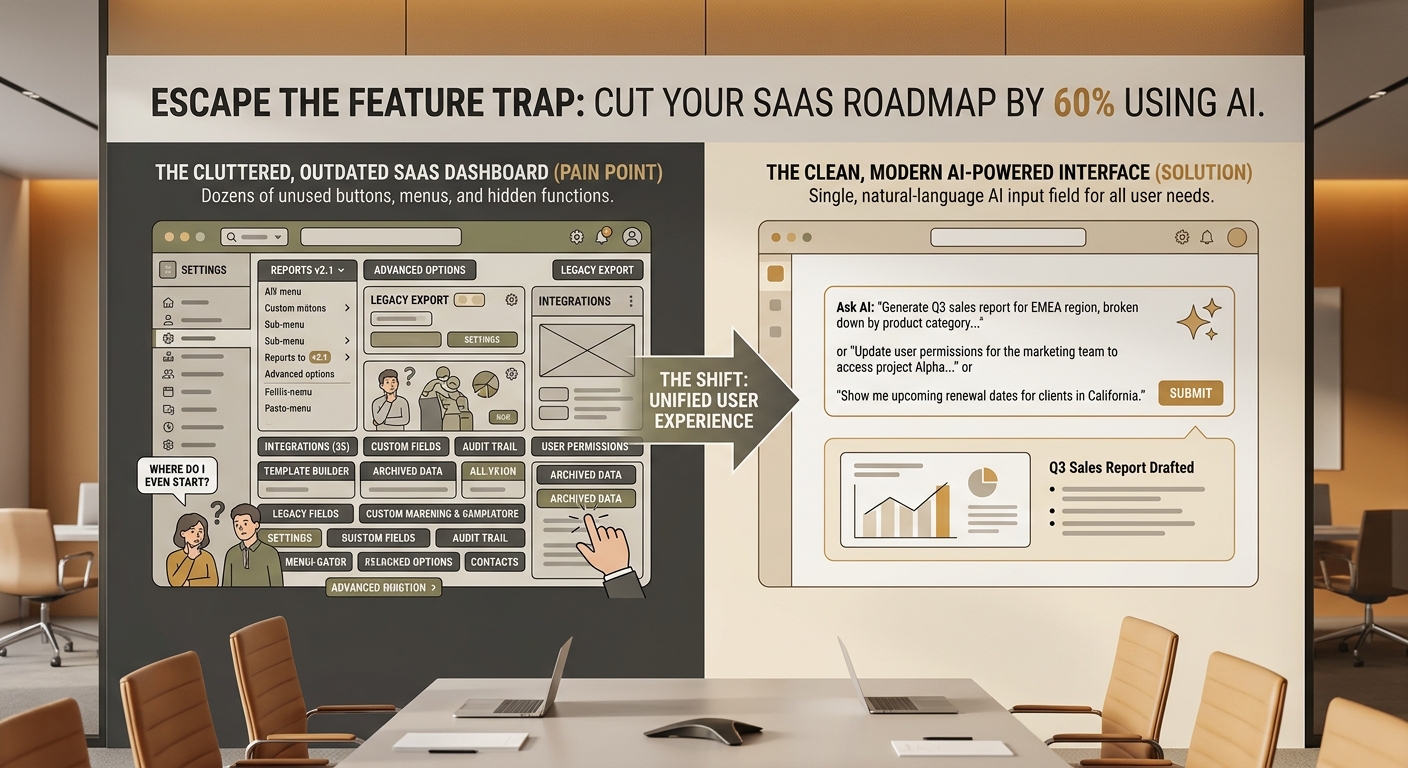
Every software founder, product manager, and engineering leader eventually faces the same terrifying realization: the product has become too complicated. What started as an elegant, focused solution to a specific problem has slowly mutated into a bloated, unwieldy "Franken-product." There are tabs within tabs, settings menus that require an engineering degree to navigate, and a backlog of feature requests that stretches into the next decade.
This is the reality of building Software as a Service (SaaS). In the pursuit of growth, we become conditioned to believe that more features equal more value. If a prospective enterprise client demands a highly specific reporting dashboard before signing a contract, the natural instinct is to build it. If a vocal segment of users wants a niche integration, it gets added to the roadmap.
But industry data paints a startling picture of this approach. According to extensive product usage research by companies like Pendo, a staggering 80% of features in typical cloud software products are rarely or never used. That means 80% of your engineering time, 80% of your maintenance budget, and 80% of the cognitive load placed on your users is effectively wasted.
At Versalence AI, we recognized that businesses were struggling to scale because they were drowning in their own product roadmaps. To grow faster, compete effectively, and deliver actual value, a radical shift was necessary. We needed to stop building rigid graphical user interfaces (GUIs) for every edge case and start leveraging intelligent automation.
By pivoting our strategy and implementing AI-powered automation and intelligent workflows, we found that businesses could confidently cut up to 60% of their planned feature roadmap. More importantly, by doing so, they grew faster, shipped quicker, and provided a far superior user experience.
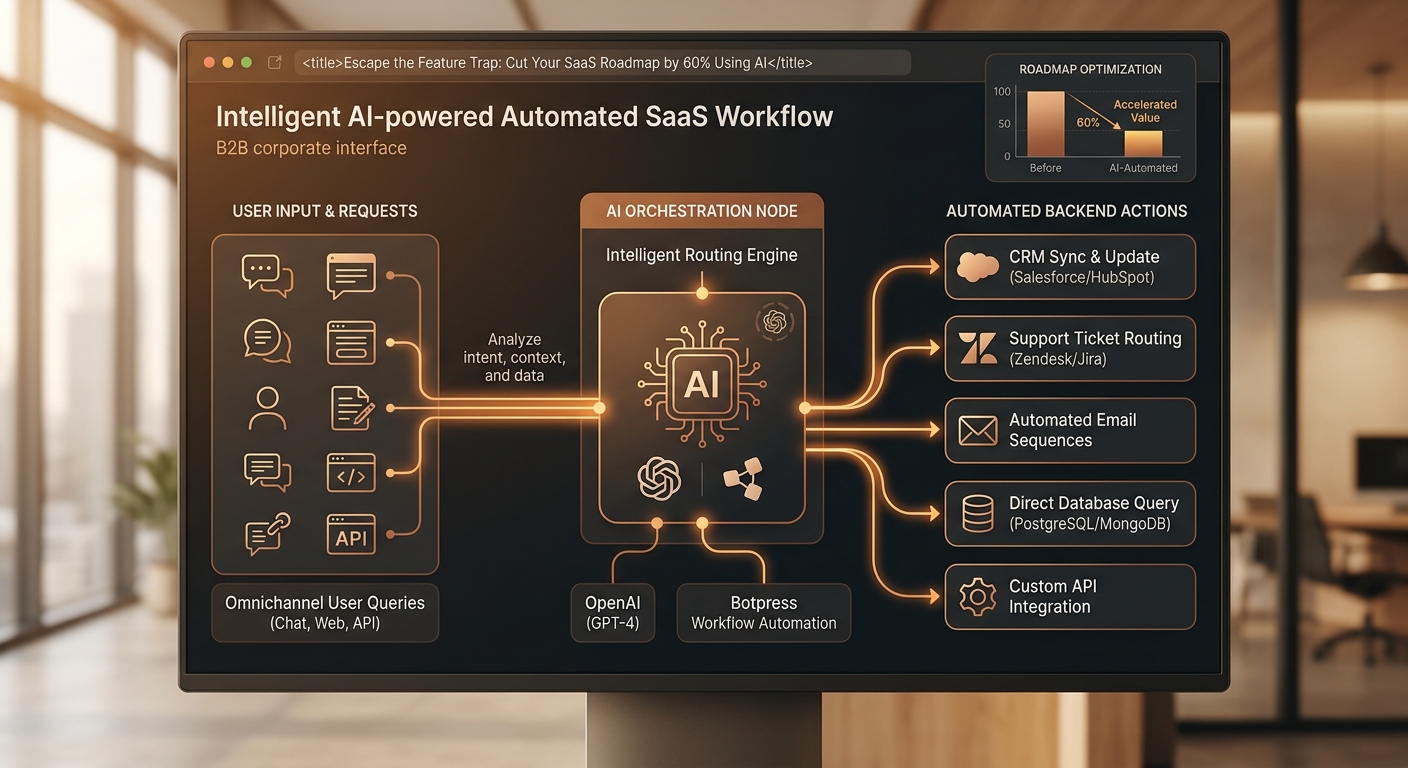
Here is the strategic breakdown of the "Feature Trap," the hidden costs it inflicts on your business, and how Versalence AI uses next-generation conversational AI—specifically leveraging the Botpress ecosystem—to replace bloated software with intelligent, outcome-driven solutions.
The Business Impact: The Hidden Cost of the "Feature Trap"
The "Feature Trap" is not an overnight phenomenon; it is a gradual erosion of product focus. It typically happens in three distinct phases, each compounding the technical and organizational debt of a company.
Phase 1: The Sales-Driven Genesis In the early days of a SaaS product, survival is the only metric that matters. When a lucrative prospect says, "We will sign a $50,000 Annual Recurring Revenue (ARR) contract if you just add this one specific custom workflow," the product team obliges. This creates a dangerous precedent. The product roadmap stops being a strategic vision and becomes a reactive checklist driven by individual sales conversations.
Phase 2: The Cognitive Overload Fast forward two years. The product now has dozens of these custom features, toggles, and specialized workflows. For the one client who requested the feature, it’s useful. For the other 99% of your user base, it is visual clutter. Cognitive load increases dramatically. New users log into the platform, see a labyrinth of options, feel overwhelmed, and churn. Time-to-value stretches from minutes to weeks.
Phase 3: The Maintenance Nightmare Every feature you ship is a liability you must support forever. Engineering velocity grinds to a halt because any new code must be tested against an increasingly complex matrix of existing features. When 70% of an engineering team's time is spent maintaining, updating, and fixing bugs in legacy features that almost no one uses, innovation dies. Competitors with leaner, faster products begin stealing market share.
The ultimate business impact of the Feature Trap is a slower time-to-market, inflated engineering budgets, skyrocketing customer support costs (because confused users submit more tickets), and stalled growth.
To escape this trap, businesses must shift their mindset from being a "feature factory" to becoming an "outcome engine." Users do not want to click buttons or navigate menus; they want a specific business result.
How Versalence Delivers the Solution: Intelligent Workflows over Static UI
The realization that you need to cut features is easy; the execution is incredibly difficult. If you cut 60% of your roadmap, how do you handle the legitimate edge cases, the complex workflows, and the power-user demands that those features were meant to address?
The answer lies in AI-powered automation and intelligent workflows. Instead of building a static, rigid user interface for every conceivable user journey, Versalence AI builds dynamic, natural-language-driven assistants that can execute complex workflows on the fly.
To achieve this, we heavily leverage Botpress, the ultimate platform for building next-generation chatbots and assistants powered by OpenAI. By utilizing Botpress Cloud, its robust SDK, and its command-line interface (CLI), we help SaaS companies transition from heavy GUIs to lightweight, intelligent conversational interfaces.
1. Transitioning from Menus to Intent Recognition
In a traditional SaaS application, a user who wants to generate a highly specific report must navigate to a reporting tab, select a date range, choose specific filters, aggregate data points, and hit "export." Building the UI to support every possible combination of filters is a massive engineering undertaking.
Instead of building that UI, Versalence implements a Botpress-powered assistant. Using OpenAI's advanced natural language understanding integrated directly into Botpress Cloud, the user simply types, "Generate a report showing user churn in Q3 for enterprise accounts, and compare it to Q2."
The AI instantly recognizes the user's intent, extracts the necessary parameters (Q3, user churn, enterprise accounts, comparison to Q2), and executes the backend API call to fetch this data. The feature is delivered perfectly without a single drop-down menu ever being coded.
2. Building Bots "As Code" with Botpress SDK and CLI
One of the reasons many companies hesitate to adopt chatbots is the legacy perception that bots are just rigid, frustrating decision trees. Versalence AI bypasses this limitation by treating conversational AI as a core engineering discipline.
We utilize the @botpress/sdk and @botpress/cli to build bots "as code." This is a fundamental paradigm shift. Instead of a marketing manager dragging and dropping a brittle flowchart, our engineers build robust, version-controlled intelligent systems that integrate seamlessly with your core product database.
When we integrate Botpress Cloud into a SaaS environment, we deploy highly secure webhooks and API clients. If a user asks the AI to perform a task—such as "Provision a new server with 16GB of RAM and alert the DevOps team"—the Botpress engine processes the natural language, but the actual execution is handled by robust code. The AI assistant makes authenticated API calls to your infrastructure, executes the workflow, and reports back.

This means that the 60% of your roadmap that consisted of "admin dashboards," "bulk action interfaces," and "custom integrations" can be completely scrapped. The AI handles the long tail of user requests dynamically.
3. Seamless Ecosystem Integrations
A major component of bloated software roadmaps revolves around third-party integrations. Customers constantly demand integrations with their specific CRM, their specific email provider, or their specific project management tool. Building and maintaining dozens of distinct integrations is a massive drain on resources.
Through the Botpress Hub, we tap into a vast ecosystem of public integrations maintained by Botpress, alongside developing custom plugins via the Botpress Studio. Rather than building a native integration into your SaaS application's UI, we build an intelligent middleware layer.
If a user wants to push data to an obscure third-party tool, they can simply ask the AI assistant to do it. The Botpress engine connects the dots behind the scenes, securely authenticating and transferring the data. Your core product remains incredibly lean and focused on its primary value proposition, while the AI layer handles the infinite permutations of integration requests.
Related Solutions We've Built
At Versalence AI, we have deployed this architecture across various industries, consistently proving that less UI combined with more AI leads to better business outcomes.
Automated and Conversational Customer Onboarding A common feature trap is the "onboarding wizard." SaaS companies spend months building multi-step tutorials, tooltips, and progress bars to teach users how to navigate complex software. We routinely replace these heavy frontend features with intelligent onboarding assistants. Using Botpress and OpenAI, new users are greeted by an AI that asks them what their immediate goal is. The AI then either guides them directly to the simplest path or, better yet, completes the setup process for them based on conversational inputs.
AI-Driven Support Triage and Resolution Most companies view AI chatbots purely as a way to deflect support tickets. We view them as a way to eliminate the need for administrative features. We built solutions where users can manage their billing, upgrade their plans, request account migrations, and troubleshoot complex technical errors entirely through a natural language interface. By integrating Botpress with platforms like Stripe and Zendesk, the AI doesn't just link to a FAQ article—it actually executes the database changes required to solve the user's problem. This allows our clients to completely remove complex billing and account management UI from their roadmap.
Internal Administrative AI Dashboards The feature trap isn't limited to customer-facing tools; internal tools suffer just as much. Operations teams constantly request custom internal dashboards to manage user data, moderate content, or track KPIs. Instead of dedicating engineering sprints to building internal React dashboards, we deploy headless Botpress assistants connected to internal Slack or Microsoft Teams channels. Operations staff can simply message the bot: "Show me all users who triggered the fraud alert in the last 24 hours and suspend their accounts." The Botpress SDK handles the API execution instantly.
Results & ROI: What Happens When You Go Lean with AI
When an organization makes the brave decision to cut 60% of its feature roadmap and replace it with AI-powered intelligent workflows, the return on investment is immediate and transformative.
1. Accelerated Time-to-Market by 40-50% When engineering teams are no longer bogged down by building, testing, and iterating complex graphical interfaces for edge-case features, their velocity skyrockets. By focusing solely on the core 40% of the product—the features that deliver the absolute most value to the majority of users—companies can ship major updates in weeks rather than months. The "long tail" of functionality is safely offloaded to the natural language processing capabilities of the Botpress AI engine.
2. Drastic Reduction in Technical Debt Every line of UI code is a liability. By replacing rigid features with dynamic AI workflows, the overall codebase shrinks. Bots built "as code" using the Botpress CLI and SDK are vastly easier to maintain than a sprawling frontend application. When an underlying API changes, you simply update the bot's integration logic rather than refactoring multiple user-facing components. This leaner infrastructure significantly reduces server costs and maintenance overhead.
3. Superior User Experience and Increased Retention Paradoxically, removing features often makes a product feel more powerful to the end-user. When users are freed from the cognitive overload of a cluttered dashboard, they can focus on their actual work. Being able to type a simple command and watch an AI perfectly execute a complex, multi-step workflow feels like magic compared to clicking through five levels of nested menus. This reduction in friction directly correlates with higher user activation rates and lower customer churn.
4. Flattening the Customer Support Curve In a traditional SaaS model, customer support costs scale linearly with the number of features. More features mean more things to break, more things to explain, and more tickets submitted. By eliminating confusing UI and replacing it with an AI assistant capable of conversational problem-solving, companies see a dramatic flattening of their support curve. The AI doesn't just guide the user; it acts as an intelligent agent, completing the task on their behalf.
Overcoming the Fear of the Cut
Cutting 60% of a planned roadmap is an incredibly daunting proposition. Sales teams will worry about lost deals; product managers will mourn the loss of their meticulously planned epics; founders will fear they are moving backward.
But the reality of modern software development is that the paradigm has irrevocably shifted. We are moving away from an era of "software as a tool" and entering an era of "software as a service-agent." Users do not want to learn how to use your tool; they want your tool to accomplish their goals.
By leveraging the power of platforms like Botpress Cloud, advanced LLMs like OpenAI, and the engineering rigor of building bots as code, you can bridge the gap between user expectations and engineering reality. You can build a product that is hyper-focused, incredibly lean, and infinitely flexible.
The Feature Trap is not inevitable. It is a choice. You can continue to pile features onto a crumbling foundation, or you can embrace intelligent automation to streamline your product and accelerate your growth.
Partner with Versalence AI
At Versalence AI, we build SaaS solutions that prioritize outcomes over bloat. We specialize in identifying the friction points in your product and replacing them with robust, scalable, AI-powered automation. Whether you are struggling with a bloated internal roadmap, high customer support costs, or a user interface that has grown out of control, our team of AI engineers can help you implement next-generation conversational architectures.
Don't let the Feature Trap stifle your company's potential. We can help you integrate intelligent workflows that empower your users and free your engineering teams to focus on true innovation.
Ready to cut the bloat and scale faster? Contact us today to discuss your architecture and discover how intelligent automation can transform your product.
Email our experts at: sales@versalence.ai Visit us at: versalence.ai
Work With Versalence
Ready to remove the drag from your business operations? Our AI automation and system integration team delivers measurable results in 30-120 days.
📧 Contact us
✉️ sales@versalence.ai