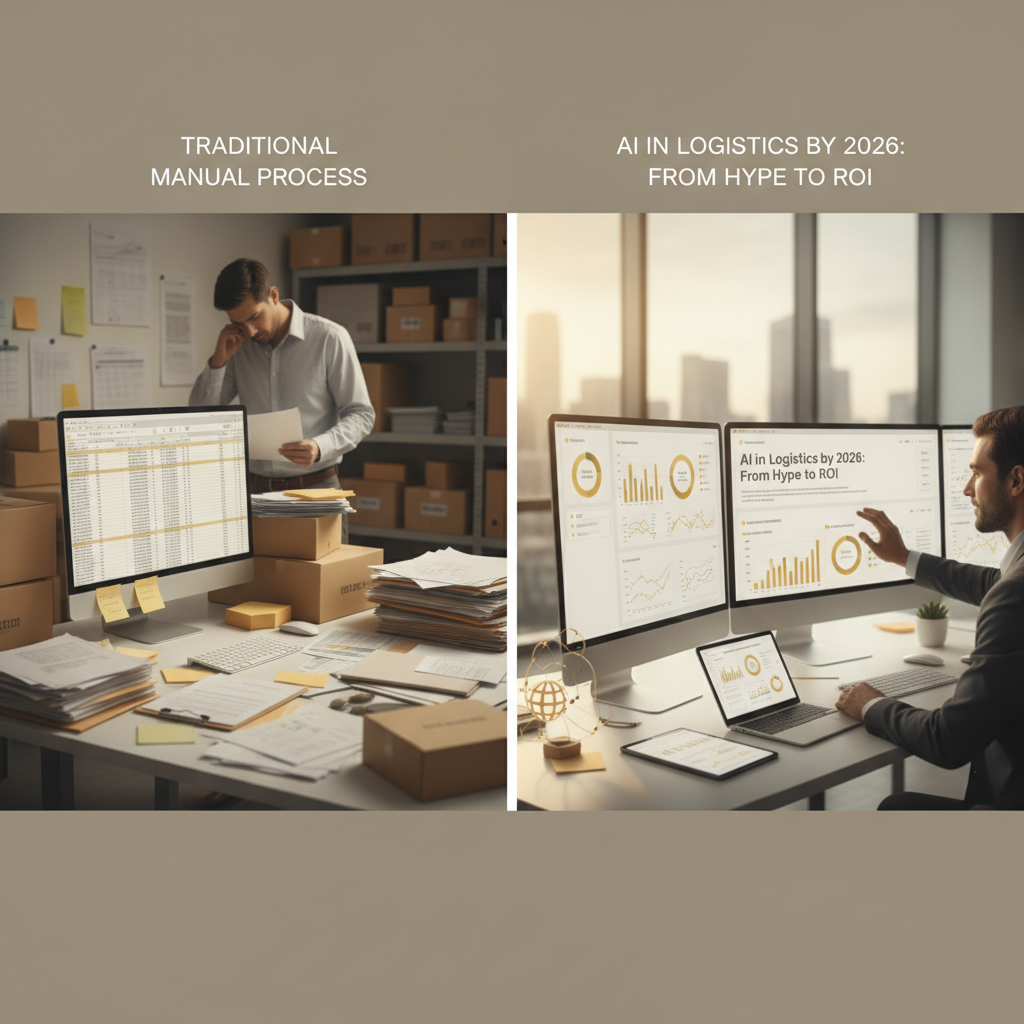
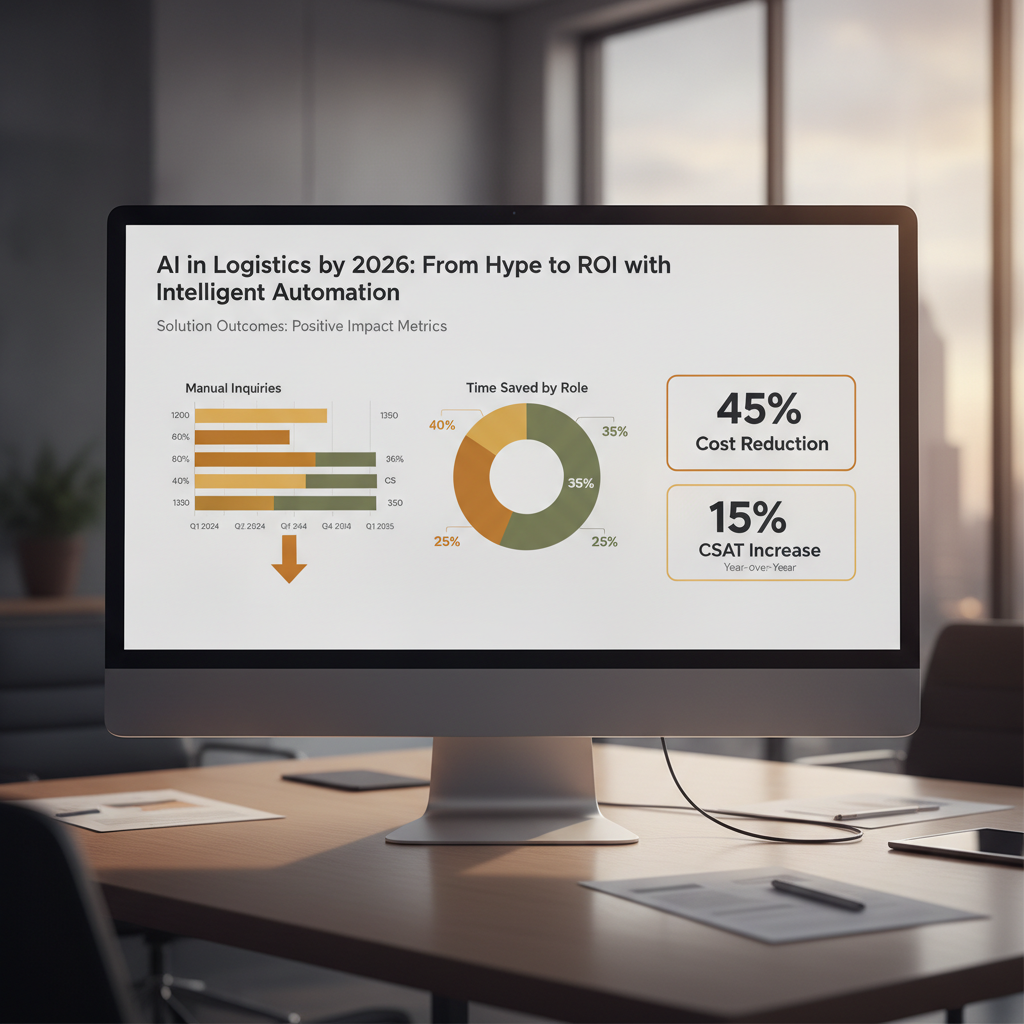
AI in Logistics by 2026: From Hype to ROI with Intelligent Automation
The global supply chain is a multi-trillion-dollar engine of modern commerce, yet for many businesses, its critical functions still run on a surprisingly fragile engine of phone calls, emails, and manual data entry. The pressure is immense. Volatile fuel costs, persistent labor shortages, and customers demanding Amazon-level transparency have stretched traditional logistics operations to their breaking point.
AI is consistently pitched as the silver bullet. We’re shown visions of fully autonomous truck fleets and self-managing warehouses orchestrated by a god-like cognitive intelligence. But for the supply chain directors and operations managers on the ground, the reality is far messier. A recent survey found that while 80% of supply chain executives believe AI is a critical technology, less than 20% have successfully scaled an AI-powered solution.
The gap between promise and reality is vast. Businesses are struggling to distinguish between science-fiction hype and the practical, ROI-positive applications available today. How do you invest confidently when every vendor promises a revolution, but your budget demands a return?
The answer lies in focusing on the friction points you can solve now. By 2026, the winners won't be those who bet the farm on moonshot projects, but those who systematically eliminated operational drag with targeted, intelligent automation.
The Business Impact: Separating 2026 Reality from Distant Hype
To make smart investments, you need a clear-eyed view of the AI landscape. Let's break down what's a practical application for the near future versus what remains on the distant horizon.

The Hype: Powerful Ideas, But Not Ready for Your 2026 Budget
These are the technologies that generate headlines but are unlikely to be scalable, affordable, or reliable enough for mainstream adoption in the next two to three years.
- Fully Autonomous Trucking (Level 5): The image of a driverless truck cruising coast-to-coast is compelling, but the reality is a decade or more away. While "platooning" and highway-assist technologies (Level 3-4) are gaining traction, the final-mile complexity, regulatory morass, insurance liability, and immense capital cost of retrofitting fleets mean Level 5 autonomy is not a strategic priority for the average logistics company in 2026.
- The "Cognitive Control Tower": The concept is a single, self-healing AI that monitors every node of your supply chain in real-time, predicts disruptions before they happen, and automatically re-routes and re-allocates resources without human intervention. It’s a powerful end-goal. However, it requires a level of data maturity, system integration, and universal API standards that fewer than 1% of companies possess. It’s a destination, not a starting point.
- A Single, Generalized AI Planner: The dream of an "all-in-one" AI that can simultaneously handle demand forecasting, inventory optimization, network design, and S&OP is seductive. In practice, these are highly distinct, complex domains. The most effective AI solutions today are specialized. A model that excels at predicting port congestion has a completely different architecture than one that optimizes pallet-stacking in a warehouse.
Chasing these futuristic goals before mastering the fundamentals is a recipe for expensive, failed projects. The real value lies in a more pragmatic approach.
The Reality: AI Applications Delivering ROI Today and Dominating by 2026
These are the mature, proven AI technologies that are already generating measurable returns. They focus on augmenting human capabilities and automating high-volume, low-value tasks.
- Predictive Analytics for Demand and ETA: This is one of the most established AI use cases. Machine learning models can now analyze historical sales data, seasonality, weather patterns, macroeconomic indicators, and even social media sentiment to produce demand forecasts that are 20-30% more accurate than traditional methods. Similarly, AI models can predict shipment ETAs with far greater precision by analyzing real-time traffic, port dwell times, and carrier performance data, allowing for proactive disruption management.
- Intelligent Warehouse Automation: This goes beyond simple conveyor belts. Autonomous Mobile Robots (AMRs) are navigating warehouses to assist human pickers, reducing walk times by over 50%. Computer vision systems equipped with AI are performing quality control checks, identifying damaged goods, and even conducting cycle counts by "seeing" inventory on shelves, all with superhuman speed and accuracy.
- Intelligent Document Processing (IDP): The logistics industry drowns in paperwork: bills of lading, customs declarations, proofs of delivery, and invoices. IDP uses AI to read these documents (even unstructured PDFs or scans), understand the context, and extract key data—like PO numbers, container IDs, and invoice amounts—directly into your TMS or ERP. This eradicates manual data entry, eliminates costly errors, and accelerates cash cycles.
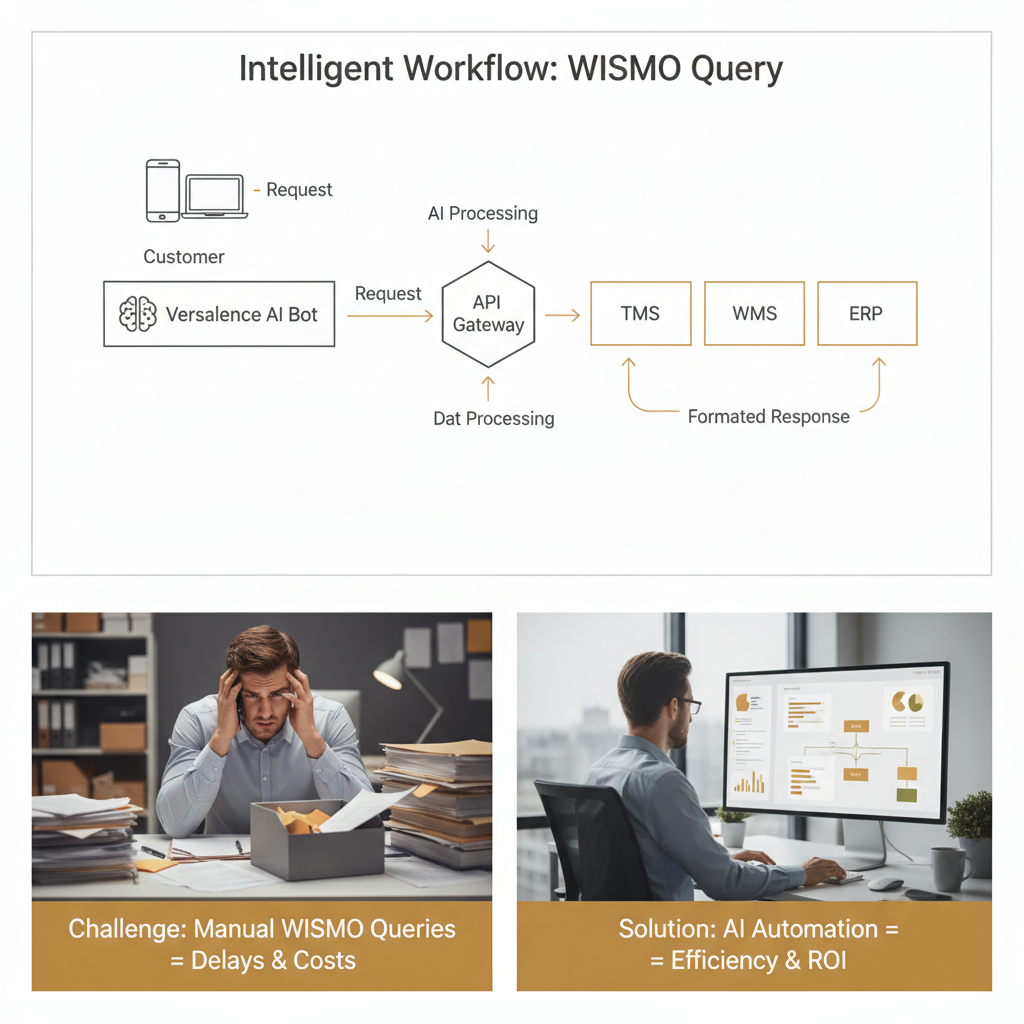
- Intelligent Workflow Automation & Conversational AI: This is arguably the most impactful and accessible AI application for the majority of logistics businesses. It acts as the intelligent "connective tissue" between your existing systems, your employees, and your customers. Instead of replacing your core systems, it makes them exponentially more efficient by automating the endless stream of communication and coordination tasks that consume your team's day.
This last point is where the most significant, immediate gains are being realized, and it's the core of what we build at Versalence AI.
Work With Versalence
Ready to remove the drag from your business operations? Our AI automation and system integration team delivers measurable results in 30-120 days.
📧 Contact us
✉️ sales@versalence.ai