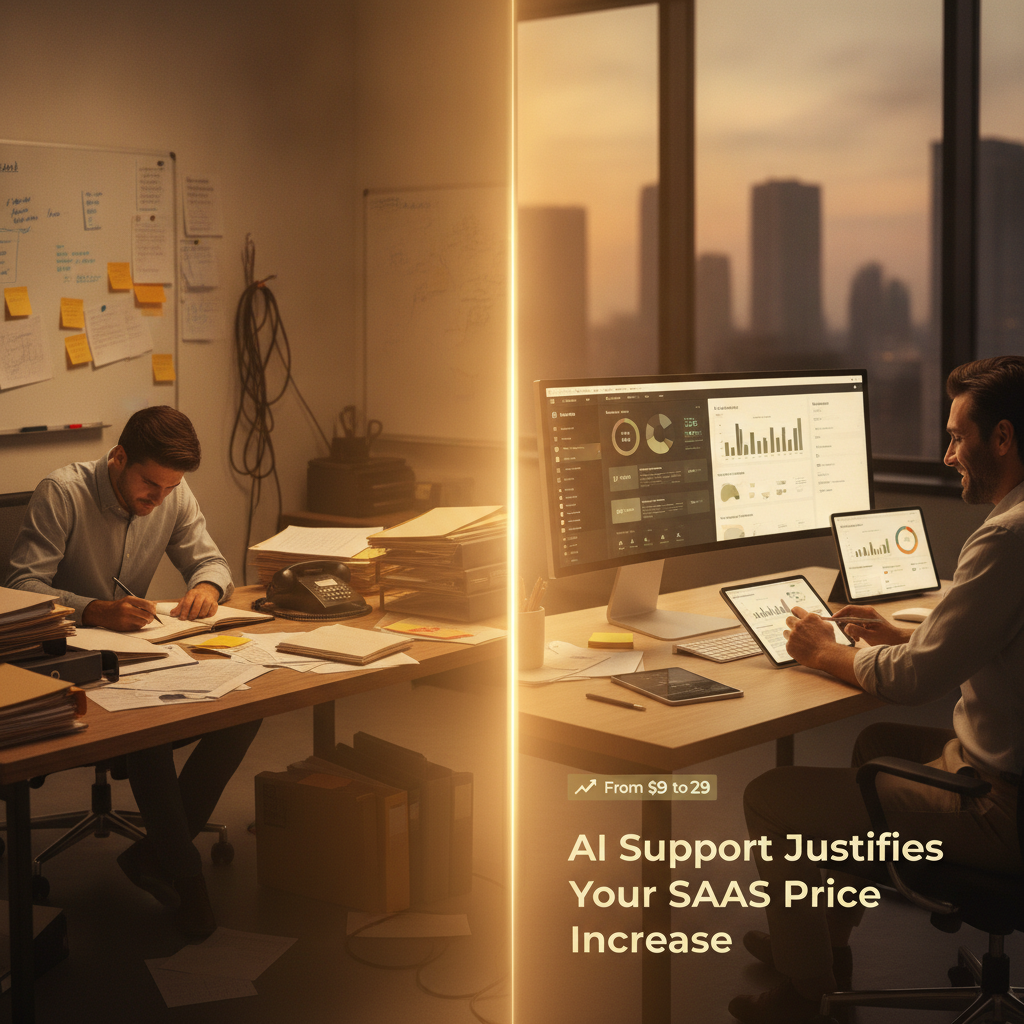
From $9 to $29: How AI Support Justifies Your SaaS Price Increase
The SaaS Founder's Dilemma: The Terrifying Gap Between $9 and $29
Every SaaS leader has stared at their pricing page, caught in a cold sweat of indecision. The numbers seem so small, yet the implications are monumental. Should you stick with the safe, volume-driven $9/month plan? Or do you take the leap to a value-driven $29/month, a price that suggests confidence, quality, and a premium experience?
This isn't just a pricing A/B test; it's a crisis of identity. The jump from $9 to $29 isn't a simple 222% increase in revenue per user. It represents a fundamental shift in the promise you make to your customers. A $9 customer might tolerate a 24-hour ticket response time. A $29 customer expects an answer now. They expect a partner, not just a tool.
The data confirms the stakes are high. Research from Price Intelligently has shown that pricing is the single most effective lever for improving SaaS revenue. A mere 1% improvement in pricing optimization can result in an 11% increase in operating profit. Yet, most companies spend less than 10 hours a year on their pricing strategy. Why? Because it’s hard. And because delivering on the promise of a higher price point is even harder.
Many businesses raise their prices only to be crushed by the weight of customer expectations. They find their small support team overwhelmed, their churn rate skyrockets, and the promised profit increase is eaten alive by the operational cost of delivering a "premium" service.
But what if you could bridge that gap? What if you could deliver a $29 experience at the cost of a $9 operation? This is no longer a hypothetical. By leveraging intelligent automation and AI-powered workflows, SaaS companies can not only justify their price increases but also build a more scalable, profitable, and customer-centric business.
The Business Impact: The Crushing Weight of the "$29 Expectation"
When a customer commits to a higher price point, their psychological contract with your business changes. They are no longer just buying access to software; they are investing in an outcome. This investment comes with a set of non-negotiable expectations that can make or break your business.
1. The Expectation of Immediacy: The modern customer, whether B2B or B2C, operates on internet time. A problem that blocks their workflow isn't something they'll file a ticket for and check on tomorrow. It's a fire that needs to be put out immediately. For a $29/month user, a "we'll get back to you within one business day" auto-reply is an insult. They expect 24/7 availability and near-instant answers to their most pressing questions. Scaling a human team to meet this demand is financially crippling for all but the largest enterprises.
2. The Expectation of Personalization: Premium customers don't want to feel like another number in a queue. They expect you to know who they are, what their goals are, and what they've struggled with in the past. When they reach out for support, they don't want to repeat their entire history to a new agent every single time. They expect a seamless, context-aware conversation that values their time and their business. Delivering this requires sophisticated systems that are often out of reach for growing companies.
3. The Expectation of Proactive Guidance: A $9 product can be self-serve. A $29 product should be a guided experience. Customers paying a premium expect you to help them succeed. This means more than just a knowledge base and a few tutorial videos. It means proactive onboarding that helps them achieve their "first win" quickly, intelligent nudges that introduce them to powerful features they might have missed, and a support system that anticipates their needs before they even articulate them.
Failing to meet these expectations has a direct and painful business impact. Customer satisfaction (CSAT) scores plummet, negative reviews pile up, and—most damagingly—churn rates increase. A higher price point with a subpar experience is the fastest way to convince a customer that your service isn't worth the money. You've made a promise with your pricing that your operations can't keep.
How Versalence Delivers the "$29 Experience" with AI
This is precisely the operational gap that Versalence AI closes. We don't just build software; we build the intelligent operational backbone that allows you to deliver a premium customer experience, scalably and profitably. Our solution is rooted in AI-powered automation and intelligent workflows, using best-in-class platforms like Botpress to create next-generation AI assistants.
The code in our versalenceai/botpress repository isn't just for a generic chatbot. It's the foundation for building sophisticated, deeply integrated assistants that become a core part of your service delivery. Here’s how we turn the "$29 Expectation" from an operational nightmare into a competitive advantage.
1. Building Your 24/7 Automated Support Tier
The first line of defense is an AI assistant that never sleeps. Using platforms like Botpress, we build and train assistants on your specific documentation, knowledge base, API guides, and past support tickets.

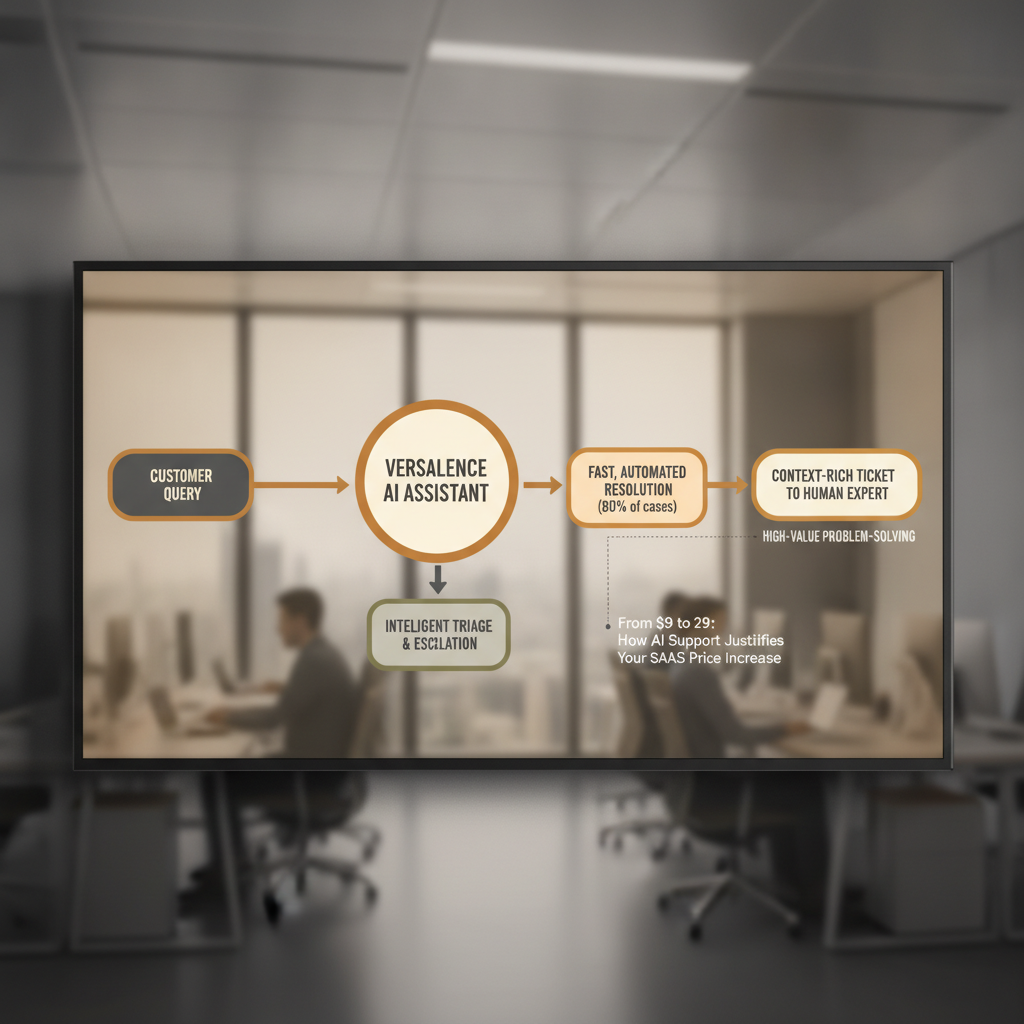
- Instant Resolutions: This assistant can instantly and accurately answer 70-80% of your most common Tier-1 support queries. Questions like "How do I reset my password?", "Where do I find my invoice?", or "How does the XYZ feature work?" are resolved in seconds, at any time of day or night. The customer gets an immediate answer, and your human team is freed from repetitive, low-impact work.
- Multi-Channel Presence: We deploy this assistant across all your customer touchpoints—your website, within your app, on Slack, or even via WhatsApp. The support is available wherever your customer is, creating a seamless experience.
- Language and Tone: The assistant is configured to match your brand voice perfectly, whether it's formal and professional or friendly and casual. It can also communicate in multiple languages, allowing you to deliver a world-class experience to your global user base.
2. Intelligent Triage: The Smart Bridge to Human Experts
For the 20-30% of queries that require human intervention, the AI assistant acts as an intelligent dispatcher, not a frustrating wall. This is a critical distinction.
- Context Gathering: Before escalating a conversation, the assistant is programmed to ask clarifying questions and gather all necessary context. What is the user's account ID? What browser are they using? Can they provide a screenshot or a screen recording of the issue?
- Automated Ticket Creation: The assistant then packages this information into a perfectly formatted, detailed support ticket in your helpdesk system (like Zendesk, Jira, or Salesforce). Your human agent receives a ticket with all the preliminary work already done. No more back-and-forth emails just to get basic information.
- Smart Routing: Based on the nature of the query, the assistant can automatically route the ticket to the correct department. Billing questions go to finance, bug reports go to engineering, and complex feature requests go to product management. This dramatically reduces internal response delays and ensures the query is handled by the right expert from the start.
This workflow transforms your human support team from ticket-takers into high-impact problem-solvers. Their time is spent on the most complex and valuable customer issues, which not only improves efficiency but also boosts team morale.
3. Proactive Onboarding and Engagement Workflows
A premium experience begins the moment a user signs up. We build AI-driven workflows that turn onboarding from a passive, self-serve process into an interactive, guided journey.
- Personalized Welcome: A new user is greeted by an AI onboarding specialist. Instead of a generic product tour, the assistant asks, "Welcome to the platform! What's the main goal you're hoping to achieve today?"
- Guided "First Win": Based on their answer, the assistant guides them step-by-step through the actions needed to achieve their first moment of value. This dramatically increases user activation rates—the single biggest predictor of long-term retention.
- Feature Discovery: The assistant can proactively reach out to users after a week to ask how they're doing and suggest an advanced feature based on their usage patterns. "I noticed you've created 10 projects. Did you know you can use our template feature to speed that up? Here's how." This feels less like a tool and more like a proactive partner invested in their success.
Related Solutions: The Versatility of Intelligent Workflows
The same core technology and strategic approach we use to revolutionize customer support can be applied across your entire organization. The principle remains the same: use AI and automation to handle repetitive tasks, allowing your human talent to focus on high-value, strategic work.
- AI-Powered Sales Qualification: An assistant on your website can engage potential customers, answer their initial questions, ask qualifying questions (like company size and use case), and, if they're a good fit, book a demo directly on your sales team's calendar. This fills your pipeline with high-intent, pre-qualified leads.
- Internal IT & HR Helpdesks: Free up your IT and HR teams by automating common internal requests. An internal assistant can handle password resets, software access requests, questions about company policies, and benefits inquiries, allowing your teams to focus on more strategic initiatives.
- Automated Feedback and Research: Deploy AI workflows to automatically collect customer feedback at key moments in their journey. The insights gathered can be automatically tagged, analyzed for sentiment, and routed to the product team, creating a powerful, real-time feedback loop.
The Results & ROI: Measuring the Impact of a Superior Experience
Implementing an AI-driven support and engagement strategy isn't just about "feeling" more premium. It delivers hard, measurable results that flow directly to your bottom line.
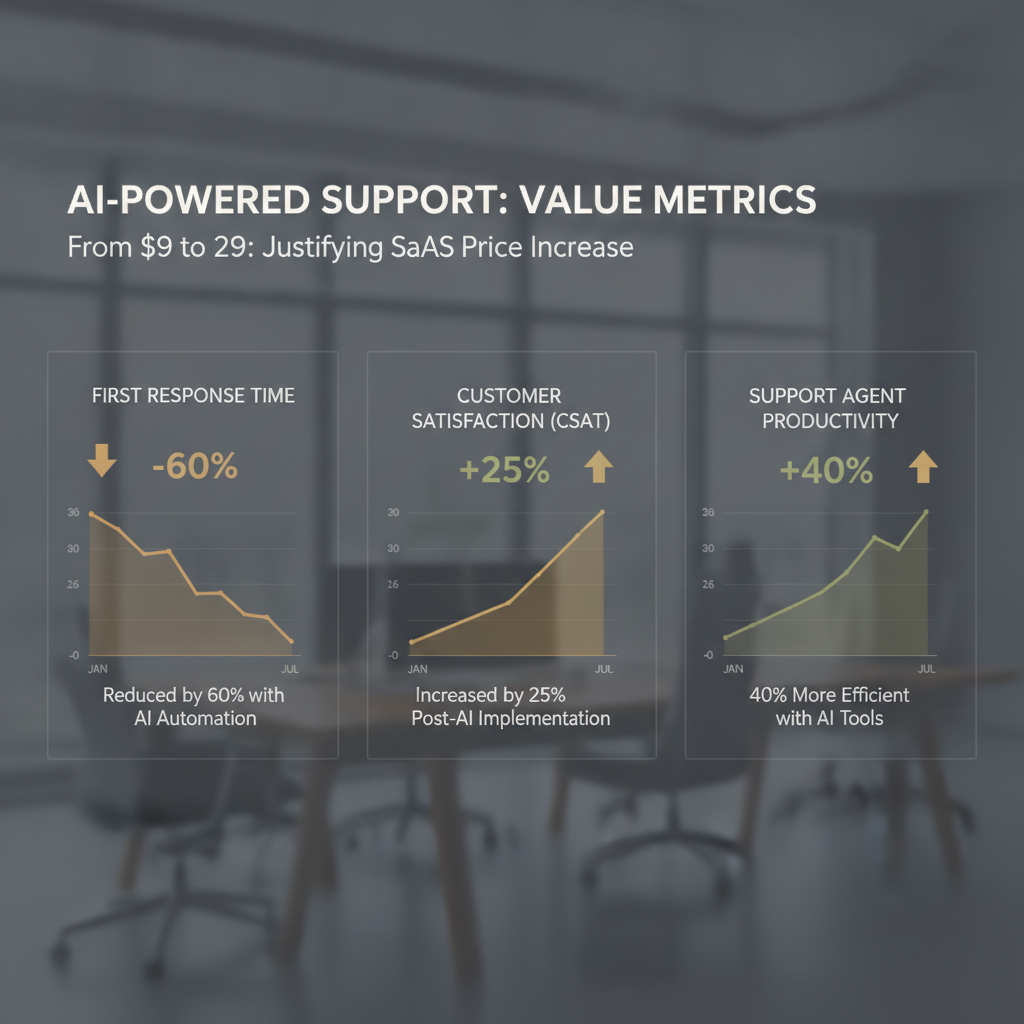
- Drastically Reduced Support Costs: By automating up to 80% of Tier-1 inquiries, businesses can significantly delay the need to hire additional support staff. A single AI assistant can handle the workload of multiple full-time agents for a fraction of the cost, directly reducing operational expenses. A typical outcome is a 40-60% reduction in cost-per-resolution.
- Increased Customer Satisfaction (CSAT) and Retention: Instant answers and seamless escalations lead to happier customers. We consistently see CSAT scores improve by 15-25% after implementation. Happy customers who feel supported are far less likely to churn, providing the stable recurring revenue base needed for growth.
- Improved Conversion and Activation: An interactive, AI-guided onboarding process can boost new user activation rates by 20% or more. By removing friction and guiding users to value faster, you turn more trials into paying customers and more paying customers into long-term advocates.
- Infinite Scalability: Perhaps the most significant benefit is the ability to scale. As your user base grows from one thousand to one hundred thousand, your AI assistant handles the increased volume effortlessly. Your support costs no longer grow linearly with your customer count. This breaks the traditional scaling model and unlocks true, profitable growth.
The $9 vs. $29 question is not about what you can charge. It's about what you can deliver. By building an intelligent, automated operational layer, you create an experience so valuable that $29 feels like a bargain. You're no longer just selling software; you're selling confidence, efficiency, and a genuine partnership.
Ready to build the premium customer experience that justifies your pricing and fuels your growth?
Contact Versalence AI today for a comprehensive consultation. Let's design the intelligent workflows that will transform your business.
Email us at sales@versalence.ai or visit us at versalence.ai.
Work With Versalence
Ready to remove the drag from your business operations? Our AI automation and system integration team delivers measurable results in 30-120 days.
📧 Contact us
✉️ sales@versalence.ai