Civil Engineering Ai Solutions: A Deep Dive for Friday
Introduction – The Silent Threat Beneath Our Feet
Imagine you’re overseeing a critical infrastructure project – a new metropolitan bridge, destined to alleviate traffic congestion and connect communities. Your teams are diligent, designs are robust, and the budget is tight. Then, an unforeseen ground condition emerges during excavation – a geological anomaly missed by conventional surveys. Suddenly, schedules are disrupted, costs spiral, and stakeholder confidence wavers. This isn't a hypothetical; it's a recurring nightmare for civil engineers globally, costing billions annually in delays and overruns.
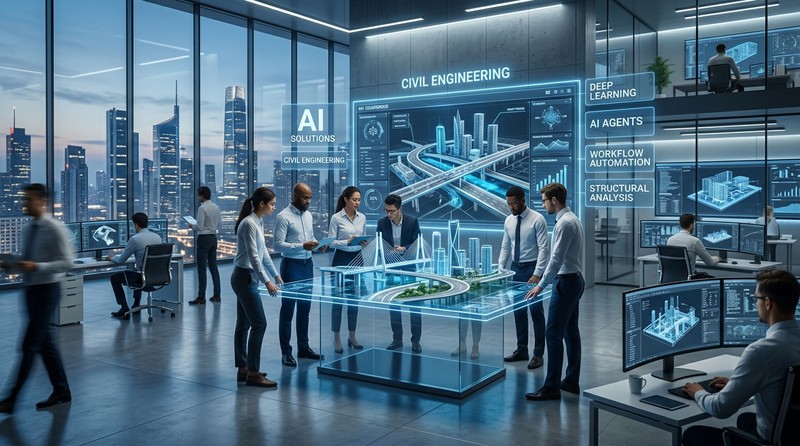
For too long, the industry has relied on reactive problem-solving, often after the damage is done. But by 2026, the leading firms are operating differently. They're leveraging advanced AI solutions to anticipate these challenges, optimize designs, streamline operations, and enhance safety with unprecedented precision. This isn't about automating away human ingenuity; it's about augmenting it, allowing engineers to focus on higher-value tasks and strategic oversight. This deep dive will cut through the marketing hype to reveal what AI solutions are genuinely delivering tangible value in civil engineering today, providing a concrete roadmap for your firm to harness this transformative power.
The Current Landscape – What's Actually Working in 2026
By 2026, the conversation around AI in civil engineering has matured significantly. We’ve moved past the initial excitement and proof-of-concept stages into widespread, practical application. The focus is firmly on solutions that demonstrate clear ROI, enhance project predictability, and drive sustainable outcomes.
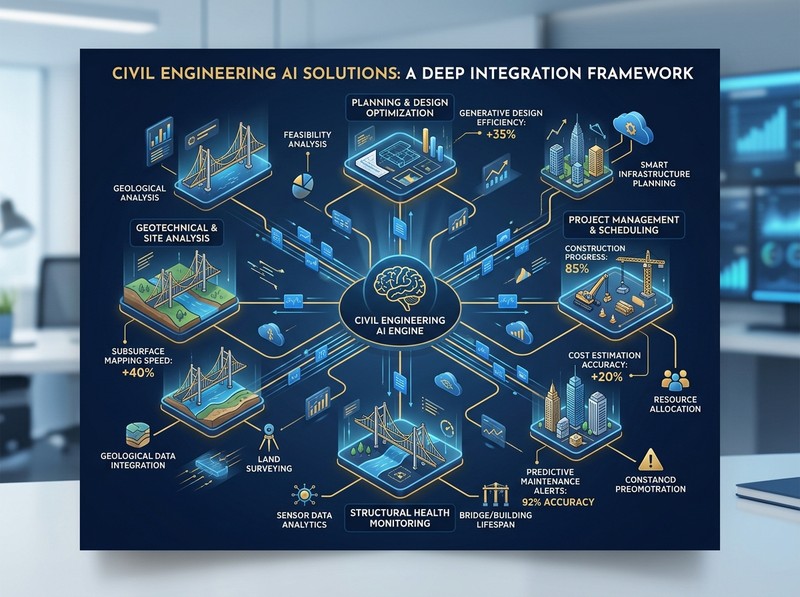
Key areas where AI is making a definitive impact include:
* Predictive Asset Maintenance: AI models analyze real-time sensor data from bridges, roads, tunnels, and water systems to forecast potential failures, optimize maintenance schedules, and extend asset lifespans. This shifts from reactive or time-based maintenance to truly predictive, condition-based interventions.
* Generative Design and Optimization: Leveraging AI, engineers can rapidly explore thousands of design permutations for structures, components, and site layouts. These solutions optimize for factors like material usage, constructability, cost, and environmental impact, often discovering efficiencies human designers might overlook.
* Automated Quality Assurance and Progress Monitoring: Drones equipped with high-resolution cameras, coupled with computer vision AI, autonomously inspect construction sites. They compare real-time progress against BIM models, detect deviations, identify quality issues, and monitor safety compliance, providing daily, objective reports.
* Advanced Project Risk Management: AI sifts through vast datasets of historical project performance, weather patterns, supply chain fluctuations, and regulatory changes to identify potential risks long before they materialize. It offers proactive insights into schedule delays, budget overruns, and resource allocation challenges.
* Environmental Impact Assessment and Optimization: AI-driven simulations analyze the environmental footprint of design choices, material selections, and construction methodologies. This enables engineers to make data-backed decisions that reduce carbon emissions, minimize waste, and enhance project sustainability.
The common thread across these applications is data. Firms that have invested in robust data collection, integration, and governance strategies are the ones reaping the most significant benefits from AI in 2026.
Deep Dive: Core Concepts – Frameworks and Analysis
To understand what truly works, it's essential to grasp the underlying AI concepts and how they are applied within civil engineering. We can broadly categorize effective AI solutions into three operational frameworks:
1. Predictive & Prescriptive AI: This framework uses machine learning (ML) algorithms to analyze historical and real-time data to forecast future events or recommend optimal actions.
* Mechanism: Supervised learning (regression, classification) and unsupervised learning (clustering) models.
* Application: Predicting structural fatigue, forecasting material demand, identifying at-risk project timelines, optimizing traffic flow, and recommending maintenance schedules.
* Key Enabler: High-quality, time-series data from sensors, project management systems, and historical records.
2. Generative & Optimization AI: This framework utilizes AI to create new designs, layouts, or solutions that meet specific performance criteria, often pushing the boundaries of traditional human design.
* Mechanism: Generative Adversarial Networks (GANs), evolutionary algorithms, topology optimization, and reinforcement learning.
* Application: Generating optimal bridge structures, designing efficient ventilation systems for tunnels, optimizing site logistics, and creating sustainable material mixes.
* Key Enabler: Clearly defined design constraints, performance objectives, and a computational environment for rapid iteration.
3. Cognitive & Perceptive AI (Computer Vision & NLP): This framework allows AI to "understand" and process visual and textual information, automating tasks that traditionally required human observation or interpretation.
* Mechanism: Deep learning for image recognition (Convolutional Neural Networks - CNNs), natural language processing (NLP) for text analysis.
* Application: Automated inspection of construction quality from drone imagery, progress tracking against BIM models, identifying safety hazards on site, extracting critical information from contracts and specifications, and automating compliance checks.
* Key Enabler: Large datasets of annotated images/videos, structured and unstructured text documents, and robust edge computing capabilities for on-site processing.
The effectiveness of any AI solution in civil engineering hinges on a virtuous cycle: Data Collection & Preparation -> Model Training & Validation -> Deployment & Integration -> Monitoring & Feedback. A robust data strategy, coupled with domain expertise, is paramount. AI doesn't replace engineers; it empowers them with superhuman analytical capabilities, allowing them to make faster, more informed decisions and innovate more freely.
Comparison and Trade-offs – Choosing the Right Tool
Choosing the right AI solution involves understanding the trade-offs. Here are a few comparisons of effective AI applications against traditional methods, highlighting their pros and cons.
Table 1: Generative Design vs. Traditional Iterative Design
| Feature/Method | Generative Design (AI-powered) | Traditional Iterative Design (Human-led) |
| :----------------------- | :----------------------------------------------------------- | :--------------------------------------------------------------------- |
| Pros | - Explores vast design space rapidly, finding novel solutions
- Optimizes for multiple objectives (cost, materials, performance)
- Reduces design iteration time significantly
- Potential for hyper-efficient and sustainable designs | - High degree of direct human control and intuition
- Predictable outcomes based on established practices
- Easier to explain and justify design choices to stakeholders |
| Cons | - Requires significant upfront definition of constraints and objectives
- Can produce designs that are initially counter-intuitive or require validation
- High computational cost and specialized software
- "Black box" perception can hinder adoption | - Limited exploration of design alternatives due to time constraints
- Prone to local optima; may miss truly innovative solutions
- Slower iteration cycles, especially for complex projects
- Human bias can influence design outcomes |
| Best Use Case | Complex structures, material optimization, highly constrained environments, performance-driven design. | Designs requiring strong aesthetic control, unique site-specific challenges with limited data, small-scale projects. |
Table 2: AI-Powered Predictive Maintenance vs. Time-Based Maintenance
| Feature/Method | AI-Powered Predictive Maintenance | Time-Based (Scheduled) Maintenance |
| :----------------------- | :----------------------------------------------------------- | :--------------------------------------------------------------------- |
| Pros | - Reduces unexpected failures and costly emergency repairs
- Optimizes maintenance schedules, extending asset lifespan
- Lower overall operational costs and improved safety
- Maximizes asset uptime and availability
- Data-driven insights for long-term asset management | - Simple to implement and understand
- Predictable scheduling for resource allocation
- Ensures regular inspection and intervention |
| Cons | - Requires significant investment in sensors and data infrastructure
- Depends on high-quality, continuous data streams
- Model complexity and need for ongoing calibration
- Initial setup costs and expertise requirements | - Leads to unnecessary maintenance of healthy assets
- Risk of unexpected failures between scheduled interventions
- Does not account for actual asset condition
- Sub-optimal asset lifespan and higher long-term costs |
| Best Use Case | High-value, critical infrastructure (bridges, tunnels, pipelines), large asset portfolios, remote or difficult-to-access assets. | Non-critical assets, where failure has low impact, or very simple, low-cost components. |
Table 3: Computer Vision for Site Monitoring vs. Manual Site Inspection
| Feature/Method | Computer Vision (Drone/Camera-based) | Manual Site Inspection (Human-led) |
| :----------------------- | :----------------------------------------------------------- | :--------------------------------------------------------------------- |
| Pros | - High frequency and consistency of data collection (daily/hourly)
- Objective, quantifiable data trails for compliance and dispute resolution
- Enhanced safety by reducing human presence in hazardous areas
- Rapid identification of deviations from plan/BIM
- Comprehensive coverage of large sites | - Human judgment and ability to interpret complex, nuanced situations
- Flexibility to adapt to unexpected scenarios
- Immediate on-site problem-solving and communication
- No specific technology investment beyond basic tools |
| Cons | - Initial investment in drones, cameras, and processing software
- Requires skilled operators and data analysts
- Potential for false positives/negatives if models are not well-trained
- Data storage and privacy concerns
- Limited ability to interact with site personnel for immediate clarification | - Time-consuming and labor-intensive, limiting inspection frequency
- Subjectivity and potential for human error or oversight
- Safety risks for inspectors in hazardous environments
- Difficult to achieve comprehensive, consistent coverage of large sites
- Lacks objective, quantifiable data trails for historical analysis |
| Best Use Case | Large, complex construction projects, repetitive tasks, safety-critical zones, progress tracking, quality control, inventory management. | Problem-solving, complex diagnostic tasks, stakeholder communication, areas requiring immediate human intervention or negotiation. |
Implementation Framework – A Step-by-Step Guide
Successfully integrating AI into your civil engineering practice requires a structured approach. This framework moves beyond theoretical principles to actionable steps.
Phase 1: Define & Assess (Weeks 1-4)
1. Identify High-Value Problem Areas: Conduct an internal audit to pinpoint your most pressing challenges. Where are you experiencing significant cost overruns, schedule delays, safety incidents, or quality issues? Prioritize areas with clear, measurable impact (e.g., "reduce change orders by X%", "improve asset uptime by Y%").
2. Assess Data Readiness: For each identified problem, evaluate the availability, quality, and accessibility of relevant data. Do you have historical project data, sensor readings, BIM models, GIS data, or textual documents? Identify data gaps and plan for collection.
3. Set Clear KPIs: Define specific, measurable, achievable, relevant, and time-bound (SMART) key performance indicators for your AI initiative. This will be crucial for measuring success.
4. Form a Cross-Functional AI Task Force: Assemble a small team comprising engineering, IT, and project management personnel. This ensures diverse perspectives and facilitates integration.
Phase 2: Pilot & Validate (Months 1-6)
1. Select a Contained Pilot Project: Choose a smaller, well-defined project or a specific aspect of a larger project where the AI solution can be tested without disrupting critical operations. This minimizes risk and allows for focused learning.
2. Choose a Proven AI Solution or Partner: Opt for a vendor with a strong track record in civil engineering, demonstrated success, and clear integration capabilities with your existing software (BIM, GIS, ERP). Alternatively, if building in-house, start with open-source tools and a dedicated data science team.
3. Run Parallel Operations: For the pilot, run the AI solution alongside your traditional methods. This allows for direct comparison of performance, validation of AI insights, and builds trust within your teams.
4. Gather User Feedback & Iterate: Actively collect feedback from engineers and project managers using the AI tool. Use this feedback to refine the solution, improve data inputs, and adjust workflows.
Phase 3: Integrate & Scale (Months 6-18+)
1. Integrate with Existing Workflows: Seamlessly embed the validated AI solution into your core operational systems (BIM 360, ArcGIS, Primavera P6, SAP, etc.). This is where the real efficiency gains are realized.
2. Develop Data Governance & MLOps Practices: Establish robust protocols for data quality, security, privacy, and continuous monitoring of AI model performance. Implement MLOps (Machine Learning Operations) to manage the lifecycle of AI models, ensuring they remain accurate and relevant.
3. Comprehensive Staff Training: Provide thorough training to all relevant personnel on how to use, interpret, and trust the AI insights. Emphasize that AI is an augmentation tool, not a replacement.
4. Monitor Performance & Continuously Optimize: Regularly review the KPIs established in Phase 1. Use performance data to identify areas for further optimization, model retraining, or expansion to other projects.
Phase 4: Culture & Governance (Ongoing)
1. Foster an AI-Literate Culture: Encourage curiosity, experimentation, and a data-driven mindset throughout the organization. Celebrate successes and learn from challenges.
2. Establish Ethical Guidelines: Develop clear policies for data usage, algorithmic transparency, and accountability to ensure responsible AI deployment.
Decision Guide – How to Choose the Right AI Solution for Your Firm
Navigating the myriad of AI solutions requires a strategic approach. Use these guiding questions and frameworks to make informed decisions:
1. Identify Your Core Pain Points:
* Cost: Are you battling consistent budget overruns? (Consider: Predictive Cost Analytics, Generative Design for material optimization)
* Schedule: Are project delays a frequent issue? (Consider: AI-powered Project Risk Management, Automated Progress Monitoring)
* Quality: Do you struggle with rework or compliance issues? (Consider: Computer Vision for QA/QC, Generative Design for constructability)
* Safety: Are safety incidents a concern? (Consider: Computer Vision for hazard detection, Predictive Maintenance for asset integrity)
* Sustainability: Are you striving for better environmental performance? (Consider: AI for Environmental Impact Assessment, Generative Design for low-carbon solutions)
* Asset Management: Is your infrastructure aging, and maintenance becoming unpredictable? (Consider: Predictive Asset Maintenance)
2. Assess Your Data Landscape:
* Data Availability: Do you have structured, historical data relevant to your pain point (e.g., sensor data, BIM models, GIS data, project schedules, cost reports, inspection logs)?
* Data Quality: Is your data clean, consistent, and reliable? AI models are only as good as the data they're trained on.
* Data Accessibility: Can you easily access and integrate data from various systems?
3. Evaluate Organizational Readiness:
* Budget: What is your realistic budget for initial investment (software, sensors, training) and ongoing operational costs (data storage, model maintenance)?
* Internal Expertise: Do you have internal data scientists, AI engineers, or IT staff capable of supporting AI initiatives, or will you rely on external partners?
* Change Appetite: How open is your organization to adopting new technologies and changing established workflows?
4. The Impact-Effort Matrix:
Use this simple matrix to prioritize potential AI initiatives:
| | Low Data/Implementation Effort | High Data/Implementation Effort |
| :------------------ | :--------------------------------------------------------------- | :--------------------------------------------------------------------- |
| High Business Impact | START HERE (Quick Wins): Automated document analysis (NLP), basic progress monitoring (CV on existing photos). | STRATEGIC INVESTMENT: Generative design, predictive asset maintenance, advanced risk management. Plan for data infrastructure and expertise. |
| Low Business Impact | AVOID INITIALLY: Small-scale, niche applications without clear ROI. | DEPRIORITIZE: Avoid significant investment where impact is unclear. |
Vendor Selection Checklist:
When engaging with AI solution providers, consider:
* Domain Expertise: Do they understand civil engineering challenges, not just AI?
* Proven Track Record: Can they provide case studies, references, and demonstrable ROI?
* Integration Capabilities: How well does their solution integrate with your existing software ecosystem (BIM, GIS, ERP, project management tools)?
* Scalability: Can the solution grow with your needs, from pilot to enterprise-wide deployment?
* Support & Training: What level of ongoing support, training, and model maintenance do they offer?
* Data Ownership & Security: Clearly understand data ownership, privacy, and security protocols.
Case Study: Optimizing MegaBuild Corp's Urban Infrastructure Projects
MegaBuild Corp, a multinational leader in urban infrastructure development, faced persistent challenges with project predictability. Their complex, multi-stakeholder projects – involving everything from underground utilities to high-rise structures – were frequently plagued by unforeseen ground conditions, design clashes, and subsequent cost overruns and schedule delays. Traditional methods of geotechnical investigation and design review proved insufficient for the scale and complexity they were tackling.
The AI Solution Implemented:
MegaBuild partnered with an AI solutions provider to implement a multi-faceted AI platform focused on early-stage risk mitigation and design optimization:
1. AI-Powered Geotechnical Predictive Analytics: The platform ingested decades of MegaBuild's historical bore log data, regional geological surveys, satellite imagery, and real-time sensor data from active nearby sites. Using machine learning models, it could predict the likelihood and severity of various ground conditions (e.g., unstable soil pockets, high water tables, rock formations) with significantly higher accuracy during the initial design phase.
2. Generative Design for Structural & Utility Layouts: Integrated with their BIM environment, the AI engine explored thousands of structural configurations for optimal material use (concrete, steel), constructability, and clash avoidance with existing or proposed utilities. It also generated optimized routing for new utility lines, minimizing excavation and disruption.
3. Automated Site Progress & Quality Monitoring: Drones equipped with LiDAR and high-resolution cameras conducted daily flights over active sites. Computer vision AI processed this data, comparing it against the planned BIM models to detect deviations in excavation depth, structural component placement, and material quantities. It also identified early signs of quality issues (e.g., uneven concrete pours, misaligned rebar) and safety non-compliance (e.g., missing PPE, unauthorized access).
Tangible Results:
On a pilot project for a new urban transit hub, MegaBuild Corp achieved remarkable results:
* 30% Reduction in Design Iteration Time: The generative design capabilities significantly sped up the design optimization process, allowing engineers to explore more options in less time.
* 15% Reduction in Change Orders: By predicting ground risks 6 months earlier and optimizing designs for constructability, the number of unforeseen issues leading to costly change orders was drastically cut.
* 10% Overall Project Cost Saving: Through optimized material usage, reduced rework, and minimized delays, the pilot project realized substantial cost efficiencies.
* Improved Safety: Automated monitoring reduced the need for manual inspections in hazardous zones, contributing to a safer work environment.
* Enhanced Project Predictability: Stakeholders received more accurate forecasts for project timelines and budgets, leading to increased trust and smoother collaboration.
This case study exemplifies how a strategic, integrated approach to AI can transform project delivery from reactive problem-solving to proactive, data-driven excellence.
30-Day Action Checklist – Your First Steps Towards AI Adoption
Ready to move beyond conceptual understanding to tangible action? Here’s a practical 30-day checklist to kickstart your AI journey in civil engineering:
Days 1-7: Internal Assessment & Vision Setting
* [ ] Day 1-2: Convene a core leadership team (Engineering, IT, Operations, Finance) to discuss AI's strategic importance.
* [ ] Day 3-4: Identify 2-3 critical project bottlenecks or operational inefficiencies that AI could potentially address. Focus on areas with high impact and measurable outcomes (e.g., recurring delays, high rework rates, maintenance costs).
* [ ] Day 5-6: Inventory your firm’s current data assets: What BIM models, GIS data, sensor readings, project management records, and historical documents do you possess? Assess their quality and accessibility.
* [ ] Day 7: Draft a preliminary "AI Vision Statement" – a concise articulation of what your firm hopes to achieve with AI in the next 1-3 years.
Days 8-15: Research & Solution Exploration
* [ ] Day 8-10: Research leading AI solutions and vendors specific to your identified bottlenecks. Look for case studies, testimonials, and industry recognition.
* [ ] Day 11-12: Identify 2-3 potential AI use cases that align with your data readiness and business impact goals (e.g., AI for predictive maintenance, generative design, automated QA/QC).
* [ ] Day 13-15: Develop clear, measurable goals for a potential AI pilot project. What specific KPIs will you aim to improve? (e.g., "reduce inspection time by 50%", "improve design efficiency by 20%").
Days 16-23: Initial Vendor Engagement & Internal Alignment
* [ ] Day 16-18: Schedule initial discovery calls or demos with 2-3 promising AI solution providers. Focus on their domain expertise, integration capabilities, and success stories.
* [ ] Day 19-20: Internally discuss potential budget implications for a pilot project, including software licenses, sensor investments (if applicable), and training.
* [ ] Day 21-23: Begin to identify a small, enthusiastic, cross-functional team (engineers, project managers, IT) to champion the pilot project. Their buy-in is crucial.
Days 24-30: Pilot Planning & Executive Buy-in
* [ ] Day 24-26: Select a specific, contained pilot project that is manageable, has clear objectives, and won't critically impact ongoing operations if challenges arise.
* [ ] Day 27-28: Prepare a concise proposal for senior management outlining the chosen pilot project, its objectives, expected ROI, required resources, and a preliminary timeline.
* [ ] Day 29-30: Secure executive buy-in and initial budget allocation for your AI pilot. Begin preliminary data preparation and team training for the selected pilot project.
Bottom Line – AI as Your Competitive Advantage
By 2026, AI is no longer an optional innovation in civil engineering; it is a critical differentiator for firms seeking to lead. The solutions that truly work are those grounded in real-world problems, supported by robust data, and designed to augment human expertise, not replace it. From predictive maintenance that extends asset lifespans and generative design that unlocks unprecedented efficiencies, to computer vision that ensures quality and safety, AI is reshaping how infrastructure is designed, built, and maintained.
The key takeaways are clear:
* Focus on Impact: Prioritize AI initiatives that address your most pressing business challenges with clear, measurable ROI.
* Data is Gold: Invest in data collection, quality, and integration. Your AI's intelligence is directly proportional to the quality of its data.
* Start Small, Scale Smart: Begin with well-defined pilot projects, learn from the experience, and then strategically scale successful solutions across your organization.
* Empower Your People: AI is a tool to enhance your engineers' capabilities, freeing them to innovate and solve more complex problems. Foster a culture of AI literacy and collaboration.
The future of civil engineering is intelligent, predictive, and optimized. Embrace AI, and position your firm at the forefront of this transformation.
Work With Versalence
At Versalence, we specialize in empowering civil engineering firms to navigate the complexities of AI adoption. Our concrete, actionable solutions are tailored to your specific challenges, helping you implement AI effectively to drive efficiency, reduce costs, and enhance project outcomes. From strategic AI roadmapping to custom solution development and seamless integration, we partner with you to unlock the full potential of AI in your operations.
Contact us today to discover how Versalence can transform your projects and secure your competitive edge.
📧 versalence.ai/contact.html | sales@versalence.ai