Integration Best Practices: A Deep Dive for Thursday
Introduction - Hook with real problem
Imagine you're the lead architect at "HealthSync," a rapidly growing telehealth provider. You've just acquired "FitTrack," a popular fitness tracker company, and the CEO is breathing down your neck. The mandate is clear: integrate FitTrack's user data (activity, sleep, biometrics) seamlessly into HealthSync's existing platform to provide personalized health recommendations and preventative care plans. Sounds simple, right?
Wrong.
HealthSync uses a microservices architecture built on Kubernetes and gRPC. FitTrack, on the other hand, is a monolithic application with a REST API and a legacy SQL database. You're facing a classic integration nightmare: disparate architectures, different data models, and tight deadlines. Failing to integrate effectively means missed revenue opportunities, frustrated users, and a potential competitive disadvantage. This isn't just about moving data; it's about creating a cohesive, valuable user experience from two fundamentally different systems. This blog post dives deep into the integration best practices that will enable you to navigate this complex landscape successfully in 2026, going beyond generic advice to provide actionable strategies and frameworks.
The Current Landscape - What's happening in 2026
In 2026, the integration landscape is defined by several key trends:
* Hyper-Connectivity: Everything is connected. IoT devices, cloud services, AI models – the sheer volume of data flowing between systems is exponentially increasing, demanding more robust and scalable integration solutions.
* AI-Powered Integration: Machine learning is revolutionizing integration. AI-powered integration platforms can automatically discover APIs, map data schemas, and even resolve integration errors, significantly reducing development time and complexity.
* Event-Driven Architectures (EDA): EDA has become the dominant paradigm for real-time data integration. Apache Kafka, Apache Pulsar, and cloud-native messaging services are essential tools for building resilient and scalable systems.
* Serverless Integration: Serverless functions offer a cost-effective and scalable way to implement integration logic. Services like AWS Lambda, Azure Functions, and Google Cloud Functions are increasingly used for event processing and data transformation.
* Composable Architecture: The move towards composable architectures, where business capabilities are delivered as independent, packaged business capabilities (PBCs), necessitates robust integration strategies to orchestrate these capabilities.
* Zero Trust Security: As security threats become more sophisticated, zero-trust principles are applied to integration. Every API call, data transfer, and system interaction must be authenticated and authorized.
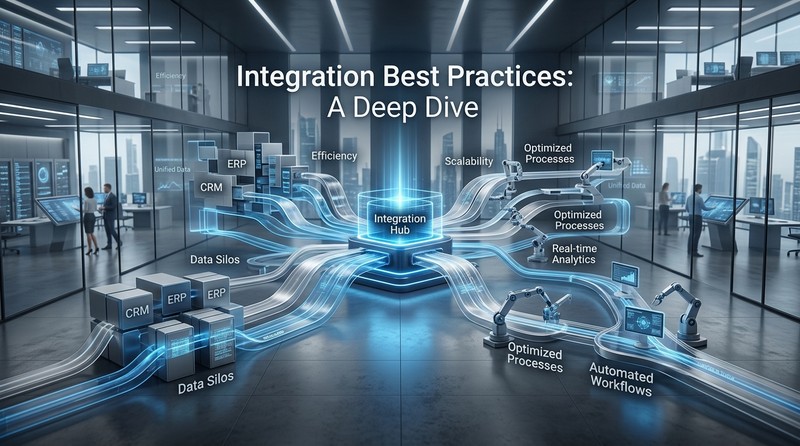
These trends necessitate a shift away from traditional point-to-point integrations towards more flexible, scalable, and intelligent integration architectures.
Deep Dive: Core Concepts - Frameworks and analysis
To tackle complex integration challenges, we need to understand the underlying principles and frameworks. Here are some key concepts:
* API-First Approach: Designing APIs before implementing any integration logic is crucial. This ensures consistency, reusability, and discoverability. Tools like OpenAPI Specification (Swagger) and GraphQL are essential for defining and documenting APIs.
* Data Transformation and Mapping: Transforming data from one format to another is a common integration task. Tools like Apache Camel, MuleSoft Anypoint Platform, and cloud-native data integration services provide powerful data transformation capabilities. Understanding data mapping techniques (e.g., XSLT, JSONata) is critical.
* Messaging Patterns: Understanding messaging patterns like publish-subscribe, request-reply, and message queues is essential for building resilient and scalable integrations. Apache Kafka and RabbitMQ are popular messaging brokers.
* Idempotency: Ensuring that operations can be safely retried without causing unintended side effects is crucial for building reliable integrations. Implement idempotency keys and other techniques to handle failures gracefully.
* Circuit Breaker Pattern: Protecting against cascading failures by preventing requests from reaching failing services. Implement circuit breakers to improve the resilience of your integrations.
* Observability: Monitoring and logging are essential for identifying and resolving integration issues. Use tools like Prometheus, Grafana, and Elasticsearch to monitor your integrations and gain insights into their performance.
* Integration Patterns: Familiarize yourself with common integration patterns such as:
* Data Synchronization: Keeping data consistent across multiple systems.
* Remote Procedure Invocation: Calling a function or method on a remote system.
* Message Queuing: Decoupling systems by exchanging messages through a queue.
* Event-Driven Integration: Triggering actions based on events occurring in other systems.
Comparison and Trade-offs - Tables with pros/cons
Choosing the right integration approach depends on the specific requirements of your project. Here's a comparison of different integration styles:
Table 1: Integration Styles
| Style | Description | Pros | Cons | Use Cases |
|---------------------|-------------------------------------------------------------------------------------------------------------------------------------------|-------------------------------------------------------------------------------------------------------------------------------------------------------------------|-------------------------------------------------------------------------------------------------------------------------------------------------------------------|--------------------------------------------------------------------------------------------------------------------------------------------------------------------------------------------------------|
| Point-to-Point | Direct connection between two systems. | Simple to implement for small integrations. | Difficult to maintain and scale. Tight coupling between systems. | Simple data synchronization between two systems. |
| Enterprise Service Bus (ESB) | Centralized hub for routing and transforming messages. | Provides centralized management and control. Supports complex transformations. | Can become a bottleneck. Complex to configure and maintain. Often requires specialized skills. | Complex integrations involving multiple systems and complex data transformations. |
| Microservices & API Gateway | Exposes microservices through a central API gateway. | Decoupled architecture. Scalable and resilient. Supports multiple protocols. | Requires more infrastructure and management overhead. Increased complexity in terms of deployment and monitoring. | Modern, cloud-native applications. Integration with external APIs. |
| Event-Driven Architecture (EDA) | Systems communicate through events. | Highly scalable and resilient. Decoupled architecture. Supports real-time data processing. | Requires careful design to ensure event consistency. Can be challenging to debug. | Real-time data processing, IoT applications, and asynchronous communication between systems. |
Table 2: Integration Technologies
| Technology | Description | Pros | Cons |
|-------------------|---------------------------------------------------------------------------------------------------------------------------------------------------------------------------|-----------------------------------------------------------------------------------------------------------------------------------------------------------------------------------------------------------------------------------------------------------------------------------------------------------------------------------|------------------------------------------------------------------------------------------------------------------------------------------------------------------------------------------------------------------------------------------------------------------------|
| Apache Kafka | Distributed streaming platform for building real-time data pipelines and streaming applications. | Highly scalable and fault-tolerant. Supports high throughput. Provides durable message storage. Large community and extensive documentation. | Can be complex to configure and manage. Requires specialized skills. Not ideal for small-scale integrations. |
| Apache Camel | Powerful integration framework that supports a wide range of protocols and data formats. | Flexible and extensible. Supports a wide range of integration patterns. Provides a rich set of components. | Can be complex to learn and use. Requires strong Java skills. |
| MuleSoft Anypoint Platform | Comprehensive integration platform that provides a wide range of features, including API management, data integration, and process automation. | Easy to use and configure. Provides a visual development environment. Supports a wide range of connectors. | Can be expensive. Vendor lock-in. |
| AWS Lambda | Serverless compute service that allows you to run code without provisioning or managing servers. | Cost-effective and scalable. Easy to deploy and manage. Integrates well with other AWS services. | Limited execution time. Cold starts can impact performance. Debugging can be challenging. |
Implementation Framework - Step-by-step guide
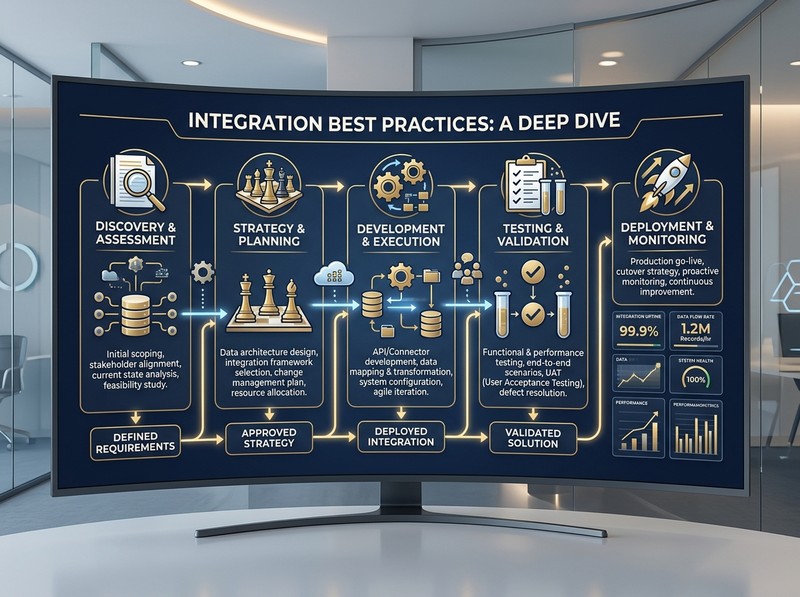
Here's a practical step-by-step guide for implementing a successful integration:
1. Define Integration Requirements: Clearly define the goals of the integration, the data that needs to be exchanged, and the performance requirements.
2. Choose an Integration Style: Select the integration style that best fits your requirements (e.g., microservices with an API gateway, event-driven architecture).
3. Design APIs: Design APIs that are consistent, reusable, and discoverable. Use OpenAPI Specification (Swagger) to define your APIs.
4. Implement Data Transformation: Implement data transformation logic to map data from one format to another. Use tools like Apache Camel or cloud-native data integration services.
5. Implement Messaging: Implement messaging patterns to decouple systems and ensure reliable communication. Use Apache Kafka or RabbitMQ.
6. Implement Security: Implement security measures to protect your integrations from unauthorized access. Use authentication, authorization, and encryption.
7. Implement Monitoring and Logging: Implement monitoring and logging to identify and resolve integration issues. Use tools like Prometheus, Grafana, and Elasticsearch.
8. Test Thoroughly: Test your integrations thoroughly to ensure they meet your requirements. Use automated testing tools and integration tests.
9. Deploy and Monitor: Deploy your integrations to production and monitor their performance. Use dashboards and alerts to identify and resolve issues.
10. Iterate and Improve: Continuously iterate and improve your integrations based on feedback and monitoring data.

Decision Guide - How to choose
Choosing the right integration approach depends on several factors:
* Complexity: For simple integrations, a point-to-point approach may be sufficient. For complex integrations, an ESB or microservices architecture may be more appropriate.
* Scalability: For applications that need to scale, an event-driven architecture or microservices architecture is recommended.
* Real-time Requirements: For real-time data processing, an event-driven architecture is the best choice.
* Budget: ESB solutions can be expensive. Serverless integration and open-source frameworks like Apache Camel can be more cost-effective.
* Skills: Choose technologies that your team is familiar with. If your team has strong Java skills, Apache Camel may be a good choice.
Here's a decision framework:
Table 3: Decision Framework
| Question | Option 1 | Option 2 | Option 3 |
|------------------------------------------------|---------------------------------------------------------------------------------------------------------------------------------------------------------------------------------------------------------------------------------------|----------------------------------------------------------------------------------------------------------------------------------------------------------------------------------------------------------------------------------------|-----------------------------------------------------------------------------------------------------------------------------------------------------------------------------------------------------------------------------------------------------------------------------------|
| Integration Complexity | Simple (2-3 systems, basic data mapping) | Moderate (Multiple systems, complex data transformations) | Complex (Many systems, real-time requirements, high scalability) |
| Recommended Approach | Point-to-Point or Lightweight API Gateway | Microservices with API Gateway or Integration Platform (e.g., MuleSoft) | Event-Driven Architecture (Kafka, Pulsar) with Microservices |
| Scalability Requirements | Low (Minimal scaling needed) | Medium (Moderate scaling requirements) | High (Must scale to handle large volumes of data and traffic) |
| Real-Time Data Processing Needs? | No | Yes, but latency requirements are not critical | Yes, and latency is critical |
| Team Skillset | Limited integration experience, familiarity with scripting languages (e.g., Python) | Good understanding of APIs and microservices, experience with Java or other object-oriented languages | Deep expertise in distributed systems, messaging platforms, and cloud-native technologies |
| Budget Constraints | Tight budget, prefer open-source solutions | Moderate budget, willing to invest in a commercial platform for ease of use | Flexible budget, prioritize scalability and performance over cost |
Case Study or Real Example
Let's return to our HealthSync and FitTrack scenario. Given the disparate architectures and the need for real-time data integration, an Event-Driven Architecture (EDA) combined with a microservices approach is likely the best solution.
1. FitTrack API Gateway: Wrap the FitTrack monolith with an API gateway to expose its functionality as a set of REST APIs.
2. Event Producer: When FitTrack users update their activity or sleep data, the API gateway publishes events to a Kafka topic.
3. Data Transformation Service: A microservice consumes these Kafka events and transforms the FitTrack data into a format compatible with HealthSync's data model.
4. HealthSync Microservices: Other HealthSync microservices subscribe to these Kafka events and use the transformed data to provide personalized health recommendations.
This approach decouples the two systems, allows for real-time data processing, and enables HealthSync to scale its services independently. We would choose Kafka for its high throughput and fault tolerance, and implement idempotency to handle potential message duplication. API Gateway will handle authorization and authentication.
30-Day Action Checklist
Here's a 30-day action checklist to kickstart your integration project:
Week 1: Planning and Discovery
* [ ] Day 1-3: Define integration scope and objectives. Identify key stakeholders.
* [ ] Day 4-7: Document existing systems (HealthSync and FitTrack). Map data models. Identify APIs.
Week 2: Architecture and Design
* [ ] Day 8-10: Choose integration style (EDA with Microservices). Select technologies (Kafka, API Gateway, Data Transformation Service).
* [ ] Day 11-14: Design APIs using OpenAPI Specification. Define data transformation rules.
Week 3: Implementation and Testing
* [ ] Day 15-21: Implement event producers and consumers. Implement data transformation logic. Implement security measures.
* [ ] Day 22-24: Develop unit tests and integration tests.
Week 4: Deployment and Monitoring
* [ ] Day 25-27: Deploy integration components to a staging environment.
* [ ] Day 28-30: Monitor performance and identify issues. Deploy to production. Establish monitoring and alerting.
Bottom Line - Key takeaways
Successful integration in 2026 requires a deep understanding of architectural patterns, technologies, and best practices. Don't rely on outdated approaches. Embrace API-first design, event-driven architectures, and AI-powered integration platforms. Focus on decoupling systems, ensuring data consistency, and implementing robust security measures. Remember that integration is an ongoing process that requires continuous monitoring, iteration, and improvement. By following these guidelines, you can build integrations that are scalable, resilient, and valuable to your business.
Work With Versalence - CTA paragraph
Navigating the complexities of modern integration requires expertise and a deep understanding of emerging technologies. At Versalence, we specialize in building robust and scalable integration solutions that empower your business to thrive. Our team of experienced engineers and architects can help you design, implement, and manage your integration projects, ensuring seamless data flow and optimal performance. From event-driven architectures to AI-powered integration platforms, we leverage the latest technologies to deliver innovative solutions that meet your unique needs. Let Versalence be your trusted partner in achieving your integration goals. Contact us today to learn more. 📧 versalence.ai/contact.html | sales@versalence.ai