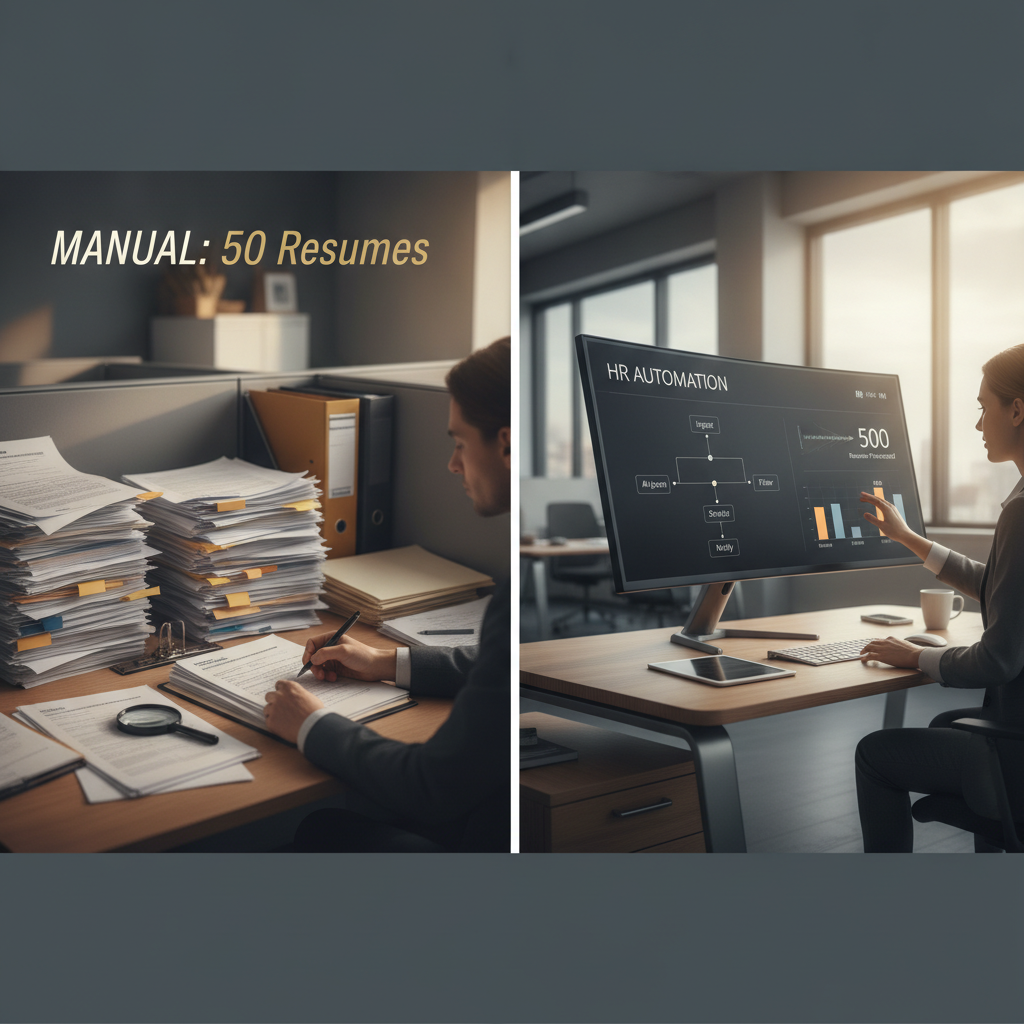
HR Automation: Screen 500 Resumes in the Time it Takes to Review 50
It’s a familiar story for any growing business. You post a new job opening—a software engineer, a marketing manager, a sales executive—and the applications flood in. First ten, then fifty, then two hundred. Before you know it, you’re staring at a digital mountain of 500 resumes, each one representing a potential future for your company. The problem? Your talent acquisition team, dedicated and hardworking as they are, is only human.
The average corporate job posting attracts 250 applications, and for popular roles at desirable companies, that number can easily double or triple. Manually sifting through this volume is a monumental task. It involves hours of opening PDFs, scanning for keywords, cross-referencing experience, and trying to read between the lines—all while the pressure to fill the role mounts.
By the time a recruiter has meticulously reviewed the first 50 candidates, their focus wanes. By resume #150, fatigue sets in. What if your perfect hire, the game-changing team member you’ve been looking for, is buried at #347? In the traditional model, their resume might never get the attention it deserves. This isn't just inefficient; it's a strategic liability. You're losing time, money, and potentially, your next great employee.
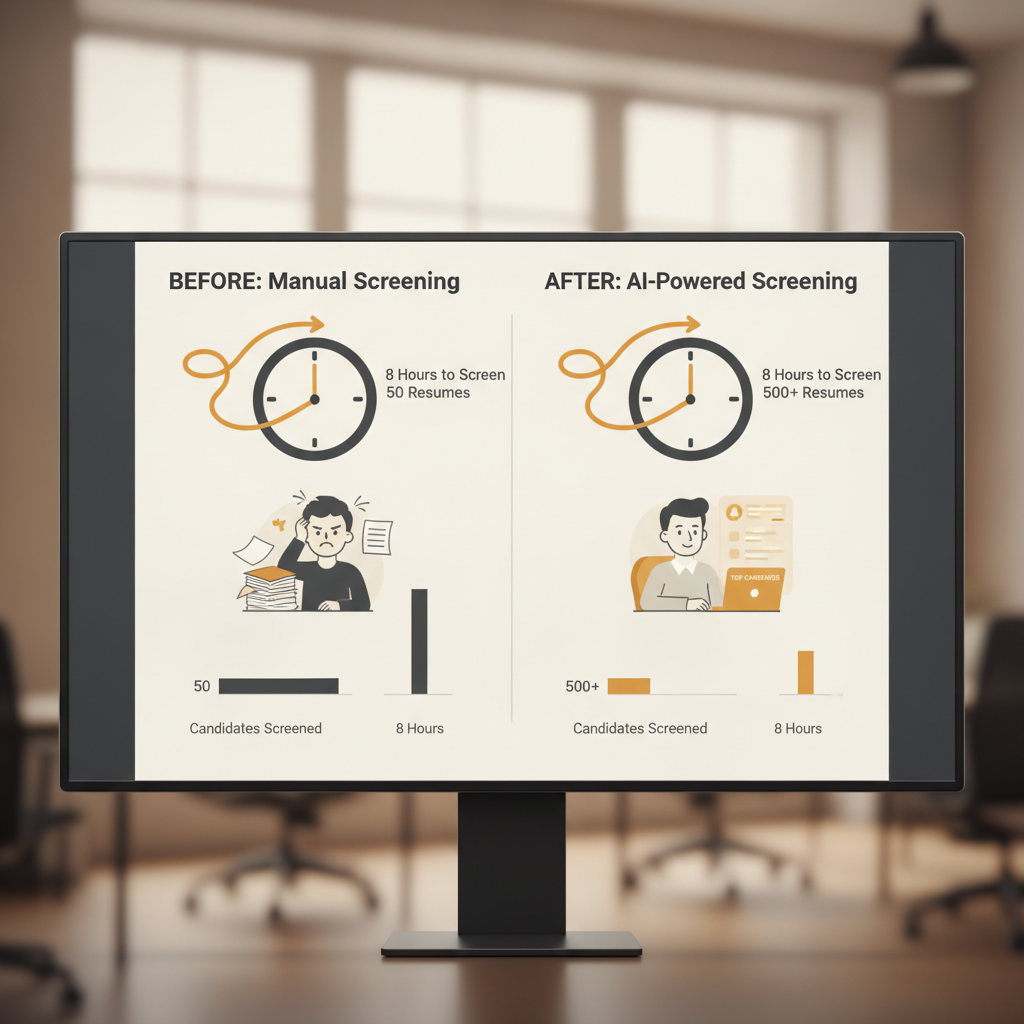
At Versalence AI, we believe this is a problem that shouldn't exist in the modern enterprise. It’s a challenge perfectly suited for intelligent automation. By leveraging the power of AI, we can transform this bottleneck into a streamlined, efficient, and equitable process, allowing your team to screen 500 candidates with the same effort and time it once took to review just 50.
The Crippling Business Impact of an Outdated Hiring Funnel
The consequences of a slow, manual screening process ripple throughout an organization, impacting everything from your bottom line to your company culture. It’s far more than just a headache for your HR department; it's a competitive disadvantage.
1. Sky-High Time-to-Fill and Productivity Loss
Every day a critical role remains vacant, your company feels the impact. Projects stall, existing team members become overworked trying to cover the gap, and business opportunities are missed. The "time-to-fill" metric isn't just HR jargon; it's a direct measure of operational drag. A manual screening process that takes weeks to produce a shortlist is the primary driver of a long time-to-fill. This delay means you’re not just losing potential candidates to faster-moving competitors; you're actively losing productivity and revenue.
2. A Damaged Employer Brand and Poor Candidate Experience
Top talent has options. The best candidates are often evaluating multiple opportunities simultaneously. When they submit an application and are met with silence for weeks, they draw a simple conclusion: the company is disorganized, inefficient, or simply doesn't value their time. This "application black hole" is a significant blow to your employer brand. Even if you eventually reach out, their initial enthusiasm may have soured, or worse, they've already accepted another offer. In contrast, a swift, communicative process, even if it leads to a rejection, leaves a positive impression and encourages future applications.
3. The Risk of Recruiter Burnout
Talent acquisition professionals are strategic partners in a company's growth. Their expertise lies in identifying talent, building relationships, and assessing cultural fit. Yet, they often spend up to 40% of their work week on administrative and repetitive tasks like manual resume screening. This isn't just a poor use of their skills; it's a direct path to burnout. When your most valuable HR assets are bogged down in low-value work, their morale drops, their strategic impact diminishes, and employee turnover within the HR department itself becomes a real risk.
4. The Pervasive Threat of Unconscious Bias
Humans are inherently biased, and even the most well-intentioned recruiter can be swayed by unconscious factors. Studies have shown that factors like a candidate's name, the university they attended, or even their personal interests can subtly influence a screener's decision. When you're reviewing hundreds of resumes under pressure, these mental shortcuts become more prevalent. This can lead to a less diverse talent pool advancing to the interview stage, ultimately hindering innovation and creating a homogenous work environment.

The Versalence Solution: An Intelligent, Automated Screening Workflow
To solve this complex problem, you need more than a simple keyword scanner. You need an intelligent system that understands context, adapts to your specific needs, and integrates seamlessly into your existing workflow. At Versalence, we build these systems on the powerful and extensible Botpress platform, supercharged with the contextual understanding of advanced Large Language Models (LLMs).
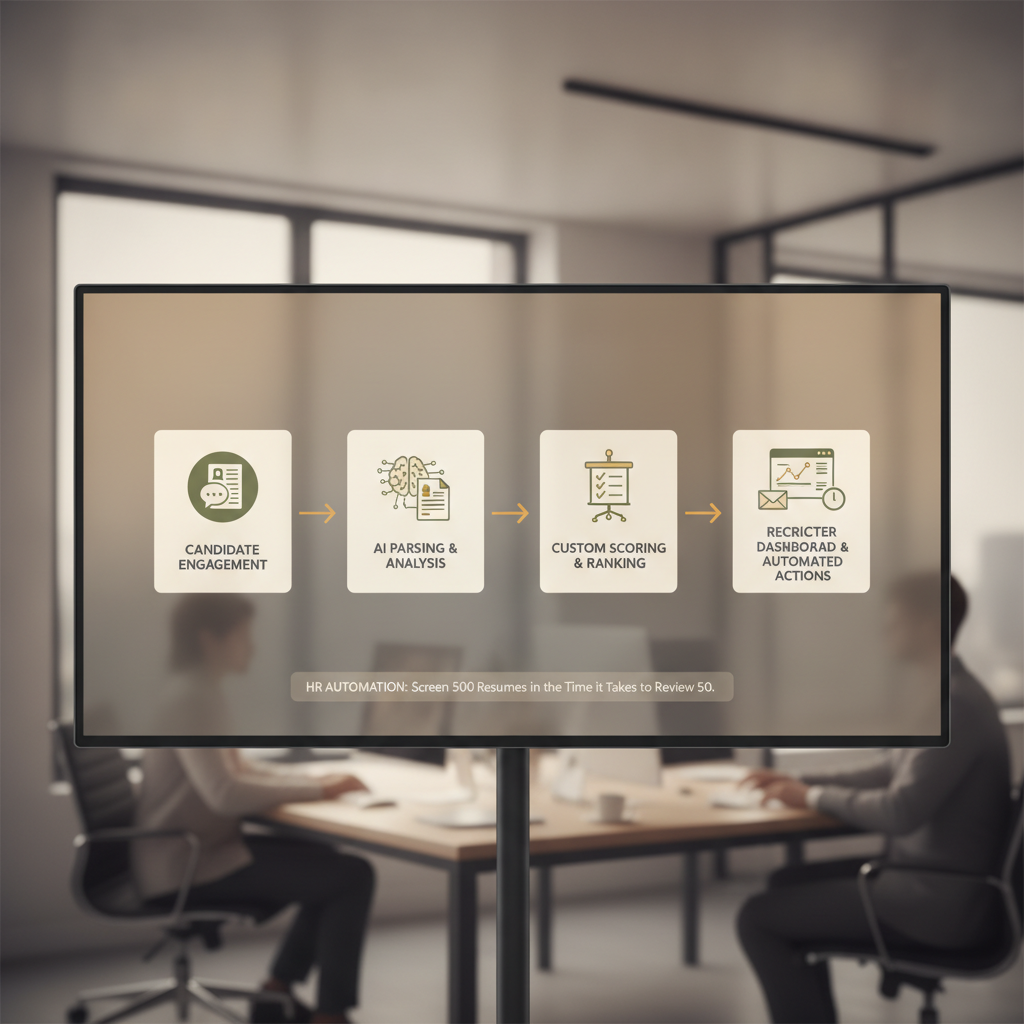
Our approach turns the entire initial screening process into an automated, data-driven workflow. Here’s how it works:
Step 1: The AI-Powered Screener Assistant
The candidate journey begins not with a sterile "Upload Your Resume" button, but with a conversation. We deploy an AI-powered assistant directly on your careers page, which can also be integrated with platforms like LinkedIn or WhatsApp. This assistant acts as the first point of contact.
- Engaging Introduction: It greets the candidate and confirms the role they’re applying for.
- Knock-Out Questions: It immediately asks critical, non-negotiable questions defined by you. "Are you legally authorized to work in the United States?" "This role requires a PMP certification. Do you currently hold this certification?" "The salary range for this position is $90,000 - $110,000. Does this align with your expectations?" This initial conversation instantly filters out candidates who don't meet the absolute basic requirements, saving everyone time and ensuring the applicant pool is immediately more qualified.
Step 2: Intelligent Resume Parsing and Data Extraction
Once the initial qualifications are met, the candidate is prompted to upload their resume. This is where our solution truly diverges from traditional Applicant Tracking Systems (ATS).
Instead of basic keyword matching, we use a sophisticated LLM to perform contextual parsing. The AI reads and understands the document like a human recruiter would. It extracts and structures key data points, including:
- Work Experience: Companies, titles, and dates.
- Core Skills: Differentiating between programming languages, software proficiency, and soft skills.
- Education & Certifications: Degrees, institutions, and relevant credentials.
- Quantitative Achievements: It can identify and extract metrics like "increased sales by 25%" or "managed a team of 10 engineers."

This contextual understanding means the system can tell the difference between "Java" listed under a "Skills" section and "worked on a project that interfaced with a legacy Java system."
Step 3: Customizable, Role-Specific Scoring and Ranking
With the structured data in hand, the system evaluates each candidate against the ideal profile for the role. This isn't a one-size-fits-all algorithm. We work with your HR team to define and weigh the criteria that matter most.
- Must-Haves vs. Nice-to-Haves: You can assign a higher weight to "5+ years of experience in SaaS sales" and a lower weight to "experience with Salesforce."
- Skill Proficiency: The system can analyze the context around a skill to estimate proficiency, ranking a candidate who "led a Python-based data science project" higher than one who simply lists "Python" in a long list of skills.
- AI-Generated Summaries: For each candidate, the AI generates a concise summary highlighting how their profile matches the job description, along with any potential red flags.
The result is a quantitative "Match Score" for every single applicant, from 1 to 100.
Step 4: A Unified Recruiter Dashboard and Automated Workflows
The true power of the system is realized in the recruiter's experience. Instead of an inbox overflowing with 500 PDFs, they log into a clean, intuitive dashboard.
- Ranked Candidate List: Candidates are automatically sorted by their Match Score, allowing recruiters to immediately focus on the top 10-20% of applicants.
- At-a-Glance Insights: Recruiters can see the score, the AI-generated summary, and key qualifications without ever opening the original resume (though it's always just a click away).
- Intelligent Automation: This is where we reclaim your team's time. Workflows can be configured based on the score:
- Top Tier (Score > 85): Automatically send a personalized email inviting the candidate to schedule a first-round interview via an integrated Calendly link.
- Mid Tier (Score 65-84): Flag these candidates for a quick manual review. They might be a great fit for a different role or have unique experience worth exploring.
- Not a Fit (Score < 65): Automatically send a polite, respectful rejection email. This simple step vastly improves the candidate experience and protects your employer brand.
This entire architecture is made possible by leveraging the tools within the versalenceai/botpress ecosystem. The Botpress platform provides the conversational AI foundation, while its open SDK and integration capabilities allow us to build custom actions and connect to any third-party system, from your existing ATS (like Greenhouse or Lever) to internal communication tools like Slack.

Beyond Screening: A Platform for Total HR Automation
The intelligent screening assistant is just the beginning. The same foundational technology we use to revolutionize your hiring funnel can be applied across the entire employee lifecycle. Because we build on a flexible platform like Botpress, we can rapidly develop and deploy a suite of related solutions that create a cohesive, automated HR ecosystem.
- Automated Interview Scheduling: An AI assistant can handle the complex, back-and-forth process of coordinating interview times between candidates and multiple internal stakeholders, finding a slot that works for everyone in seconds.
- AI-Powered Employee Onboarding: Guide new hires through their first days with a dedicated onboarding bot. It can answer questions about benefits, help with IT setup, introduce them to key team members, and ensure all necessary paperwork is completed on time.
- Internal HR Helpdesk: Free up your HR team from answering the same questions over and over. An internal chatbot can provide instant, 24/7 answers to employee queries about PTO policies, expense reports, benefits enrollment, and company holidays.
By viewing HR automation as a holistic strategy rather than a point solution, you create compounding returns on your investment, freeing up your team to focus on the most human elements of their work: culture, strategy, and employee development.
The Tangible Results and ROI of Intelligent Automation
Implementing an AI-driven screening process isn't just about modernizing your tech stack; it's about delivering measurable business outcomes that impact your efficiency, profitability, and growth.
- Reduce Screening Time by up to 90%: The most immediate impact. Tasks that once took an entire day can now be completed in under an hour. Your team can move from screening to interviewing top candidates in a fraction of the time, dramatically shortening the time-to-fill.
- Increase Quality of Hire: By systematically evaluating every single candidate against objective, predefined criteria, you ensure that no hidden gems are overlooked. Recruiters spend their valuable time engaging with a highly qualified shortlist, leading to more productive interviews and better hiring decisions.
- Boost Recruiter Capacity by 2x-3x: When you automate the most time-consuming part of their job, your recruiters can handle more open requisitions simultaneously without a drop in quality. Alternatively, they can reallocate that newfound time to more strategic activities, such as proactive sourcing of passive candidates and building long-term talent pipelines.
- Mitigate Bias and Improve Diversity: AI applies the exact same logic to every resume, regardless of name, background, or other demographic information. This significantly reduces the impact of unconscious human bias at the top of the funnel, leading to a more diverse and representative group of candidates advancing to the interview stages.
- Enhance Candidate Experience: Every candidate receives a prompt, professional interaction. They know their application has been received and reviewed, and they get closure much faster. This respect for their time builds goodwill and strengthens your reputation as an employer of choice.

Stop Drowning in Resumes and Start Discovering Talent
The traditional approach to high-volume recruiting is broken. It's slow, costly, biased, and drains the energy of your most valuable HR professionals. Continuing down this path means accepting that you will miss out on great talent and fall behind more agile competitors.
With Versalence AI, you can fundamentally change the equation. You can empower your team with a system that is ten times more efficient, allowing them to shift their focus from the tedious work of sifting to the strategic work of hiring. Imagine a world where your recruiters are excited, not overwhelmed, when they see hundreds of new applications. Imagine filling your open roles faster, with better candidates, all while building a stronger employer brand.
This isn't a futuristic vision; it's what we build today.
Ready to transform your hiring process and reclaim hundreds of hours for your HR team?
Let's schedule a call to discuss your specific challenges and demonstrate how our AI-powered automation can help you screen 500 candidates in the time it used to take to review 50.
Contact us today at sales@versalence.ai or visit versalence.ai to book your personalized demo.
Work With Versalence
Ready to remove the drag from your business operations? Our AI automation and system integration team delivers measurable results in 30-120 days.
📧 Contact us
✉️ sales@versalence.ai