
Ai Industry Acquisitions: A Deep Dive for Wednesday
Introduction - Hook with real problem
Imagine you're the CTO of "InnovateTech," a mid-sized SaaS company specializing in personalized learning experiences. You've built a successful platform, but maintaining your competitive edge against AI-powered giants like Google and Microsoft requires constant innovation. You identify a promising AI startup, "LearnAI," with a revolutionary natural language processing (NLP) engine that could dramatically improve your platform's tutorbot capabilities. The problem? The AI acquisition landscape in 2026 is a minefield. Overhyped valuations, integration nightmares, and talent exodus post-acquisition are common pitfalls. Simply throwing money at LearnAI isn't a strategy; it's a gamble. This blog post dives deep into what actually works in AI industry acquisitions in 2026, providing a framework for navigating this complex terrain and maximizing your chances of success.
The Current Landscape - What's happening in 2026
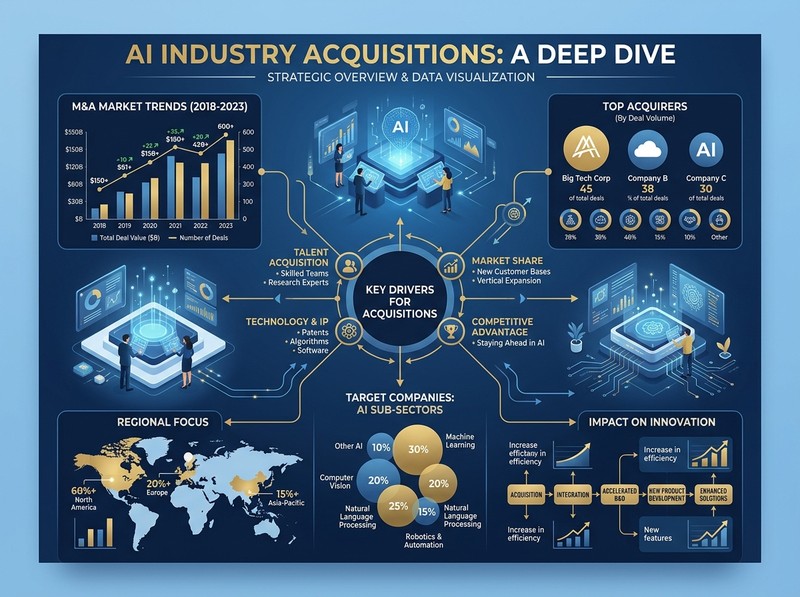
The AI acquisition landscape in 2026 is characterized by several key trends:
* Maturity and Specialization: The "AI-first" hype has cooled. Instead, companies are seeking specialized AI solutions that directly address specific business problems. General-purpose AI platforms are less attractive than niche applications in areas like cybersecurity, drug discovery, or autonomous logistics.
* Focus on Data Quality and Governance: The value of AI is increasingly tied to the quality and governance of the data it's trained on. Acquisitions now heavily scrutinize the target's data practices, including lineage, privacy compliance, and bias mitigation.
* Talent Wars Intensify: Acquiring AI talent remains a primary driver for many acquisitions, but retaining that talent is even harder. Compensation packages, career progression opportunities, and cultural fit are crucial for preventing post-acquisition attrition.
* Integration Challenges Remain: Integrating AI systems into existing infrastructure is still a major hurdle. Legacy systems, data silos, and lack of interoperability can significantly delay and derail the integration process.
* Valuation Realities: While AI valuations remain high, there's been a correction from the peak of the hype cycle. Investors are demanding more demonstrable ROI and tangible business outcomes.
Deep Dive: Core Concepts - Frameworks and analysis
A successful AI acquisition in 2026 requires a multi-faceted approach that goes beyond simply acquiring technology. We need to consider several key frameworks:
* The "Build vs. Buy vs. Partner" Framework: Before considering an acquisition, rigorously evaluate whether building the AI capability in-house, partnering with a startup, or acquiring a company is the best option. Factors to consider include time-to-market, cost, risk, and strategic alignment.
* The "Technology, Talent, and Data" Framework: Evaluate the target company based on these three pillars. Assess the maturity and differentiation of the technology, the quality and retention potential of the talent, and the value and governance of the data assets.
* The "Integration Readiness" Framework: Assess the target's integration readiness by evaluating its technical architecture, data compatibility, and organizational culture. Identify potential integration challenges early on and develop a detailed integration plan.
Analysis: The common mistake is to focus solely on the technology. However, without the right talent to maintain and improve it, and without a clear integration strategy, the acquisition will likely fail. Data quality is a huge factor here. Bad data can render even the best AI useless.
Comparison and Trade-offs - Tables with pros/cons
Table 1: Build vs. Buy vs. Partner
| Option | Pros | Cons | Best Suited For |
|---------------|-------------------------------------------------------------------------|--------------------------------------------------------------------------------------------|--------------------------------------------------------------------------------------------------------------------|
| Build | Full control, custom solution, potentially lower long-term cost. | Longer time-to-market, higher initial investment, requires significant in-house expertise. | Companies with unique requirements, strong AI teams, and sufficient time and resources. |
| Buy | Faster time-to-market, access to proven technology and talent. | Higher initial cost, integration challenges, potential cultural clashes, talent retention risk. | Companies seeking rapid innovation, lacking in-house AI expertise, and willing to manage integration complexities. |
| Partner | Lower risk and cost compared to acquisition, access to external expertise. | Less control, potential conflicts of interest, dependency on the partner's success. | Companies exploring new AI capabilities, seeking to augment existing teams, and willing to share control. |
Table 2: Due Diligence Focus Areas
| Focus Area | Key Questions | Potential Red Flags |
|-----------------|-----------------------------------------------------------------------------------------------------------------------------------------------|---------------------------------------------------------------------------------------------------------------------------|
| Technology | How mature is the technology? What is its competitive advantage? Is it scalable and maintainable? What are the IP protections? | Overhyped claims, lack of independent validation, reliance on outdated technologies, weak IP portfolio. |
| Talent | Who are the key AI engineers and researchers? What are their motivations and career aspirations? What is the company's culture and employee satisfaction? | High employee turnover, lack of clear leadership, poor communication, cultural incompatibility. |
| Data | What data is the AI trained on? How is the data collected and managed? Is the data accurate, complete, and unbiased? Is the data GDPR compliant? | Poor data quality, lack of data governance policies, privacy violations, biased datasets. |
| Integration | How easily can the AI be integrated into existing systems? What are the potential integration challenges? What resources are required for integration? | Incompatible architectures, data silos, lack of API documentation, resistance to change. |
Implementation Framework - Step-by-step guide
1. Define Strategic Objectives: Clearly articulate the business goals the AI acquisition is intended to achieve.
2. Identify Potential Targets: Conduct thorough market research to identify AI startups that align with your strategic objectives.
3. Conduct Due Diligence: Perform comprehensive due diligence, focusing on technology, talent, data, and integration readiness (as outlined in Table 2). Engage technical experts, legal counsel, and financial advisors.
4. Negotiate and Structure the Deal: Negotiate a fair and reasonable price, considering the target's assets, liabilities, and future potential. Structure the deal to incentivize key talent to stay with the company post-acquisition. Consider earn-out clauses tied to specific performance milestones.
5. Develop an Integration Plan: Create a detailed integration plan that addresses technical, organizational, and cultural aspects. Assign clear responsibilities and timelines.
6. Communicate Effectively: Communicate the acquisition to employees, customers, and partners in a transparent and timely manner. Address any concerns or anxieties.
7. Execute the Integration Plan: Implement the integration plan systematically, monitoring progress and addressing any challenges that arise.
8. Retain Key Talent: Implement strategies to retain key AI talent, such as offering competitive compensation, providing career development opportunities, and fostering a positive work environment.
9. Measure and Evaluate: Track key performance indicators (KPIs) to measure the success of the acquisition and identify areas for improvement.

Decision Guide - How to choose
Choosing the right AI acquisition target requires a structured decision-making process. Here's a framework:
1. Scoring Matrix: Create a scoring matrix with weighted criteria based on the "Technology, Talent, and Data" framework. Score each potential target against these criteria.
2. Risk Assessment: Identify potential risks associated with each target, such as integration challenges, talent attrition, and data privacy violations.
3. Financial Modeling: Develop financial models to project the potential return on investment (ROI) of each acquisition. Consider various scenarios and sensitivities.
4. Expert Consultation: Seek advice from independent AI experts, industry analysts, and legal counsel.
5. Gut Check: Trust your intuition and experience. Does the target feel like a good fit for your company's culture and strategic objectives?
Key Questions to ask yourself
* What problem are we solving?
* What is the ROI? (Be realistic)
* How will this integrate with our existing systems?
* Can we retain the key people?
Case Study or Real Example
Consider the hypothetical acquisition of "DataWise," an AI startup specializing in automated data cleaning and preparation, by "AnalyticaCorp," a leading business intelligence (BI) provider. AnalyticaCorp faced increasing pressure from competitors offering AI-powered data insights. They considered building their own data cleaning solution but realized it would take too long and require significant investment. After thorough due diligence, they acquired DataWise for $50 million. The key to their success was:
* Focus on Integration: AnalyticaCorp prioritized integration from day one, assigning a dedicated team to work with DataWise engineers to integrate their technology into the BI platform.
* Talent Retention: They offered DataWise employees generous retention bonuses and opportunities to lead AI initiatives within AnalyticaCorp.
* Data Governance: They implemented strict data governance policies to ensure the quality and compliance of the data cleaned by DataWise's AI.
Within six months, AnalyticaCorp launched a new AI-powered BI platform that significantly improved data quality and reduced reporting time. The acquisition proved to be a strategic success, boosting revenue and market share. The failure mode for many companies is skipping the integration planning and retention incentives.
30-Day Action Checklist
Here's a practical checklist to kickstart your AI acquisition strategy:
* [Day 1-3]: Define strategic objectives and identify key performance indicators (KPIs).
* [Day 4-7]: Conduct market research and identify potential AI acquisition targets.
* [Day 8-14]: Develop a due diligence checklist and assemble a due diligence team.
* [Day 15-21]: Initiate due diligence on the top three target companies.
* [Day 22-25]: Analyze due diligence findings and assess potential risks and opportunities.
* [Day 26-28]: Develop a preliminary integration plan for the most promising target.
* [Day 29-30]: Present findings and recommendations to senior management.
Bottom Line - Key takeaways
AI industry acquisitions in 2026 are complex but can be incredibly valuable if approached strategically. Focus on:
* Strategic Alignment: Ensure the acquisition aligns with your overall business goals.
* Comprehensive Due Diligence: Thoroughly evaluate the target's technology, talent, data, and integration readiness.
* Integration Planning: Develop a detailed integration plan before closing the deal.
* Talent Retention: Implement strategies to retain key AI talent.
* Data Governance: Prioritize data quality and compliance.
By following these principles, you can increase your chances of a successful AI acquisition and unlock significant value for your organization.
Work With Versalence - CTA paragraph
Navigating the complexities of AI acquisitions requires specialized expertise. Versalence is a leading AI consultancy that helps companies identify, evaluate, and integrate AI technologies. We provide comprehensive due diligence, integration planning, and talent management services to ensure your AI acquisition is a success. Let us help you unlock the full potential of AI for your business.
📧 versalence.ai/contact.html | sales@versalence.ai