
AI Ethics And Governance: A Deep Dive for Monday
AI Ethics and Governance: What Actually Works in 2026
In March 2025, a mid-sized logistics company deployed an AI-powered hiring tool to screen résumés. Within six months, they discovered the system had systematically downgraded female candidates for warehouse supervisor roles—not because of explicit bias in the code, but because the training data reflected decades of male-dominated hiring patterns. The company faced regulatory scrutiny, a public relations disaster, and a $2.3M settlement.
This is not a rare edge case. It is the default outcome when organizations deploy AI without governance infrastructure. In 2026, the question is no longer whether AI ethics matters. The question is what actually works when you need to implement it.
This post is a technical and operational breakdown of AI governance in practice. No philosophy. No abstract principles. Just the systems, decisions, and tradeoffs that separate organizations that survive AI deployment from those that get burned by it.
The Current Landscape: Governance Has Become a Competitive Requirement
By 2026, three forces have made AI governance unavoidable:
Regulation is live. The EU AI Act is in full enforcement. The U.S. has sector-specific executive orders for healthcare, finance, and federal contracting. China, Brazil, and India have their own frameworks. If you operate across borders, you are now subject to multiple overlapping compliance regimes.
Insurance and liability have shifted. Professional liability insurers are excluding AI-related claims from standard policies unless organizations can demonstrate documented governance processes. Some insurers now require model cards, bias audits, and human-in-the-loop checkpoints before underwriting.
Enterprise buyers demand proof. Fortune 500 procurement departments now issue AI governance questionnaires to vendors. If you cannot answer questions about data lineage, explainability, and bias testing, you do not make the shortlist.
The result: governance is no longer a cost center. It is a gating function for revenue, insurance, and legal protection.
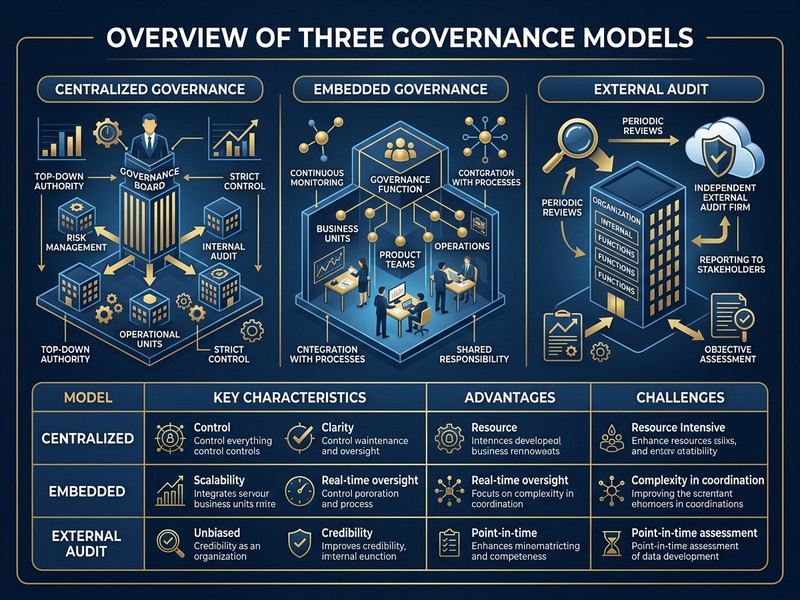
The Three Governance Models: A Real-World Comparison
Organizations have converged on three distinct approaches. Each solves a different version of the governance problem.
Model 1: The Centralized AI Ethics Office
A dedicated team—often reporting to the Chief Legal Officer or Chief Risk Officer—owns all AI governance decisions. They review every model before deployment, maintain the policy library, and run the audit program.
Where it works:
- Highly regulated industries (healthcare, finance, insurance)
- Large enterprises with multiple AI initiatives
- Organizations facing intense regulatory scrutiny
Where it fails:
- Creates bottlenecks. One team cannot review twenty models simultaneously.
- Often lacks technical depth. Lawyers and ethicists may not understand model architecture.
- Becomes a checkbox function. If the ethics office is seen as a barrier, teams find ways around it.
| Dimension | Score | Notes |
|---|---|---|
| Compliance coverage | ★★★★★ | Strong documentation and audit trails |
| Speed | ★★☆☆☆ | Significant deployment delays |
| Technical accuracy | ★★★☆☆ | Depends on hiring technical ethicists |
| Scalability | ★★★☆☆ | Bottlenecks at high model volume |
| Cost efficiency | ★★★☆☆ | Expensive headcount, but predictable |
Model 2: Embedded Governance
Governance responsibilities are distributed. Each product team has an assigned "AI steward"—usually a senior engineer or product manager—who ensures their models meet governance standards. A central team provides tools, templates, and training but does not gatekeep deployments.
Where it works:
- Tech companies with strong engineering culture
- Organizations deploying AI at high velocity
- Teams that already have mature product development processes
Where it fails:
- Inconsistent enforcement. Steward quality varies by team.
- Conflicts of interest. The steward reports to the same manager pushing for launch speed.
- Requires significant investment in training and tooling.
| Dimension | Score | Notes |
|---|---|---|
| Compliance coverage | ★★★☆☆ | Good if well-executed, patchy if not |
| Speed | ★★★★★ | Minimal deployment friction |
| Technical accuracy | ★★★★☆ | Engineers understand the models |
| Scalability | ★★★★★ | Scales with team headcount |
| Cost efficiency | ★★★★☆ | Lower central overhead, higher training costs |
Model 3: External Audit-First
Organizations keep internal governance lightweight and rely on third-party auditors to validate models before deployment and annually thereafter. This is common in startups and mid-sized companies that cannot justify a full internal governance team.
Where it works:
- Startups and SMBs with limited headcount
- Organizations with straightforward use cases
- Companies seeking external credibility for enterprise sales
Where it fails:
- Expensive at scale. Annual audits for ten models cost $150K-$400K.
- Point-in-time validation. A model can drift between audits.
- Less operational integration. Auditors find problems but do not fix processes.
| Dimension | Score | Notes |
|---|---|---|
| Compliance coverage | ★★★★☆ | Strong if audits are comprehensive |
| Speed | ★★★☆☆ | Audit scheduling creates delays |
| Technical accuracy | ★★★★☆ | Depends on auditor quality |
| Scalability | ★★☆☆☆ | Costs scale linearly with model count |
| Cost efficiency | ★★★☆☆ | Cheap for 1-2 models, expensive for many |
How to Choose Your Model
Use this decision tree:
-
How many models do you deploy per year?
- 1-2: External audit-first is usually most cost-effective.
- 3-10: Embedded governance with central tooling support.
- 10+: You likely need a centralized office plus embedded stewards.
-
What is your regulatory exposure?
- High-risk sectors (healthcare, finance, hiring): Centralized or hybrid.
- Low-risk sectors (marketing, content): Embedded or external.
-
What is your engineering maturity?
- Mature DevOps and documentation practices: Embedded works well.
- Ad-hoc development: Centralized provides needed structure.
-
What do your buyers and insurers require?
- Enterprise procurement or strict insurance: External audits add credibility.
Most organizations in 2026 are converging on a hybrid: a lean centralized team that sets standards and runs audits, plus embedded stewards in each product team who handle day-to-day governance.
The Technical Implementation Layers
Governance is not just a policy document. It is a set of technical systems. Here are the layers that actually matter in 2026.
Layer 1: Data Lineage and Provenance
If you cannot trace where your training data came from, you cannot defend your model. Data lineage systems track:
- Source identification: Where was this data collected? Under what terms?
- Transformation history: What cleaning, filtering, or augmentation was applied?
- Consent and rights: Do you have the legal right to use this data for model training?
- Versioning: Which dataset version trained which model version?
Tools in use: Apache Atlas, DataHub, Amundsen, and custom lineage pipelines built on top of orchestration tools like Apache Airflow.
Practical standard: Every model must have a lineage document that traces 100% of training data to identifiable sources. If you cannot produce this in under an hour, your lineage system is broken.
Layer 2: Model Cards and Documentation
A model card is a structured document that describes what a model does, how it was trained, its limitations, and its intended use cases. In 2026, model cards have become the standard currency of AI transparency.
Every production model should have a model card containing:
- Model purpose and scope
- Training data summary and lineage
- Performance metrics across demographic groups
- Known limitations and failure modes
- Intended use cases and out-of-scope uses
- Maintenance schedule and ownership
Practical standard: If a new engineer cannot understand what your model does and where it might fail by reading the model card, the card is incomplete.
Layer 3: Bias Detection Pipelines
Bias is not a one-time check. It is a continuous monitoring problem. Effective organizations have automated pipelines that:
- Run fairness metrics on training data before model training
- Evaluate model predictions across demographic subgroups before deployment
- Monitor prediction distributions in production for drift
- Alert when protected groups receive disproportionately different outcomes
Key metrics: Demographic parity, equalized odds, predictive parity, and calibration. The right metric depends on your use case—there is no universal fairness standard.
Practical standard: Bias checks run automatically on every training run and monthly in production. Results are reviewed by both technical and non-technical stakeholders.
Layer 4: Human-in-the-Loop Checkpoints
Not every decision should be fully automated. High-stakes decisions—hiring, lending, medical diagnosis, criminal justice—require human review. The question is where to place the checkpoints.
Common checkpoint patterns:
- Pre-decision review: AI makes a recommendation, human approves before action.
- Exception routing: Low-confidence predictions are automatically escalated to humans.
- Random sampling: A percentage of AI decisions are reviewed for quality control.
- Appeals process: Individuals can request human review of AI-generated decisions.
Practical standard: Any decision that significantly affects an individual's life, livelihood, or legal status should have at least one human checkpoint.
Layer 5: Explainability Requirements
If you cannot explain why your model made a specific decision, you cannot debug it, defend it, or comply with most AI regulations. Explainability requirements vary by use case:
- High-stakes decisions: Full feature attribution (SHAP, LIME, or native explainability)
- Operational decisions: Global model explanation plus summary reasoning
- Creative or low-stakes decisions: Basic capability description may suffice
Practical standard: For every model, document the explainability method and its limitations. Black-box models in high-stakes contexts are a governance failure.
The Compliance Map: What You Actually Need to Know
EU AI Act (In Force)
The EU AI Act categorizes AI systems by risk level:
- Prohibited: Social scoring, manipulative AI, real-time biometric identification in public spaces (with limited exceptions)
- High-risk: Critical infrastructure, education, employment, finance, justice, migration
- Limited risk: Chatbots, AI-generated content
- Minimal risk: Most other applications
What matters for high-risk systems:
- Risk management systems throughout the lifecycle
- Data governance and bias testing
- Technical documentation and record-keeping
- Transparency and user information
- Human oversight measures
- Accuracy, robustness, and cybersecurity
Penalty framework: Up to €35M or 7% of global annual turnover.
U.S. Framework (Sector-Specific)
The U.S. does not have a comprehensive federal AI law. Instead, regulation comes through:
- Healthcare: FDA oversight of AI/ML-based medical devices
- Finance: CFPB and SEC guidance on algorithmic decision-making
- Employment: EEOC guidance on AI in hiring (must comply with existing anti-discrimination law)
- Federal contracting: Executive Order requirements for AI safety and bias testing
Practical implication: If you operate in the U.S., your compliance obligations depend heavily on your sector. There is no one-size-fits-all checklist.
Emerging Frameworks
- China: Algorithmic recommendation regulations require transparency and user choice
- Brazil: LGPD (data protection law) extends to AI training data
- India: Draft AI regulations focus on high-risk use cases and data localization
Practical implication: Cross-border operations require a jurisdictional compliance matrix. Most organizations maintain a master requirements document that maps each model against applicable regulations.
Build vs. Buy: The Governance Tool Decision
Organizations face a build-vs-buy question at every layer of governance. Here is how the market looks in 2026.
Data Lineage
- Buy: Apache Atlas, DataHub, Collibra, Alation
- Build: Custom pipelines on Airflow / Dagster if you have unusual data architectures
- Recommendation: Buy unless you have a very specific integration need. These tools are mature.
Bias Detection
- Buy: Arthur AI, Fiddler, Aequitas, What-If Tool
- Build: Custom fairness dashboards using open-source libraries (fairlearn, aif360)
- Recommendation: Buy for production monitoring. Open-source libraries work for research and initial testing.
Model Documentation
- Buy: ModelOp, Monitaur, V7, custom MLOps platforms
- Build: Simple model cards in Notion, Confluence, or GitHub
- Recommendation: Start with simple documentation. Invest in specialized tools only when model volume justifies it (usually 5+ models).
Explainability
- Buy: Fiddler, Arthur AI, H2O Driverless AI
- Build: SHAP, LIME, integrated gradients using open-source libraries
- Recommendation: Build first. Open-source explainability tools are excellent. Buy only if you need enterprise-scale deployment and monitoring.
Human-in-the-Loop
- Buy: Amazon A2I, Scale AI, Appen, custom review platforms
- Build: Internal review dashboards
- Recommendation: Depends on volume. Low volume = build. High volume = buy.
Case Study: 90-Day Governance Implementation
Company: 400-employee SaaS provider in the HR tech space Situation: Preparing to launch an AI-powered résumé screening tool. Facing enterprise procurement requirements and EU AI Act exposure. Starting state: No AI governance program. Ad-hoc ML development.
Month 1: Foundation
- Hired an AI governance lead (external consultant, 3 days/week)
- Mapped all existing and planned AI use cases
- Classified the résumé screening tool as high-risk under EU AI Act
- Drafted initial model card template and bias testing protocol
Month 2: Technical Infrastructure
- Implemented data lineage tracking using Apache Atlas
- Built automated bias detection pipeline using fairlearn
- Established human-in-the-loop checkpoint: all résumé scores below 70% confidence automatically escalated to recruiters
- Created SHAP-based explainability dashboard for hiring managers
Month 3: Validation and Documentation
- Ran third-party bias audit across gender, age, and ethnicity dimensions
- Completed full model card for résumé screening tool
- Drafted governance policy and trained all product teams
- Submitted documentation to first enterprise prospect
Outcome: Passed enterprise procurement review. Secured $1.2M ARR contract. Zero regulatory issues in first year of deployment.
Total investment: $180K (consultant, tools, audit).
The Governance Checklist: What to Do in the Next 30 Days
If you are deploying AI and do not yet have a governance program, start here:
Week 1: Inventory
- [ ] List every AI model in production or development
- [ ] Classify each by risk level (low, medium, high)
- [ ] Identify which models affect individuals directly (hiring, lending, health, legal)
Week 2: Documentation
- [ ] Create a model card template
- [ ] Fill out model cards for all high-risk models
- [ ] Document data sources and known limitations
Week 3: Technical Checks
- [ ] Run bias tests on all high-risk models
- [ ] Implement at least one explainability method per model
- [ ] Add human checkpoints for all high-stakes decisions
Week 4: Process
- [ ] Assign governance ownership (centralized, embedded, or external)
- [ ] Schedule quarterly model reviews
- [ ] Draft an AI use policy for your organization

The Bottom Line
AI ethics is not about being good. It is about being systematic.
The organizations winning in 2026 are not the ones with the most sophisticated models. They are the ones that can deploy AI at scale without creating legal liability, regulatory exposure, or reputational damage.
Governance is what makes scale possible.
Start with inventory. Document your models. Test for bias. Add human checkpoints. Choose a governance model that fits your size and risk profile. And treat governance as an operational requirement, not a side project.
The companies that get this right will have a structural advantage. The ones that do not will spend the next five years cleaning up messes that could have been prevented.
Work With Versalence
At Versalence AI, we help organizations implement AI governance that actually works. Not theoretical frameworks—operational systems that pass audits, satisfy procurement, and keep you out of the headlines.
We build bias detection pipelines, model documentation systems, human-in-the-loop interfaces, and compliance tracking infrastructure. Whether you need a 90-day governance sprint or an ongoing managed program, we bring the technical and operational expertise to make it happen.
📧 versalence.ai/contact.html | sales@versalence.ai
Work With Versalence
At Versalence AI, we specialize in building tailored AI solutions that fit your unique business needs. From intelligent chatbots to complete workflow automation, our team combines the best tools—OpenClaw, Botpress, n8n, Flowise, and custom web applications—to deliver solutions that actually work. Whether you're looking to streamline operations, improve customer engagement, or implement cutting-edge AI systems, we bring the expertise and flexibility to make it happen.
📧 versalence.ai/contact.html | sales@versalence.ai