Apple Chose Google Over OpenAI: What Siri's Gemini-Powered Future Reveals About AI's Real Winners
Apple's revamped Siri -- launching March 2026 -- runs on Google's Gemini, not OpenAI's models. For a deal worth $1-5 billion annually, Apple handed Google the keys to 2+ billion devices. The message is unmistakable: even Apple, with all its resources and talent, couldn't build competitive AI fast enough and had to partner with its biggest rival.
The announcement landed like a thunderbolt. After years of struggling to keep pace in the AI race, Apple revealed that its most significant software transformation in a decade would be powered not by its own Apple Intelligence, not by the market-leading OpenAI, but by Google -- its arch-rival in mobile operating systems, app stores, and cloud services.
For OpenAI, this was a devastating loss. The company that had defined the generative AI era, that had turned ChatGPT into a household name, that had achieved a $730 billion valuation, had been passed over by one of the most important distribution partners in tech. Analysts immediately called it a "critical blow to valuation" and a strategic setback that would ripple through OpenAI's enterprise and consumer ambitions.
For Google, the victory was comprehensive. The deal brings $1-5 billion in annual revenue, immediate validation that pushed Google's market cap above $4 trillion in January 2026, and -- most crucially -- positions Gemini as the default AI for over 2 billion Apple devices worldwide. In one stroke, Google went from AI also-ran to the infrastructure layer of the most valuable ecosystem in consumer technology.
Why Apple Chose Google
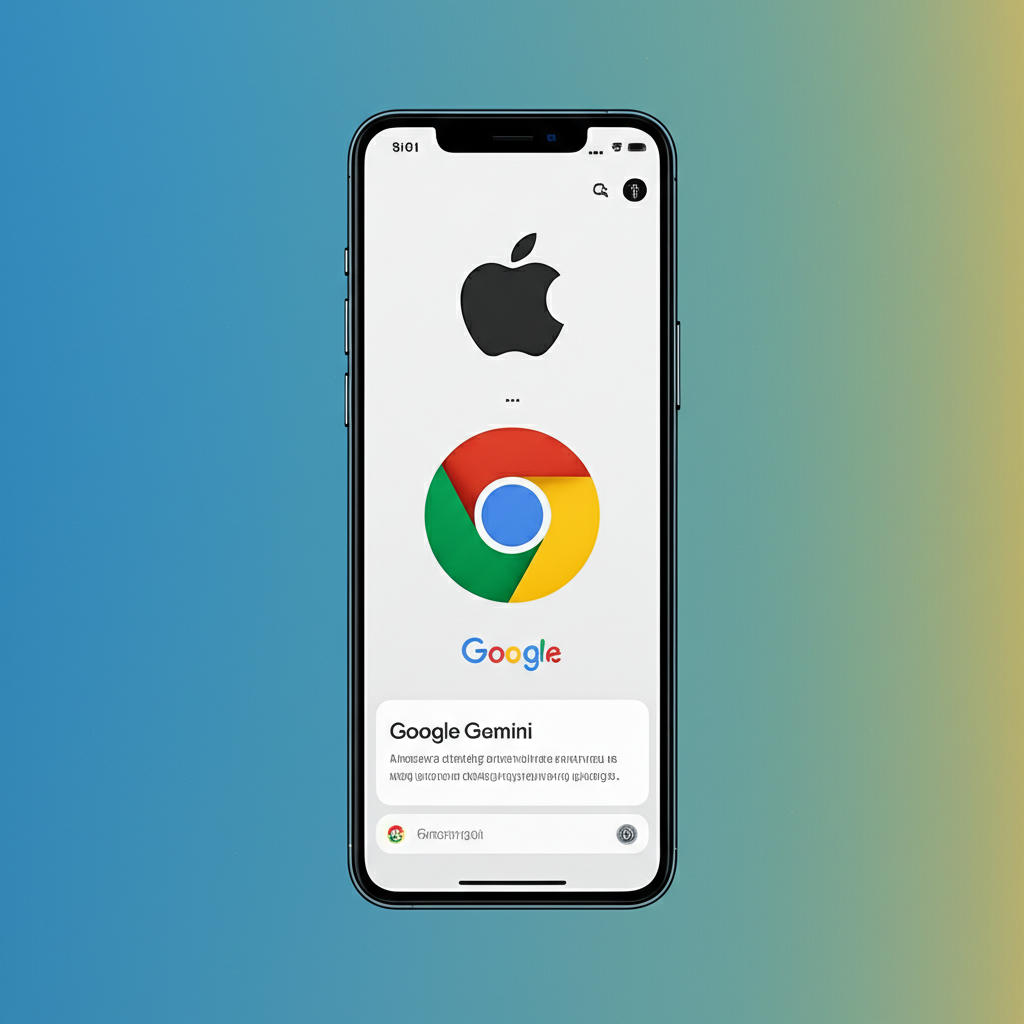
Apple's decision wasn't made lightly. The company had spent years and billions of dollars developing Apple Intelligence, its homegrown AI initiative. Tim Cook had called AI "the most profound technology of our time." The company had hired top researchers, acquired AI startups, and built specialized neural engine hardware into every iPhone, iPad, and Mac.
Yet by late 2025, the reality was undeniable. Apple Intelligence wasn't competitive. While ChatGPT, Claude, and Gemini were handling complex reasoning, multi-turn conversations, and creative tasks, Apple's AI struggled with basic queries. The gap wasn't closing -- it was widening.
The iOS 26.4 beta, released to developers in February 2026, told the story. Apple Intelligence-powered features were glitchy, slow, and prone to hallucinations. The promised Siri transformation -- contextual understanding, proactive assistance, natural conversation -- simply wasn't materializing. Internal deadlines were missed. Morale was reportedly low on the AI teams.
Apple faced a choice: ship a subpar product that would damage its reputation for quality, or partner with a company that had already solved the problems Apple couldn't. Apple chose pragmatism over pride.
The specific choice of Google over OpenAI surprised many observers. OpenAI had the brand recognition, the developer ecosystem, the technical leadership. But Google offered something OpenAI couldn't: scale, infrastructure, and -- critically -- a willingness to structure the deal Apple's way.
Google's Gemini, particularly the 1.2 trillion parameter model that powers the new Siri, was capable enough to meet Apple's quality bar. Google's cloud infrastructure could handle the massive inference load from billions of devices. And Google was willing to accept a non-exclusive arrangement that would let Apple eventually transition to its own AI if and when Apple Intelligence caught up.
The Technical Architecture: A Hybrid Approach
The new Siri isn't simply a Gemini wrapper. Apple engineered a sophisticated hybrid architecture that attempts to preserve its privacy promises while leveraging Google's AI capabilities.
On-device processing remains Apple's domain. Simple queries -- setting timers, checking weather, sending messages -- are handled locally by Apple Intelligence, just as before. The device knows your calendar, your contacts, your habits. This data never leaves Apple's secure enclave.
Complex queries -- the ones requiring reasoning, creativity, or access to broad knowledge -- are routed to Gemini through Apple's Private Cloud Compute infrastructure. The queries are anonymized, encrypted, and processed in Apple's secure cloud environment before being sent to Google's servers. Responses come back through the same path, maintaining the privacy-protecting architecture Apple has championed.
The result is a Siri that finally feels intelligent. It understands context across multiple turns. It can write and revise text. It answers complex questions with accurate, up-to-date information. It can even generate images through integration with Google's image models.
For users, the experience is transformative. For privacy advocates, the architecture offers plausible deniability -- your data touches Google's systems, but in a way that makes individual tracking theoretically impossible. For Apple, it's a stopgap solution that buys time to rebuild Apple Intelligence from the ground up.
The Winners and Losers
The Apple-Google deal reshuffles the AI landscape in ways that will take years to fully understand. But the immediate winners and losers are already apparent.
Winner: Google
Google gets validation, distribution, and revenue. For years, Gemini was seen as lagging behind ChatGPT and Claude. Being chosen by Apple -- the most discerning technology company on Earth -- erases that perception overnight. The $1-5 billion annual payment is significant, but the real prize is becoming the default AI for billions of users who might never have tried Gemini otherwise.
Google also gets leverage. Every query that goes through Siri is a query that doesn't go through ChatGPT. Every user who learns to rely on Gemini is a user who might choose Google's services elsewhere. The deal is an existential threat to OpenAI's consumer ambitions.
Loser: OpenAI
OpenAI lost the most important distribution deal in AI. Apple's 2+ billion devices represented the ultimate platform for scaling AI to mainstream users. Without it, OpenAI is dependent on its own marketing, Microsoft's distribution, and developer goodwill. All of those are valuable, but none compare to being baked into every iPhone.
The loss also raises questions about OpenAI's partnership strategy. If Apple chose Google despite OpenAI's clear technical leadership, what does that say about OpenAI's ability to negotiate? About its infrastructure readiness? About its willingness to accommodate partners' needs?
Winner: Apple
Apple gets a competitive AI assistant without the years of development time it would have taken to build one itself. It maintains user trust by keeping the on-device experience under its control. It preserves optionality through the non-exclusive deal structure. And it signals to investors and customers that it's serious about AI, even if it had to buy that seriousness from Google.
The reputational hit of admitting Apple Intelligence wasn't ready is real but temporary. The reputational hit of shipping a bad AI assistant would have been permanent.
Loser: Privacy Purists
For users who valued Apple's total control over their data, the Google partnership is a compromise. No matter how sophisticated the anonymization architecture, queries are still being processed by Google's systems. Apple has traded absolute privacy for competitive functionality.
Whether users will notice or care remains to be seen. Apple's marketing will emphasize the on-device processing and Private Cloud Compute. The Gemini integration will be presented as a seamless enhancement, not a privacy concession. Most users will probably accept the trade-off.
What This Reveals About AI's Real Winners
Beyond the immediate winners and losers, the Apple-Google deal reveals deeper truths about where power is accumulating in the AI era.
Infrastructure Beats Innovation
OpenAI had the best models, the strongest brand, and the most developer mindshare. Google had the infrastructure to serve billions of users at scale. Apple chose infrastructure. This suggests that in the maturing AI market, distribution and reliability matter more than raw capability.
The implications are profound for AI startups. Building a better model is no longer sufficient. You need the infrastructure to deploy it at scale, the partnerships to distribute it, and the balance sheet to survive the transition from research to product.
The Default is Decisive
Being the default AI on iPhone is worth billions because defaults are sticky. Users can download ChatGPT or Claude if they want to, but most won't. They'll use what's built in, what's easiest, what requires no additional installation or learning.
This is why distribution partnerships are the most valuable assets in AI. It's also why the closed ecosystems of Apple and Google -- the very thing regulators target as anticompetitive -- are such durable moats.
Even the Mighty Must Partner
If Apple, with its $3+ trillion market cap, its massive R&D budget, and its history of vertical integration, couldn't build competitive AI internally, what hope do lesser companies have? The Apple-Google deal validates the emerging consensus that AI development requires such massive capital and compute that even the largest companies must specialize and partner.
This points toward a future of AI oligopoly. A handful of companies -- Google, OpenAI, Microsoft, possibly Meta and Anthropic -- will control the foundation models. Everyone else will build on top of their infrastructure or partner for access.
The Road Ahead
The Apple-Google deal isn't the end of the story. It's the beginning of a new phase in AI competition.
For Apple, the immediate priority is shipping a Siri that justifies the Gemini partnership. The new Siri launches with iOS 26.4 in March 2026, alongside the iPhone 17e, M4-powered iPad Air, and M5 MacBooks. The rollout will be watched closely by competitors, regulators, and the 2+ billion users whose daily experience of AI is about to change.
For Google, the challenge is execution. Can it serve Apple's massive user base without latency issues, downtime, or quality degradation? Can it improve Gemini fast enough to stay ahead of OpenAI's next release? Can it leverage the Apple partnership to win enterprise and developer mindshare?
For OpenAI, the task is finding alternative distribution paths. The Microsoft partnership is strong but constrained by Microsoft's own AI ambitions. Direct-to-consumer marketing is expensive and increasingly competitive. Developer platforms are promising but take time to mature. OpenAI needs a path to billions of users that doesn't go through Apple.
For users, the new Siri represents the moment AI truly goes mainstream. Not as a chatbot they have to seek out, but as an ambient intelligence available on the device they already use dozens of times per day. The iPhone becomes an AI device first, a phone second. That's a transformation that will reshape how billions of people work, create, and learn.
The Bottom Line
Apple chose Google over OpenAI because it had to. Its own AI wasn't ready. OpenAI's wasn't structured the right way. Google offered the combination of capability, scale, and flexibility that Apple needed to compete in the AI era without compromising its core values -- at least not entirely.
The deal reveals that AI's real winners aren't necessarily the companies with the best technology. They're the companies with the best infrastructure, the strongest distribution, and the willingness to do the deals that put their technology in front of billions of users.
Google won this round. But the AI race is far from over. OpenAI is still ahead in capability and developer mindshare. Microsoft has enterprise locked down. Anthropic has safety and research credibility. Amazon has cloud dominance. Meta has social distribution.
What the Apple deal proves is that in 2026, AI is no longer a research competition. It's a business competition. And business competitions are won by companies that can scale, partner, and execute.
About Versalence: We help businesses navigate the shifting landscape of AI partnerships, platform strategy, and competitive positioning. If you're making critical decisions about AI in your organization, let's talk.